Fei-Fei Li’s World Labs Unveils Atlas, an AI Model Built to Generate, Reconstruct and Simulate 3D Worlds
The model was announced on September 1, 2026, by World Labs, the AI company co-founded by computer-vision researcher Fei-Fei Li. World Labs describes Atlas as an “omni world model” for spatial intelligence.
Unlike a standard image or video generator, Atlas is designed to maintain a shared understanding of spatial information.
That means the system can work with camera movement, 3D geometry and visual information while generating new views of an environment.
The result is a technology aimed at several areas at once, including AI video, 3D reconstruction, virtual environments, visual effects and robotics simulation.
What Is World Labs Atlas?
Atlas is World Labs' next-generation world model for spatial intelligence.
World Labs says it was pretrained from scratch to natively operate across text, images, video and 3D.
Technically, Atlas uses a multimodal autoregressive diffusion transformer. Rather than treating each type of information as a completely separate input, the model combines them into a shared spatial context.
This gives Atlas a different objective from conventional generative AI.
A typical image generator focuses on producing a convincing image.
A video generator focuses on producing a sequence of visually consistent frames.
Atlas is designed to understand something closer to the underlying structure of a world.
It attempts to understand where objects are, how a camera moves through a scene and what the environment could look like from a different viewpoint.
What Makes Atlas Different From Normal AI Video Models?
Traditional AI video generation is usually controlled through text prompts or image references.
The user might describe a camera movement such as:
“Move the camera around the character.”
The model then attempts to create a plausible sequence.
Atlas takes a more spatially grounded approach.
World Labs says camera trajectories and spatial information can be treated as native inputs, allowing users to control viewpoints more precisely.
This matters because camera movement is one of the hardest problems in AI-generated video.
A model can create impressive individual frames while still struggling to maintain correct geometry when the camera moves around an object.
Atlas is designed specifically around that spatial problem.
How Atlas Generates 3D-Consistent Worlds
Atlas combines multiple types of information into what World Labs calls a shared spatial context.
This can include:
- Text
- Images
- Video
- 3D information
- Camera trajectories
- Spatial geometry
- Depth-related information
The model then uses this context to predict what comes next while attempting to maintain consistency with the world it has already observed.
This allows Atlas to generate new views that were not directly captured by a camera.
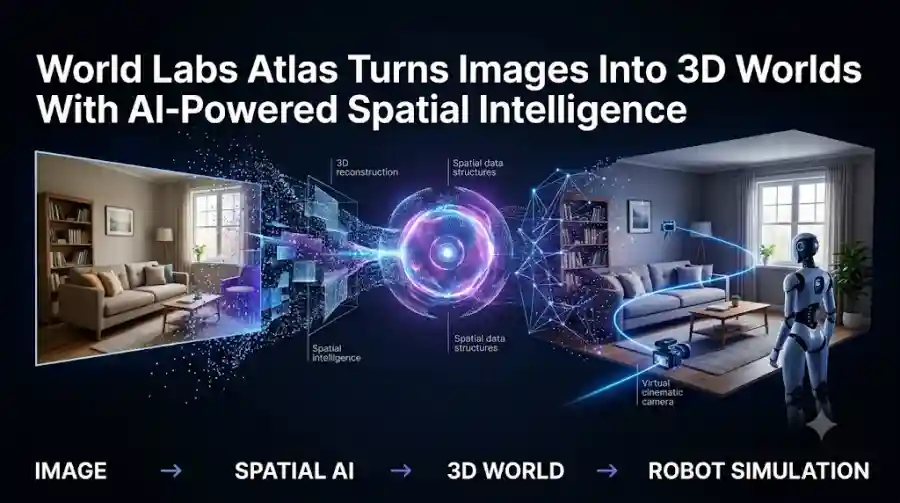
For example, if a user provides images of a room, the system can reason about the space and generate views from other positions.
It can therefore move beyond simply editing the original image.
Atlas Can Generate Camera-Controlled Video
One of the most important capabilities demonstrated by World Labs is camera-controlled generation.
The company says Atlas can generate video while following specified camera trajectories.
World Labs has demonstrated video generation at resolutions of up to 1440p, with sequences lasting up to approximately one minute in its showcased workflows.
The significance is not simply the resolution.
The important part is maintaining spatial consistency while the camera moves.
For filmmakers, visual-effects artists and game developers, this could eventually provide a way to generate shots where the camera can be controlled more precisely than with conventional text-to-video systems.
Atlas Can Reconstruct 3D Environments
Atlas is also designed to work in the opposite direction.
Instead of generating a new world from a prompt, it can reconstruct a physical environment from visual information.
World Labs says Atlas can reconstruct spaces from sparse inputs and produce explicit 3D representations, including formats such as point clouds and 3D Gaussian splats.
This is important because 3D reconstruction normally requires specialized software, multiple cameras or extensive scanning.
Atlas is designed to make the process more flexible.
A small amount of visual information can become the starting point for a larger spatial representation.
Why 3D Reconstruction Matters for AI
The ability to reconstruct 3D environments could have applications far beyond creative content.
Consider robotics.
A robot needs more than a 2D picture of a room.
It needs to understand:
- Where objects are located
- How far away they are
- How the environment is structured
- How its sensors will see the environment
- How objects may change as the robot moves
A 3D world model can potentially provide a simulation environment where these situations can be tested before a physical robot enters the real world.
This is one of the main reasons World Labs is interested in spatial intelligence.
Atlas Could Help Train Robots
World Labs says Atlas can support real-to-sim workflows for robotics.
The basic idea is straightforward.
A developer captures a real environment using cameras.
Atlas reconstructs the environment.
The resulting digital world can then be used as a simulation environment for robots.
World Labs says Atlas can generate the RGB and depth information that a simulated robot would observe as it moves through the reconstructed environment.
That could make robot training more scalable.
Instead of repeatedly testing hardware in physical environments, developers could create digital versions of those environments and run large numbers of simulations.
Atlas Can Simulate Space and Time
Atlas is not limited to reconstructing static environments.
World Labs also positions the model as a system for space-time simulation.
That means the model is intended to understand both the structure of an environment and how that environment changes over time.
This is particularly important for physical AI.
A robot operating in a warehouse, for example, cannot assume that objects will remain in the same location.
People move.
Packages move.
Lighting changes.
Doors open.
Objects are picked up and placed somewhere else.
A useful world model needs to account for those changes.
Atlas is designed around this broader concept of understanding how worlds appear, behave and evolve.
What Can Atlas Be Used For?
World Labs identifies several potential applications for the technology.
AI Video and Filmmaking
Atlas could give filmmakers more precise control over generated camera movement.
Instead of relying entirely on text descriptions, creators could specify spatial trajectories and generate footage from controlled viewpoints.
This could be useful for:
- Virtual cinematography
- Visual effects
- Previsualization
- Concept development
- Virtual production
3D Content Creation
Atlas could also help transform ordinary images into explorable 3D environments.
That could make it useful for designers, game developers and immersive-media creators.
Robotics
Robotics may ultimately be one of Atlas's most important applications.
A world model can create simulated environments where robots can be trained and evaluated without requiring every experiment to happen in the physical world.
Spatial AI Research
Atlas could also serve as a foundation for researchers studying how AI systems understand physical environments.
This is closely related to the broader field of embodied AI.
How Atlas Could Change AI Video
AI video generation has advanced rapidly, but camera control remains a major challenge.
Users want to specify not only what appears in a video but also exactly how the camera moves around the scene.
A world model offers a possible solution.
Instead of asking an AI system to guess what a camera movement should look like, the system can incorporate the movement as part of its spatial understanding.
This could eventually allow creators to think about AI video more like a virtual camera system.
The creator specifies the world and camera.
The AI generates the result.
How Atlas Compares With Conventional 3D Tools
Traditional 3D workflows often require artists to manually build scenes.
A typical workflow may involve:
- Creating or importing 3D assets
- Building environments
- Setting up cameras
- Applying materials
- Adding lighting
- Animating objects
- Rendering the scene
Atlas explores a very different workflow.
A creator can start with visual information and allow the model to reconstruct or generate the environment.
This does not mean traditional 3D software is going away.
Professional production still requires precise control.
But AI world models could become another layer in the workflow, particularly during concept development, environment generation and simulation.
Atlas Is Not Yet a General Consumer AI Tool
Despite the impressive demonstrations, Atlas is not currently positioned as a mainstream consumer application.
World Labs says Atlas is entering early access with selected partners and invites developers interested in building with it to request access.
The company has not announced a broad public release for everyone.
That means most users should not expect to immediately open a website and start generating Atlas worlds.
The current focus is on research, development and early applications.
What Are Atlas's Biggest Challenges?
Atlas is ambitious, but several challenges remain.
Spatial Accuracy
A world model needs to maintain consistent geometry across different viewpoints.
Small errors can become obvious when a camera moves around an object.
Long-Term Consistency
Generating one impressive frame is easier than maintaining a coherent world across a long sequence.
Objects and environments need to remain stable.
Physical Accuracy
A visually convincing simulation is not automatically a physically accurate simulation.
Robotics requires reliable information about depth, movement and interaction.
Computational Cost
Large multimodal world models can require substantial computing resources.
Making these systems fast and affordable enough for everyday use remains a major challenge.
Real-World Generalization
A model that performs well on demonstrations still needs to prove that it can handle unpredictable environments.
Real-world spaces contain unusual objects, lighting conditions and interactions that may not appear in curated examples.
What Does Atlas Mean for AI Agents?
Atlas could eventually become useful for AI agents that need to understand physical environments.
Most current AI agents operate primarily inside digital environments.
They navigate websites, use software or manipulate files.
A spatially intelligent agent could eventually interact with physical environments through robots or augmented-reality systems.
In that scenario, the agent would need an internal representation of the world.
World models like Atlas are designed around that type of problem.
This creates a potential connection between:
World Models + AI Agents + Robotics
Together, these technologies could move AI from purely digital tasks toward physical interaction.
When Can Developers Access Atlas?
Atlas is currently entering early access with selected partners.
World Labs provides an access-request process for developers and organizations interested in building with the model.
The company has not announced general consumer pricing or an unrestricted public version.
Developers should therefore treat Atlas as an early-access research and development platform rather than a finished mainstream AI tool.
Why Atlas Matters
The significance of Atlas goes beyond another AI model launch.
The broader AI industry has spent years improving language understanding and image generation.
World Labs is focusing on another dimension:
spatial intelligence.
Humans naturally understand that objects occupy physical space.
We can walk around a chair and know it is still the same chair.
We understand that moving a camera changes what we see without changing the underlying room.
We can predict that an object behind a wall still exists even though it is temporarily outside our field of view.
Building AI systems with similar spatial understanding is considerably more difficult.
Atlas represents World Labs' attempt to address that problem with a single multimodal world model.
World Labs Atlas is a significant new development in the emerging world-model category.
The model is designed to work natively with text, images, video and 3D information while maintaining a shared spatial context.
Its capabilities extend beyond ordinary AI video generation.
Atlas can generate camera-controlled imagery, reconstruct 3D environments and simulate spatial experiences.
The technology could eventually be useful for filmmakers, game developers, designers, robotics companies and AI researchers.
Its robotics potential may be particularly important because reconstructed environments could provide safer and more scalable places for robots to train and test.
However, Atlas is still entering early access.
The technology needs to demonstrate reliable spatial consistency, physical accuracy and real-world performance before it can become a mainstream platform.
For now, Atlas is best viewed as an important experiment in the future of spatial AI.
If world models continue to improve, the next generation of AI may not simply understand words, images or videos.
It may begin to understand the worlds those things represent.
FAQs
What is World Labs Atlas?
Atlas is a multimodal world model from World Labs designed for spatial intelligence. It works with text, images, video and 3D information in a shared spatial context.
What can Atlas do?
Atlas can generate camera-controlled visual content, reconstruct 3D environments and support simulations involving space and time.