AWS Brings AI Agents Into Power Grid Planning to Speed Up Interconnection Studies
On September 17, 2026, Amazon Web Services announced Agentic Grid Planning on AWS, a program developed in collaboration with Duke Energy that gives qualified utilities access to specialized AI agents for transmission planning workflows.
The system is designed to automate several time-consuming parts of an interconnection study, including preparing cases, running simulations, rerunning studies when inputs change and assembling reports.
The important distinction is that the AI does not replace the engineering simulation software or make the final engineering decisions.
AWS says the simulation systems continue to perform deterministic modeling and analysis, while the AI agents coordinate the workflow around those tools. Engineers remain responsible for directing the study and approving decisions.
That makes the launch a different type of enterprise AI product: an agentic layer around specialized engineering software.
What Is AWS Agentic Grid Planning?
Agentic Grid Planning is an AWS-managed AI-agent program for utilities and grid operators.
It is specifically designed for steady-state transmission studies used in generation and large-load interconnection work.
The agents can work with the simulation software, grid models, scripts and engineering standards already used by a utility's planning team.
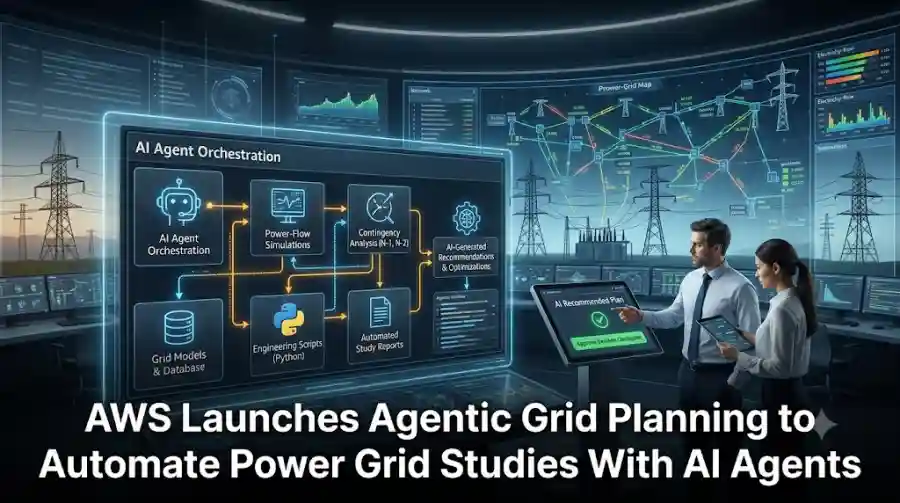
Instead of asking engineers to manually move information between applications, update study cases, rerun procedures and prepare reports, the agents coordinate those steps.
AWS describes the system as automating three major stages:
Prepare the study → Run and rerun the analysis → Capture and reuse the procedure
Each stage includes an engineer review checkpoint.
Why Grid Interconnection Studies Need More Automation
Connecting a new generation project or large electricity load to a transmission network can require extensive technical analysis.
Utilities may need to evaluate different network conditions, identify potential violations, determine required upgrades and assess multiple scenarios.
AWS says the number and complexity of these studies are increasing while engineering capacity has not kept pace.
The Amazon announcement cites Lawrence Berkeley National Laboratory data showing that more than 2,000 GW of generation and storage were seeking U.S. transmission interconnection at the end of 2025. It also says projects entering operation in 2025 had spent a median of more than five years in the process.
AWS also points to rapidly growing large-load interconnection requests.
The result is a workflow where highly trained engineers may spend significant time on repetitive data preparation and study execution rather than exclusively on engineering judgment.
Agentic Grid Planning is designed to shift some of that repetitive work to AI.
Duke Energy Helped Build the System
AWS developed Agentic Grid Planning in collaboration with Duke Energy.
Duke brought transmission-planning expertise and provided feedback during development, according to AWS.
Duke Energy engineers are now using the agents to automate and enhance portions of the interconnection process, including:
- Data preparation
- Analysis execution
- Workflow coordination
- Study-related automation
AWS says Duke has seen certain data-preparation tasks that previously required approximately two weeks of manual work reduced to hours when using the agents. That is a company-provided customer example rather than an independently measured industry-wide result.
This distinction matters because the actual time savings will depend on the utility's data, software, processes and study complexity.
How Agentic Grid Planning Works
The system is designed around existing engineering tools rather than replacing them.
AWS describes three main stages.
Step 1: Prepare Study-Ready Cases
The first stage involves preparing the cases required for the study.
An engineer can select a base case along with a single interconnection request or a cluster of requests.
The AI agents can then propose a point of interconnection and the topology changes needed to connect the request.
Engineers can review those recommendations and either confirm or override them.
Once approved, the agents can generate updated cases across relevant planning scenarios.
This creates a human checkpoint before proposed changes are carried forward into the study.
Step 2: Run and Rerun Studies
After the cases are ready, the agents can coordinate the actual study workflow.
AWS says the system supports power-flow and contingency analysis.
The agents can run the study, categorize violations, propose potential mitigations for approval and draft reports.
A particularly useful capability appears when inputs change.
In a traditional process, engineers may need to rebuild or repeat multiple manual steps.
With Agentic Grid Planning, AWS says the agents can rerun the workflow without requiring engineers to reconstruct the entire study manually.
That is where an agentic workflow can provide a practical advantage: coordinating repetitive steps across existing tools.
Step 3: Capture and Reuse Procedures
The third stage focuses on institutional knowledge.
AWS says engineers can direct an initial study interactively and then have the AI agents create a workflow guide from the recorded session.
Engineers can review that guide and promote it for future reuse.
The procedure then becomes a versioned team asset.
This is significant because specialized engineering workflows often depend on the experience of individual planners.
Capturing the steps digitally can make it easier for teams to reproduce established procedures without asking experienced engineers to manually explain every step each time.
AI Handles Workflow Coordination, Not Deterministic Engineering Simulation
One of the most important details about the product is what the AI actually does.
The system does not replace the physics-based simulation tools used by utility engineers.
AWS explicitly separates the responsibilities:
Simulation software: performs deterministic modeling and analysis.
AI agents: run and coordinate the study workflow.
Engineers: review recommendations and make final engineering decisions.
This architecture is important for high-stakes engineering environments.
The AI can automate repetitive orchestration, but the underlying simulation remains tied to established engineering software and models.
That makes Agentic Grid Planning closer to an AI workflow coordinator than a general-purpose chatbot trying to calculate the power grid by itself.
The System Creates a Reviewable Record
Another major feature is traceability.
AWS says the agents version artifacts and record each step of the workflow.
Reviewers can distinguish between:
- Simulation evidence
- AI reasoning
- Engineering decisions
They can also trace values back to the runs that produced them.
This is particularly useful for engineering organizations that need to understand not only the final output, but also how a result was produced.
A study can involve many intermediate files, configurations and scenarios.
Keeping those artifacts connected creates a clearer audit trail.
Engineers Remain in Control
AWS has emphasized human review throughout the workflow.
For example, when the agents propose a point of interconnection and topology changes, engineers can confirm or override those recommendations.
Mitigation proposals also require approval.
AWS says engineer review checkpoints are built into the decision gates throughout the process.
This means the product is not designed around completely autonomous grid decision-making.
Instead, AI handles portions of the process that are repetitive and procedural while engineering teams retain authority over the technical decisions.
Security Is Built Around the Utility's AWS Environment
Because grid-planning information can be sensitive, the deployment model is another important part of the announcement.
AWS says the program runs in the customer's own AWS environment.
The infrastructure is attached to the utility's AWS account rather than operating in a shared environment.
Access is governed through AWS identity and access controls.
AWS says customers can use IAM policies and their own identity provider through AWS IAM Identity Center to determine who can access what.
This gives utility IT teams control over access to the agentic workflow.
Amazon Bedrock Provides the Model Layer
The AI agents use foundation models through Amazon Bedrock.
AWS says prompts and completions are not used to train the models and are not shared with model providers under this architecture.
That is a relevant consideration for utilities handling operational and engineering information.
The architecture attempts to keep the utility's data and access controls within its AWS environment while using foundation models as the reasoning component behind the agents.
Compliance Positioning
AWS says Agentic Grid Planning is designed around the regulatory requirements of the energy and utilities sector.
The AWS product page lists the solution as:
- FedRAMP-aligned
- SOC 2 Type II
- ISO 27001 certified
These are AWS-provided statements about the solution and its security/compliance positioning.
Utilities will still need to determine how the service fits into their own regulatory, contractual and operational requirements.
What Problems Can It Solve?
The most immediate use case is transmission interconnection planning.
When a utility receives a new generation or large-load request, engineers may need to prepare cases, modify network assumptions, execute analyses and evaluate results.
Agentic Grid Planning is designed to reduce the manual coordination required across those stages.
Potential benefits include:
Faster Study Preparation
Agents can automate data movement, case preparation and other repetitive setup operations.
More Scenario Testing
With less manual overhead, engineers can potentially examine more scenarios and options.
Faster Reruns
When inputs change, agents can rerun existing workflows without requiring the study to be rebuilt from scratch.
Reusable Engineering Procedures
Recorded workflows can be converted into versioned team procedures after engineer review.
Better Traceability
Each step and artifact can be recorded so reviewers can follow how a result was produced.
These capabilities are described by AWS as workflow automation rather than autonomous engineering judgment.
Why Agentic AI Is Moving Into Energy Infrastructure
Many early AI-agent products focused on tasks such as coding, research, customer service and office productivity.
Agentic Grid Planning shows a different direction.
The agent is not primarily generating text for a user.
Instead, it operates across a chain of specialized software tools.
That is a useful pattern for industrial AI.
A power-grid engineer does not necessarily need another chatbot. They need a system that can move data through an established process, run trusted software, collect outputs, recognize what needs review and keep the process organized.
That is the workflow AWS is targeting.
Agentic Grid Planning Compared With a General AI Assistant
The difference becomes clearer when the two approaches are compared.
| Capability | General AI Assistant | AWS Agentic Grid Planning |
|---|---|---|
| General conversation | Yes | Not the primary purpose |
| Power-grid studies | Limited | Core use case |
| Existing simulation software | Not necessarily | Designed to work with existing tools |
| Case preparation | General assistance | Automated workflow stage |
| Power-flow analysis | Not inherently | Supported through existing simulation software |
| Contingency analysis | Not inherently | Supported |
| Study reruns | Manual or tool-specific | Agent-coordinated |
| Engineering approval | User-dependent | Built-in review checkpoints |
| Versioned workflow record | Not always | Core feature |
The product is therefore much more specialized than a generic AI assistant.
Its value depends on integrating AI with a particular engineering workflow.
Availability
AWS Agentic Grid Planning is currently available to qualified utilities and grid operators.
AWS says Professional Services support is available when integration assistance is required.
The company directs interested organizations to its Energy & Utilities team for further information rather than publishing a standard public consumer-style price.
That is consistent with the product's enterprise and industry-specific positioning.
What This Means for Future AI Agents
The launch points toward a broader trend in enterprise software.
The next generation of AI agents may not always look like standalone chat applications.
They may sit between humans and specialized software, coordinating existing tools rather than replacing them.
In this model, the AI agent becomes the workflow layer.
For a utility, that could mean telling an agent what study needs to be performed, reviewing the proposed setup, allowing it to run the necessary simulations, examining the resulting evidence and approving the engineering conclusions.
The specialist software remains important.
The AI simply makes the surrounding process more automated.
AWS Agentic Grid Planning is an example of AI being applied to a highly specialized professional workflow rather than another general-purpose assistant.
Launched with Duke Energy, the system is designed to automate portions of transmission interconnection studies, including case preparation, power-flow and contingency analysis, reruns and report preparation.
Its architecture is particularly notable because AWS is not attempting to replace the simulation software or remove engineers from the process.
Instead, AI agents coordinate existing tools while engineers review recommendations, approve decision points and make the final engineering decisions.
The system also creates versioned records of its work, allowing teams to distinguish simulation evidence from AI reasoning and engineering judgment.
For utilities dealing with growing numbers of interconnection requests, the ability to automate repetitive study operations could become an important use case for enterprise AI.
More broadly, Agentic Grid Planning demonstrates how AI agents can move into industries where the most valuable task is not generating an answer, but coordinating an entire workflow around trusted domain-specific software.
Frequently Asked Questions
What is AWS Agentic Grid Planning?
AWS Agentic Grid Planning is an AWS-managed AI-agent program designed to automate parts of transmission interconnection studies for utilities and grid operators.
Who developed Agentic Grid Planning?
AWS developed the solution in collaboration with Duke Energy, which provided transmission-planning expertise and feedback during development.