Building an AI Agent Is Easier Than Most Beginners Think—If You Start With the Right Framework
For years, building AI applications meant stitching together multiple APIs, writing custom orchestration code, managing prompts manually, and handling complicated workflows yourself.
Then AI agents arrived.
Instead of creating systems that simply answer questions, developers started building software that could reason through tasks, use tools, call external services, maintain context, and complete multi-step workflows.
The problem?
Building those systems from scratch was often difficult.
That's where the OpenAI Agents SDK comes in.
The OpenAI Agents SDK was created as an open-source framework for building agent workflows with tools, handoffs, guardrails, sessions, and tracing. It allows developers to focus more on application logic and less on orchestration boilerplate. OpenAI describes it as a production-ready framework built around a small set of core primitives.
If you've been curious about building AI agents but weren't sure where to start, this guide will walk you through the concepts that matter most.
What Is the OpenAI Agents SDK?
The OpenAI Agents SDK is an open-source framework designed to help developers build AI agents and multi-agent workflows.
Instead of manually managing every step in the interaction loop, the SDK provides built-in structures for:
- Agents
- Tools
- Handoffs
- Guardrails
- Sessions
- Tracing
These capabilities allow developers to create intelligent systems that can perform tasks beyond simple conversations. The SDK coordinates model calls and tool execution while providing built-in support for orchestration and observability.
Think of it as a toolkit for building practical AI-powered applications.
Why Developers Use the Agents SDK
Many AI projects start simple.
A chatbot.
A support assistant.
A research helper.
But as projects grow, developers often need:
- Multiple specialized agents
- External tools
- Validation systems
- Workflow management
- Persistent context
Without a framework, maintaining these features becomes difficult.
The Agents SDK was designed to simplify these workflows by providing reusable building blocks and runtime management. OpenAI highlights tools, handoffs, guardrails, sessions, and tracing as some of the framework's core features.
Understanding the Core Components
Before building anything, it's important to understand the major concepts.
1. Agents
Agents are the foundation of the framework.
An agent is essentially:
- A model
- Instructions
- Optional tools
- Optional guardrails
- Optional handoffs
You can think of an agent as a specialist with a specific job.
Examples:
Research Agent
Finds information.
Coding Agent
Writes code.
Marketing Agent
Creates content.
Customer Support Agent
Answers customer questions.
OpenAI describes agents as the core unit of SDK-based workflows, packaging a model, instructions, and runtime behavior.
2. Tools
Agents become much more useful when they can interact with the outside world.
That's where tools come in.
Tools allow agents to:
- Search databases
- Call APIs
- Access files
- Query systems
- Execute functions
Without tools, an agent can only reason.
With tools, an agent can act.
The SDK supports function tools and integrations with external systems, allowing agents to perform tasks rather than simply generate responses.
3. Handoffs
As workflows become more complex, one agent may not be enough.
Imagine:
- A support agent receives a technical question.
- A coding agent is better suited to answer.
- Control is transferred automatically.
This process is called a handoff.
Handoffs allow agents to delegate tasks to other specialized agents, making multi-agent systems easier to manage.
4. Guardrails
Powerful AI systems require safety controls.
Guardrails help validate:
- User inputs
- Tool usage
- Agent outputs
For example:
A support agent should not provide financial advice.
A guardrail can prevent inappropriate responses before they reach the user.
OpenAI's guardrail system supports input, output, and tool-level validation to reduce risk and improve reliability.
5. Sessions
Many applications need memory.
Without sessions:
Every interaction starts fresh.
With sessions:
Agents can maintain context across multiple interactions.
This is especially useful for:
- Customer support
- Research workflows
- Long-running tasks
The SDK includes session management to preserve conversation context and working state across runs.
6. Tracing
Debugging AI systems can be challenging.
Developers often ask:
- Why did the agent choose this action?
- Which tool was called?
- Where did the workflow fail?
Tracing provides visibility into agent behavior.
The SDK includes built-in tracing that records model calls, tool calls, handoffs, guardrails, and workflow events.
How the OpenAI Agents SDK Works
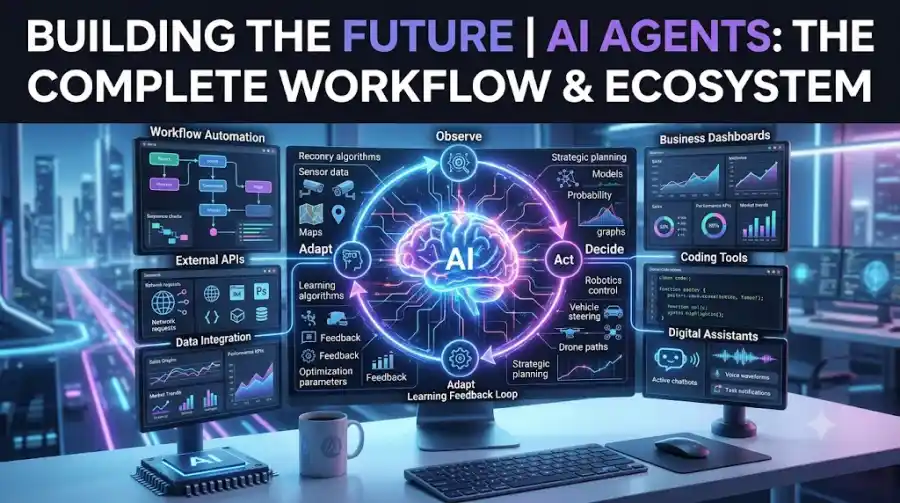
A simplified workflow looks like this:
Step 1
User submits a request.
Step 2
Agent interprets the request.
Step 3
Agent decides whether tools are needed.
Step 4
Tools execute.
Step 5
Results return to the agent.
Step 6
Agent produces an answer.
Step 7
Tracing records activity.
Step 8
Session state is updated.
This workflow allows applications to perform complex tasks while maintaining structure and observability.
Building Your First AI Agent
Although implementation details change over time, the basic process remains similar.
Install the SDK
OpenAI's quickstart shows installation packages for Python and JavaScript environments.
Create an Agent
Define:
- Name
- Instructions
- Model
Run the Agent
Provide input and receive output.
Add Tools
Expand capabilities.
Add Guardrails
Improve safety and validation.
Add Handoffs
Create specialist workflows.
Monitor With Tracing
Debug and improve performance.
This progression mirrors the learning path recommended in OpenAI's documentation.
Practical AI Agent Ideas for Beginners
If you're learning the framework, start with simple projects.
Research Assistant
Collect and summarize information.
Customer Support Agent
Answer frequently asked questions.
Blog Assistant
Generate content ideas and outlines.
Email Assistant
Draft responses and organize communication.
Coding Helper
Explain code and assist with debugging.
These projects help you understand tools, memory, and workflow orchestration without excessive complexity.
Multi-Agent Systems Explained
One of the most exciting capabilities is building multiple cooperating agents.
Imagine:
Agent 1
Receives the request.
Agent 2
Conducts research.
Agent 3
Analyzes information.
Agent 4
Creates a report.
Instead of one giant system, responsibilities are distributed.
The SDK supports both agents-as-tools and handoff mechanisms for coordinating specialized agents.
Common Beginner Mistakes
Building Too Much Too Soon
Start with one agent.
Expand gradually.
Ignoring Guardrails
Validation should be added early.
Skipping Tracing
Visibility is critical when debugging workflows.
Creating Unnecessary Agents
Not every problem requires a multi-agent architecture.
Forgetting User Experience
Technology alone does not create value.
Solve real problems.
Agents SDK vs Agents API
This is an important distinction in 2026.
OpenAI notes that the Agents SDK is feature complete and continues to receive maintenance and compatibility updates. However, OpenAI recommends starting many new agent applications with the newer Agents API when appropriate.
A simplified comparison:
Agents SDK
- Runs in your application
- Greater customization
- Developer-managed workflows
Agents API
- Managed runtime
- Less infrastructure management
- Recommended starting point for many new projects
Both approaches support agent-based development but serve slightly different needs.
Why AI Agents Matter in 2026
The software industry is moving beyond simple AI chat interfaces.
Organizations increasingly want systems that can:
- Understand goals
- Use tools
- Execute workflows
- Collaborate with humans
- Complete tasks
AI agents are becoming the foundation of many next-generation applications.
The OpenAI Agents SDK helped establish practical patterns around orchestration, guardrails, tools, tracing, and multi-agent workflows that continue to influence modern agent development.
Frequently Asked Questions
- What is the OpenAI Agents SDK?
The OpenAI Agents SDK is an open-source framework for building agent workflows using tools, handoffs, guardrails, sessions, and tracing.
- Is the Agents SDK still supported?
- Is the Agents SDK still supported?
Yes. OpenAI states that the SDK is feature complete and continues to receive maintenance, security, and compatibility updates.
- What are handoffs?
Handoffs allow one agent to delegate work to another specialized agent within a workflow.
- What are guardrails?
Guardrails validate inputs, outputs, and tool usage to improve safety and reliability.
- Should beginners learn the Agents SDK?
Yes. Even if you later use other frameworks, learning concepts like tools, sessions, guardrails, and orchestration provides a strong foundation for building agentic applications.
The OpenAI Agents SDK helped make AI-agent development far more approachable for developers.
Instead of building everything from scratch, developers can work with a structured framework that includes tools, sessions, handoffs, guardrails, and tracing.
Whether you're building a research assistant, support agent, coding helper, or multi-agent workflow, understanding these concepts will help you create more capable AI applications.
The future of software isn't just about generating answers.
It's about building systems that can take meaningful action—and AI agents are leading that transformation.