The Best Customer Support Teams in 2026 Aren't Working Longer Hours—They're Working Alongside AI
A decade ago, customer support looked very different.
Customers called support centers.
Waited on hold.
Submitted tickets.
Waited for email replies.
And often spent hours trying to solve relatively simple problems.
Today, customer expectations have changed dramatically.
People expect instant answers.
They want help on their preferred channels.
They expect businesses to be available at all hours.
And they increasingly want personalized support rather than generic responses.
Meeting those expectations with human teams alone is becoming difficult.
That's why businesses across industries are turning to AI agents.
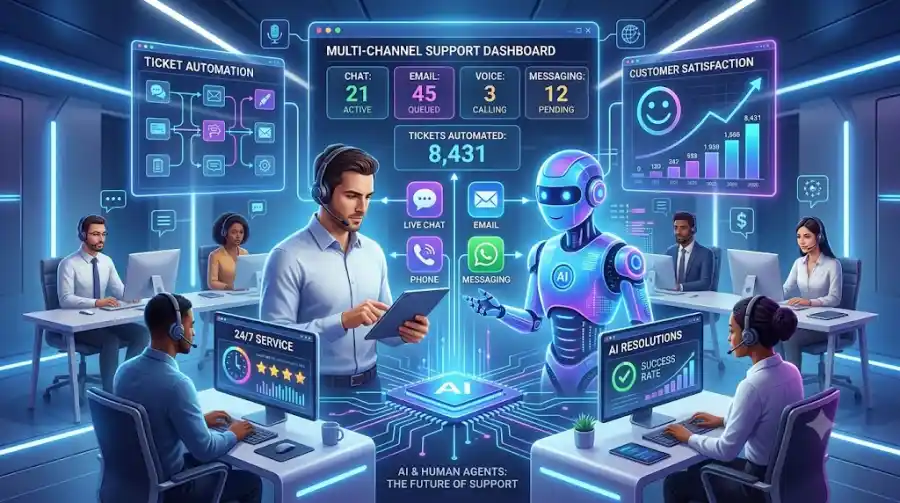
Unlike traditional chatbots that mainly answer simple questions, modern AI agents can understand requests, retrieve information, take actions, automate workflows, and work alongside human support teams to resolve customer issues faster. Modern customer-service agents can handle sophisticated interactions across chat, email, messaging, and voice channels while escalating complex cases when necessary.
As a result, AI agents are becoming one of the most important technologies in customer support.
Let's explore why.
What Are AI Agents for Customer Support?
An AI customer support agent is an intelligent software system designed to understand customer requests and help resolve issues.
Unlike older rule-based chatbots, AI agents can:
- Understand intent
- Analyze context
- Access customer information
- Retrieve knowledge base articles
- Trigger workflows
- Take approved actions
- Escalate issues to humans
The goal is not simply answering questions.
The goal is solving problems.
Modern AI support agents can retrieve account information, personalize interactions, identify customer sentiment, and guide customers toward resolutions with minimal human intervention.
Why Customer Support Is Changing
Customer service teams face several challenges.
Rising Ticket Volumes
As businesses grow, support requests increase.
Higher Customer Expectations
Customers expect faster responses than ever.
Multi-Channel Communication
Support now happens across:
- Websites
- Mobile apps
- Social media
- Messaging apps
Limited Resources
Many companies cannot continuously expand support teams.
AI agents help address these challenges by automating repetitive tasks while improving support efficiency. AI-powered support systems can handle large request volumes simultaneously without requiring proportional staffing increases.
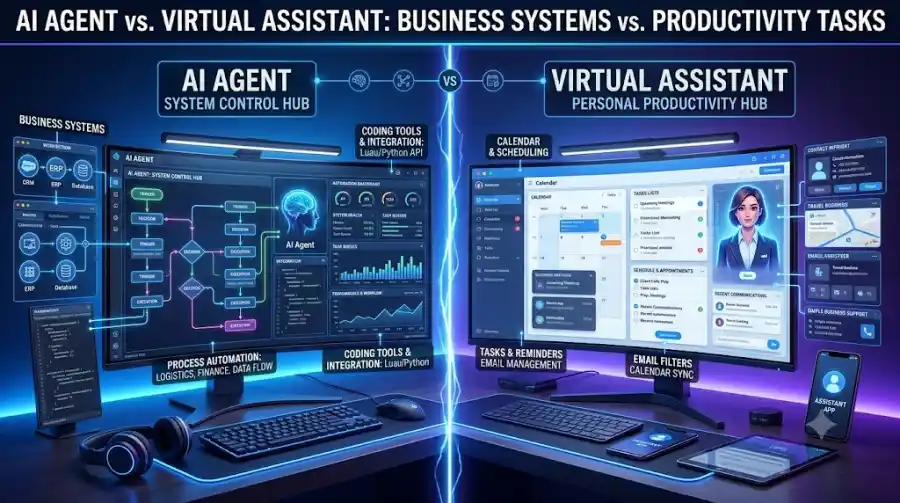
AI Agents vs Traditional Chatbots
Many people still use the terms interchangeably.
However, there is a major difference.
Traditional Chatbots
Typically:
- Follow predefined rules
- Answer FAQs
- Handle simple conversations
- Struggle with complex requests
AI Agents
Can:
- Understand context
- Adapt responses
- Access systems
- Complete tasks
- Escalate intelligently
- Learn from interactions
An AI chatbot may answer:
"What is your return policy?"
An AI agent may:
Check the customer's order, determine eligibility, initiate the return process, and update records.
That ability to act is what separates modern AI agents from traditional chatbot systems.
Why Businesses Are Investing in AI Agents
Businesses are not adopting AI agents simply because they're trendy.
They're investing because customer support is expensive.
Support operations require:
- Staffing
- Training
- Scheduling
- Infrastructure
- Quality assurance
AI agents help reduce repetitive workloads while maintaining service availability.
Many support leaders believe automation will handle a growing share of customer interactions in the coming years. Zendesk's CX Trends research found that nearly 90% of CX leaders expect most customer issues to be resolved without human intervention in the future.
1. 24/7 Customer Support
Perhaps the biggest advantage is continuous availability.
Human teams need:
- Breaks
- Shifts
- Time off
AI agents do not.
They can assist customers:
- Day
- Night
- Weekends
- Holidays
This ensures customers receive support regardless of location or time zone. Continuous support availability is consistently identified as one of the primary benefits of AI-powered customer service systems.
2. Faster Response Times
Nobody enjoys waiting for support.
AI agents can respond immediately.
Benefits include:
- Reduced wait times
- Faster resolutions
- Improved customer satisfaction
Instead of waiting minutes or hours for an initial response, customers often receive assistance within seconds.
Organizations deploying AI support systems frequently report improvements in first-response and resolution times.
3. Reduced Support Costs
Customer support can become expensive as businesses scale.
AI agents help reduce costs by:
- Handling repetitive questions
- Deflecting routine tickets
- Automating workflows
- Supporting human agents
This allows teams to focus on high-value interactions.
Reducing manual workload is one of the most frequently cited benefits of AI-powered service operations.
4. Personalized Customer Experiences
Customers increasingly expect personalized interactions.
AI agents can use:
- Purchase history
- Account details
- Previous conversations
- Customer preferences
to tailor responses.
Rather than generic answers, customers receive support relevant to their specific situations. Modern AI support systems integrate with customer data to personalize recommendations and assistance.
5. Intelligent Ticket Routing
Support requests vary widely.
Some require:
- Billing assistance
- Technical support
- Account updates
- Product information
AI agents can classify requests and direct them to the correct team.
This reduces delays and improves resolution efficiency. AI service desks commonly automate request classification and routing as part of support workflows.
6. Assisting Human Support Teams
A common misconception is that AI replaces support agents.
In reality, many organizations use AI to assist human employees.
AI agents can:
- Gather information
- Summarize cases
- Suggest responses
- Surface knowledge articles
- Prepare tickets
This allows human agents to spend more time solving complex problems and building customer relationships.
Common Customer Support Use Cases
Order Tracking
Customers frequently ask:
"Where is my order?"
AI agents can instantly retrieve shipping information.
Password Resets
A highly repetitive support task.
AI agents can automate the process.
Appointment Scheduling
Agents can book, modify, and confirm appointments.
Subscription Management
Customers can:
- Upgrade plans
- Downgrade services
- Update billing information
without waiting for a human representative.
Returns and Refunds
Many support agents can initiate approved return workflows automatically.
AI Agents in Ecommerce Support
Ecommerce businesses are among the biggest adopters of AI support agents.
Common use cases include:
- Order tracking
- Product recommendations
- Returns
- Refund requests
- Shipping updates
- Product availability checks
For online stores, AI agents often act as the first line of support while escalating complex situations when necessary.
AI Agents in SaaS Businesses
Software companies also benefit significantly.
Support agents can assist with:
- Account management
- Technical troubleshooting
- Product onboarding
- Knowledge-base guidance
- Subscription questions
This helps SaaS businesses scale customer support without continuously expanding support headcount.
Challenges Businesses Must Consider
AI agents are powerful, but they are not perfect.
Complex Cases
Some issues require human judgment.
Data Accuracy
Incorrect data can lead to incorrect responses.
Customer Frustration
Customers should always have a path to reach a human when needed.
Recent consumer advocacy groups have emphasized the importance of maintaining human support options, particularly for complex or sensitive issues.
Security and Privacy
Organizations must carefully manage customer data access and permissions.
Best Practices for Implementing AI Agents
Start With Repetitive Tasks
Automate frequently asked questions first.
Build a Strong Knowledge Base
AI performs best when supported by accurate information.
Monitor Performance
Track:
- Resolution rates
- Customer satisfaction
- Escalation rates
Maintain Human Oversight
AI should support teams—not operate without accountability.
The Future of AI Customer Support
The future is unlikely to be entirely human or entirely automated.
Instead, businesses are moving toward hybrid support models.
In these systems:
- AI handles routine work
- Humans handle complex situations
- Both collaborate seamlessly
Industry experts increasingly view AI agents as a core component of future customer experience strategies. Support leaders expect automation, personalization, and intelligent workflow execution to become standard capabilities across customer service operations.
Frequently Asked Questions
- What is an AI customer support agent?
An AI customer support agent is software that can understand customer requests, retrieve information, automate tasks, and assist in resolving support issues.
- How is an AI agent different from a chatbot?
Traditional chatbots mainly answer questions, while AI agents can often perform actions such as updating records, processing requests, and initiating workflows.
- Can AI agents replace customer service teams?
Most organizations use AI agents to augment support teams rather than fully replace them. Human expertise remains important for complex issues and relationship-building.
- What are the biggest benefits of AI customer support?
Key benefits include 24/7 availability, faster responses, reduced costs, personalization, scalability, and improved efficiency.
Customer support is evolving rapidly.
Customers want immediate assistance, personalized experiences, and round-the-clock availability.
AI agents help businesses meet those expectations by automating repetitive tasks, accelerating response times, and supporting human teams.
The most successful companies in 2026 aren't replacing customer service professionals.
They're combining human expertise with intelligent AI agents to create faster, more scalable, and more satisfying customer experiences.
As AI technology continues to improve, businesses that learn how to balance automation with human support will be best positioned to deliver exceptional service in an increasingly competitive market.