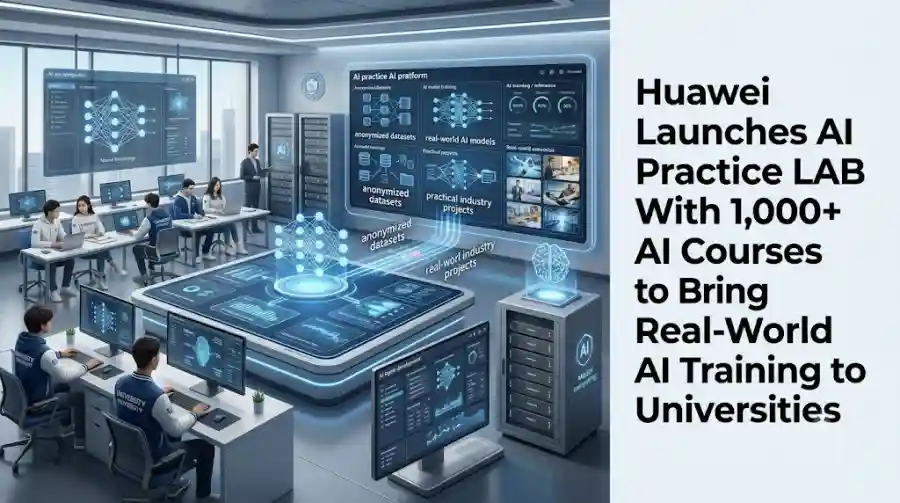
Huawei AIPL Brings Real Industry Data, AI Computing and Agent Development Into University Education
On September 19, 2026, Huawei officially launched its AI Practice LAB (AIPL) Solution globally during HUAWEI CONNECT 2026 in Shanghai. The platform is designed around real-world scenarios, real data and real algorithms, using a project-based learning approach across AI fundamentals, AI-related disciplines and the combination of AI with other academic fields.
Huawei says AIPL already works with 12 baseline partners and has been deployed at multiple universities, including Beijing Institute of Technology and Shanghai Jiao Tong University.
The company says the platform contains more than 1,000 AI practice courses, provides a unified environment for AI training and inference, and includes tools for agent development.
The broader goal is to move AI education from primarily theoretical instruction toward hands-on work that more closely resembles what students may encounter in industry.
What Is Huawei AI Practice LAB?
Huawei AI Practice LAB, or AIPL, is an education-focused AI platform that combines teaching resources, computing infrastructure, engineering tools and practical industry scenarios.
Rather than treating AI as a standalone academic subject, Huawei designed AIPL to support three broad areas:
- AI fundamentals
- AI-related disciplines
- Discipline + AI
This last category is particularly important.
The platform is intended to let universities connect AI with fields outside traditional computer science. Huawei's announcement cites practical combinations where AI can support different disciplines and professional areas.
That means an economics, law, chemistry, management or education student could potentially encounter AI as part of their existing field rather than having to become a specialist computer scientist first.
AIPL Uses Real Industry Scenarios Instead of Only Classroom Exercises
One of the central ideas behind the platform is the use of real-world scenarios, real data and real algorithms.
Huawei says the solution brings industry cases, anonymized datasets and engineering tools into teaching environments so students can work on problems closer to actual industry requirements.
This is different from a basic online AI course where students might only work with prepared examples.
A practical AI laboratory can expose students to the complete development process:
Problem → Data → Model → Training → Inference → Evaluation → Application
The more realistic that process becomes, the more opportunities students have to understand how AI systems behave outside controlled classroom examples.
More Than 1,000 Practical AI Courses
Huawei says AIPL currently covers over 1,000 AI practice courses across its three main teaching areas.
The company's model is designed to provide universities with a broader collection of practical resources instead of requiring every institution to build its entire AI curriculum from scratch.
Courses can be connected to industry cases and practical projects.
This can be particularly useful for institutions that want to expand AI education but do not have enough staff or infrastructure to independently create large numbers of laboratory exercises.
Huawei also says the platform includes scenario-based cases designed around practical AI applications.
The exact course selection can vary depending on the university and implementation.
AIPL Includes AI Training and Inference Tools
The platform is not only a library of teaching material.
Huawei says its AIPL enablement platform exposes practice capabilities through standard APIs and provides toolchains for AI training and inference. It also includes an agent development platform.
That turns the environment into more of an AI laboratory.
Students can work through development tasks while interacting with the same kinds of technical stages found in real AI projects.
Training and inference also introduce students to an important distinction.
Training focuses on developing or adapting a model.
Inference focuses on using that model to generate results after deployment.
Understanding both stages is important for anyone moving from AI coursework into practical development.
Agent Development Is Part of the Platform
Another notable feature is support for AI agent development.
AI agents are becoming an increasingly important part of enterprise software, where systems can reason about goals, use tools and execute multi-step workflows.
Huawei says AIPL includes an agent-development platform as one of its standardized toolchains.
For universities, this means practical AI education does not have to stop at model training.
Students can also experiment with systems that combine models, tools and workflows.
That creates a more modern view of AI development:
AI model + tools + data + workflow + application
The approach can also connect classroom lessons with the kinds of AI systems businesses are increasingly deploying.
Huawei Says AIPL Can Improve Practical Skill Development
Huawei reports several results from its AIPL implementation.
The company says its real-world scenario and data approach can improve students' mastery of AI knowledge points by 30%.
It also says the unified practice platform can improve experiment-development efficiency by 50%.
These figures are Huawei's own reported results, not independent measurements applicable to every university.
The precise impact will naturally depend on factors such as curriculum design, instructor training, student background and how extensively the platform is integrated into teaching.
Still, the numbers illustrate what Huawei is trying to achieve: reducing the gap between learning an AI concept and actually applying it.
The Computing Backbone Uses Huawei Ascend
AIPL is also connected to Huawei's AI computing ecosystem.
Huawei says the solution uses an Ascend AI computing backbone along with the AIPL enablement platform.
The company describes the infrastructure as combining computing, networking and storage management and says the backbone is compatible with more than 60 mainstream industry models.
That gives universities an infrastructure layer underneath their practical AI courses.
In a conventional classroom, students may use whatever cloud API or local hardware happens to be available.
A dedicated AI practice environment instead gives the institution a consistent platform for experimentation and teaching.
Why AI Computing Matters in University Laboratories
AI education becomes harder when students do not have access to suitable computing infrastructure.
Simple machine-learning exercises can run on ordinary computers.
More advanced workloads can require:
- GPU or accelerator resources
- Large datasets
- Model-serving infrastructure
- Training frameworks
- Inference environments
- Development platforms
AIPL attempts to place these components into one educational environment.
The goal is not necessarily to make every student a hardware specialist.
Instead, the computing infrastructure becomes part of the practical laboratory through which students learn how AI systems are built and deployed.
The "Discipline + AI" Approach
AIPL's focus on Discipline + AI is one of its most interesting components.
AI increasingly affects fields that were traditionally taught separately from computer science.
For example, AI can be applied to:
Law
Students can study how models process legal information, analyze documents and support professional workflows.
Chemistry
AI can be used in areas such as data analysis, scientific modeling and research workflows.
Economics and Management
Students can apply AI to business data, forecasting, decision-support systems and operational analysis.
Education
AI can support learning analytics, content development and educational applications.
The objective is not to turn every disciplinary student into a machine-learning engineer.
Instead, it is to create professionals who understand both their primary field and the practical role AI can play within it.
Beijing Institute of Technology Helped Pioneer the Model
Huawei's September global launch follows an earlier implementation of the AIPL concept at Beijing Institute of Technology (BIT).
BIT and Huawei launched an AI Practice Laboratory in March 2026 as a practical-education experiment. The university described the model as connecting theory, practice, application and innovation.
BIT said its implementation combines AI computing power, data, algorithms, frameworks and application scenarios.
The university also described practical courses that integrate AI with other disciplines.
This earlier work helped provide a foundation for Huawei's broader AIPL rollout.
Shanghai Jiao Tong University Is Also Involved
Huawei says Shanghai Jiao Tong University is among the universities where the AIPL approach has been deployed.
The university has also been developing AI computing and capability infrastructure.
That university-industry collaboration is an important part of Huawei's model.
Rather than treating an AI education platform as a software product that universities simply purchase, Huawei is presenting AIPL as a broader ecosystem involving academic institutions, industry partners and technology infrastructure.
Huawei Released an AI Practical Teaching White Paper
Alongside the AIPL launch, Huawei and education partners also released the AI+ Practical Teaching White Paper.
The document focuses on how universities can restructure AI-era education around practical learning rather than relying primarily on conventional knowledge-transfer models.
Huawei says the proposed framework contains:
- One foundation
- Two types of elements
- Three levels of courses
- Four-dimensional evaluation
- A five-party ecosystem
The framework is intended to give university administrators, teachers, researchers and industry participants a structured way to develop practical AI education.
UNESCO-ICHEI Took Part in the Initiative
The white paper was released with participation from UNESCO International Centre for Higher Education Innovation, universities and industry partners.
UNESCO-ICHEI says the document focuses on reshaping talent development in higher education around AI practical teaching. It also confirms Huawei's global launch of the AIPL solution.
This is significant because the initiative is being framed as more than a commercial software launch.
It is also connected to a broader discussion around how higher education should adapt to AI.
AIPL Is Designed Around Project-Based Learning
Huawei says AIPL uses a Project-Based Learning (PBL) teaching model.
In practice, that means students can learn through projects built around a real problem rather than only completing isolated theoretical exercises.
A project can connect several stages of learning.
For example:
Identify a real problem → collect or prepare data → choose an AI approach → train or use a model → evaluate the result → build an application
Students can therefore see how individual concepts fit into a complete AI workflow.
This is especially useful for AI because understanding a model's theory does not automatically teach someone how to build a reliable application around it.
AIPL Could Help Universities Build Shared AI Infrastructure
Another potential advantage is standardization.
Without a common platform, universities may have separate systems for:
- Training
- Inference
- Datasets
- Course material
- Model access
- AI development
- Application deployment
AIPL is designed to bring several of these capabilities together.
Huawei describes the enablement platform as exposing standardized practice capabilities through APIs and common toolchains.
This can make it easier for universities to offer AI laboratories across departments.
It also potentially makes it easier to update course material as AI technologies evolve.
The Platform Is Not Only for AI Majors
AIPL's emphasis on AI + disciplines means the target audience is broader than computer-science students.
A university could potentially use the platform to introduce AI projects into multiple academic programs.
That model reflects a wider shift in AI education.
Many industries now expect professionals to understand how AI affects their specific field even when they are not building foundation models themselves.
A lawyer, economist, scientist, teacher or business manager may increasingly need to understand how to work with AI systems.
The "Discipline + AI" approach is designed for that intersection.
Challenges Universities Still Need to Address
A practical AI platform does not automatically solve every problem in AI education.
Universities still need instructors who understand the technology and can supervise projects.
They also need curriculum design, suitable datasets, computing access and responsible-AI policies.
Huawei's own announcement acknowledges issues such as uneven infrastructure and differences in teacher capabilities across education systems.
That means platforms such as AIPL are only one part of the transition.
Successful implementation also depends on the people and institutions using them.
Privacy and Data Handling Matter in Practical AI Education
Using real industry scenarios introduces another consideration: data governance.
Huawei says its approach incorporates anonymized data into teaching environments.
That distinction is important.
Universities should not simply expose confidential company information to students for experimentation.
Anonymization and appropriate access controls become necessary when practical education involves realistic business datasets.
The quality of a practical AI lab therefore depends not only on its models and computing infrastructure but also on how it manages data.
AIPL Could Bring Agentic AI Into University Courses
The inclusion of agent development is particularly timely.
Many AI education programs still focus primarily on prompt engineering, conventional machine learning or basic model APIs.
AIPL's agent-development component points toward a broader curriculum.
Students can potentially explore:
Models → Tools → Agents → Applications
That progression mirrors the development of modern AI software.
Agents can combine model reasoning with software tools and external information sources to perform multi-step tasks.
Teaching those concepts in a laboratory environment could help students understand the engineering challenges that come with deploying agentic systems.
Huawei's Larger AI Education Strategy
AIPL is part of Huawei's broader push to bring AI computing and application technologies into educational institutions.
The company says it intends to continue working with universities and partners to expand the AIPL model across disciplines and transform industry technologies and real-world scenarios into educational resources.
That includes practical training, smart teaching, smart-campus applications and research innovation.
The strategy therefore extends beyond teaching students how to use AI tools.
It connects education infrastructure with Huawei's broader AI ecosystem.
Huawei AIPL vs a Conventional Online AI Course
| Capability | Conventional AI Course | Huawei AIPL |
|---|---|---|
| Theory lessons | Yes | Yes |
| Practical projects | Varies | Core focus |
| Real industry scenarios | Limited | Core component |
| Realistic datasets | Varies | Supported |
| AI training | Course-dependent | Platform capability |
| AI inference | Course-dependent | Platform capability |
| Agent development | Not always | Included |
| AI computing infrastructure | Varies | Ascend-based backbone |
| Cross-disciplinary AI | Limited | Core "Discipline + AI" model |
| Large course library | Varies | 1,000+ practice courses claimed by Huawei |
The major difference is the emphasis on building a complete practical environment instead of providing only educational content.
Who Can Benefit From Huawei AI Practice LAB?
The platform is primarily aimed at universities and higher-education institutions.
It can potentially serve:
Universities Building AI Programs
Institutions can use AIPL as infrastructure for practical AI courses.
Engineering and Computer Science Departments
Students can work directly with AI training, inference and agent development.
Non-Technical Departments
The Discipline + AI model allows other academic fields to incorporate AI projects into their curriculum.
Teachers and Researchers
Educators can use industry scenarios and practical toolchains when developing new courses.
Industry-University Partnerships
Companies and universities can potentially collaborate around realistic AI projects and workforce development.
Availability
Huawei officially launched the AI Practice LAB Solution globally on September 19, 2026.
The platform has already been deployed at multiple universities, including Beijing Institute of Technology and Shanghai Jiao Tong University, and Huawei says it is working with 12 baseline partners.
Huawei's announcement is aimed at universities, education organizations and partners rather than individual consumers.
Pricing for the AIPL Solution is not publicly specified in the launch announcement.
Huawei's AI Practice LAB is a different kind of AI-tool launch.
Instead of introducing another chatbot, model or coding assistant, Huawei is building an environment for learning how AI is actually developed and applied.
The platform combines real-world scenarios, anonymized data, AI algorithms, practical courses, computing infrastructure, training and inference capabilities, and agent development tools. Huawei says it now includes more than 1,000 practice courses and supports a backbone compatible with more than 60 mainstream industry models.
The most interesting part is its "Discipline + AI" approach.
AI is increasingly becoming a layer across science, business, law, education and other fields. Preparing students for that environment may require more than teaching them how to use a chatbot.
It requires hands-on experience with data, models, applications and increasingly AI agents.
AIPL is Huawei's attempt to provide that environment at the university level.
The technology alone will not determine whether the model succeeds. Instructor capability, curriculum quality, infrastructure, data governance and industry collaboration will all influence the results.
But the direction is clear: AI education is moving from learning about AI toward learning by building with AI.
Frequently Asked Questions
What is Huawei AI Practice LAB?
Huawei AI Practice LAB, or AIPL, is an education-focused AI platform designed to give universities practical access to industry scenarios, data, algorithms, AI computing and development tools.
How many courses does Huawei AIPL provide?
Huawei says AIPL covers more than 1,000 AI practice courses across AI fundamentals, AI-related disciplines and "Discipline + AI."