The Fastest-Growing Companies in 2026 Aren't Reading Thousands of Resumes Manually—They're Using AI Agents to Find Better Talent
Hiring has always been one of the most important responsibilities in business.
The right employee can help a company grow faster, improve productivity, strengthen culture, and create long-term success.
The wrong hire can cost time, money, and opportunities.
For decades, recruiters have faced the same challenge.
Too many applications.
Too little time.
Growing pressure to find the best candidates quickly.
Today, that challenge is even greater.
Remote work has expanded talent pools.
Online job boards generate massive application volumes.
Companies compete globally for skilled professionals.
As a result, recruitment teams often spend countless hours reviewing resumes, scheduling interviews, responding to candidates, and managing hiring pipelines.
This is where AI agents are beginning to transform the hiring process.
Rather than replacing recruiters, AI agents help automate repetitive tasks so hiring professionals can focus on what matters most—finding and engaging the right people.
In 2026, organizations of all sizes are using AI-powered recruitment systems to improve efficiency, reduce administrative workloads, and make better hiring decisions.
What Are AI Agents for Recruitment?
AI agents are intelligent software systems designed to complete tasks, manage workflows, and achieve specific objectives with limited human intervention.
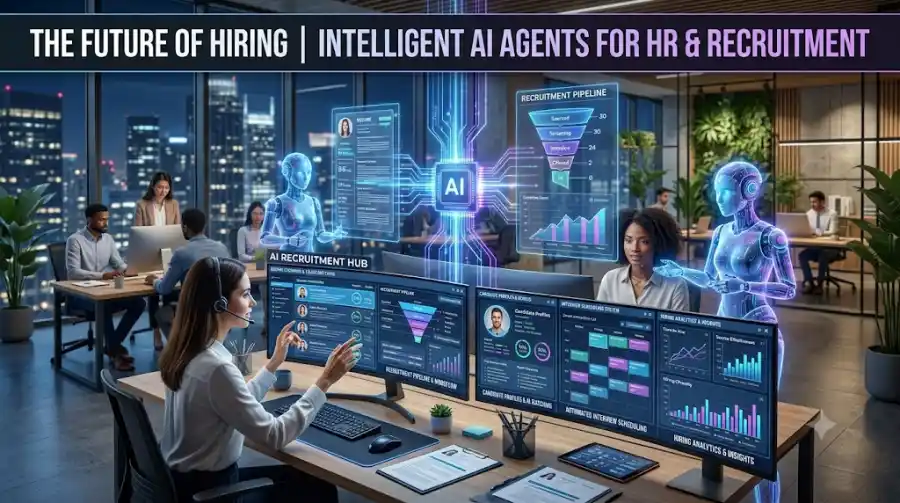
In recruitment, AI agents can assist with:
- Candidate sourcing
- Resume screening
- Applicant ranking
- Interview scheduling
- Candidate communication
- Hiring pipeline management
- Recruitment analytics
- Onboarding support
Unlike traditional automation software that follows rigid rules, AI agents can analyze information, recognize patterns, prioritize tasks, and adapt to changing circumstances.
Think of them as digital recruiting assistants working behind the scenes.
They never get tired.
They never forget follow-ups.
And they can process information at a scale that would be impossible for most human teams.
Why Recruitment Is Changing in 2026
Recruitment today is very different from what it was ten years ago.
Companies often receive hundreds or even thousands of applications for a single role.
Candidates expect:
- Faster responses
- Better communication
- Simpler application processes
- More personalized experiences
Meanwhile, recruiters must:
- Evaluate applicants
- Coordinate interviews
- Communicate with hiring managers
- Manage multiple open positions
The workload can become overwhelming.
AI agents help by automating many repetitive processes that traditionally consume hours every week.
The Biggest Hiring Challenge: Too Much Data
Modern recruitment generates enormous amounts of information.
Every position can produce:
- Resumes
- Cover letters
- Assessments
- Interview notes
- Email conversations
- Candidate feedback
Managing this information manually becomes increasingly difficult as organizations grow.
AI agents help organize, analyze, and prioritize recruitment data.
This enables recruiters to focus on decision-making rather than administration.
1. AI-Powered Candidate Sourcing
Finding qualified candidates is one of the most time-consuming aspects of recruitment.
Traditionally, recruiters search through:
- Job boards
- Professional networks
- Talent databases
- Employee referrals
AI agents can assist by identifying potential candidates based on predefined requirements.
For example:
A company looking for a software engineer might specify:
- Experience level
- Technical skills
- Industry background
- Geographic preferences
The AI agent can then help identify suitable prospects from available talent pools.
This dramatically reduces sourcing time.
2. Resume Screening Automation
Resume screening is often repetitive and time-intensive.
Recruiters may review hundreds of applications for a single role.
AI agents can help organize and prioritize candidates based on:
- Relevant skills
- Experience
- Certifications
- Educational background
- Job requirements
This allows hiring teams to focus attention on the most relevant applicants.
Importantly, recruiters should continue reviewing candidates rather than relying entirely on automated systems.
AI works best as a support tool rather than a replacement for human judgment.
3. Candidate Ranking and Prioritization
Not every applicant is equally suited for a position.
AI agents can analyze candidate information and help recruiters prioritize their review process.
This helps hiring teams:
- Reduce response times
- Improve efficiency
- Focus on high-potential candidates
Rather than sorting applications manually, recruiters can begin with the strongest matches.
4. Interview Scheduling
Interview scheduling may sound simple.
In reality, it often involves:
- Multiple calendars
- Time zone coordination
- Availability conflicts
- Rescheduling requests
AI agents can automate much of this process.
They help coordinate schedules between:
- Recruiters
- Hiring managers
- Candidates
This reduces administrative work and accelerates hiring timelines.
5. Candidate Communication
One of the most common complaints among job seekers is poor communication.
Candidates often submit applications and hear nothing for weeks.
AI agents can improve communication by:
- Sending application confirmations
- Providing updates
- Delivering reminders
- Answering common questions
This creates a better candidate experience.
Even simple communication improvements can strengthen an employer's reputation.
AI Agents and Recruitment Marketing
Recruitment is increasingly similar to marketing.
Companies compete for talent just as businesses compete for customers.
AI agents can support recruitment marketing efforts by helping organizations:
- Promote job openings
- Create employer branding content
- Manage outreach campaigns
- Track engagement
This helps attract stronger candidates.
6. Employer Branding Support
Candidates often research employers before applying.
Organizations with strong employer brands tend to attract more qualified applicants.
AI agents can help HR teams create:
- Career page content
- Recruitment campaigns
- Social media updates
- Employee spotlight content
This improves visibility and engagement.
7. Recruitment Analytics
Data-driven hiring is becoming increasingly important.
AI agents can help analyze:
- Application volume
- Hiring timelines
- Source effectiveness
- Candidate engagement
- Interview conversion rates
These insights help organizations optimize recruitment strategies.
AI Agents for Staffing Agencies
Staffing firms manage large numbers of clients and candidates.
AI agents can support agencies by:
- Matching candidates to positions
- Organizing talent databases
- Managing follow-ups
- Tracking placements
This allows recruiters to handle larger workloads without sacrificing quality.
AI Agents for Small Businesses
Many small businesses assume AI recruitment tools are only for large corporations.
This is no longer true.
Modern AI solutions are increasingly accessible to smaller organizations.
Benefits include:
- Faster hiring
- Reduced administrative workload
- Improved candidate organization
- Better communication
Small businesses often gain significant value because they typically have limited HR resources.
AI Agents for Enterprise Recruitment
Large organizations face different challenges.
They may hire hundreds or thousands of employees annually.
AI agents can assist with:
- Large-scale applicant management
- Internal mobility programs
- Talent pipeline development
- Global recruitment coordination
This improves consistency across hiring operations.
Benefits of AI Agents in Recruitment
Faster Hiring
Recruitment processes move more efficiently.
Improved Productivity
Recruiters spend less time on repetitive tasks.
Better Candidate Experiences
Communication becomes more consistent.
Enhanced Organization
Information remains easier to manage.
Improved Scalability
Organizations can support higher hiring volumes.
Better Insights
Recruitment decisions become more data-informed.
Common Misconceptions About AI Recruitment
AI Will Replace Recruiters
This is one of the biggest myths.
Recruitment remains a human-centered activity.
Relationships matter.
Culture fit matters.
Interview quality matters.
AI helps recruiters work more efficiently.
It does not eliminate the need for human expertise.
AI Makes Perfect Hiring Decisions
No technology can guarantee perfect hiring outcomes.
AI should support decision-making rather than replace it.
Human oversight remains essential.
AI Only Benefits Large Companies
Modern AI recruitment solutions are increasingly accessible to businesses of all sizes.
Challenges Organizations Should Consider
AI recruitment systems are powerful, but they are not without challenges.
Organizations should consider:
Data Quality
Poor information produces poor results.
Human Oversight
Recruiters should remain involved in hiring decisions.
Candidate Experience
Automation should enhance—not replace—meaningful communication.
Compliance Requirements
Organizations must follow employment and privacy regulations.
Responsible implementation is critical.
Best Practices for Using AI Agents in Recruitment
Start With Repetitive Tasks
Automate scheduling, reminders, and administrative workflows first.
Keep Recruiters Involved
Human judgment remains essential.
Monitor Performance
Track:
- Time-to-hire
- Candidate satisfaction
- Interview completion rates
- Hiring outcomes
Continuously Improve
Recruitment workflows should evolve as organizational needs change.
The Future of AI Recruitment
The future of hiring will likely involve greater collaboration between recruiters and AI systems.
Future AI agents may become better at:
- Talent discovery
- Candidate matching
- Workforce planning
- Internal mobility recommendations
- Recruitment forecasting
However, people will remain central to hiring.
Technology can analyze data.
Technology can automate workflows.
Technology can improve efficiency.
But people understand culture, relationships, motivation, and potential in ways that technology cannot fully replicate.
The future of recruitment is not recruiters versus AI.
It is recruiters working alongside AI.
Frequently Asked Questions
- What are AI agents for recruitment?
AI agents are intelligent software systems that help automate sourcing, screening, scheduling, communication, and recruitment workflows.
- Can AI replace recruiters?
No. AI supports recruiters by automating repetitive tasks and improving efficiency.
- How do AI agents improve hiring?
They help organize information, accelerate workflows, improve communication, and reduce administrative workloads.
- Are AI recruitment tools suitable for small businesses?
Yes. Many AI recruitment solutions are designed for organizations of all sizes.
- What is the biggest advantage of AI in recruitment?
The biggest advantage is saving time while helping recruiters focus on building relationships and making better hiring decisions.
Hiring has never been more important—or more challenging.
Organizations must compete for talent in an increasingly crowded market.
At the same time, recruiters face growing workloads and higher expectations.
AI agents are helping solve this problem.
By automating sourcing, screening, scheduling, communication, and administrative work, they allow recruitment teams to focus on what truly matters.
Finding the right people.
Building strong teams.
Supporting business growth.
The most successful hiring organizations in 2026 will not replace recruiters with AI.
They will combine human expertise with intelligent automation.
And that combination is quickly becoming a competitive advantage.