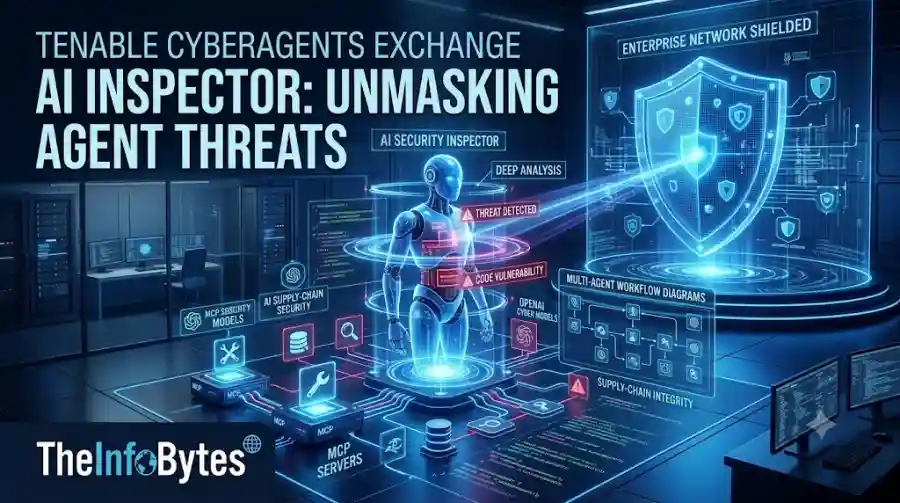
Tenable and OpenAI Introduce AI Security Review System for Agents, MCP Servers and AI Skills
Instead of only answering questions, modern agents can use tools, access data, execute workflows and interact with other software.
That creates a new security problem.
Organizations may install an AI agent, skill, MCP server or multi-agent workflow created by another developer without fully understanding what it can access or what it might do.
Tenable is now targeting that problem with a new security review system called CyberAgents Exchange AI Inspector.
The company announced the system on September 3, 2026, in collaboration with OpenAI. It is designed to help security teams evaluate AI agents and related components before they are introduced into enterprise environments.
The announcement is particularly important because AI components are beginning to resemble traditional software dependencies.
A company might carefully inspect a normal third-party software package before installing it.
Tenable wants organizations to apply a similar security mindset to AI agents.
What Is Tenable CyberAgents Exchange AI Inspector?
CyberAgents Exchange AI Inspector is a planned security-review process for components distributed through Tenable's CyberAgents Exchange.
It is designed to assess:
- AI agents
- AI skills
- MCP servers
- Multi-agent playbooks
Tenable says the system combines three major layers of analysis:
- Frontier AI assessment using OpenAI GPT cyber models
- AI-component inspection using Tenable One AI Exposure
- Expert review by Tenable security researchers
The combination is intended to give security teams more information before they deploy community-built AI components.
Tenable expects the AI Inspector to become available during September 2026.
Why AI Components Need Security Reviews
Traditional software already has a major supply-chain security problem.
Organizations routinely depend on third-party libraries, packages, APIs and cloud services.
AI agents add another layer.
An AI agent can potentially contain instructions that determine how it reasons, what tools it uses and what systems it can access.
An MCP server can provide an AI system with access to external tools or information.
A skill can give an agent specialized capabilities.
A multi-agent playbook can coordinate several AI systems to complete a larger task.
The more components an organization connects, the larger its potential attack surface becomes.
This makes security review increasingly important.
How the AI Inspector Works
Tenable's approach combines automated analysis with human security expertise.
OpenAI Models Perform Frontier Assessment
One part of the process uses OpenAI GPT cyber models to assess AI components.
The purpose is to use advanced AI reasoning to identify potential security concerns.
This is different from simply scanning a file for known vulnerabilities.
AI components can contain behaviors or instructions that are difficult to evaluate using traditional signature-based security tools.
A capable cyber model can potentially examine the component's intended behavior and identify suspicious or risky patterns.
Tenable says this frontier assessment is one of the three major components of the AI Inspector process.
Tenable One AI Exposure Adds Security Analysis
The second layer comes from Tenable's own security technology.
Tenable says skills inspection will be powered by Tenable One AI Exposure.
This gives the process an additional security-analysis layer beyond the OpenAI model assessment.
The goal is to identify and prioritize risks associated with AI components before organizations introduce them into their environments.
Tenable Researchers Provide Expert Review
The third layer is human expertise.
Tenable researchers review AI components as part of the security process.
This is important because AI-generated security assessments should not automatically become the final decision.
A model can identify a suspicious behavior, but a security researcher can examine the evidence and determine whether it represents a meaningful enterprise risk.
The combination creates a layered approach:
AI assessment → security inspection → expert review
What Is the CyberAgents Exchange?
The AI Inspector is built around Tenable's CyberAgents Exchange.
Tenable launched the CyberAgents Exchange in August 2026 as an open-source, cybersecurity-focused registry for AI agents, skills, MCP servers and multi-agent playbooks.
The platform is designed to provide a place where security professionals can discover, share and build AI components specifically for cybersecurity workflows.
Tenable says the exchange already contains more than 100 community-submitted AI components following its recent SWARM build event.
That makes the new AI Inspector particularly relevant.
As the number of community-built components grows, organizations need a way to distinguish potentially trustworthy components from risky ones.
Why MCP Security Is Becoming Important
The growing adoption of Model Context Protocol, or MCP, makes this announcement even more relevant.
MCP provides a standardized way for AI applications to connect with external tools and information.
This can make AI agents significantly more useful.
An agent could potentially connect to:
- Databases
- Development tools
- Cloud services
- File systems
- Business applications
- Security platforms
- Internal knowledge bases
But each connection also creates a potential security boundary.
If an MCP server is poorly designed or malicious, an AI agent could potentially be exposed to unwanted actions or information.
That means organizations need to think about MCP servers as part of their software supply chain.
Tenable's decision to specifically include MCP servers in the AI Inspector is therefore significant.
AI Agents Are Becoming Enterprise Infrastructure
The larger trend behind Tenable's announcement is the rapid movement of AI agents into enterprise environments.
Businesses are increasingly experimenting with agents that can perform tasks rather than simply generate text.
For example, an agent might:
- Receive a business objective.
- Search internal information.
- Call external tools.
- Analyze the results.
- Take an action.
- Coordinate with another agent.
- Report the outcome.
This creates much more value than a traditional chatbot.
It also creates more opportunities for security problems.
An AI agent with no external access has a relatively limited impact.
An AI agent connected to databases, APIs and enterprise applications has considerably more power.
That difference makes component security essential.
The AI Supply Chain Could Become a Major Security Issue
The traditional software industry has spent years dealing with supply-chain attacks.
AI is creating a similar challenge.
Instead of only asking:
“Is this package safe?”
security teams may soon need to ask:
“Is this AI component safe?”
That includes questions such as:
- What tools can the agent access?
- What permissions does it require?
- Can it execute arbitrary commands?
- Can it access sensitive information?
- Can it communicate with external systems?
- Does it contain hidden instructions?
- Can another component manipulate its behavior?
- What happens when it receives untrusted input?
These questions are becoming more important as organizations build complex agent ecosystems.
Why Community-Built AI Components Need Extra Attention
Open-source development has enormous benefits.
Developers can share tools, improve each other's work and avoid rebuilding the same systems repeatedly.
Tenable's CyberAgents Exchange follows that model.
But openness also means organizations need strong mechanisms for evaluating what they download and deploy.
The challenge is particularly complicated with AI components because traditional source-code review may not tell the entire story.
An AI agent can behave differently depending on:
- Its prompt
- Model behavior
- Tool permissions
- External context
- Retrieved information
- MCP connections
- Other agents
- Runtime instructions
Security testing therefore needs to consider more than just static code.
AI Inspector Adds a Trust Layer
The AI Inspector can potentially become a trust layer between community-built AI components and enterprise deployment.
Instead of simply downloading an AI component and deciding whether to use it, an organization could look for additional security assessment information.
This could make AI marketplaces more similar to modern software ecosystems where users expect security information before installing third-party packages.
If this model becomes widespread, AI components could eventually have security indicators based on:
- Automated testing
- Model-based security analysis
- Static inspection
- Expert review
- Community feedback
- Known vulnerabilities
- Permission requirements
That would make AI adoption easier for enterprise security teams.
How Tenable's Approach Differs From AI Agent Firewalls
The AI security market is developing several different approaches.
Your existing TheInfoBytes coverage includes Operant AI's Semantic Firewall, which focuses on monitoring AI-agent intent during execution and allowing, blocking or redacting potentially dangerous actions.
Tenable is approaching the problem earlier in the lifecycle.
Its AI Inspector is focused on evaluating AI components before deployment.
That creates an important distinction.
Tenable AI Inspector
Primary focus: Pre-deployment assessment.
It asks:
“Should we trust this AI component before introducing it into our environment?”
Operant Semantic Firewall
Primary focus: Runtime protection.
It asks:
“Should this AI agent be allowed to perform this action right now?”
These approaches can potentially work together rather than compete directly.
One evaluates the component before deployment.
The other protects the agent while it is operating.
How It Fits With OpenAI's Cybersecurity Push
The Tenable partnership also connects with OpenAI's broader cybersecurity strategy.
Tenable says the collaboration grew from its participation in the OpenAI Daybreak Defense Network.
OpenAI has been expanding its cybersecurity work through Daybreak, while Tenable is applying OpenAI's cyber models to its own exposure-management ecosystem.
This creates a useful example of how frontier AI models can be integrated into specialized security products rather than being used only through a general chatbot.
The AI model provides advanced reasoning capabilities.
Tenable provides security data, exposure-management technology and human expertise.
The result is a specialized security workflow.
The Importance of Human Review
One of the strongest aspects of Tenable's approach is that AI is not the only layer.
Security decisions can have serious consequences.
A false positive may prevent a useful AI component from being deployed.
A false negative could allow a malicious component into a sensitive environment.
That makes expert review valuable.
Tenable's model therefore combines:
AI speed + security tooling + human expertise
rather than assuming that an AI model alone can determine whether an AI component is safe.
Could AI Security Reviews Become Standard?
The answer will depend on how quickly enterprise AI adoption grows.
If organizations deploy only a handful of internal agents, manual security review may remain practical.
But if companies begin using hundreds or thousands of agents and AI components, manual review could become difficult to scale.
Automated AI security assessment could then become necessary.
Platforms such as CyberAgents Exchange could eventually provide a structured ecosystem where developers publish components and security teams evaluate them before deployment.
That could create a new category of AI supply-chain security.
What This Means for Developers
Developers building AI agents should also pay attention.
Security review may become part of the normal lifecycle for AI components.
That could encourage developers to document:
- Required permissions
- External connections
- MCP tools
- Data access
- Model dependencies
- Agent instructions
- Security controls
- Known limitations
Transparent AI components are easier for security teams to evaluate.
That could eventually become a competitive advantage for developers publishing agents and skills.
What This Means for Enterprises
For enterprises, Tenable's announcement highlights a problem that is easy to overlook.
AI adoption is not just about choosing a model.
Organizations also need to secure the growing ecosystem surrounding that model.
An enterprise AI stack may eventually contain:
- Foundation models
- Agents
- Skills
- MCP servers
- Plugins
- APIs
- Databases
- Multi-agent workflows
- External tools
Every component can introduce risk.
Security teams therefore need visibility across the entire AI environment.
Tenable's Bigger Vision for Agentic Security
Tenable's CyberAgents Exchange and AI Inspector suggest the company sees AI agents as a new security category rather than simply another software feature.
The company wants security teams to have a place where they can discover AI components while also evaluating their risks.
The combination of an open exchange and security-review mechanism could become increasingly useful as agentic AI adoption expands.
It also reflects a broader shift in enterprise cybersecurity.
Security teams are moving from protecting only traditional infrastructure toward protecting AI-powered systems themselves.
Tenable's CyberAgents Exchange AI Inspector is a timely addition to the growing AI security market.
The system combines OpenAI GPT cyber models, Tenable One AI Exposure and expert security research to evaluate AI agents, skills, MCP servers and multi-agent playbooks before they are deployed.
The bigger story is the emergence of an AI supply chain.
As businesses increasingly install community-built agents and connect AI systems to external tools, simply trusting an AI component because it works will no longer be enough.
Security teams will need to know what the component can access, what it can do and whether it contains hidden risks.
Tenable's approach is interesting because it places security review before deployment rather than waiting for problems to appear in production.
Combined with runtime security products such as Operant's Semantic Firewall, this points toward a future where AI agents may need security controls throughout their entire lifecycle:
Build → Inspect → Approve → Deploy → Monitor → Protect
That lifecycle could become one of the most important parts of enterprise AI adoption.
FAQs
What is Tenable AI Inspector?
Tenable AI Inspector, officially called CyberAgents Exchange AI Inspector, is a security-review process designed to evaluate AI agents, skills, MCP servers and multi-agent playbooks before enterprise deployment.
What AI models does Tenable AI Inspector use?
Tenable says the system uses OpenAI GPT cyber models for frontier security assessment. It also combines that assessment with Tenable One AI Exposure and expert review from Tenable researchers.