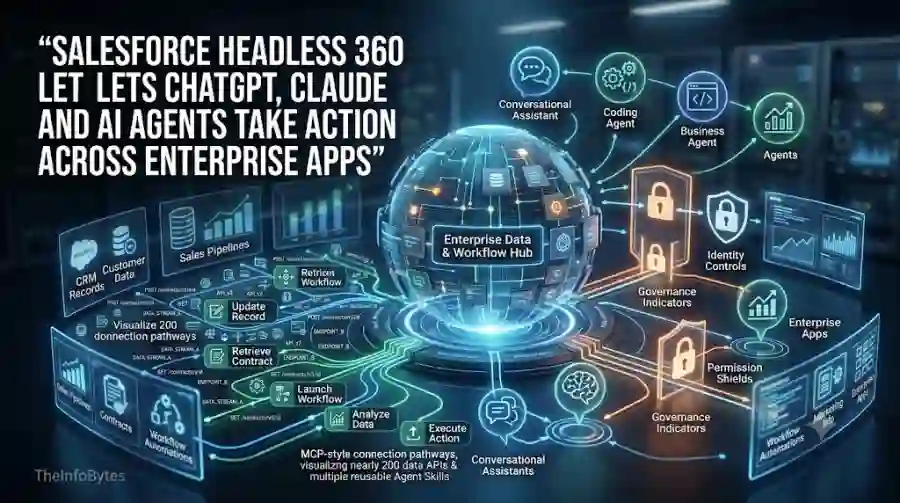
Salesforce Expands Headless 360 With MCP Servers, 100+ Agent Skills and Nearly 200 Data APIs
The update includes a new Headless 360 MCP Server, expanded Data 360 capabilities, more than 100 reusable Agent Skills, Slack integrations and support across major Salesforce products.
Most importantly, Salesforce says AI systems including ChatGPT, Claude, Cursor and Agentforce can dynamically discover and use Salesforce capabilities through open standards while inheriting existing permissions and business rules.
That could make Headless 360 one of the more important enterprise AI-agent infrastructure developments of 2026.
What Is Salesforce Headless 360?
Salesforce Headless 360 is an initiative designed to make Salesforce capabilities available outside the traditional Salesforce user interface.
Historically, a user might open Salesforce, navigate through several screens and manually perform an action.
For example:
Open Salesforce → Find customer → Update opportunity → Save
An AI agent works differently.
It does not necessarily need a visual interface.
It needs structured access to the underlying business capability.
Headless 360 is designed around that idea.
Salesforce describes the broader strategy as transforming its clouds into reusable enterprise capabilities that authorized AI agents, applications and other experiences can securely consume.
Instead of forcing agents to imitate humans clicking through software, Salesforce wants them to interact directly with business functions.
The Headless 360 MCP Server Is the Core Upgrade
At the center of the expansion is the Headless 360 MCP Server.
MCP stands for Model Context Protocol, an open standard increasingly used to connect AI systems with tools, data sources and external services.
Salesforce says the Headless 360 MCP Server gives MCP-aware agents access to Salesforce through a single connection.
Instead of exposing thousands of individual Salesforce capabilities as thousands of separate tools, Salesforce designed the server around a smaller, more manageable tool surface.
Its developer documentation says the beta server currently exposes four core tools backed by a growing library of Salesforce operations.
That matters because AI agents can struggle when they are forced to choose from extremely large numbers of possible tools.
A smaller discovery layer can make tool selection more manageable.
ChatGPT, Claude and Cursor Can Use Salesforce Capabilities
Salesforce specifically says the Headless 360 MCP Server is designed to work with AI agents operating through platforms such as:
- ChatGPT
- Claude
- Cursor
- Agentforce
- Other MCP-aware AI systems
The agent can dynamically discover which Salesforce operations are available rather than requiring a developer to manually describe every Salesforce API in the prompt.
This changes the integration model.
A traditional integration might require engineers to build a custom connection between an AI application and Salesforce.
Headless 360 is designed to provide a reusable standardized layer.
That could significantly reduce the amount of integration work required as organizations deploy more AI agents.
AI Agents Can Do More Than Read CRM Data
One of the most interesting parts of Headless 360 is that it is not limited to retrieving information.
Salesforce documentation shows that authorized agents can perform actions.
Current Headless 360 capabilities include operations such as:
- Querying Salesforce records
- Creating records
- Updating records
- Managing users
- Assigning permission sets
- Working with Apex triggers
- Building event-driven integrations
- Managing named credentials
- Managing some Commerce Cloud operations
Salesforce says the available operation library will continue expanding.
This means an AI agent could potentially move beyond:
“Show me this customer.”
toward:
“Update the customer record and start the appropriate workflow.”
That is the difference between an AI assistant and an AI agent.
Salesforce Is Making MCP Aware of Business Rules
Connecting AI to enterprise software creates a major problem.
Giving an agent access to an API does not automatically mean the agent understands how a business is supposed to operate.
Enterprise systems contain:
- Permissions
- Validation rules
- Workflows
- Relationships
- Identity controls
- Business logic
- Governance policies
Salesforce says its Headless 360 MCP Server is metadata-aware.
That means agents can discover not only endpoints but also context surrounding how Salesforce capabilities should be used.
Salesforce says actions inherit existing identity, security, governance and business rules already configured inside the organization.
This could be a major advantage for enterprise adoption.
Companies generally do not want AI agents bypassing years of existing security and workflow controls.
Data 360 MCP Server Exposes Nearly 200 APIs
Another major part of the announcement is the Data 360 MCP Server.
Salesforce says this server exposes nearly 200 Data 360 APIs through open standards.
Authorized AI agents can use these capabilities for tasks including:
- Building semantic models
- Transforming data
- Generating calculated insights
- Mapping fields
- Inspecting identity graphs
- Creating audience segments
- Activating marketing campaigns
- Creating data streams
This is significant because it gives AI agents access to more than basic CRM records.
They can interact with a broader data layer.
For organizations using Salesforce as a major customer-data platform, that could make AI agents much more useful.
Agent Skills Turn Business Logic Into Reusable AI Capabilities
Salesforce is also introducing more than 100 reusable Agent Skills.
An Agent Skill packages a business capability so that it can be used repeatedly by AI agents.
Rather than asking every team to rebuild the same workflow, an organization can expose a trusted skill and let authorized agents invoke it.
Salesforce says more than 100 Agent Skills are generally available as part of the Headless 360 expansion.
This could support workflows such as:
- Sales operations
- Customer service
- Marketing
- Commerce
- Data management
- Administrative tasks
- Internal automation
The idea is similar to giving AI agents standardized enterprise functions.
Why Agent Skills Matter
AI agents can be powerful, but unrestricted autonomy is risky.
Suppose an AI agent is asked:
“Update this sales opportunity.”
A poorly designed system might allow the agent to manipulate data directly without understanding business rules.
A reusable Skill can provide a controlled way to perform the task.
That means organizations can design approved actions first and then allow AI agents to use them.
The workflow becomes:
User request → AI agent → Approved Skill → Salesforce action
rather than:
User request → AI agent → unrestricted system access
This is likely to become increasingly important as AI agents gain more authority inside companies.
Slackbot Can Now Act as an MCP Client
Slack is also becoming part of Salesforce's agent infrastructure.
Salesforce says Slackbot's MCP Client is generally available.
The MCP client allows Slackbot to securely connect with Salesforce MCP servers and more than 20 partner applications.
Salesforce names partners including:
- Atlassian
- Box
- Canva
- Docusign
- Notion
- Zoom
This means employees could potentially perform enterprise actions directly from a Slack conversation.
Examples provided by Salesforce include:
- Updating Salesforce opportunities
- Retrieving contracts
- Launching workflows
- Working across connected enterprise systems
The goal is to reduce context switching.
Instead of leaving Slack, opening Salesforce and navigating through several interfaces, users can potentially perform work through natural-language interactions.
AI Agents Still Inherit User Permissions
Security is one of the most important details in the Headless 360 architecture.
Salesforce's developer quick-start documentation makes clear that Salesforce remains the system of record and continues controlling authentication.
For example, when connecting Claude to Salesforce through Hosted MCP servers, Claude can only call Salesforce tools that the authenticated user is already allowed to use.
That means connecting an AI agent does not automatically give it unlimited Salesforce access.
The permissions remain tied to the user and organization.
This is critical for enterprise AI.
An employee who cannot access a sensitive customer database should not gain that access simply because they are using an AI agent.
Headless 360 Is Bigger Than Claude or ChatGPT
It would be easy to describe this as another Claude or ChatGPT integration.
That would miss the larger point.
Headless 360 is designed as an AI-model-independent enterprise layer.
Salesforce wants organizations to expose trusted business capabilities to whichever authorized AI systems they choose.
That could include:
- Salesforce Agentforce
- ChatGPT
- Claude
- Cursor
- Future enterprise AI assistants
- Custom internal AI agents
This model-independent approach could become strategically important.
Companies do not necessarily want their entire automation architecture locked to one AI provider.
Salesforce Is Turning CRM Into Agent Infrastructure
For decades, Salesforce was primarily something humans interacted with through screens.
Headless 360 changes that model.
The new architecture treats Salesforce as a collection of services and capabilities that AI agents can use.
Salesforce summarized the strategy earlier in 2026 by saying its goal was essentially to rebuild Salesforce for agents.
The company argues that agents do not need traditional browser interfaces because they interact through APIs, MCP tools and command-line systems.
That could represent an important shift in enterprise software.
Why Enterprise Software Is Becoming Headless
Traditional software is designed around visual navigation.
For humans, that makes sense.
We click buttons, open menus and fill out forms.
AI agents do not need those interfaces.
An agent can interact directly with structured functions.
This means future enterprise platforms may increasingly separate:
Business capability
from
Visual interface
A human might access Salesforce through a traditional application.
Another employee might access the same capability through Slack.
An AI agent might access it through MCP.
A custom application might call the same business function through an API.
The underlying capability remains the same.
Headless 360 Could Reduce Custom AI Integrations
One of the biggest problems with enterprise AI is integration work.
Companies frequently need developers to connect an AI assistant to:
- CRM
- Customer data
- Marketing systems
- Sales workflows
- Analytics
- Support tools
- Internal databases
Each connection can become a custom project.
Salesforce says Headless 360 is designed to reduce that duplication by making existing Salesforce capabilities discoverable through open standards.
If the approach works, companies could spend less time rebuilding integrations and more time designing useful agent workflows.
Headless 360 Is Expanding Across Major Salesforce Clouds
Salesforce says Headless 360 is being expanded across much of its platform, including:
- Marketing
- Sales
- Service
- Commerce
- MuleSoft
- Informatica
- Tableau
- Data 360
That makes the initiative much broader than a CRM connector.
Salesforce is effectively trying to make its enterprise ecosystem accessible to AI agents through reusable, governed capabilities.
Headless Experience Layer Opens Another Direction
The company is also introducing a Headless Experience Layer, currently in open beta.
This allows developers to create web, mobile, embedded and conversational experiences around Salesforce capabilities.
This means companies can create custom AI-powered applications without forcing every user into the standard Salesforce interface.
For example, a company could build a specialized internal assistant for its sales team that uses Salesforce data and business logic behind the scenes.
The employee sees a conversational interface.
Salesforce remains the system powering the workflow.
Salesforce Multi-Framework Supports React Development
Salesforce has also made Salesforce Multi-framework generally available.
The system allows developers to build modern React applications while using Salesforce authentication, security and governance.
This fits the broader Headless 360 strategy.
Salesforce wants developers to use its capabilities inside different interfaces rather than requiring everything to look like a traditional Salesforce application.
That could help the platform remain relevant as AI changes how people interact with software.
What Is Available Now?
According to Salesforce's August announcement:
- Headless 360 MCP Server — open beta
- Data 360 MCP Server — generally available
- Expanded Data 360 API coverage — generally available
- Salesforce Multi-framework — generally available
- Headless Experience Layer — open beta
- 100+ Agent Skills repository — generally available
- Headless Commerce — generally available
- Slackbot MCP Server and Client — generally available
Individual capabilities can still vary by product and region.
Businesses should therefore check their specific Salesforce products and agreements before planning a deployment.
What Does Headless 360 Cost?
Salesforce has not announced one simple standalone price covering every Headless 360 capability.
Pricing and packaging can vary based on the Salesforce products and services an organization uses.
Salesforce specifically notes that pricing, packaging and availability may change and can vary by region.
Businesses considering Headless 360 should therefore evaluate it within their existing Salesforce contract rather than assuming it is a single independent subscription.
Why This Matters for ChatGPT and Claude Users
Headless 360 could significantly increase the usefulness of general-purpose AI assistants inside businesses.
Without connectors, ChatGPT or Claude may be excellent at reasoning but unable to interact with a company's actual operational systems.
With governed access, the AI can potentially combine reasoning with enterprise actions.
The experience moves from:
“Tell me what I should do.”
to:
“Help me do it using the systems I already have.”
That is the core promise of agentic enterprise AI.
The Main Risk Is Giving Agents Too Much Power
The same capabilities that make enterprise agents useful also create risk.
An AI agent capable of updating records, managing workflows or changing enterprise configurations can cause real damage if it misunderstands a request.
That is why Salesforce is emphasizing governance, permissions and metadata-aware access.
However, organizations still need to design careful policies around:
- Which agents can connect
- Which users can authorize them
- Which actions require confirmation
- Which data can be accessed
- How activity is logged
- How mistakes are reversed
- How autonomous workflows are monitored
AI-agent infrastructure needs more than connectivity.
It needs control.
What Headless 360 Means for the Future of AI Agents
Salesforce's strategy provides a useful preview of where enterprise AI may be heading.
Today, many employees still work by switching between dozens of applications.
An AI-agent workflow could operate differently.
The employee describes the desired outcome.
The agent determines which approved capabilities it needs.
MCP connects the agent with business systems.
Existing enterprise security controls determine what the agent is allowed to do.
The agent performs the workflow.
The user reviews the result.
That could reduce the importance of individual software interfaces.
Salesforce Headless 360 is an important enterprise AI development because it focuses on the infrastructure required to let AI agents perform real business work.
The expanded platform gives authorized agents such as ChatGPT, Claude, Cursor and Agentforce access to Salesforce capabilities through the Model Context Protocol while preserving existing identity, permissions and governance.
The Data 360 MCP Server exposes nearly 200 APIs, while Salesforce is also providing 100+ reusable Agent Skills, Slackbot MCP integrations and Headless capabilities across its major clouds.
The most important shift is architectural.
Salesforce is moving from software designed primarily for humans clicking through screens toward enterprise capabilities that can be consumed by humans, AI agents and applications through different interfaces.
If this approach succeeds, the future Salesforce user may not always open Salesforce at all.
They might simply tell an AI agent what they need done.
The AI could then securely use Salesforce behind the scenes.
That makes Headless 360 less about another chatbot feature and more about rebuilding enterprise software for the agentic AI era.
FAQs
What is Salesforce Headless 360?
Salesforce Headless 360 is an architecture that exposes Salesforce business capabilities to authorized AI agents, applications and other interfaces through APIs, MCP and reusable Skills.
Can ChatGPT connect to Salesforce Headless 360?
Salesforce says its Headless 360 MCP Server can be used by agents running in platforms including ChatGPT, Claude, Cursor and Agentforce.