Fugu Max and Ultra v2 Push Multi-Agent AI Beyond the Single-Model Approach
On September 11, 2026, Sakana AI introduced Fugu Max and Fugu Ultra v2, two new versions designed around different priorities. Fugu Max focuses on getting strong results at a lower cost, while Fugu Ultra v2 is designed to push maximum performance on difficult, multi-step tasks.
The release is significant because Fugu is not simply another conventional large language model.
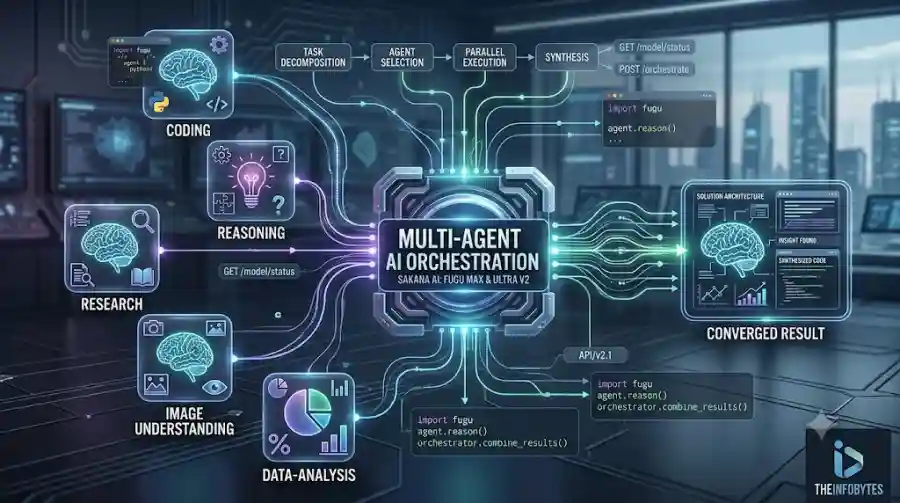
Sakana describes its approach as a learned orchestration system that decides which models and capabilities should be used to solve a particular task. The company argues that future AI systems may become more efficient by learning which intelligence to deploy, rather than always using the largest available model.
What Are Fugu Max and Fugu Ultra v2?
Fugu Max and Fugu Ultra v2 are the newest versions of Sakana AI's Fugu family.
The two systems have different objectives.
Fugu Max is designed around the cost-performance frontier. It attempts to deliver strong results while using a broader pool of open and specialized models efficiently.
Fugu Ultra v2 is the performance-focused version. It is intended for complex tasks where the quality of the final result matters more than minimizing every inference cost.
Both are accessible through Sakana's API, allowing developers to interact with the orchestration system without manually building their own multi-agent architecture.
That is one of the most interesting parts of the release.
A developer does not necessarily need to decide in advance which model should handle every part of a task. Fugu is designed to make those orchestration decisions itself.
Fugu Is Not Just Another Single AI Model
The biggest difference between Fugu and conventional AI models is the architecture.
A traditional AI application might select one model and send every request to it.
For example:
User request → AI model → answer
A multi-agent system can instead divide the problem:
User request → planner → specialized models → tools → reasoning → final answer
Sakana's Fugu system attempts to package that type of orchestration into a single model-like interface. The company describes Fugu as a multi-agent orchestration system delivered through one model API.
This could allow developers to benefit from multiple specialized systems without having to manage every routing decision themselves.
Fugu Max Focuses on Cost Efficiency
Fugu Max is the more cost-focused release.
Sakana says it expands the pool of models available to its orchestration system and is designed to find a better balance between capability and cost. The company specifically frames this as expanding the Pareto efficiency frontier — improving what users can accomplish without simply increasing model size and expense.
The published API pricing is $2 per million input tokens and $6 per million output tokens, with cached input priced lower.
That makes Fugu Max particularly interesting for developers who need to run large numbers of AI tasks.
Cost becomes increasingly important when an AI application handles thousands or millions of requests.
A model that is slightly less capable but significantly cheaper can sometimes be more useful for production workloads than the most powerful model available.
Fugu Max is built around that idea.
Fugu Ultra v2 Targets Difficult AI Tasks
Fugu Ultra v2 takes the opposite direction.
Instead of primarily optimizing for cost, Sakana positions Ultra v2 as the high-performance member of the new Fugu family.
The company says it is designed to push performance higher on difficult, multi-step workloads while continuing to use model orchestration rather than depending entirely on a single frontier model.
This makes Fugu Ultra v2 particularly relevant to coding, research, reasoning and other tasks where several stages of work may need to be coordinated.
The model supports a 1-million-token context window and up to 128,000 output tokens, according to current model listings.
That large context window could be useful for applications that need to work with lengthy documents, large codebases or extended task histories.
Fugu Ultra v2 Claims Strong Benchmark Results
Sakana AI is also making strong performance claims for Fugu Ultra v2.
In the company's announcement, Fugu Ultra v2 is presented as a system that can reach or exceed the performance of some frontier models on selected benchmarks without directly relying on those models in its orchestration pool.
Independent coverage of the release reports that Fugu Ultra v2 achieved a 48.3 score on Chartography, compared with 27.3 for Opus 5 in the cited comparison.
Other reported results include a 74.3 score on DeepSWE, another benchmark focused on software-engineering performance.
These figures should be treated as benchmark-specific results rather than proof that Fugu Ultra v2 is universally better than every competing model.
Benchmark performance can vary significantly depending on the task, evaluation methodology and model configuration.
Still, the results highlight what makes Sakana's approach interesting: the company is trying to achieve high performance through coordination of multiple models, rather than relying exclusively on one enormous model.
Fugu Does Not Need Every Leading Model in Its Pool
One of Sakana's more interesting claims is that Fugu Ultra v2 can compete strongly even without including some of the industry's most prominent models in its orchestration pool.
Sakana says the latest Fugu system does not rely on models such as GPT-6 Astra, Claude Fable 5 or Claude Fable 5.1 in the pool used for the new release.
That is important because model availability can change.
AI providers can alter API pricing, impose geographic restrictions, change usage limits or discontinue models.
A system that can switch between multiple models could potentially reduce the impact of those changes.
This is one of the strategic advantages Sakana is attempting to create.
Why Model Orchestration Could Matter
The AI industry's current model race often focuses on parameter counts, benchmark scores and training compute.
But real-world AI applications have a different problem.
Not every task needs the same level of intelligence.
A simple classification task does not necessarily require the most expensive reasoning model.
A difficult programming problem may need significantly more computation.
A document-analysis workload could benefit from a model optimized for long context.
An image-related request may require a multimodal specialist.
An effective AI system could therefore improve efficiency by selecting different models depending on the task.
That is the basic idea behind Fugu.
Instead of asking:
“What is the best AI model?”
the system asks:
“Which combination of AI capabilities is best for this task?”
That could become an increasingly important question as AI applications become more complex.
Fugu Could Reduce Multi-Agent Development Complexity
Building a multi-agent AI system from scratch can be complicated.
Developers need to create routing logic, decide how agents communicate, manage context, monitor failures and determine when one model should hand work to another.
They may also need to integrate several APIs.
Fugu attempts to hide much of that complexity behind a single interface.
A developer can interact with the Fugu system through its API while Sakana's orchestration layer handles the underlying model selection.
This could be particularly attractive to smaller development teams that want advanced agentic behavior without maintaining an extensive orchestration framework.
Fugu Max vs Fugu Ultra v2
The two new systems are aimed at different use cases.
| Feature | Fugu Max | Fugu Ultra v2 |
|---|---|---|
| Main objective | Cost-performance | Maximum capability |
| Architecture | Multi-agent orchestration | Multi-agent orchestration |
| API | OpenAI-compatible | OpenAI-compatible |
| Context | Up to 1M tokens | Up to 1M tokens |
| Max output | Up to 128K tokens | Up to 128K tokens |
| Input price | $2 / 1M tokens | $5 / 1M tokens* |
| Output price | $6 / 1M tokens | $30 / 1M tokens* |
| Best suited for | Cost-sensitive workloads | Difficult multi-step tasks |
*Current published model listings show different pricing tiers depending on context usage for Fugu Ultra v2, so developers should verify the live Sakana pricing before production deployment.
The distinction is straightforward.
Fugu Max is designed to ask: “How can we get strong AI performance for less?”
Fugu Ultra v2 asks: “How far can coordinated AI systems push performance?”
Developers Get an OpenAI-Compatible API
Another important part of the launch is accessibility.
Sakana says Fugu Max and Fugu Ultra v2 are available through its API, and coverage of the release confirms that the models use an OpenAI-compatible API interface.
An OpenAI-compatible interface can make experimentation easier for developers who already have applications built around standard LLM API patterns.
Instead of completely redesigning an application, developers can potentially adapt existing model calls to test Fugu.
This lowers the barrier to experimenting with a different AI architecture.
Fugu Is Especially Interesting for Coding and Research
The orchestration approach could be particularly valuable for complex technical tasks.
Software development often requires several types of intelligence.
One model may be good at planning.
Another may be stronger at code generation.
A third may be better at reviewing a proposed solution.
A fourth may be useful for reasoning through an unusual bug.
A multi-agent system can potentially combine these strengths.
Sakana's reported DeepSWE performance makes coding one of the areas worth watching, although developers should test the model against their own workloads before assuming benchmark performance will translate directly to production.
Research could benefit from the same concept.
A research task may involve retrieving information, comparing evidence, analyzing documents, writing code and validating conclusions.
Different models can potentially contribute to different parts of that workflow.
The Bigger AI Trend Behind Fugu
Sakana's release reflects a broader shift in AI development.
The industry may be moving from model-centric AI toward system-centric AI.
In the model-centric approach, companies compete to build the single best foundation model.
In the system-centric approach, the goal is to build an AI system that knows how to use multiple models, tools and agents effectively.
This does not mean large foundation models will become irrelevant.
Instead, they could become components inside larger AI systems.
A powerful model might be selected only when a difficult task actually requires it.
For simpler tasks, a smaller or specialized model could handle the workload at a fraction of the cost.
If that approach works reliably, AI companies may increasingly compete on orchestration and efficiency rather than model size alone.
What Fugu Means for AI Developers
For developers, the most interesting question is not whether Fugu wins a particular benchmark.
It is whether automated model orchestration can produce better real-world cost-to-performance ratios.
A production application might process millions of requests.
Sending every request to an expensive frontier model can quickly become costly.
A smart orchestration layer could potentially route easy requests to inexpensive models while reserving more powerful systems for difficult problems.
That could lower infrastructure costs without forcing developers to sacrifice performance everywhere.
The challenge is making the routing itself reliable.
If the orchestrator selects the wrong model, the cost savings may not justify the performance loss.
That makes real-world testing particularly important.
Sakana AI's launch of Fugu Max and Fugu Ultra v2 is interesting because it challenges one of the biggest assumptions in today's AI race: that better AI necessarily requires a bigger single model.
Sakana is betting on coordination instead.
Fugu Max focuses on cost-efficient intelligence, while Fugu Ultra v2 aims for stronger performance on complex tasks. Both use Sakana's multi-agent orchestration approach to coordinate different AI models behind a single API.
The approach could become increasingly valuable as AI applications grow more complicated.
Developers may not always need one model that does everything.
They may instead need a system that knows which model should do what.
That makes Fugu more than another model release. It is an experiment in how the next generation of AI infrastructure could be built.
If Sakana can continue improving performance while keeping orchestration costs under control, model-routing systems like Fugu could become an important layer between developers and the rapidly expanding ecosystem of AI models.
Frequently Asked Questions
What is Fugu Max?
Fugu Max is Sakana AI's cost-focused multi-agent orchestration system. It coordinates a pool of models and is designed to improve the balance between AI performance and inference cost.
What is Fugu Ultra v2?
Fugu Ultra v2 is the performance-focused version of Sakana's Fugu orchestration system, designed for difficult, multi-step AI workloads.