Runway Solaris Turns AI-Generated Interfaces Into Living, Interactive Software
Runway announced Solaris on August 31, 2026, describing it as an early step toward a future where websites and applications could be generated dynamically instead of being completely designed and programmed before users access them.
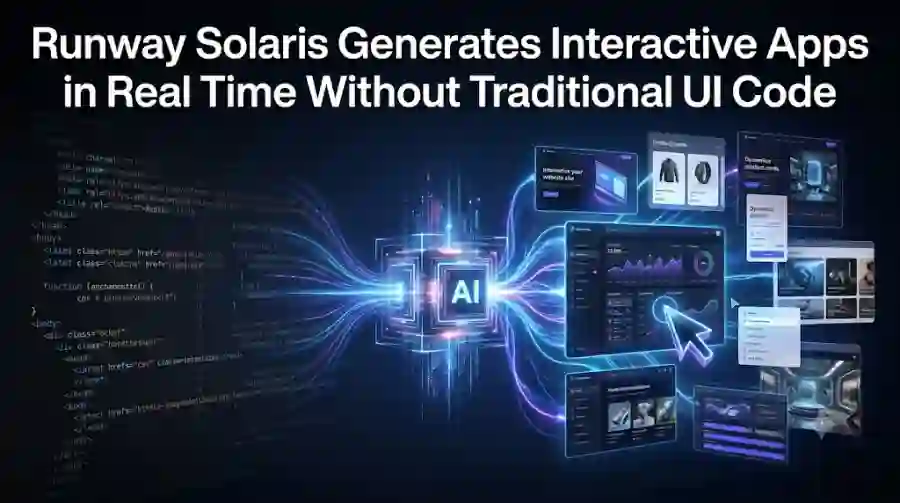
The idea is particularly interesting for developers, designers and AI researchers because Solaris does not simply generate HTML, CSS or JavaScript.
Instead, the model renders the visual interface itself, frame by frame.
That could eventually change how people think about applications.
What Is Runway Solaris?
Solaris is an experimental AI system from Runway designed to generate interactive interfaces continuously.
Runway calls the technology an Interface World Model.
Traditional software normally has several layers.
A designer creates a visual concept. Developers then convert that concept into code. The browser or operating system renders the code, and predefined interaction logic determines what happens when users click, drag or type.
Solaris attempts to remove much of that intermediate process.
The model generates each frame while also responding to user interactions. Runway says the entire frame becomes the interface rather than being a visual representation of an underlying coded interface.
This means a generated interface could potentially behave more like an interactive environment than a conventional collection of buttons, menus and pages.
What Makes Solaris Different?
The biggest difference is that Solaris does not treat an interface as a fixed collection of programmed components.
Instead, it continuously generates the visual environment.
Runway describes three major characteristics:
- Entirely visual
- Continuously alive
- Open-ended
These characteristics allow an interface to respond to actions that developers may not have explicitly programmed in advance.
For example, Runway demonstrates environments where users can interact directly with objects rather than navigating through conventional menus.
A virtual clothing store could allow users to pick up clothing, drag it onto a digital representation of themselves and rearrange products.
A learning environment could allow students to interact directly with a simulation rather than clicking through a sequence of static pages.
How Does Solaris Generate an Interface?
Solaris is built on Runway's Gen-4.5 video generation model and draws on the company's earlier GWM-1 general world-model research.
The system was adapted to understand user interactions and respond to them in real time.
When a person clicks, drags or changes something, that interaction becomes conditioning for the next generated frame.
Instead of looking at an interaction as an instruction that triggers a pre-programmed function, Solaris learns the relationship between the action and the visual result.
Runway describes the process as a continuous loop:
User interaction → model interprets action → new frame generated → user interacts again
This happens continuously while the experience is running.
Solaris Separates Reasoning From Rendering
An important part of the system is the combination of a language model and the world model.
The language model determines what should happen next.
Solaris then determines how that behavior should appear visually.
Runway explains that the language model interprets the user's request, decides whether an interaction should modify the current scene or transition somewhere else, and generates instructions that guide the visual model.
This creates two connected responsibilities:
Language model: Determines what the experience should do.
World model: Determines how that experience looks and behaves.
That architecture is different from the standard AI coding workflow, where an AI model writes code and a browser executes that code.
What Can Solaris Do?
Runway's demonstrations show several possible applications for the technology.
Interactive Shopping
A virtual storefront could become a generated environment instead of a conventional e-commerce webpage.
Users could interact directly with products, change arrangements and explore objects visually.
Runway suggests that layouts, recommendations and other elements could eventually adapt to individual users in real time.
Interactive Tutorials
Traditional tutorials usually show the same sequence to every user.
Solaris could theoretically generate the next step based on what the user has already done.
If someone makes a mistake, the system could respond to that situation rather than simply replaying a fixed instruction.
Runway specifically identifies adaptive tutorials as one possible future use for Interface World Models.
Education and Simulation
Solaris can also be used to create interactive visual demonstrations.
Runway gives an example involving combustion, where users can experiment with different materials and observe generated reactions.
This could eventually create more dynamic educational experiences than static videos or diagrams.
Visual Product Experiences
Brands could potentially create product environments that change based on what visitors want to explore.
Instead of every customer seeing exactly the same webpage, the interface could adapt dynamically.
This is one of the areas where generated interfaces could become especially interesting for e-commerce and digital marketing.
Why Runway Thinks Traditional Interfaces Have a Limitation
Runway's argument is that today's software requires a translation step.
A designer might create a detailed visual concept.
That concept then has to be translated into components, frameworks and code.
The final software may therefore lose some of the visual richness of the original design.
Solaris attempts to avoid this translation by keeping the interface inside the generative model itself.
Runway says this removes the intermediate representation that normally sits between visual design and the running application.
The result is intended to be more flexible because the system does not have to wait for developers to define every possible interaction beforehand.
Solaris Could Also Change AI Agent Training
The technology has another important application beyond human-facing software.
AI agents increasingly need to operate computers.
However, many computer-use agents are trained around existing interfaces.
That can make them sensitive to changes in layout.
For example, an agent that learns how to navigate one hotel-booking website may struggle when another website uses a different interface.
Runway believes generated interfaces could provide more dynamic environments for training agents.
Because Solaris can continually create different layouts and interactions, agents could potentially learn to adapt rather than memorize a specific interface.
This makes Solaris relevant to both generative UI and AI-agent research.
How Fast Is Solaris?
Real-time interaction creates a major technical challenge.
A conventional video-generation model can take seconds or minutes to produce a clip.
That is acceptable when creating a video.
It is not acceptable when someone is clicking a button and waiting for the interface to respond.
Runway says interactions begin to feel less interactive around roughly half a second of delay.
To address this, Solaris generates frames autoregressively, with each frame depending on what came before. Runway also says it distilled the generation process into fewer steps and trained the faster model on its own outputs.
The company says the resulting system can operate at interactive speeds while maintaining visual quality at 720p.
What Did Runway's Testing Show?
Runway compared Solaris with a coded interface in a user study.
The company tested 30 interaction examples with 250 participants and collected nearly 7,500 pairwise judgments.
According to Runway's results, participants preferred Solaris for following requested interactions in 61% of comparisons, while the coded interface was preferred in 24%.
For natural behavior within the scene, Solaris was preferred in 71% of comparisons compared with 21% for the coded interface.
These are Runway's own reported results, not an independent benchmark.
They nevertheless provide an early indication of the company's claim that generated interfaces can create more natural visual interactions than conventional coded interfaces in certain scenarios.
What Are Solaris's Current Limitations?
Solaris is ambitious, but Runway openly acknowledges that the technology is not ready to replace normal software development.
Several major problems remain.
Text Generation
Stable and readable text is still difficult for generative video systems.
That is a serious problem for software because interfaces often contain large amounts of text.
Runway says fully real-time generated text remains an open challenge.
Long-Term Consistency
An application must remain consistent during an entire session.
Objects, layouts, text and visual elements cannot randomly change.
Runway says maintaining visual and semantic coherence during long, open-ended interactions remains an active research challenge.
Accuracy and Trust
A conventional application normally retrieves information from defined databases or executes programmed logic.
A generative interface could produce convincing but incorrect information.
Runway says grounding generated experiences in verified product information, documents and other references is an active area of research.
Accessibility
Software must also work with assistive technologies.
Screen readers and accessibility APIs generally depend on structured interfaces.
A purely generated visual experience creates new challenges for accessibility and integration with existing software systems.
Could Solaris Replace Websites and Apps?
Not anytime soon.
Solaris is currently a research-oriented system rather than a replacement for conventional web development.
Modern websites and applications depend on reliable text, databases, authentication, payments, accessibility, security and predictable behavior.
Those requirements are difficult to satisfy with a system that generates every frame dynamically.
However, Solaris points toward a different future.
Instead of choosing an application from a fixed catalog, users could potentially describe what they want and receive a generated interface designed around that task.
Runway describes this as a possible future where the app stops being the primary unit of interaction.
How Solaris Could Affect AI Tool Development
For AI-tool developers, Solaris represents an important shift.
Most AI software today still uses traditional interfaces.
An AI model may generate the content, but the surrounding interface is built using conventional software technologies.
Solaris suggests a future where the AI itself could generate both the content and the interface through which users interact with it.
That could create new categories of:
- AI-generated applications
- Dynamic dashboards
- Personalized learning environments
- Interactive product demos
- Generative e-commerce
- Adaptive tutorials
- AI-powered simulations
- Agent training environments
The technology could therefore eventually become relevant far beyond video generation.
When Can Users Try Runway Solaris?
Solaris is not currently presented as a normal consumer product with an open public launch.
Runway says it is working with key partners to launch Solaris publicly and has opened a process for people to request early access.
That means users should not expect Solaris to function like a standard Runway video-generation feature yet.
It is better understood as an emerging research system demonstrating what generated software interfaces could look like.
Why Solaris Matters for the Future of Software
The most interesting part of Solaris is not simply that it generates attractive visuals.
The bigger idea is that the interface itself becomes generated content.
Today, software generally follows this sequence:
Design → Code → Interface → User interaction
Solaris explores:
Intent → Generated interface → Continuous interaction
That difference could eventually change how websites and applications are designed.
Instead of developers defining every possible state in advance, AI systems could generate an appropriate experience dynamically.
The technology still has major technical and practical problems to solve.
But the direction is significant.
Runway Solaris is one of the more unusual AI announcements of the current week because it moves beyond AI-generated images, videos and code.
The system attempts to generate the interactive interface itself.
Runway describes Solaris as its first Interface World Model, with the ability to generate software interfaces frame by frame while responding to clicks, drags and other interactions.
The company believes this approach could create more flexible websites, applications, tutorials and digital environments while also providing new ways to train AI agents.
However, Solaris remains experimental.
Stable text, long-session consistency, trust, accessibility and integration are still unresolved challenges.
For now, Solaris should be viewed as a research preview rather than a replacement for conventional software development.
But if real-time generated interfaces become reliable enough, the concept could eventually change one of the oldest assumptions in computing:
That software must be built before the user can interact with it.
FAQs
What is Runway Solaris?
Runway Solaris is an experimental AI system that generates interactive software interfaces frame by frame in response to user interactions. Runway calls it an Interface World Model.
Is Runway Solaris a video generator?
Solaris uses technology derived from Runway's video-generation research, but its purpose is different. It is designed to generate interactive interfaces rather than ordinary video clips.