New Operant Semantic Firewall Watches AI Agent Intent Before Tools, Code and Data Can Cause Damage
Operant AI is now targeting that problem with a new product called Operant Semantic Firewall.
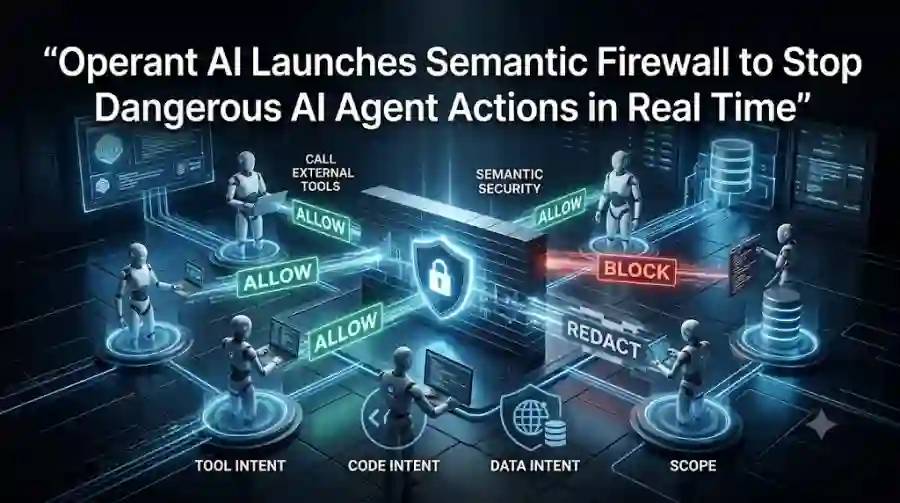
Announced on August 27, 2026, the system is designed to analyze the meaning and intent behind AI-agent activity in real time and make an allow, block or redact decision before an action executes.
The company says the firewall can examine prompts, model responses, commands, tool calls and data movement instead of relying only on traditional signatures or fixed blocklists.
That makes the launch particularly relevant as companies move AI agents from experiments into production environments.
What Is Operant Semantic Firewall?
Operant Semantic Firewall is an AI security layer designed specifically for autonomous and semi-autonomous AI systems.
Traditional security products often look for known indicators of malicious activity.
That approach works well when an attack has a recognizable pattern.
AI agents create a different problem.
An agent may perform a completely legitimate-looking action that becomes dangerous because of the context surrounding it.
For example, an agent could have permission to access a database.
The problem may not be the database request itself.
The problem could be that the agent is suddenly attempting to copy thousands of sensitive records when its original task was only to analyze one customer account.
Operant's approach is to examine the intent and impact of the action rather than only checking whether the technical request is allowed.
The company's official documentation describes the system as an inline control that can evaluate an agent's prompt, plan, tool call, command and data payload before execution.
Why AI Agents Need a Different Security Model
Traditional applications generally follow predefined instructions.
AI agents are different.
They can interpret goals and decide which actions to take.
That flexibility is what makes agents useful, but it also creates unpredictable paths.
An agent might:
- Call an unexpected tool
- Read more data than necessary
- Install a package
- Execute shell commands
- Follow malicious instructions hidden inside content
- Send sensitive information to an external service
- Modify records
- Attempt an unauthorized action
The difficult part is that the individual technical operation may appear legitimate.
An API call might be valid.
A shell command might be syntactically correct.
A file might be accessible.
But the purpose of the action could violate the organization's policy.
Operant is attempting to place a security layer directly around that decision-making loop.
How the Semantic Firewall Works
The system evaluates agent activity and returns one of three outcomes:
Allow
The action is considered acceptable and can continue.
Block
The action violates a policy and is stopped.
Redact
Sensitive information or an unsafe portion of the action can be removed while allowing the broader workflow to continue.
Operant says the system works inline rather than relying exclusively on after-the-fact monitoring.
That distinction is important.
A security product that tells an administrator about a dangerous action five minutes after it happened is useful for investigation.
A security layer that prevents the action from executing in the first place can potentially prevent the damage.
Four Intent Guards Protect Different Agent Activities
Operant's Semantic Firewall brings several security controls into one system.
The company describes four primary intent guards.
Tool Intent Guard
The Tool Intent Guard evaluates what an agent's tool call actually does.
It is designed to detect activity such as:
- Data exfiltration
- Bulk data access
- Credential access
- Unauthorized information sharing
The important difference is that the system is intended to evaluate the real-world impact of the operation.
An ordinary-looking request could therefore be blocked if its broader effect violates an organization's policy.
Code Intent Guard
Coding agents introduce another major security challenge.
An AI coding assistant may install packages, execute commands, interact with MCP servers or modify files.
Those actions can become dangerous if an attacker injects instructions or if an agent goes beyond its intended task.
Operant says its Code Intent Guard can identify risks including:
- Code injection
- Shell breakout
- Privilege escalation
- Hidden directives
- Malicious execution
- Unsafe package or tool installation
This is particularly relevant as AI coding agents become more autonomous.
Data Intent Guard
The Data Intent Guard focuses on information access and movement.
Organizations often have different classifications for their data.
Some files may be public.
Others may contain:
- Customer information
- Financial records
- Personal data
- Internal documents
- Business secrets
- Regulated information
Operant says its Data Intent Guard can work with enterprise data-classification systems, including Microsoft Purview, so decisions can respect existing sensitivity labels.
Scope Guard
The fourth layer is the Scope Guard.
This is designed around a simple question:
Is the agent still doing what it was originally authorized to do?
That matters because an agent can potentially drift away from its original task.
For example, an agent could be asked to summarize a customer account.
During the process, it might encounter instructions suggesting that it should access unrelated records.
The action might technically be possible.
But it is outside the original scope.
Operant says Scope Guard continuously checks whether the agent remains within its assigned purpose.
Natural-Language Security Policies
One of the more interesting parts of the product is the ability to express policies using natural language.
Instead of requiring security teams to translate every rule into complicated technical conditions, organizations can define policies around business intent.
Examples include:
“No unauthorized deletes.”
“No customer PII leaving this workspace.”
“Do not access credentials.”
The firewall then evaluates agent activity against those policies.
Operant says every decision can include a plain-language explanation describing why an action was allowed, blocked or redacted.
This could make AI security easier for organizations where security policies are written primarily in business language.
The System Is Designed to Stop Prompt Injection
Prompt injection is one of the biggest security concerns surrounding AI agents.
An attacker can attempt to place instructions inside:
- Web pages
- Documents
- Emails
- Code repositories
- Tool responses
- Database records
- External content
The AI agent may then interpret those instructions as part of its task.
A traditional firewall may not understand that a seemingly normal instruction is trying to manipulate an AI system.
Operant's approach is to examine the meaning of the agent's activity.
If the agent starts following a malicious instruction that causes it to leave its authorized scope, the Semantic Firewall can potentially block the resulting action.
The company specifically positions the product as protection against jailbreaks, prompt injection and data breaches.
It Can Also Protect Against Agent Drift
Not every dangerous action requires an attacker.
This is an important distinction.
An AI agent can make an incorrect decision while honestly attempting to complete its assigned goal.
For example, imagine an agent instructed to improve a company's sales pipeline.
It might decide that deleting old records would make the database cleaner.
The action could technically be related to the broader objective.
But the user never authorized deletion.
A system based only on traditional permissions may not recognize the difference.
An intent-based security layer can instead ask whether the action fits the agent's assigned purpose.
Operant calls this problem agent drift.
Security Can Run Inside the Enterprise
Data sovereignty is becoming another important issue for enterprise AI.
Companies often do not want sensitive prompts, files or security decisions sent to another external service.
Operant says Semantic Firewall can operate inside an organization's own environment, including:
- Virtual private clouds
- On-premises infrastructure
- Air-gapped environments
The company also says its enforcement decisions use Operant's own models rather than routing the security decision to an external frontier model provider.
That could be particularly important for organizations operating under strict data-residency or regulatory requirements.
Model-Independent Security
Another major feature is that Operant positions the Semantic Firewall above the underlying AI model.
That means an organization could theoretically change its AI provider without rebuilding its entire security layer.
A company might use one model today and another model tomorrow.
The security policies can remain in place.
Operant says the firewall works across models and frameworks, reducing dependence on any single AI provider.
This is becoming increasingly relevant as companies use multiple AI models rather than relying on one provider.
Operant Is Also Expanding Browser AI Protection
The Semantic Firewall is not the only announcement from Operant.
The company is also launching expanded Browser AI Protection.
AI-powered browsers and computer-use agents can interact with authenticated sessions, which introduces a new security challenge.
An AI system might have access to a browser session that already contains:
- Logged-in websites
- Company accounts
- Internal dashboards
- Customer information
- Financial systems
Operant says its browser protection can inspect AI conversations and help block sensitive content before prompts are sent or responses are rendered across services including ChatGPT, Claude, Copilot and Gemini.
This expands the security model beyond APIs and backend systems.
Claude Coverage Is Also Expanding
Operant says it is expanding its Claude coverage as part of the same platform update.
The company says its new coverage includes Claude Cowork cloud-mode sessions and additional Claude environments through an inference-hook integration.
This includes areas such as:
- Claude desktop activity
- Claude Cowork
- Claude Tag
- Claude Design
The goal is to provide security controls around more of the places where AI agents can operate.
Operant Token Meter Tracks AI Spending
Another new capability is Operant Token Meter.
AI usage can become expensive when agents perform long-running tasks.
An agent may repeatedly call tools, invoke models and process large amounts of context without a user noticing how quickly consumption is increasing.
Operant says Token Meter provides near-real-time usage information by:
- User
- Team
- Agent
- Model
It can also enforce budgets during an active session.
This makes cost control part of the broader AI governance problem.
Security teams may need to ask not only:
“Is this action safe?”
but also:
“Is this agent consuming an unreasonable amount of AI resources?”
Why AI Agent Security Is Becoming a Major Market
AI agents are moving into increasingly important workflows.
They are no longer limited to answering questions.
They can now:
- Write software
- Search company databases
- Send messages
- Use external tools
- Browse websites
- Modify records
- Trigger workflows
- Process documents
- Manage business operations
Every additional capability creates another possible attack surface.
That means the AI security market is moving beyond protecting models themselves.
Companies increasingly need to protect the actions performed by models.
This is where products such as Semantic Firewall fit.
Traditional Permissions Are Not Enough
Permissions answer one question:
Can this user or system technically perform this action?
Agent security needs to answer another:
Should this particular AI action happen in this context?
Those are different questions.
An employee may have permission to download customer data.
That does not mean an AI agent working for that employee should automatically download the entire database.
Similarly, a coding agent may have permission to execute shell commands.
That does not mean every command it generates should be trusted.
Intent-based controls attempt to fill this gap.
Why This Matters for MCP
The growth of Model Context Protocol is making the issue even more important.
MCP allows AI systems to connect with external tools and data sources.
That makes agents more useful.
It also means an agent can potentially reach more systems.
An AI agent connected to ten MCP servers has far more capabilities than one operating inside a closed environment.
Each new connection becomes another potential route for:
- Data leakage
- Unauthorized actions
- Malicious instructions
- Tool abuse
- Credential exposure
Operant already has an MCP security focus, and its broader platform is designed to protect AI, agents and MCP connections in real time.
What Businesses Should Watch
The launch highlights a larger trend in AI.
The first wave of enterprise AI focused heavily on getting models into companies.
The next wave is about making autonomous systems safe enough to operate independently.
That requires controls around:
- Identity
- Permissions
- Tool access
- Data
- Code execution
- Agent scope
- Browser activity
- MCP connections
- Model usage
- Cost
Semantic Firewall is attempting to combine several of these controls into one runtime layer.
Is Operant Semantic Firewall Available?
Yes.
Operant says Semantic Firewall, Browser AI Protection, expanded Claude coverage and Token Meter are available as part of its AI Defense Platform.
However, the product is positioned primarily toward organizations deploying AI and agents at enterprise scale.
It is not simply a consumer firewall application that individuals can install to protect a personal chatbot.
Businesses interested in deployment should evaluate the platform according to their infrastructure, compliance requirements and AI-agent architecture.
What This Means for the Future of AI Agents
AI agents are becoming more autonomous.
That creates a fundamental security problem.
When a normal application makes a request, engineers usually know what the application is programmed to do.
When an AI agent makes a decision, the exact path can vary from one situation to another.
The security layer therefore needs to understand more than network traffic.
It needs to understand what the agent is attempting to accomplish.
That is the idea behind semantic security.
Instead of asking only:
“Is this request technically allowed?”
the system asks:
“What is this action actually trying to accomplish, and does it violate the user's intent or company policy?”
That could become one of the most important security questions in the agentic AI era.
Operant AI's Semantic Firewall arrives as companies move AI agents from experimental environments into real business workflows.
The product is designed to analyze agent intent across prompts, tool calls, commands, code and data movement and make real-time allow, block or redact decisions.
Its four main intent controls cover tools, code, data and agent scope.
The company is also expanding browser AI protection, Claude coverage and real-time AI cost monitoring through Token Meter.
The larger story is bigger than Operant itself.
AI agents are becoming capable of taking actions that can affect real systems.
As that happens, traditional security based only on permissions, network controls and known attack signatures may not be enough.
Organizations will increasingly need security systems that understand what an AI agent is trying to do, not just what technical request it is making.
If AI agents become the new interface for enterprise software, then intent-based security could become just as important as the agents themselves.
FAQs
What is Operant Semantic Firewall?
Operant Semantic Firewall is an AI security system designed to understand AI-agent intent in real time and allow, block or redact actions before they execute.
What can Operant Semantic Firewall protect?
The system is designed to protect AI-agent activity involving tools, code, data and assigned task scope. It can also address risks such as prompt injection, data exfiltration and unauthorized actions.