OpenArt Arena Brings Task-Specific AI Model Rankings for Image, Video, Design and Creative Work
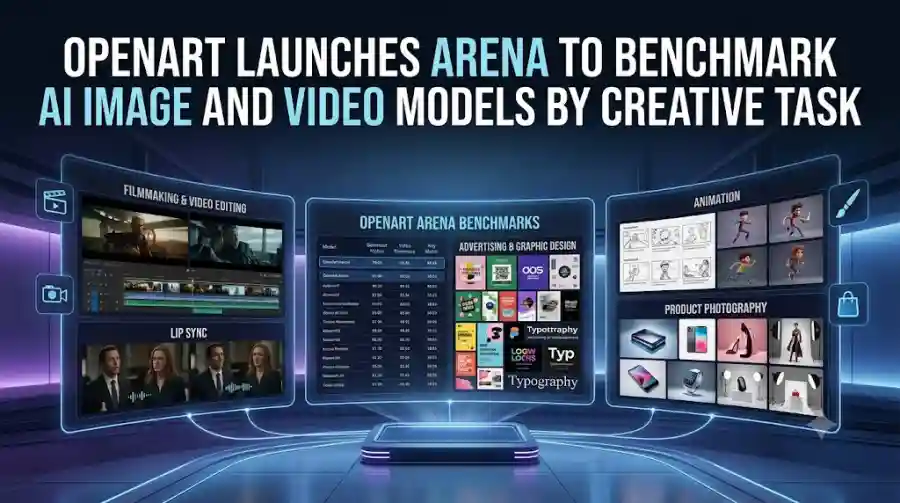
Announced on September 15, 2026, OpenArt Arena evaluates AI image and video models through blind comparisons organized around specific creative tasks and industries. Instead of treating every visual-generation task as one category, the platform separates results into areas such as filmmaking, advertising, animation, motion design, product imagery, graphic design, editing and lip sync.
The Arena is now live, giving creators another resource for researching which models to test for particular projects.
What Is OpenArt Arena?
OpenArt Arena is a public leaderboard created by OpenArt for comparing AI image and video generation models.
The key difference is its focus on creative workflows rather than one general AI score.
OpenArt says the benchmark was created for creators, filmmakers, advertisers, animators and other creative professionals who need to evaluate AI models according to the actual work they want to produce.
The platform includes an overall ranking as well as more specific boards.
These include categories such as:
- Advertising
- Film
- Animation
- Motion design
- Product imagery
- Graphic design
- Image editing
- Video editing
- Lip sync
This structure allows users to look beyond a single overall model score and examine performance in a particular type of creative production.
Why OpenArt Is Focusing on Creative Tasks
AI model comparisons often attempt to answer a broad question: which model performs best?
For creative professionals, however, that question can be difficult to apply.
A filmmaker may care about camera movement and visual consistency. An advertising team may care about product accuracy and composition. A graphic designer may prioritize typography, layout and editing control.
Those requirements can be very different.
OpenArt Arena is designed around this distinction.
OpenArt says its benchmark is intended to answer a more practical question: which AI model is suitable for a particular creative task?
That makes the platform particularly relevant as AI-generated images and videos move from experimentation into professional production workflows.
How OpenArt Arena Evaluates AI Models
OpenArt says Arena uses blind, paired comparisons.
During an evaluation, judges compare outputs without seeing which AI model produced each result.
The models receive the same creative brief, and the outputs are evaluated against criteria associated with the particular task.
According to OpenArt's published methodology, the rankings use a Bradley–Terry model, with confidence intervals provided alongside results.
This is important because the platform is not simply asking users to vote for a model they already recognize.
Instead, the evaluation attempts to separate the identity of the model from the visual result being judged.
OpenArt says the current Arena index uses outputs generated from identical prompts and settings, while judges do not see the model identity during comparison.
More Than One Type of AI Model Ranking
The Arena is structured around multiple creative applications.
Filmmaking and Video Production
Video-generation models can be evaluated according to filmmaking-related requirements rather than being placed into one broad video category.
This gives filmmakers and production teams a way to investigate models using criteria closer to their actual workflow.
Advertising and Commercial Content
Advertising is another dedicated area.
This can be useful for teams producing campaign visuals, promotional videos, product advertisements and other branded creative assets.
Product Imagery
Product imagery presents different requirements from cinematic video.
Accuracy, composition and presentation can be more important than cinematic movement.
OpenArt Arena therefore treats product imagery as a separate creative use case rather than assuming the same model characteristics apply across every visual workflow.
Graphic Design and Editing
The platform also includes graphic design and editing-related boards.
This gives creators another way to examine AI models for workflows where editing, composition and controlled modifications matter.
Lip Sync
Lip sync is another dedicated category.
This is particularly relevant to AI-generated characters, presenters, marketing videos and other applications where visual speech synchronization is important.
Who Is Evaluating the Models?
OpenArt says Arena combines evaluations from creative professionals and a larger group of community participants known as Tastemakers.
The September 15 launch announcement described the benchmark as being built around evaluations from experts across industries including film, television, advertising and the creator economy.
OpenArt's current Arena documentation reports 28 expert judges and more than 1,000 Tastemakers participating in the published evaluation system.
The judging process is designed to keep model identities hidden during comparisons.
That blind approach is intended to reduce the effect of brand familiarity when participants evaluate generated outputs.
OpenArt Uses a Weighted Evaluation System
Not every participant's evaluation carries the same weight.
OpenArt says its published methodology gives greater weight to the expert council than to Tastemaker votes.
The current methodology assigns expert votes a 3× weight and Tastemaker votes a 1× weight. Results are then processed using the Bradley–Terry model.
OpenArt also publishes confidence intervals around results.
That matters because small differences between models should not automatically be interpreted as meaningful.
OpenArt explicitly notes that overlapping confidence intervals can indicate that differences between models are not statistically meaningful for the tested evaluation set.
OpenArt Arena Is Not a Universal AI Quality Score
One of the most important details about Arena is how its results should be interpreted.
OpenArt's own terms state that Arena results represent subjective human preferences on a specific set of prompts.
The results are not presented as a universal measurement of overall AI quality, safety, licensing suitability or fitness for every production environment.
This distinction is important for companies considering AI models for professional work.
A model can perform strongly on a particular benchmark while still requiring additional testing against a company's own prompts, datasets, brand requirements, workflows and production constraints.
The Arena is therefore best viewed as a discovery and comparison resource rather than a replacement for real-world testing.
Which Models Are Included?
OpenArt Arena brings together image and video models available through OpenArt's creative platform.
The exact models and model versions can change as providers release updates.
OpenArt's methodology documentation says that rankings apply to the specific model versions, Arena index version and evaluation date shown with each result. Providers can also update their models without notice.
That makes the date and version information important when comparing results.
An AI model can change substantially after an update, meaning an older benchmark result should not automatically be treated as representative of the current version.
Why This Matters for AI Creators
The rapid expansion of generative AI has created a new problem for creators: model selection.
A creator might have access to several image generators, multiple video models and specialized editing systems.
Testing every model independently can consume significant time and resources.
A task-specific benchmark can help narrow the initial choices.
For example, a creator producing product advertisements can examine advertising and product-imagery results rather than relying only on a general image-generation leaderboard.
Similarly, a filmmaker can investigate models using filmmaking-oriented evaluations.
This approach can make model discovery more closely connected to the work creators actually perform.
OpenArt Is Also the Platform Behind the Ranked Models
Another notable part of Arena is that OpenArt operates a creative platform where users can access AI generation tools.
That means the company is combining model discovery with a platform where creators can experiment with different models.
OpenArt says its platform has more than 8 million monthly active users, according to the company's September 15 announcement. This is a company-reported figure rather than an independently audited measurement.
For OpenArt, Arena can therefore function as both a benchmark and a discovery layer within a broader AI creative ecosystem.
How Creators Can Use OpenArt Arena
Creators can use the leaderboard as an initial research step.
A practical workflow could look like this:
- Identify the type of content being produced.
- Open the corresponding Arena category.
- Examine the models and evaluation results.
- Check the confidence intervals and methodology.
- Shortlist several models.
- Test those models using the creator's own prompts.
- Compare the results against actual production requirements.
- Select the model or workflow that fits the specific project.
The final step remains important.
Benchmark results can help reduce the number of models a creator needs to test, but they cannot completely replace testing with real project requirements.
OpenArt Arena vs General AI Leaderboards
OpenArt Arena is entering a space that already contains model comparison platforms.
Its main distinction is its emphasis on creative tasks.
Instead of placing image, video and other creative models into a single general-purpose score, OpenArt is creating separate evaluation boards around specific jobs.
That approach can make the information easier to interpret for people who are not primarily interested in AI benchmarks themselves.
A creative director may not need to know which model has the highest overall score.
They may need to know which models are worth testing for a specific advertising campaign.
The Arena is designed around that use case.
The Limits Creators Should Keep in Mind
OpenArt's methodology itself provides several reasons to avoid treating the rankings as final answers.
The evaluations are based on specific prompts and controlled settings.
Creative quality is also subjective.
A model that receives strong human preference on one prompt may produce different results on another prompt.
In addition, model versions can change over time.
Licensing is another separate consideration. A strong benchmark result does not automatically establish that a particular model meets the commercial licensing requirements of a company's project.
OpenArt explicitly says its results should not be interpreted as a measure of licensing suitability or overall model quality.
For professional users, benchmark results should therefore be combined with pricing, licensing, reliability, generation speed, API access and workflow compatibility.
What OpenArt Arena Means for AI Model Discovery
OpenArt Arena arrives at a time when the AI creative market is becoming increasingly fragmented.
Instead of having only a handful of general-purpose image and video systems, creators now have specialized models and rapidly changing model versions.
That makes simple model comparisons less useful.
OpenArt's task-based approach attempts to organize the market around what creators actually need to accomplish.
The launch also highlights a broader shift in AI evaluation.
As models become more specialized, the question is increasingly moving from “Which AI model is best?” to “Which model should I test for this particular job?”
OpenArt Arena is built around that second question.
OpenArt Arena is a new AI image and video model benchmark focused specifically on creative production.
Its main feature is the separation of rankings by creative task and industry, including advertising, filmmaking, animation, product imagery, graphic design, editing and lip sync.
The platform uses blind comparisons, expert evaluations and a published statistical methodology rather than relying solely on a single public vote.
At the same time, OpenArt makes clear that Arena results are not universal measures of AI quality. They reflect human preferences for specific evaluation sets and model versions.
For creators, agencies and teams experimenting with generative media, that makes the platform potentially useful as a model-discovery tool: a way to narrow down which systems deserve hands-on testing before committing time and production resources.
Frequently Asked Questions
What is OpenArt Arena?
OpenArt Arena is a public benchmark and leaderboard for AI image and video generation models, organized around creative tasks and industries.
When did OpenArt Arena launch?
OpenArt announced Arena on September 15, 2026, and the live Arena platform is now available.