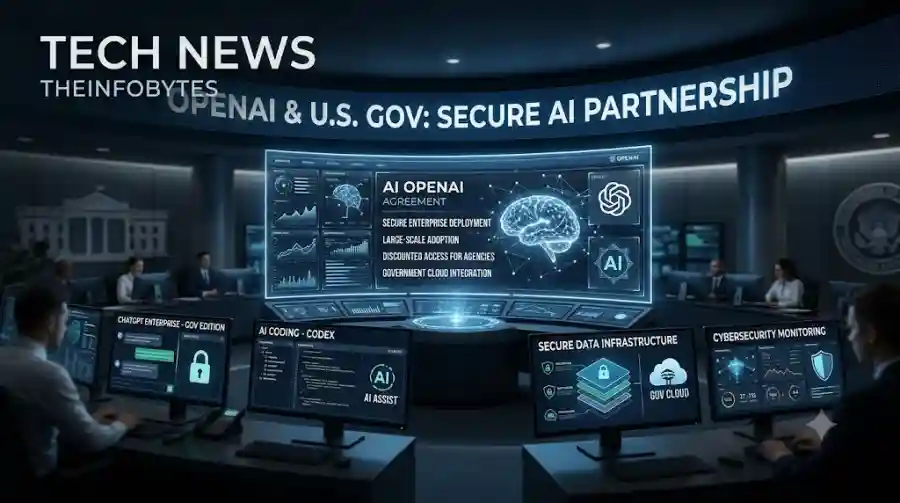
OpenAI Expands Government AI Access With Free ChatGPT Enterprise Licenses and 50% Usage Discounts
Under the arrangement, eligible government organizations can receive $0 platform fees, compared with the standard $15-per-user monthly platform fee cited by OpenAI, along with 50% off eligible usage. The agreement also expands support for public-sector cybersecurity teams.
The deal is important because it moves OpenAI's AI products deeper into government workflows.
Rather than offering AI only to individual employees experimenting with consumer chatbots, the agreement is aimed at organizations that need enterprise-level controls, administration, security and support.
OpenAI says eligible public servants will be able to access products including ChatGPT Enterprise, Codex and OpenAI models through the government program.
What Is the New OpenAI and GSA Agreement?
The new agreement is a government-focused expansion of OpenAI's relationship with the U.S. government.
OpenAI says the deal builds on an earlier federal government offer and extends the benefit beyond federal agencies to state, local and tribal governments.
The core commercial benefits include:
- $0 platform fees for eligible organizations
- 50% off eligible usage
- A multi-year agreement
- Access to OpenAI's enterprise AI products
- Additional support for public-sector cybersecurity teams
- Training and enablement designed for public servants
OpenAI's government program currently describes the agreement as having a 27-month program term, with each agency responsible for funding its own order.
This makes the announcement more than a simple discount.
It is effectively an effort to make OpenAI's AI infrastructure easier for government organizations to adopt at scale.
What Does $0 Platform Fee Actually Mean?
The phrase $0 platform fee is important because it does not mean every AI-related cost becomes completely free.
OpenAI says the normal platform fee of $15 per user per month is being reduced to $0 for eligible organizations under the agreement. Eligible usage is then subject to a separate 50% discount.
In other words, government agencies do not simply receive unlimited free access to every OpenAI service.
Instead, the deal reduces the platform and usage costs associated with deploying OpenAI's products.
This distinction matters for organizations calculating their AI budgets.
The final cost can still depend on which products are used, how much AI usage an agency generates and the procurement structure of the deployment.
Which OpenAI Products Are Included?
OpenAI's government offering includes several of its enterprise-focused AI products.
The official OpenAI government page specifically lists:
- ChatGPT Enterprise
- Codex
- OpenAI models
- OpenAI API access
- Cyber and specialty models
The government program is designed around secure access rather than a consumer ChatGPT subscription.
That means agencies can potentially use AI across several different workflows.
ChatGPT Enterprise
ChatGPT Enterprise provides organizations with an administrative environment for deploying ChatGPT to employees.
For government organizations, enterprise-level controls are particularly important because agencies may need centralized management, access controls and governance.
Codex
Codex provides AI assistance for software development.
Government technology teams could potentially use it for software engineering, code analysis, maintenance and other development workflows, subject to their security and procurement requirements.
OpenAI Models and API Access
The program also covers access to OpenAI models through government deployment options.
OpenAI's government materials list direct API access and access through AWS Bedrock as possible deployment routes.
That gives agencies more flexibility than simply providing employees with a chatbot.
Why Government AI Adoption Is Different
Government organizations have requirements that are often different from those of ordinary businesses.
An AI tool may need to satisfy requirements around:
- Security
- Privacy
- Data handling
- Access control
- Compliance
- Auditing
- Procurement
- Deployment environments
- Employee permissions
A government agency cannot necessarily adopt an AI service simply because employees find it useful.
The organization also needs to understand how the system will be managed.
This is why OpenAI is emphasizing enterprise products and government-specific deployment options rather than treating the agreement as a consumer promotion.
OpenAI Is Also Targeting Cybersecurity Teams
Cybersecurity is one of the most important elements of the announcement.
OpenAI says the agreement includes expanded support and access for public-sector cyber defenders.
This comes as government agencies face increasingly complex cybersecurity threats.
Security teams need to analyze large amounts of information, investigate vulnerabilities, understand malicious activity and respond to incidents quickly.
AI can potentially help with some of those workflows.
For example, authorized security teams could use AI to help:
- Analyze security alerts
- Understand technical reports
- Review code
- Investigate vulnerabilities
- Summarize incident information
- Assist with defensive research
- Develop documentation
- Support security engineering workflows
However, AI access alone does not replace cybersecurity expertise.
Government agencies still need appropriate controls, human oversight and authorization around security-related AI use.
The Deal Extends Beyond Federal Agencies
One of the most significant parts of the announcement is its broader reach.
OpenAI says the same offer is being extended to state, local and tribal governments.
That could potentially expand AI access to a much larger number of public-sector organizations.
Large federal agencies often have substantial technology budgets and dedicated AI teams.
Smaller local governments may have fewer resources.
A discounted enterprise AI program could therefore be more significant for smaller organizations that want to experiment with AI but face tighter technology budgets.
For example, a local government could potentially use AI to assist employees with document-heavy workflows, research, software development, internal knowledge management and administrative tasks.
The actual use cases will depend on each organization's security requirements and procurement decisions.
Why the 50% Usage Discount Matters
The platform-fee reduction gets attention because it sounds simple.
But the 50% usage discount could become even more important for organizations deploying AI at scale.
AI usage can become expensive when an organization has thousands of employees or when applications make large numbers of model requests.
Reducing eligible usage costs can make it easier for government agencies to move AI projects from small pilots toward broader deployments.
This is particularly relevant for API-based applications.
An agency could potentially integrate AI into internal software, research systems or specialized workflows rather than limiting AI usage to a chat interface.
Government AI Could Move Beyond Chatbots
The agreement also reflects a broader change in how governments are approaching AI.
Early government AI experiments often centered on chatbots.
Employees could ask AI questions, summarize documents or draft text.
The next stage is more likely to involve AI embedded directly into workflows.
For example, an agency could potentially build a system where AI helps analyze large document collections, supports software development or assists employees with complex research.
Codex could also become relevant for government software teams that maintain large amounts of legacy code.
The more AI becomes integrated with organizational systems, the more important governance becomes.
OpenAI Already Has a Government AI Strategy
The new GSA agreement does not exist in isolation.
OpenAI has been building a dedicated government offering through OpenAI for Government, with products and deployment options designed around public-sector requirements.
OpenAI's government materials list ChatGPT Enterprise, Codex, OpenAI API access and specialized deployment options, including AWS GovCloud-related pathways.
The company also highlights FedRAMP-related compliance for ChatGPT and the OpenAI API.
This indicates that OpenAI is treating government AI as a separate strategic market rather than simply selling consumer AI subscriptions to public employees.
How This Differs From OpenAI's Earlier $1 Government Deal
OpenAI previously announced a government arrangement in 2025 that provided participating federal agencies access to ChatGPT Enterprise for $1 per agency for one year.
The new 2026 agreement changes the structure.
Instead of the earlier nominal $1 agency arrangement, the new announcement describes a $0 platform fee and a 50% discount on eligible usage, while also extending the offer to state, local and tribal governments.
That makes the latest agreement broader in scope.
It also indicates that OpenAI is moving from an initial federal pilot-style arrangement toward a more extensive public-sector commercialization strategy.
Why the Deal Could Matter for AI Competition
Government contracts are strategically important for AI companies.
Public-sector organizations represent a large potential customer base, but they also have demanding requirements around security, compliance and deployment.
Winning those customers can provide AI companies with long-term enterprise relationships.
OpenAI is therefore competing not only with other AI models but also with cloud providers and enterprise software companies offering government AI infrastructure.
Microsoft, Google, Amazon and other technology companies already have substantial government businesses.
OpenAI's strategy is to make its own models and AI products easier for government organizations to adopt within those existing procurement and security frameworks.
What Government Employees Could Use AI For
The potential applications are broad.
Document and Report Work
Employees can potentially use enterprise AI to draft, summarize and analyze large amounts of text.
Research
AI can assist analysts with information organization, comparison and preliminary research.
Software Development
Codex can assist government development teams with coding, debugging and software maintenance.
Cybersecurity
Security teams can use AI for authorized defensive analysis and technical workflows.
Internal Knowledge
Organizations can potentially connect AI systems to approved internal information sources.
Public Services
AI could eventually support workflows that help government employees deliver services more efficiently.
These are potential applications rather than guarantees that every feature is immediately available to every agency.
Security Will Remain the Biggest Challenge
Giving government employees access to advanced AI also creates new security questions.
An AI system can process large amounts of information, but agencies must still determine:
- What information can be provided to AI?
- Which employees can use which models?
- What actions can AI systems perform?
- How are outputs reviewed?
- How are API credentials protected?
- How is AI usage audited?
- What happens if an AI system produces an incorrect result?
These questions become even more important when AI agents can interact with software and external systems.
Government adoption therefore cannot be measured only by how intelligent an AI model is.
Reliability, governance and deployment controls will be equally important.
OpenAI's Government Push Is Getting Bigger
The new GSA agreement shows that OpenAI wants government agencies to become a major part of its AI ecosystem.
The company is offering a combination of:
AI models + ChatGPT Enterprise + Codex + API access + government deployment + cybersecurity support
That is significantly broader than selling a chatbot.
The strategy is closer to becoming an AI infrastructure provider for public-sector organizations.
If successful, OpenAI could become deeply integrated into government software workflows, research operations and cybersecurity programs.
What Happens Next?
The immediate question is adoption.
A government agency still needs to decide whether AI is appropriate for a particular workflow.
The agreement makes access cheaper, but agencies must still handle procurement, implementation, security and employee training.
OpenAI's government program includes training and enablement designed specifically for public servants, which suggests the company recognizes that successful deployment requires more than simply providing access to models.
Over time, the most interesting developments will likely come from how agencies actually use the technology.
The strongest government AI applications may not be flashy consumer-facing assistants.
They may be invisible systems that help employees process documents, analyze information, maintain software and respond to operational problems faster.
OpenAI's new agreement with the U.S. GSA is a major expansion of the company's government AI strategy.
Eligible federal, state, local and tribal government organizations can receive $0 platform fees and 50% off eligible usage, while gaining access to enterprise-focused OpenAI products and expanded support for public-sector cybersecurity teams.
The significance goes beyond the discount.
OpenAI is trying to make AI a deeper part of government infrastructure.
ChatGPT Enterprise can provide the employee-facing AI layer. Codex can support software teams. OpenAI models and APIs can power custom applications, while government-specific deployment and security options address public-sector requirements.
The challenge will be turning access into responsible adoption.
Government agencies handle sensitive information and operate systems that millions of people depend on. AI therefore needs to be introduced with strong controls, human oversight and clear accountability.
If agencies can solve those challenges, this agreement could become an important step toward moving AI from experimental government projects into everyday public-sector workflows.
Frequently Asked Questions
What is the new OpenAI GSA agreement?
It is a multi-year agreement between OpenAI for Government and the U.S. General Services Administration that provides eligible government organizations with $0 platform fees, discounted eligible usage and expanded AI support.
Is ChatGPT completely free for U.S. government agencies?
Not exactly. OpenAI says eligible organizations receive a $0 platform fee, while eligible usage receives a 50% discount. The arrangement does not mean unlimited AI usage is free.