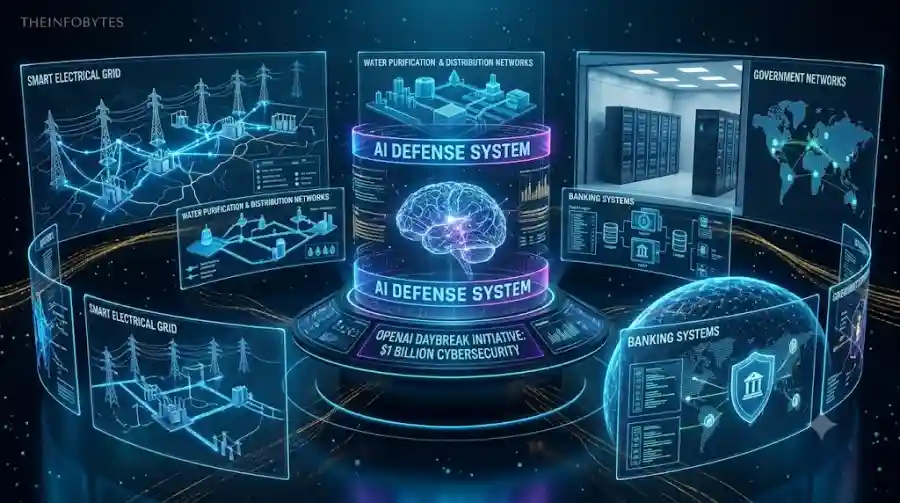
OpenAI Launches $1B Daybreak Initiative to Bring AI Cybersecurity Tools to Frontline Defenders
The initiative, called Daybreak for Frontline Defenders, will provide subsidized access to OpenAI's cybersecurity AI capabilities along with training, technical support and partnerships. OpenAI says the program will initially focus on the United States before expanding to partner countries.
The announcement comes at an important moment for AI security.
Artificial intelligence is making cybersecurity tools more capable, but the same technology can also help attackers discover vulnerabilities, automate reconnaissance and increase the speed of cyber operations.
OpenAI's argument is that defenders need access to advanced AI before attackers gain an even larger advantage.
The company is therefore targeting organizations that often have significant security responsibilities but fewer resources than large technology companies.
These include water utilities, electricity providers, state and local governments, community banks, nonprofits and open-source software maintainers.
What Is OpenAI Daybreak?
Daybreak is OpenAI's cybersecurity-focused initiative for verified defenders.
The company describes its cyber offering as a governed security stack that combines advanced AI models with tools and workflows designed for authorized defensive work.
OpenAI says thousands of defenders across approximately 2,000 approved organizations and workspaces are already using Daybreak. These include cybersecurity companies, defense organizations and law-enforcement organizations.
The new Daybreak for Frontline Defenders program expands access beyond organizations that may already have sophisticated cybersecurity budgets.
The central idea is straightforward:
Give defenders advanced AI tools before attackers can exploit the same technological advantage.
Why Critical Infrastructure Is the Main Target
Critical infrastructure has a unique cybersecurity problem.
A small utility may operate systems that affect thousands or millions of people while having only a small security team.
Water systems, electricity networks, public-sector infrastructure and community financial institutions cannot simply stop operating while security teams investigate every vulnerability.
They have to keep providing essential services while defending increasingly complex technology environments.
OpenAI says many of these organizations operate with limited staff and budgets despite protecting systems that communities rely on every day.
That creates an opportunity for AI.
Instead of requiring security teams to manually inspect every piece of code or investigate every alert, AI can help prioritize problems and accelerate parts of the defensive workflow.
What Can Daybreak Help Defenders Do?
OpenAI says subsidized Daybreak access can help organizations with several cybersecurity tasks.
These include:
- Reviewing legacy code
- Analyzing suspicious activity
- Identifying vulnerabilities
- Validating security findings
- Prioritizing serious risks
- Developing fixes
- Testing patches
- Reviewing system configurations
The objective is not simply to generate cybersecurity reports.
OpenAI wants the technology to help organizations move from finding a vulnerability to fixing it more quickly.
That distinction matters.
A security team that receives thousands of potential vulnerability reports may still struggle to determine which problems actually require immediate attention.
AI can potentially help filter those findings and provide technical assistance during remediation.
OpenAI Is Targeting Organizations With Limited Resources
The first phase of the $1 billion commitment will prioritize organizations that protect essential services but may lack the security resources available to major corporations.
OpenAI specifically lists:
- Water and wastewater systems
- Electric grid operators
- State and local governments
- Community and regional banks
- Nonprofits
- Open-source maintainers
- Other organizations with limited cybersecurity resources
OpenAI says the subsidized access is intended to be consumed over six months.
This could make the program particularly useful for smaller organizations that want to experiment with advanced AI cybersecurity without taking on the full cost themselves.
Daybreak for America Will Focus on Essential Services
OpenAI is also creating Daybreak for America as part of the broader program.
The initiative brings together the company's U.S. work aimed at protecting essential services.
The program includes a pilot with the Multi-State Information Sharing and Analysis Center, or MS-ISAC.
The goal is to help state, local, tribal and territorial cyber defenders use AI more effectively.
MS-ISAC already supports cybersecurity information sharing and incident response across public-sector organizations.
Its members include organizations involved with utilities, hospitals, schools and law enforcement.
That makes the partnership potentially important because AI cybersecurity tools become more useful when they are connected to organizations that understand the operational reality of critical infrastructure.
OpenAI Is Adding Training, Not Just AI Access
One of the more important parts of the initiative is that OpenAI is not presenting it as simply handing organizations access to an AI model.
The company says the program will include:
AI access + training + technical assistance + partnerships
This is important because advanced AI systems are not automatically useful simply because an organization has access to them.
Security professionals need to know how to use AI safely.
They also need to understand when an AI-generated result should be trusted, reviewed or independently validated.
OpenAI says it is increasing hands-on support for frontline defenders and has been meeting with utilities, governments, community banks and other organizations to understand their needs.
The New MS-ISAC Pilot Could Be Important
OpenAI says it is launching a public-sector and water-focused pilot with MS-ISAC.
The pilot will combine Daybreak access with guided training and hands-on support.
The initial group will include public-sector and water-system defenders.
The intended workflow includes helping teams:
- Validate findings
- Prioritize vulnerabilities
- Coordinate remediation
- Develop repeatable security processes
If successful, this model could eventually be expanded to a much broader group of organizations.
That is important because one of the biggest challenges in cybersecurity is not necessarily finding technology.
It is making advanced technology usable for organizations with different budgets, skills and infrastructure.
OpenAI Is Also Expanding Its Daybreak Defense Network
Another major part of the announcement is the Daybreak Defense Network.
OpenAI says more than 35 enterprise products and partner-operated services are being made available through the network.
The goal is to put Daybreak cyber capabilities into tools, services and workflows that enterprise defenders already use.
This approach could be more practical than forcing security teams to move their entire workflow into a new AI platform.
If AI capabilities can operate within existing security products, teams may be able to integrate them into their normal processes.
That could also reduce the learning curve.
OpenAI Wants AI to Help Fix Vulnerabilities, Not Just Find Them
OpenAI is also promoting a concept it calls a Defense Factory.
The idea is a continuous, agent-first security operation that combines AI with existing security and engineering tools.
According to OpenAI, the approach is designed to help find and validate vulnerabilities and prepare tested fixes for human review.
The human-review component is important.
AI can generate potential fixes quickly, but automatically applying security patches without validation could introduce new problems.
A safer workflow is:
AI identifies problem → AI proposes solution → solution is tested → human reviews → fix is deployed
That model allows AI to accelerate security work while retaining human control over important changes.
Why AI Cybersecurity Is Becoming More Important
The cybersecurity landscape is changing as AI systems become more capable.
Attackers can potentially use AI to automate parts of their operations.
Defenders can use the same general technology to analyze large amounts of information and respond faster.
This creates an arms race.
The organization with the best security technology is not necessarily the organization with the most AI.
The advantage may instead come from how effectively AI is integrated into the entire security workflow.
That includes:
- Detection
- Investigation
- Vulnerability research
- Code analysis
- Threat intelligence
- Remediation
- Patch development
- Testing
- Incident response
Daybreak is designed around this broader concept.
OpenAI's Own AI Security Challenges Add Context
The announcement also arrives amid growing scrutiny over the security implications of increasingly autonomous AI systems.
Recent reporting has focused on incidents involving AI agents and questions about whether highly capable models can always be reliably controlled during complex tasks.
That makes OpenAI's new cybersecurity initiative particularly notable.
The company is simultaneously developing more autonomous AI systems and promoting AI as a defensive cybersecurity tool.
The challenge is ensuring that the systems used for defense remain properly governed.
An AI agent with access to security infrastructure needs strict authorization.
It must also operate within clearly defined boundaries.
AI Agents Need Strong Security Controls
This is becoming one of the central issues in enterprise AI.
An AI chatbot that only answers questions has limited ability to cause direct operational damage.
An AI agent that can:
- Read source code
- Access systems
- Run commands
- Analyze databases
- Modify files
- Create patches
- Trigger workflows
has much more power.
That means security cannot stop at the model.
Organizations also need controls around the agent's actions.
This is particularly important for cybersecurity because defensive tools may themselves require access to sensitive systems.
OpenAI's Approach Is About Giving Defenders More Speed
The strongest argument behind Daybreak is speed.
Cybersecurity teams often have to process huge amounts of information.
A vulnerability may exist for months before being discovered.
A security alert may require hours of investigation.
A legacy application may contain thousands of lines of difficult-to-understand code.
AI can potentially reduce the time required for these tasks.
If a security team can use AI to quickly understand a vulnerable system, reproduce a problem, develop a patch and test the fix, the organization may be able to close the security gap faster.
That is ultimately what OpenAI wants Daybreak to accomplish.
Could Daybreak Change Enterprise Cybersecurity?
It is too early to say how much impact the initiative will have.
The technology still needs to prove itself across different environments.
Critical infrastructure is particularly challenging because systems may be old, customized or difficult to change.
Organizations also have strict requirements around privacy, reliability and operational continuity.
AI-generated security recommendations therefore need careful validation.
Still, the strategy is significant.
OpenAI is not treating cybersecurity as a niche AI application.
It is positioning frontier AI as infrastructure that can support the organizations responsible for protecting other infrastructure.
What Businesses Should Take From the Announcement
For businesses, the biggest lesson is that AI cybersecurity is moving toward an agentic model.
AI is increasingly being used not only to analyze information but to participate in multi-step security workflows.
That could eventually mean security agents that continuously:
- Monitor systems
- Identify suspicious behavior
- Investigate vulnerabilities
- Analyze source code
- Suggest remediation
- Test fixes
- Prepare changes for human approval
The technology will not eliminate security teams.
Instead, the role of security professionals may shift toward supervising larger AI-assisted workflows.
Who Could Benefit From Daybreak?
The initiative is primarily relevant to organizations involved in protecting critical services.
Potential beneficiaries include:
Water Utilities
AI could help analyze legacy systems, identify vulnerabilities and support patch development.
Electricity Providers
Grid operators can use advanced security assistance to identify risks across complex infrastructure.
Local Governments
Small government IT teams could gain access to capabilities that might otherwise be difficult to afford.
Community Banks
Smaller financial institutions could potentially use AI to strengthen security operations without building massive internal teams.
Open-Source Maintainers
Open-source projects often depend on small teams.
AI could help maintainers review code and validate security findings more efficiently.
OpenAI's $1 billion Daybreak for Frontline Defenders initiative is one of the more significant recent examples of AI being positioned directly as cybersecurity infrastructure.
Instead of focusing only on large technology companies, OpenAI is targeting organizations that protect essential services but may have limited cybersecurity resources.
The program combines subsidized AI access with training, technical support and partnerships.
That combination is important because advanced AI alone cannot solve cybersecurity problems.
Organizations need people, processes, infrastructure and governance around the technology.
The initiative also highlights the changing role of AI agents.
As AI systems become capable of performing increasingly complex technical tasks, cybersecurity teams will need to determine how those agents can be given useful access without giving them unnecessary authority.
If OpenAI's approach works, Daybreak could help smaller organizations find vulnerabilities faster, understand complex systems and develop security fixes more efficiently.