Interact Introduces Cue and Conductor to Personalize Employee Work and Automate Intranet Operations With AI
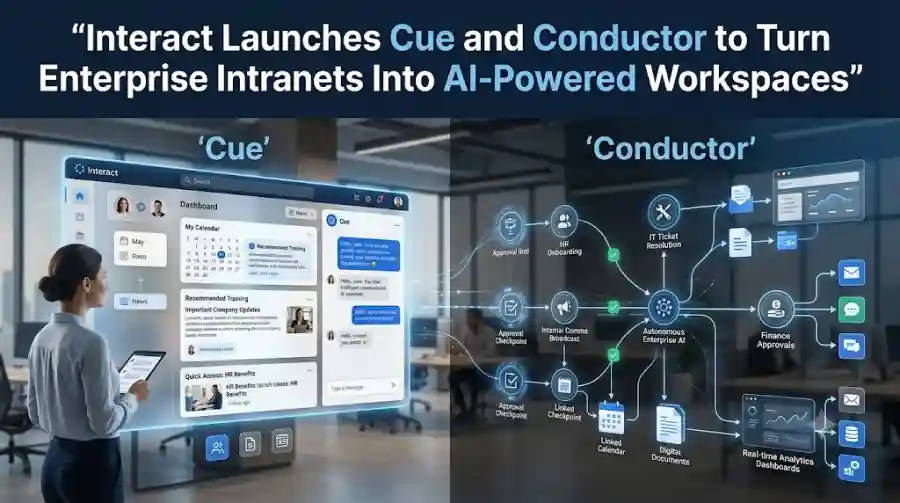
Conductor works on the organizational side. It is an agentic AI engine that can turn high-level goals into plans and coordinated actions across an organization's intranet.
The two products are designed to work together while keeping existing permissions and governance controls in place.
What Is Interact Cue?
Cue is Interact's new adaptive AI intranet experience.
Instead of presenting every employee with the same static homepage, Cue adapts the experience based on information such as:
- Role
- Team
- Location
- Tenure
- Live workplace context
The goal is to make the intranet more relevant to each individual employee.
An employee working in HR, for example, may need a different set of resources and actions than someone working in sales or IT.
Cue is designed to reflect those differences automatically rather than requiring every employee to manually search through the same collection of company information.
Interact describes Cue as a conversational interface through which employees can ask questions, find trusted answers, open relevant tools and resources, and move directly toward the next action.
Cue Goes Beyond AI Search
One of the more important parts of Cue is that it is not positioned simply as an AI search box.
The system combines conversational interaction with the broader intranet experience.
Employees can ask questions and receive answers, but they can also use the system to discover relevant resources and take actions.
Interact says answers remain traceable, actions are previewed, and existing permissions continue to apply.
That is important in an enterprise environment because an AI assistant should not automatically give employees access to information that they were not already authorized to see.
Cue is therefore being designed around the existing access structure of the organization rather than operating as an unrestricted AI layer.
How Cue Personalizes the Employee Experience
Traditional intranets generally rely on a common structure.
Every employee receives the same basic navigation and homepage, even though their responsibilities may be completely different.
Cue takes a different approach.
Its interface can adapt according to workplace context, allowing employees to see information and resources that are more relevant to their role.
For example, an employee could use the conversational interface to find a company policy, locate an internal tool or determine what action they need to take next.
Rather than forcing employees to understand where information is stored, the AI can help connect the question with the relevant company resources.
This is particularly useful in large organizations where internal information can be distributed across multiple departments and systems.
What Is Interact Conductor?
While Cue focuses on employees, Conductor focuses on the teams responsible for running the intranet.
Interact describes Conductor as an agentic AI engine for communications, HR and IT teams.
Instead of manually completing every step of an internal communications campaign or workplace-management task, teams can provide Conductor with a high-level goal.
For example, a team could enter a request such as:
- Launch a new company policy
- Improve employee onboarding
- Clean up outdated content
Conductor can then build a plan around the goal.
According to Interact, the system can draft and target content, coordinate approvals, schedule follow-up activities and measure completion.
Conductor Turns Goals Into Workflows
The most significant difference between Conductor and a conventional AI writing assistant is its focus on coordinated execution.
A typical generative AI tool might help an employee write an announcement.
Conductor is designed to handle the broader workflow surrounding that announcement.
The process can include:
- Understanding the organizational goal.
- Building a plan.
- Drafting the required content.
- Determining the relevant audience.
- Coordinating approvals.
- Scheduling follow-up.
- Measuring completion.
That makes Conductor closer to an AI operations layer for the intranet than a simple content-generation tool.
Interact says teams can review the plan before Conductor takes action, keeping humans involved in the workflow.
Conductor Can Also Audit the Intranet
Content management is another area where Conductor is designed to help.
Interact says the system can:
- Audit content
- Surface gaps
- Manage permissions
- Make bulk changes
This could be useful for organizations with large intranets containing thousands of pages and documents.
Keeping internal information accurate is difficult when content is created by many departments over several years.
An AI system capable of identifying gaps or outdated information could help platform teams spend less time manually reviewing content.
However, organizations would still need appropriate review processes before allowing automated changes to sensitive internal information.
Governance Remains Part of the System
Enterprise AI introduces an important question: how much control should an AI agent have?
Interact's answer with Conductor is to keep review and governance within the workflow.
The company says teams review the plan before Conductor acts.
The system also operates with existing permissions and governance controls.
This matters because Conductor may work across communication, HR and IT functions where mistakes can affect large groups of employees.
An agent that can make bulk changes needs a different control model from an AI chatbot that only generates text.
Interact is therefore positioning Conductor around controlled execution rather than unrestricted automation.
Cue and Conductor Work Together
The two products serve different sides of the same workplace system.
Cue serves the employee.
Conductor serves the organization.
Cue determines what an individual employee needs to know and do.
Conductor helps the organization create and deliver the information, workflows and actions required to make that happen.
Interact describes this combination as organizational intelligence.
The concept is different from using separate AI tools for individual tasks.
Instead, the AI layer becomes part of the company's internal workplace infrastructure.
How This Could Change Internal Communications
Internal communications teams often have to manage repetitive workflows.
A single policy announcement can involve writing the message, identifying the right audience, obtaining approval, scheduling distribution and tracking whether employees received or interacted with it.
Conductor is designed to coordinate these stages.
Meanwhile, Cue can present the resulting information differently to individual employees based on their workplace context.
This creates a potential loop:
Organizational goal → AI planning → Content and targeting → Employee delivery → Employee action → Measurement
The important part is that the two systems are connected rather than operating as isolated AI tools.
Potential HR Use Cases
HR departments could also use the new system for recurring employee workflows.
Employee Onboarding
A company could define onboarding as a broader organizational goal.
Conductor could help organize the content, schedule follow-up and coordinate the required communications.
Cue could then surface the relevant information to each new employee.
Policy Changes
When a company introduces a new policy, different employee groups may need different information.
Conductor can help plan and target the communication, while Cue can provide employees with relevant answers and resources.
Employee Self-Service
Cue's conversational interface could reduce the need for employees to search manually through internal pages.
Instead, employees can ask questions and receive answers tied to trusted company information and their existing access permissions.
Potential IT Use Cases
IT teams can also benefit from an AI-native intranet.
Organizations often use internal portals for software access, technical documentation, support information and security policies.
Cue can provide employees with a conversational route to these resources.
Conductor, meanwhile, can help IT teams manage content, identify gaps and coordinate internal initiatives.
This could reduce some of the repetitive administrative work involved in maintaining a large workplace portal.
Why AI-Native Intranets Are Emerging
The traditional intranet model was built around publishing information.
Employees were expected to navigate menus, search documents and locate the correct page.
Generative AI changes that interaction model.
Instead of asking employees to learn the structure of the organization's information, an AI system can interpret what they are trying to accomplish and connect them with the relevant information or action.
This is one reason enterprise software companies are increasingly embedding AI agents into existing workplace systems.
The AI becomes less of a separate application and more of an interface to company information and workflows.
Cue and Conductor Are Different From a General AI Chatbot
A general-purpose chatbot can answer questions across a broad range of subjects.
Cue is designed around the specific employee and organization.
Its value comes from workplace context, permissions, company information and the tools available through the intranet.
Conductor is even more specialized.
It is designed to execute organizational workflows across the Interact platform rather than simply answering questions.
This specialization could be important for enterprise environments where generic AI assistants do not automatically understand organizational structures or internal governance.
What Businesses Should Know
The launch does not mean every company will immediately replace its existing intranet.
Organizations considering AI-powered employee platforms still need to evaluate information quality, permissions, governance, integrations and human review.
AI-generated answers are only as useful as the information they are based on.
Similarly, automated workflows require clear controls when they involve sensitive HR, IT or communications processes.
Interact's approach attempts to address these issues by keeping existing permissions in place and requiring teams to review Conductor's plans before execution.
Availability
Interact announced Cue and Conductor on September 15, 2026, as part of its AI-native employee experience platform.
The company directs organizations toward its product information and demo process rather than publishing consumer-style pricing for the new capabilities in the launch announcement.
Businesses interested in evaluating the platform can explore the official Interact website and product information.
Final Thoughts
Interact's launch of Cue and Conductor reflects a broader shift in enterprise AI: moving from AI that simply generates content toward AI that can understand workplace context and coordinate actions.
Cue focuses on the employee side of the experience, adapting the intranet to each person's role and providing a conversational way to find information and take action.
Conductor addresses the operational side, turning organizational goals into structured plans involving content, targeting, approvals, scheduling and measurement.
The combination gives Interact an AI architecture with two distinct functions: help employees navigate work and help organizations run the workplace experience.
The company is also emphasizing permissions, traceable answers, previewed actions and human review, which are particularly relevant when AI moves from answering questions to performing enterprise tasks.
If enterprise AI continues moving toward agentic workflows, products such as Cue and Conductor show how that technology can extend beyond coding and customer-service agents into the internal systems employees use every day.
Frequently Asked Questions
What is Interact Cue?
Cue is Interact's adaptive AI intranet experience that personalizes information, tools, content and actions for individual employees based on workplace context.
What is Interact Conductor?
Conductor is an agentic AI engine designed to help communications, HR and IT teams plan and manage intranet workflows using natural-language goals.