K2 Horizon Brings Fully Open AI Models From 0.9B to 375B Parameters for Coding, Reasoning and AI Agents
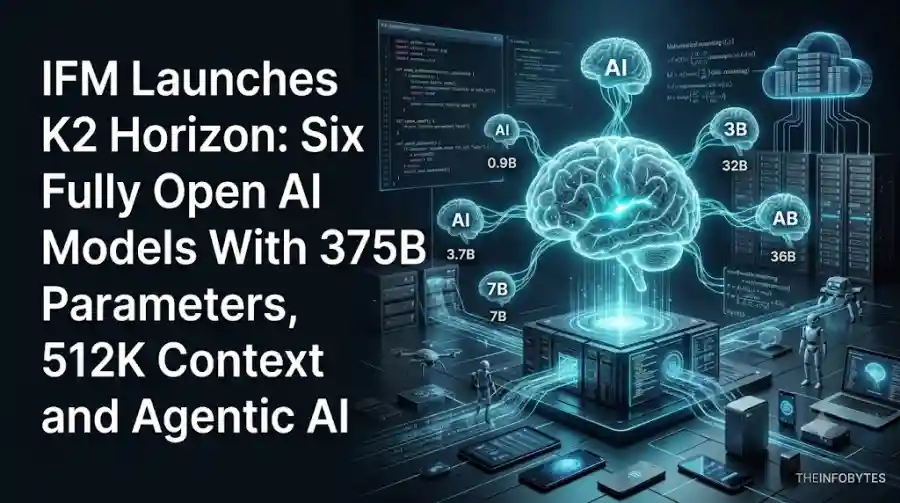
The family ranges from a lightweight 0.9-billion-parameter model designed for highly constrained environments to a 375-billion-parameter sparse Mixture-of-Experts model aimed at advanced reasoning, coding and agentic workloads.
What makes the release particularly interesting is how much of the development process IFM says it is opening.
The organization says K2 Horizon includes model weights, code, training information and methodologies. The models are released under the Apache 2.0 license, while datasets use their applicable licenses.
This makes K2 Horizon different from simply publishing open weights.
IFM is attempting to provide a broader blueprint for developers and researchers who want to understand how the models were created and build on top of them.
What Is K2 Horizon?
K2 Horizon is a connected family of six foundation models created by IFM.
The lineup includes:
- K2 Horizon 375B-A23B
- K2 Horizon MoVA 36B-A4B
- K2 Horizon 32B
- K2 Horizon 7B
- K2 Horizon 3.7B
- K2 Horizon 0.9B
The naming reflects differences in model size and architecture.
The flagship 375B-A23B model is a sparse Mixture-of-Experts system containing 375 billion total parameters while activating about 23 billion parameters per token. It also provides a native context window of 524,288 tokens, or approximately 512K tokens.
Smaller models target very different deployment scenarios.
IFM says the 0.9B model is intended for highly constrained devices such as watches and glasses, while the 3.7B and 7B versions are designed to bring stronger AI capabilities to phones and other on-device environments.
That gives the K2 Horizon family a broad deployment strategy rather than focusing only on cloud-scale inference.
Why the 375B Model Stands Out
The flagship K2 Horizon 375B-A23B is built around a sparse Mixture-of-Experts architecture.
Although the model stores 375 billion parameters, only approximately 23 billion are activated for each token.
This approach can provide access to a very large model while limiting the amount of computation required for each individual token compared with activating the entire parameter set.
The model also supports a 512K context window, making it suitable for workloads involving large amounts of source code, documents, technical information or extended agentic workflows.
IFM says the model is designed for agentic tool use, terminal tasks and long-horizon workflows.
According to the model card, K2 Horizon 375B-A23B achieved a 1,441 Elo score on GDPval-AA, 34.0 on τ³-Banking and 70.2 on Terminal-Bench 2.1. These are IFM-reported evaluation results and should be interpreted within the specific benchmark configurations rather than as universal performance guarantees.
The model is therefore aimed at more than traditional chatbot conversations.
Its target workloads include AI agents and coding systems that need to reason through multiple steps and interact with tools.
K2 Horizon Is More Than an Open-Weights Release
One of the biggest parts of the announcement is IFM's approach to openness.
The organization says it is releasing information across the model development lifecycle, including:
- Model weights
- Training code
- Open architecture
- Training data or detailed data-construction recipes
- Mixture compositions
- Intermediate checkpoints
- Configurations
- Fine-grained logs
- Evaluation results
IFM describes this as a way to make the development process more reproducible and inspectable.
This distinction matters.
An open-weight model allows developers to download and run the final model. A more comprehensive open release can also help researchers understand how capabilities evolved during training.
For academic researchers, that can make it easier to study model behavior.
For developers, it can provide more information when adapting the models to specialized applications.
For companies, it could create another option for organizations that want greater control over their AI infrastructure.
K2 Horizon Targets AI Agents and Coding
Agentic AI is one of the most important areas in the current AI market.
Instead of simply generating an answer, an AI agent can break a task into steps, use tools, interact with software and continue working toward an objective.
That makes model capabilities such as tool use, coding and long-context reasoning increasingly important.
IFM specifically positions K2 Horizon around reasoning, mathematics, coding, general capabilities and agentic tasks.
The flagship model's model card includes support for tool calling and provides deployment guidance for frameworks such as vLLM and SGLang.
This could make K2 Horizon particularly interesting to developers building autonomous coding agents or enterprise workflows.
The broader trend is already visible across the AI market.
For example, TheInfoBytes previously covered Replit's Intelligent Model Routing, which automatically chooses models based on different coding requirements.
K2 Horizon approaches the problem from another direction: rather than automatically selecting between models, developers can directly deploy models from an open family and control more of the underlying infrastructure.
Smaller K2 Horizon Models Could Be Important for Local AI
The largest AI models attract most of the attention, but smaller models could ultimately have a much wider deployment footprint.
A 0.9B or 3.7B model can potentially be used in environments where running a massive cloud model would be impractical.
IFM specifically positions its smallest models for constrained and on-device environments.
This is important as the AI industry moves toward local inference.
Phones, wearables, computers and other edge devices can benefit from models that are smaller, faster and easier to deploy.
The K2 Horizon lineup therefore creates a progression from tiny edge models to large-scale agentic systems.
That could give developers the flexibility to select a model according to available hardware rather than forcing every application onto one giant model.
How K2 Horizon Compares With Other Open AI Models
K2 Horizon enters an increasingly competitive open-model market.
TheInfoBytes recently covered Tencent Hy4 Preview, a much larger 770-billion-parameter open model designed for coding, research, office work and long-context workloads.
K2 Horizon takes a different approach.
Rather than releasing one enormous model, IFM is launching a family covering multiple sizes and deployment scenarios.
This is closer to a model portfolio.
Developers can choose a small model for local applications or move toward larger models for demanding reasoning and agentic workloads.
The strategy also resembles the wider industry movement toward specialized model sizes instead of assuming that one model should handle every task.
K2 Horizon's open licensing and development transparency could become another major differentiator.
How Developers Can Access K2 Horizon
IFM has published the K2 Horizon models through Hugging Face.
The official K2 Horizon collection includes the different model sizes as well as supporting datasets and resources.
The flagship 375B model can be used with Transformers and deployed using tools such as vLLM.
IFM's model documentation also provides SGLang deployment guidance and tool-calling configuration for agentic applications.
The release is therefore not limited to researchers studying the models.
Developers can experiment with the models and integrate them into their own AI infrastructure.
The project also has public development resources through IFM's GitHub organization, including K2 Horizon post-training code.
What K2 Horizon Means for the Open AI Market
K2 Horizon arrives at an important moment for open AI.
The industry is moving toward AI systems that can write code, operate tools, interact with software and perform multi-step tasks.
That increases the value of models that developers can deploy and customize themselves.
The release also highlights another trend: openness is becoming more than downloadable model weights.
Researchers increasingly want access to training data, intermediate checkpoints, evaluation information and training methods.
IFM is attempting to address that demand with K2 Horizon.
The approach could be especially useful for researchers studying how reasoning and agentic capabilities develop during training.
At the same time, the wide range of model sizes gives developers more choices for local and cloud deployment.
K2 Horizon Could Give Developers More Control Over AI
The biggest significance of K2 Horizon may not be the 375-billion-parameter headline.
It is the combination of scale, model variety and openness.
The family provides models ranging from 0.9B to 375B parameters, while the flagship offers a 512K context window and support for agentic workloads.
More importantly, IFM says it is opening significant parts of the model-development lifecycle.
That could make K2 Horizon useful not only as an AI model but also as a research platform.
As companies increasingly evaluate the cost, privacy and control implications of closed AI APIs, fully open models could become more attractive.
K2 Horizon gives developers another option.
Instead of treating AI as a black-box service, they can download models, inspect the available resources, deploy them on supported infrastructure and build their own applications around them.
For the open-source AI ecosystem, that makes K2 Horizon one of the more notable model releases of September 2026.
FAQs
What is K2 Horizon?
K2 Horizon is a family of six AI foundation models launched by the Institute of Foundation Models in September 2026. The models range from 0.9B to 375B parameters and target reasoning, coding, mathematics and agentic AI workloads.
How large is the biggest K2 Horizon model?
The flagship K2 Horizon 375B-A23B contains 375 billion total parameters and activates approximately 23 billion parameters per token. It supports a native context window of 524,288 tokens.