Huawei’s CodeArts Agent Takes Aim at Enterprise AI Coding With Multi-Agent Development and Deep Codebase Understanding
Huawei Cloud announced that CodeArts Agent became commercially available at 23:59:59 GMT+08:00 on August 26, 2026. The company said pricing would remain unchanged from the pre-launch period and that existing users would not be affected.
The launch puts Huawei Cloud into an increasingly competitive AI coding market that already includes platforms such as Cursor, GitHub Copilot, Replit and other agent-based development environments.
However, CodeArts Agent is targeting a somewhat different part of that market.
Huawei is emphasizing enterprise software development, large codebases, multi-agent collaboration, security, governance and integration with existing development workflows.
That makes the platform particularly interesting for companies rather than only individual programmers.
What Is Huawei Cloud CodeArts Agent?
Huawei Cloud CodeArts Agent is an AI-powered coding assistant that combines an integrated development environment with autonomous development capabilities and AI coding models.
According to Huawei's documentation, the platform can generate project code from scratch, complete existing code, answer technical questions and create unit tests. It also uses code slicing and retrieval-augmented generation to retrieve relevant information from projects.
The idea is to move from:
AI suggests code → developer writes the rest
toward:
Developer describes a task → AI understands the project → AI plans and executes development work.
That distinction is becoming increasingly important as coding agents become more capable.
Instead of only generating a function, an agent can work with a broader software project and perform multiple steps.
CodeArts Agent Is Built Around Autonomous Development
Huawei positions CodeArts Agent as more than an AI autocomplete system.
Its platform includes agent capabilities designed to support larger software-development workflows.
These include:
- Code generation
- Code completion
- Technical question answering
- Unit-test generation
- Codebase understanding
- Agent Teams
- Custom agents
- MCP support
- Rules and Skills
- Code review
- Automated fixes
- CLI/TUI workflows
Huawei's product documentation also describes Agent Team capabilities that allow different specialized agents to collaborate on development tasks.
This puts CodeArts Agent firmly inside the growing agentic coding category.
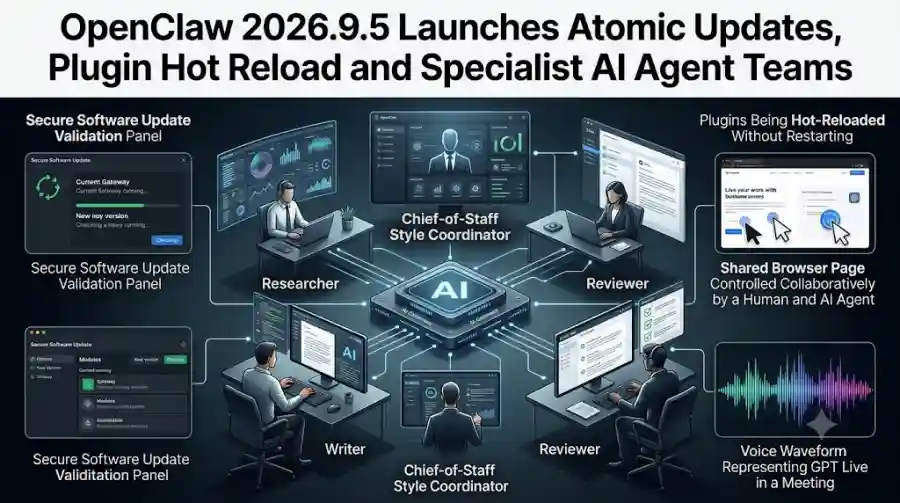
Agent Team Lets Multiple AI Agents Work Together
One of CodeArts Agent's more interesting features is Agent Team.
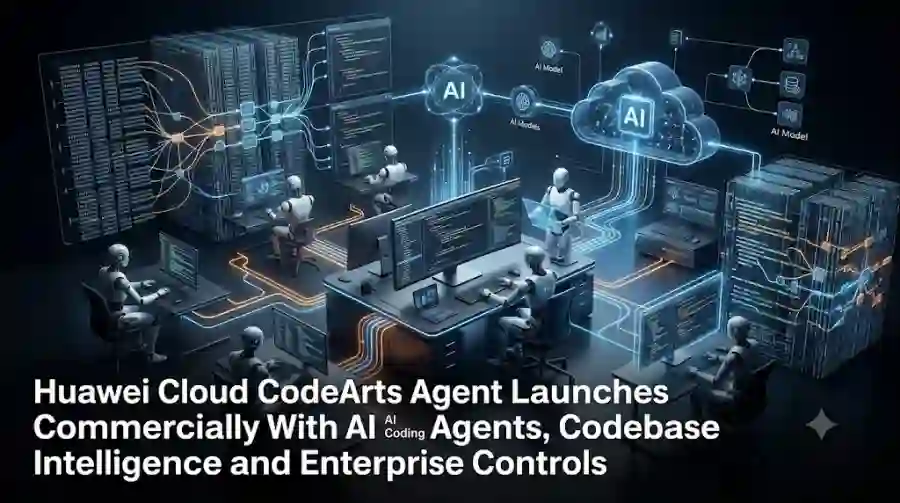
Instead of assigning an entire software project to one AI agent, the platform can divide work among specialized agents.
Huawei describes the system as allowing a main agent to plan and break down tasks before distributing individual jobs to specialized agents.
Those agents can work in parallel while sharing results through collaboration tools.
This approach resembles how human engineering teams work.
A software project may involve different responsibilities:
- Planning
- Coding
- Testing
- Reviewing
- Debugging
- Documentation
A multi-agent system can potentially assign these responsibilities to different AI workers.
The advantage is not simply having more agents.
The important part is task specialization and coordination.
CodeArts Agent Can Understand Large Codebases
Large software projects are one of the biggest challenges for AI coding tools.
Generating a new function is relatively simple.
Understanding how that function interacts with hundreds or thousands of existing files is much harder.
Huawei has built CodeArts Agent around a Codebase system designed to help the AI retrieve relevant information from existing projects.
The company says its system uses semantic retrieval and a combination of vector and graph-based approaches to improve code search and dependency understanding.
Huawei's product information says CodeArts Agent can support up to 100,000 indexed codebase files in its Professional Edition.
That makes codebase intelligence one of the platform's central selling points.
For enterprise developers, this may be more important than raw code-generation benchmarks.
An AI assistant that understands an organization's existing architecture can potentially be much more useful than one that only produces isolated code snippets.
Multi-Platform Development Support
CodeArts Agent is not restricted to one development environment.
Huawei lists several supported product forms, including:
- AI IDE
- CLI/TUI
- JetBrains IDE plugin
- VS Code plugin
This gives developers different ways to access the same AI development capabilities.
The CLI option is particularly relevant for developers who prefer terminal-based workflows.
Huawei's CodeArts Agent CLI documentation shows that developers can provide natural-language instructions directly through the command line and have the agent generate structured project code.
That makes the tool suitable for developers who do not want to spend their entire workflow inside a graphical AI IDE.
CodeArts Agent Also Supports Custom Agents
Another important enterprise feature is the ability to create custom agents.
Huawei says developers can configure prompts, skills and tool sets to create dedicated assistants for specific development scenarios.
Custom agents can be created for different scopes, including:
- Enterprise
- Team
- Project
- Individual developer
They can also be implemented as local or cloud agents.
This could allow companies to build AI agents around their own development standards.
For example, an organization could create an agent specifically for:
- Security reviews
- Internal coding standards
- Test generation
- Documentation
- Code migration
- API development
- Architecture checks
This is a major difference between a generic coding chatbot and an enterprise development platform.
Huawei Is Adding Enterprise Governance
Enterprise customers generally need more than coding intelligence.
They also need control.
CodeArts Agent includes administrative features for managing members, subscriptions, usage and model configuration.
Huawei's enterprise console provides tools for permission management, usage analysis and model policy management.
The Professional Edition also includes features such as:
- Operation logs
- Model management
- Enterprise custom models
- Usage management
- SSO
- Larger codebase limits
These features are designed for organizations that need to monitor how employees use AI rather than simply giving every developer an unrestricted AI chatbot.
CodeArts Agent Pricing
Huawei currently lists several CodeArts Agent plans.
Its international product page lists:
Basic Edition: $20 per seat per month
Professional Edition: $60 per seat per month
The Chinese product page lists corresponding local pricing of:
Basic Edition: ¥39 per seat per month
Professional Edition: ¥139 per seat per month
Pricing and included token quotas can vary by market and product configuration, so organizations should check the relevant Huawei Cloud region before purchasing.
Huawei also lists a free Experience Edition in its Chinese product interface.
The Experience Edition provides limited agent capabilities and monthly token allocation, making it possible for users to test the platform before moving to a paid package.
What Does the Free Experience Include?
Huawei's current product page lists the Experience Edition at ¥0.
It includes:
- 5 million tokens per month
- 500 MB knowledge space
- 5,000 Codebase indexed files
- Basic Agent capabilities
- Q&A
- Coding
- MCP
- Rules
- Skills
The plan supports up to 50 seats according to Huawei's current product information.
This could make the free tier useful for evaluation, although enterprise users should check regional eligibility and account requirements.
Huawei's English documentation also indicates that CodeArts Agent usage can require a Huawei Cloud account and specific account configuration depending on the product form.
Huawei Is Adding Its Own Coding Models
CodeArts Agent is not simply a front end for third-party AI models.
Huawei has been expanding the model options available inside the platform.
Its August product changelog says CodeArts added OpenPangu-2.0-Flash and OpenPangu-2.0-Pro as built-in Pangu models.
This gives Huawei another strategic advantage.
The company can combine:
AI models + coding agents + cloud infrastructure + developer tools
inside one ecosystem.
That is becoming an increasingly common strategy across the AI industry.
CodeArts Agent Also Supports MCP
Model Context Protocol, or MCP, has become an important part of modern AI agent development.
CodeArts Agent includes MCP capabilities as part of its agent functionality. Huawei's current product documentation lists MCP among the supported capabilities across its plans.
MCP allows AI systems to connect with external tools and information sources through standardized interfaces.
For coding agents, this can make it easier to connect AI workflows with development tools and project resources.
It also expands what an agent can potentially do beyond simply generating text.
Security Is a Major Part of Huawei's Enterprise Strategy
Enterprise AI coding introduces security concerns.
An AI agent may have access to source code, project files, internal documentation and development systems.
CodeArts Agent therefore emphasizes security controls.
Huawei says the platform uses zero-trust architecture, controlled access permissions, local data storage and encrypted transmission.
It also describes network sandbox isolation and behavior detection for agents.
The platform also includes mechanisms intended to make AI-agent activity more traceable.
These features are particularly relevant to organizations considering autonomous coding systems for internal projects.
How CodeArts Agent Differs From Cursor
Cursor is currently one of the best-known AI coding platforms.
However, CodeArts Agent approaches the market with a stronger enterprise-management focus.
Cursor has built a highly popular AI-native coding environment around multiple AI models and autonomous coding.
Huawei is emphasizing:
- Enterprise administration
- Large-codebase indexing
- Custom agents
- Multi-agent teams
- Model management
- SSO
- Usage controls
- Enterprise knowledge
- Huawei-specific development
The products therefore overlap but are not identical.
For individual developers, the choice may depend heavily on workflow and preferred models.
For large organizations, governance and integration can become equally important as coding quality.
Why the Launch Matters
Huawei's commercial CodeArts Agent launch is another sign that AI coding is becoming an enterprise software category rather than simply a developer productivity feature.
Companies are increasingly looking for AI systems that can:
- Understand existing software
- Follow internal rules
- Work across large repositories
- Generate and test code
- Review changes
- Fix problems
- Coordinate multiple agents
- Maintain security controls
- Track AI usage
CodeArts Agent is designed around many of those requirements.
That makes its commercial launch strategically important even if it is less well known among Western individual developers than platforms such as Cursor.
What Happens Next for AI Coding?
The competition is increasingly moving from basic code generation to autonomous software engineering.
The next generation of coding tools will likely compete on several layers:
Model intelligence
How well can the underlying model reason about software?
Agent capability
Can the AI plan and execute multiple steps?
Context management
Can it understand a large existing project?
Tool use
Can it interact with development systems?
Collaboration
Can multiple agents work together?
Governance
Can enterprises control what the AI can access?
Cost
Can organizations afford to run agents at scale?
Huawei's CodeArts Agent launch addresses nearly all of these areas.
That is why the platform deserves attention beyond the Huawei ecosystem.
Who Should Consider Huawei CodeArts Agent?
CodeArts Agent is particularly relevant for:
- Enterprise development teams
- Large software projects
- Huawei Cloud customers
- Developers working with large codebases
- Organizations interested in AI agents
- Teams requiring centralized AI governance
- Companies using VS Code or JetBrains
- Developers interested in multi-agent coding
Individual developers can also test the platform, but its strongest differentiation appears to be enterprise-oriented development.
Huawei Cloud's commercial launch of CodeArts Agent adds another serious competitor to the rapidly expanding AI coding market.
The platform combines autonomous coding agents, large-codebase understanding, Agent Teams, custom agents, MCP, enterprise model management and security controls.
Its strongest selling point may not be simply generating code faster.
Huawei is trying to build an environment where AI agents can participate in the complete software-development process.
The platform became commercially available on August 26, 2026, and Huawei continues to expand its coding models and agent capabilities.
For developers, the growing competition is good news.
More serious coding-agent platforms mean more choices, more specialized capabilities and greater pressure on vendors to improve reliability, cost and developer experience.
CodeArts Agent shows that the AI coding race is no longer limited to a handful of Western AI companies.
Cloud providers and enterprise technology companies are increasingly building their own complete AI development stacks.
FAQs
What is Huawei Cloud CodeArts Agent?
Huawei Cloud CodeArts Agent is an AI-powered coding platform that combines an IDE, autonomous development agents and AI coding models to help developers build, understand, test and maintain software.
When did Huawei CodeArts Agent launch commercially?
Huawei Cloud announced that CodeArts Agent became commercially available on August 26, 2026.