Google Expands Lyria 3.5 to Gemini With More Expressive Vocals, Richer Music and Flexible Track Lengths
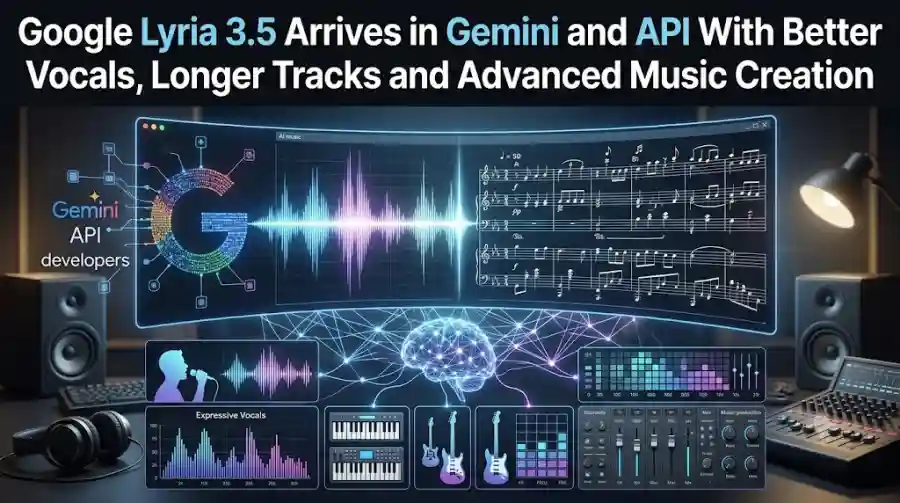
On September 4, 2026, Google announced that Lyria 3.5 is now available in the Gemini app and Gemini API, giving both everyday users and developers access to its newest music-generation capabilities.
The expansion is important because Lyria 3.5 is no longer limited to a specialized music-creation environment.
Users can now create music directly inside Gemini, while developers can build applications around the model through Google's AI development ecosystem.
Google says Lyria 3.5 improves musicality, vocals and audio quality while giving users more control over genre, vocal or instrumental styles and track length.
The update also gives creators more practical ways to use AI-generated music.
A user could create background music for a video, generate a personalized birthday song, experiment with different genres or produce a short brand jingle.
For developers, the API opens another possibility: building custom AI music applications rather than using music generation only through Google's own interface.
What Is Lyria 3.5?
Lyria 3.5 is Google's latest music-generation model from Google DeepMind.
It is designed to generate high-quality music from text instructions.
Google's model documentation describes Lyria 3.5 as a system capable of synthesizing music from text prompts, with audio and lyrics as outputs. The model uses a latent-diffusion architecture applied to temporal audio latents.
The model is focused on several parts of music generation:
- Musical structure
- Vocal quality
- Lyrics
- Audio fidelity
- Prompt adherence
- Genre control
- Track duration
- Creative direction
That makes it more than a simple background-music generator.
The system is designed to give users control over the characteristics of a generated track while allowing the model to handle the complex musical arrangement.
Lyria 3.5 Is Now Available in Gemini
The biggest consumer-facing change is its arrival inside Gemini.
Google says Lyria 3.5 is available to users globally through the Gemini app on both web and mobile.
Users can describe the type of music they want instead of working with a traditional digital audio workstation.
For example, someone could request a cinematic instrumental track for a video.
Another user could ask for a birthday song with vocals.
A content creator could generate a backing track for a social-media video.
The system is designed to turn these natural-language instructions into music.
This lowers the technical barrier for people who do not have formal music-production experience.
Users Can Choose Genres and Vocal Styles
One of the more useful additions in the Gemini experience is greater control over the type of music being created.
Google says users can select or describe their preferred genre and choose between vocal and instrumental styles.
That means the creation process can start with a simple idea and become more specific through prompting.
For example, a creator could request:
An upbeat electronic pop track with expressive female vocals and a strong chorus.
The user could then experiment with different musical directions.
This makes prompting an important part of the Lyria workflow.
Instead of manually selecting instruments, adjusting effects and arranging individual sections, users can describe the desired result and let the AI handle the underlying production.
Lyria 3.5 Supports Different Track Lengths
Another important improvement is flexibility around output length.
Google says Gemini users can now choose between shorter and longer tracks.
This matters because not every music-generation task requires a full song.
A short clip may be enough for a social-media post.
A longer composition could work better as background music for a video.
A personalized song may require a more complete structure.
Google DeepMind's Lyria page says the broader Lyria family can create cohesive tracks of up to three minutes and supports control over the duration of generated music.
That gives creators more flexibility than systems designed around one fixed output length.
Lyria 3.5 Improves AI Vocals
AI-generated vocals remain one of the hardest areas of synthetic music.
A generated song can have a good melody but still sound artificial if the vocals lack expression, timing or natural pronunciation.
Google says Lyria 3.5 brings improvements in vocal quality and musicality. Its earlier Flow Music launch highlighted more expressive and emotionally nuanced vocals, improved pronunciation and stronger control over tempo and duration.
The September expansion therefore gives more users access to those improvements.
For creators, better vocals can make generated music more useful for songs rather than limiting AI music to instrumental background tracks.
This could be particularly relevant for:
- Social-media creators
- Video producers
- Independent musicians
- Advertising teams
- Game developers
- Podcasters
- Small businesses
Lyria 3.5 Is Also Available Through the Gemini API
The developer side of the announcement could be even more important over time.
Google has made Lyria 3.5 available through the Gemini API, allowing developers to build music-generation functionality into their own applications.
This changes the role of Lyria from a standalone creative tool into an AI infrastructure component.
Developers could potentially build applications that automatically generate music based on other inputs.
For example, an application could create background music based on:
- A video
- A written story
- A game scene
- A marketing brief
- A mood description
- A visual concept
The exact application depends on how developers integrate the API.
But the underlying idea is significant: AI music generation can become part of another software product instead of remaining inside one chatbot.
Developers Can Experiment Through Google AI Studio
Google says Lyria 3.5 is also available to developers and technologists through Google AI Studio.
That provides an easier starting point for developers who want to experiment before building a complete application.
Google AI Studio can serve as a testing environment for Google's generative AI capabilities.
For developers interested in music generation, this can make it easier to understand how prompts affect generated audio before integrating the model into a production workflow.
It also means Lyria can reach developers who may not be professional musicians.
A programmer building a video application, for example, may be able to add automated soundtrack generation without becoming an audio engineer.
Lyria 3.5 Can Also Work With Images
One particularly interesting capability of Google's Lyria family is the connection between visual content and music.
Google DeepMind says users can upload an image and ask Lyria to transform it into a custom high-fidelity track.
This opens the door to a different style of AI-assisted creativity.
Instead of starting with a text description, the image itself can become the creative reference.
A filmmaker could provide a scene.
A game developer could provide concept art.
A photographer could upload an image and generate music matching its atmosphere.
The system can then turn the visual idea into an audio interpretation.
This is part of the larger movement toward multimodal AI, where one type of media becomes the input for another.
Google Is Targeting More Than Musicians
Lyria 3.5 is not designed only for professional musicians.
Google's examples include practical everyday uses such as custom birthday tracks, background music and brand jingles.
That broadens its potential audience.
Content Creators
YouTube creators and social-media publishers often need background music.
AI generation can provide a faster way to create tracks tailored to specific video concepts.
Small Businesses
A small business may need a short audio identity or advertising jingle without commissioning a traditional production.
Podcasters
Podcasters can use music for intros, transitions and background sections.
Game Developers
Indie developers can potentially use generative music during prototyping and development.
Personal Projects
Users can create personalized songs for birthdays, celebrations and other events.
The common factor is customization.
Traditional stock music libraries provide large catalogs, but creators still need to find a track that fits their specific requirements.
Generative music attempts to reverse that process.
Instead of searching for the right track, users describe the track they want.
Lyria 3.5 Competes in a Growing AI Music Market
The AI music market has become increasingly competitive.
Several companies are developing systems that can generate songs, instrumental tracks and vocals from text prompts.
Google's advantage is its ability to connect Lyria with a much larger ecosystem.
Lyria 3.5 can now sit alongside:
- Gemini
- Google AI Studio
- Gemini API
- Google Flow Music
- Google Vids
Google's broader AI ecosystem can therefore provide multiple entry points for the same underlying music-generation technology.
That could be important for adoption.
A user does not necessarily need to discover a separate AI music website.
They can encounter music generation directly inside a product they already use.
Lyria 3.5 and the Rise of Multimodal AI
The expansion also shows how AI products are becoming less specialized.
Earlier AI systems were often divided into categories.
One tool generated text.
Another generated images.
Another generated audio.
Another generated video.
That separation is gradually becoming less important.
Modern AI platforms increasingly combine multiple forms of generation.
Google's Gemini ecosystem is moving in this direction.
Users can work with text, images, audio and other forms of media through interconnected AI experiences.
Lyria 3.5 is an example of that strategy.
Music generation becomes another capability inside a broader AI assistant and developer platform.
AI Music Generation Still Has Important Limitations
Despite the improvements, users should not treat AI-generated music as identical to human-produced recordings.
Generated tracks can still contain unusual musical decisions, inconsistent structures or artifacts.
The quality can also depend heavily on the prompt.
A vague instruction may produce a generic result.
A detailed prompt describing genre, instrumentation, tempo, mood and vocals can provide more direction.
There are also important questions around copyright, artist rights and responsible AI-generated music.
Google says Lyria's generated audio includes SynthID, an imperceptible watermark intended to help identify AI-generated or AI-edited content.
That type of provenance technology could become increasingly important as AI-generated music becomes harder to distinguish from traditionally produced audio.
Google Is Adding More Control to AI Music
The main trend behind Lyria 3.5 is not simply better audio quality.
It is greater creative control.
Users can influence:
- Genre
- Vocal or instrumental output
- Lyrics
- Musical style
- Tempo
- Track duration
- Arrangement
- Creative direction
That is important because early generative music systems often worked like simple prompt-to-audio engines.
The more control users receive, the closer the technology moves toward an AI-assisted music-production workflow.
The goal is not necessarily to replace every traditional production tool.
Instead, AI can handle some of the time-consuming work while the creator decides what the final result should sound like.
What Lyria 3.5 Means for AI Music Developers
For developers, the API availability is perhaps the most important part of the announcement.
A music model inside a consumer application is useful.
A music model that developers can program around can become infrastructure.
This creates opportunities for new types of software.
Imagine a video editor that automatically generates a soundtrack based on the video's pacing.
Or a game engine that creates temporary music for a scene.
Or an education application that turns a lesson into a personalized song.
Or a marketing platform that creates multiple audio variations for different campaigns.
These are examples of what developers could build around generative music technology.
The actual capabilities will depend on Google's API documentation, access conditions and implementation details.
Lyria 3.5 Is Another Step Toward AI-Native Creative Software
The September 4 expansion shows Google's broader strategy for generative media.
Instead of treating AI music as an isolated experiment, Google is putting Lyria 3.5 into products and developer platforms where users can actually use it.
The model is now available in Gemini, the Gemini API and Google AI Studio, while Google also supports Lyria through creative products such as Flow Music.
That makes the technology more accessible to both consumers and developers.
For creators, the biggest benefit is speed.
A musical idea that previously required a musician, producer or extensive software work can now begin with a natural-language prompt.
For developers, the opportunity is even broader.
Lyria 3.5 can become one component inside an application that combines text, images, video and audio.
Google's expansion of Lyria 3.5 into Gemini and the Gemini API is an important development for AI music generation.
The model brings improved vocals, richer musical arrangements and greater control over the generated output. Google has also added flexible track-length options and made the technology available to developers through its API and AI Studio.
The biggest change is accessibility.
Users no longer need to enter a specialized music-generation workflow to experiment with Lyria.
They can start directly inside Gemini.
At the same time, developers can use the API to build entirely new applications around AI-generated music.
As generative AI expands from text and images into increasingly sophisticated audio and video workflows, Lyria 3.5 shows where the next generation of creative software could be heading: AI that does not simply answer prompts, but helps turn ideas into finished creative media.
FAQs
What is Google Lyria 3.5?
Lyria 3.5 is Google's latest AI music-generation model from Google DeepMind. It generates music from text instructions and provides improvements in musicality, vocals, lyrics and audio fidelity.
Is Lyria 3.5 available in Gemini?
Yes. Google announced on September 4, 2026 that Lyria 3.5 is available in the Gemini app globally on web and mobile.