Google Gemini 3.8 Live Brings Real-Time Voice Agents, Visual Understanding and Background AI Tasks to Developers
Google describes Gemini 3.8 Live as a model designed for scale and cost efficiency, combining conversational intelligence, fluid dialogue and visual grounding. The Extended Thinking version is aimed at more complex tasks that require deeper, multi-step reasoning.
For developers, both models are available through the Gemini API and Google AI Studio, giving them a new foundation for building real-time voice applications and production-oriented voice agents.
What Is Gemini 3.8 Live?
Gemini 3.8 Live is Google's latest native speech-to-speech model for interactive AI applications.
Unlike a conventional voice interface that primarily converts speech into text, sends it to a language model and then converts the response back into speech, Google's Live models are designed around direct, continuous voice interaction.
The goal is to reduce the feeling of waiting between individual stages of an AI conversation.
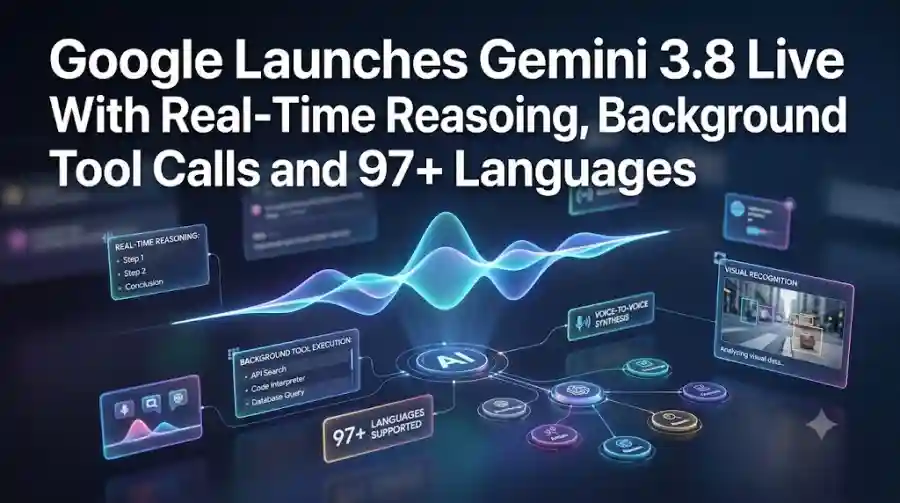
Google says Gemini 3.8 Live can reason and execute tasks while maintaining the flow of dialogue. That means an agent can acknowledge a request, perform work through tools or APIs and continue communicating with the user while the task happens in the background.
This architecture is particularly relevant for customer-service agents, assistants, onboarding systems, interactive applications and other products where interruptions can make voice interaction feel unnatural.
Gemini 3.8 Live Extended Thinking Adds Deeper Reasoning
Google is launching two related models rather than treating every voice interaction the same way.
Gemini 3.8 Live
The standard Gemini 3.8 Live model is designed around fast, natural conversations and efficient deployment at scale.
Google says it combines:
- Conversational intelligence
- Fluid real-time dialogue
- Visual grounding
- Background tool execution
- Multilingual interaction
- Support for complex voice-agent workflows
The model is intended for situations where responsiveness and continuous conversation are important.
Gemini 3.8 Live Extended Thinking
The Extended Thinking version is aimed at tasks where the AI needs more reasoning before completing an action.
Google says the model can reason and speak simultaneously. It can provide early verbal cues while working through a complex request and continue narrating progress as background tasks are completed.
This could be useful for multi-step workflows where users do not want to wait silently while an AI agent processes information.
Google reports that Gemini 3.8 Live Extended Thinking achieved a score of 82.6 on Artificial Analysis' Speech to Speech Quality Index and reported results on several agentic and reasoning benchmarks. These figures are Google's cited benchmark results and should be understood in the context of the specific tests and evaluation setups.
AI Agents Can Call Tools Without Stopping the Conversation
One of the most important capabilities in the new models is asynchronous function calling.
Google says Gemini 3.8 Live can execute API and tool calls in the background while continuing to stream audio responses.
That changes the interaction pattern for voice agents.
A traditional voice assistant may need to stop speaking while it waits for an external service to return information.
With background execution, an agent can continue communicating while the external operation takes place.
For example, a voice agent could potentially:
- Receive a spoken request.
- Understand the user's intent.
- Call an external API.
- Continue the conversation.
- Receive the tool result.
- Incorporate that information into its response.
This approach could be useful for customer support, reservations, business workflows, technical assistance and other applications where AI needs access to external systems.
Google specifically positions the models as building blocks for production-ready voice agents.
Gemini 3.8 Live Can Understand Visual Context
Gemini 3.8 Live is not limited to hearing what the user says.
Google says the model can process visual inputs in near real time and use that information to enrich conversations.
This creates possibilities for AI systems that can understand both what a person is saying and what they are showing.
A user could, for example, point a camera toward an object, interface or physical situation and discuss it verbally with the AI.
Google demonstrates use cases including real-time employee onboarding and interactive gameplay involving visual context. The company also shows Gemini 3.8 Live working with visual information while maintaining a natural conversational flow.
This combination of audio and visual understanding could be particularly useful for support applications where users need to show rather than describe a problem.
Support for 97+ Languages
Google is also targeting international voice applications.
The developer announcement says Gemini 3.8 Live and Gemini 3.8 Live Extended Thinking support 97+ languages, with accent consistency designed to help developers build applications for global audiences.
The models can also automatically detect and transition between supported languages during a conversation.
That matters for voice applications because real-world conversations are not always limited to one language.
A customer could switch languages during a support interaction, while an international employee could communicate with an AI assistant without having to manually select a different language every time.
For developers building voice products for multiple markets, multilingual support can therefore reduce some of the complexity involved in creating separate experiences for different regions.
Gemini 3.8 Live Can Handle Precise Spoken Information
Another developer-focused capability is what Google calls alphanumeric precision.
The models are designed to accurately process information such as confirmation codes, claim numbers and technical data.
This is particularly relevant for business voice agents.
Voice AI is useful for conversational tasks, but small transcription mistakes can become serious problems when users are communicating identifiers, codes or technical information.
Improved handling of these details could make voice agents more practical for areas such as customer support, insurance, account services and technical operations.
Developers Can Access Gemini 3.8 Live Through the Gemini API
Google is making the new models available through its developer ecosystem.
Gemini 3.8 Live and Gemini 3.8 Live Extended Thinking are available through the Gemini API and Google AI Studio. Google says the models are also rolling out through enterprise offerings and consumer-facing Gemini experiences.
For developers, this means Gemini 3.8 Live is not simply a demonstration of future voice technology.
It is being positioned as an API-level model that can be incorporated into applications.
Google also highlights integrations with platforms and companies including Agora, Fishjam, LangChain, LiveKit, Pipecat, Vercel and Vision Agents. These platforms can handle parts of the real-time media infrastructure needed by voice applications.
Developers can therefore focus more heavily on the agent's behavior and application logic rather than building every part of the real-time audio infrastructure themselves.
Gemini 3.8 Live Pricing
Google's developer announcement lists Gemini 3.8 Live and Gemini 3.8 Live Extended Thinking at $0.005 per minute for audio input and $0.018 per minute for audio output through the Live API.
That pricing structure is particularly relevant for developers evaluating voice agents because audio applications can generate substantial usage volume.
The actual cost of running a complete application will still depend on the amount of audio processed, output generated, tool usage and other services involved in the application's architecture.
Developers should therefore check Google's current API documentation and pricing before deploying a production application.
Google Gemini API documentation
Gemini 3.8 Live vs Gemini 3.5 Transcribe
Google's new Live models also complement its recently released Gemini 3.5 Transcribe, rather than replacing it.
Gemini 3.5 Transcribe is designed specifically for speech-to-text transcription, while Gemini 3.8 Live is designed for interactive speech-to-speech experiences.
Google says Gemini 3.5 Transcribe supports more than 85 languages and is optimized for high-precision transcription.
For developers, this distinction is important.
A transcription application may need a specialized speech-to-text model, while a conversational voice agent may require a model capable of maintaining dialogue, reasoning and performing actions.
TheInfoBytes has already covered Google's Gemini 3.5 Transcribe launch, making the two stories useful companion pieces rather than duplicate coverage.
Gemini 3.5 Transcribe: Google's AI Speech-to-Text Model
Google Is Moving Voice AI From Conversation Toward Action
The bigger development behind Gemini 3.8 Live is the shift from voice assistants that simply answer questions toward voice agents that can actually perform work.
The difference is significant.
A traditional voice assistant might answer:
“Your request has been received.”
An agentic voice system could potentially receive the request, call an external service, process information and return with the result while maintaining the conversation.
Gemini 3.8 Live is designed around this second model.
The combination of continuous dialogue, visual understanding, reasoning and background tool execution gives developers more pieces needed to build voice-first agents.
Google's own examples include employee onboarding, complex task completion, multi-step bookings, business planning and interactive applications.
What Gemini 3.8 Live Means for AI Developers
For developers, the most important part of this release is not simply that Gemini can speak more naturally.
The more significant change is the integration of voice, reasoning, visual input and actions into one real-time workflow.
That can reduce the need for developers to build complicated cascaded systems in which separate models handle speech recognition, reasoning, tool execution and speech generation.
Google specifically describes its new Live models as a more streamlined alternative to cascaded architectures.
That could make advanced voice applications easier to prototype and deploy.
The challenge will be reliability.
Voice agents that can call tools and perform actions need strong safeguards around permissions, authentication, data access and error handling. Natural conversation alone is not enough for production deployment.
What Comes Next for Gemini Voice Agents?
Gemini 3.8 Live shows Google's increasing focus on AI systems that operate continuously rather than waiting for isolated prompts.
The model can listen, process visual information, reason, call tools and continue talking with the user.
For developers, the combination of API access, Google AI Studio support, multilingual capabilities and background function calling makes the release particularly relevant to the growing voice-agent market.
Google is also extending the technology into its own products. The company says Gemini 3.8 Live is rolling out in Search Live, while the Extended Thinking model is being integrated into Gemini Live and selected Google Workspace experiences.
The release therefore represents both a new developer platform capability and another step in Google's broader effort to make Gemini a more action-oriented AI system.
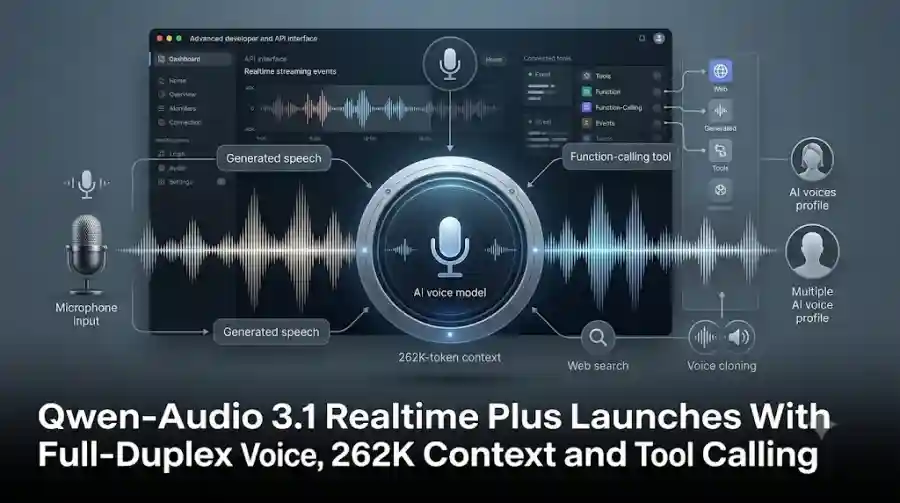
Google Gemini 3.8 Live and Gemini 3.8 Live Extended Thinking mark a significant new stage in Google's voice AI development.
The models are designed not only to hold conversations but also to reason through complex requests, understand visual context, call external tools and continue communicating while those tasks are being completed.
For developers, the combination of Gemini API access, Google AI Studio, 97+ language support and real-time tool execution makes the release especially relevant to voice-agent development.
The biggest change is that voice AI is becoming less about simply answering a spoken question and more about understanding a goal and helping complete it while the conversation continues.
As more AI platforms move in this direction, the quality of voice agents will increasingly depend not just on how naturally they speak, but on how reliably they can understand context, use tools and complete real-world tasks.
Frequently Asked Questions
What is Gemini 3.8 Live?
Gemini 3.8 Live is Google's new native speech-to-speech AI model designed for real-time conversations, visual understanding and voice-agent workflows.
What is Gemini 3.8 Live Extended Thinking?
It is a higher-reasoning version designed for complex, multi-step tasks. Google says it can reason in the background while continuing the conversation.