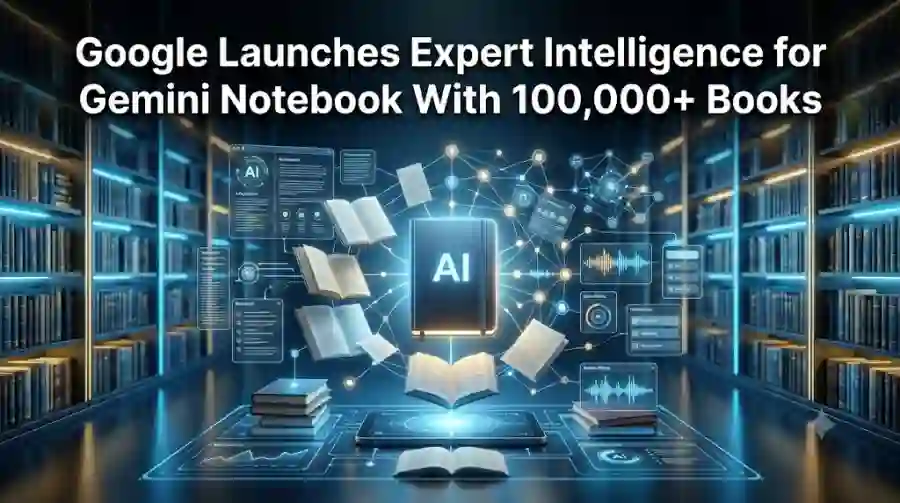
Gemini Notebook Can Now Turn Purchased Google Play Books Into Interactive AI Knowledge Sources
Google says Expert Intelligence launched with more than 100,000 books from publishers including Penguin Random House, Macmillan Publishers, Bloomsbury, O'Reilly Media, Johns Hopkins University Press and De Gruyter Brill.
Google also worked with more than 15 bestselling authors to create special Featured Notebooks that combine their books with additional materials.
The feature is particularly interesting because it tackles two important AI trends at once: using artificial intelligence with trusted source material and finding ways for AI products to work with copyrighted content while respecting access controls.
For students, professionals, researchers and regular readers, it could also turn books from static reading material into interactive AI knowledge sources.
What Is Google Expert Intelligence?
Expert Intelligence is a new initiative designed to bring information from trusted authors, publishers and professional sources into Google's AI products.
Gemini Notebook is the first product receiving the feature.
Eligible books purchased through Google Play Books can now be added as notebook sources. Gemini Notebook can then answer questions using the content of those books.
Google describes the system as a way to engage directly with knowledge from sources users trust rather than relying only on general AI knowledge.
This distinction matters.
A normal AI chatbot may answer a question using information learned during model training or gathered from other sources.
With Expert Intelligence, users can deliberately tell Gemini Notebook to work from a specific book they own.
That can create a more focused research or learning experience.
What Can You Do With a Book in Gemini Notebook?
Adding a supported book does more than make its text searchable.
Google says users can use Gemini Notebook's existing content-generation capabilities with eligible books.
That includes creating:
- Infographics
- Audio Overviews
- Quizzes
- Study materials
- Explanations
- Question-and-answer sessions
- Personalized analyses
Users can also combine a book with other notebook sources.
This is potentially one of the most useful aspects of the feature.
Instead of treating a book as an isolated source, Gemini Notebook can compare it with notes, documents or other material that the user adds.
Google provides several examples.
A manager could combine workplace information with advice from a business-management book to think through difficult employee conversations.
Someone could combine personal information with an expert-authored book to understand how its lessons might apply to their situation.
A user could even add visual information and ask Gemini Notebook to combine it with ideas from an eligible book.
The important point is that Expert Intelligence is intended to make books usable inside broader AI workflows.
More Than 100,000 Books Are Supported at Launch
Google says Expert Intelligence begins with more than 100,000 books.
Participating publishers include:
- Bloomsbury
- De Gruyter Brill
- Johns Hopkins University Press
- Macmillan Publishers
- O'Reilly Media
- Penguin Random House
Independent coverage from The Verge and Publishers Weekly also confirmed the large launch catalogue.
The catalogue does not mean every Google Play Books title automatically works with Expert Intelligence.
Google specifically refers to select ebooks.
Users therefore need to check whether an individual title supports the feature.
Google says an eligible title will show Gemini Notebook when the user opens the "Tools" option on the book's Google Play Books page.
You Must Own the Book
One of the most important rules is that users cannot simply gain AI-powered access to books they have not purchased.
Google says a person must own an eligible book through Google Play Books before interacting with it through Gemini Notebook.
This remains true when notebooks are shared.
Suppose one person buys an eligible book, adds it to Gemini Notebook and then shares that notebook with another person.
The second person does not automatically receive access to the book.
Google says collaborators who want to interact with the source will be asked to purchase their own copy. Otherwise, the book remains unavailable to them inside the notebook.
That is a meaningful difference from simply uploading a copied ebook file into an AI tool.
Google is tying access to legitimate ownership through its Play Books ecosystem.
Why Publishers May Care About Expert Intelligence
Generative AI and publishing have had a difficult relationship.
Authors and publishers have repeatedly raised questions about how books are used by AI companies and whether copyrighted works are being handled appropriately.
Expert Intelligence follows a different model.
Instead of giving users unrestricted access to book content through AI, Google has built ownership requirements directly into the experience.
Publishers Weekly reported that publishers have responded positively to this approach because the interaction remains tied to purchased titles and publisher participation.
Google says it developed the system in consultation with authors and publishers.
For publishers, there is also a potential commercial benefit.
An AI feature that encourages users to purchase a book before accessing its interactive capabilities could create another discovery and sales channel.
Google itself says it believes Expert Intelligence can help users discover content and allow authors to reach more engaged readers.
Featured Notebooks Add Extra Author Material
Google is not limiting the launch to ordinary book imports.
The company has worked with more than 15 bestselling authors to create Featured Notebooks.
These can supplement a book with additional sources and interactive materials selected in collaboration with the author.
Google named authors including Steven Pinker, Michael Pollan and Jennifer Wallace among its launch partners.
This could make Expert Intelligence more than a simple "chat with a book" feature.
A Featured Notebook could potentially provide a structured learning environment around an author's work, combining the original title with additional context.
That creates an interesting new format between traditional ebooks, AI tutors and digital courses.
How to Use Expert Intelligence in Gemini Notebook
Google's Play Books interface provides two main ways to get started.
First, users can open an eligible book's Google Play Books page.
If the title supports Expert Intelligence, the Tools section should include Gemini Notebook.
Users can then add that book to a notebook.
Another option is to open Gemini Notebook, choose Add Source, and select Google Play Books.
Google's Play Books page for the feature says users can then select eligible books from their library.
A basic workflow would look like this:
- Purchase or locate an eligible book in Google Play Books.
- Open Gemini Notebook.
- Select Add Source.
- Choose Google Play Books.
- Add the supported title.
- Ask questions about the book.
- Generate learning materials such as quizzes, infographics or Audio Overviews.
- Combine the book with other relevant notebook sources when useful.
Availability can depend on whether a particular title participates in the program.
Why Students Could Benefit
Education is one of the clearest potential use cases.
Instead of reading a book and then separately creating study material, a student could use Gemini Notebook to generate questions, explanations and review materials directly from a supported title.
For example, a student could ask:
- Explain this chapter in simpler language.
- Create a quiz from these concepts.
- Compare two ideas discussed in this book.
- Make an Audio Overview for revision.
- Build an infographic showing the main arguments.
- Find sections related to a specific topic.
Because the answers are grounded in the selected book, this may also help reduce the problem of AI answering from unrelated material.
Students would still need to verify important information and read the original source rather than treating an AI summary as a replacement for the book.
But the feature could make revision and comprehension more interactive.
Why Professionals and Researchers May Use It
Expert Intelligence could also be useful outside education.
Professionals often buy books containing frameworks, industry knowledge or technical guidance.
Instead of trying to remember where a particular concept appeared, they could question the book through Gemini Notebook.
O'Reilly Media's involvement is particularly notable because its catalogue includes large amounts of technical and professional material.
Users could potentially combine book sources with their own project documents or notes.
For example, a developer might combine a technical book with project documentation.
A manager could combine a leadership book with personal notes.
A researcher could compare ideas from several supported sources.
The usefulness will depend heavily on the quality and relevance of the books users already own.
Google Plans to Expand Beyond Books
Books are only the beginning of Expert Intelligence.
Google says it plans to eventually bring Expert Intelligence-enabled content into additional products, including the Gemini app and AI Mode in Google Search.
The company also says future sources are expected to include:
- Third-party subscriptions
- Business research reports
- Textbooks
- Additional expert content
This could become much more significant than the initial Play Books integration.
Imagine an AI assistant capable of working with a combination of legitimately licensed books, paid research reports, professional subscriptions and personal documents.
Instead of relying only on the general knowledge inside an AI model, users could assemble their own collection of trusted expertise.
That appears to be the larger direction behind Expert Intelligence.
Expert Intelligence vs Regular Gemini Answers
The important difference is source control.
A regular Gemini conversation can draw on the model's broader knowledge and available information.
Expert Intelligence allows the user to intentionally bring a particular trusted source into the AI workflow.
That means the user knows which book or expert material is contributing to the answer.
Gemini Notebook is already designed around source-grounded research, and Expert Intelligence expands the kinds of professionally published sources users can add.
For tasks where credibility matters, this model could be more useful than simply asking a general chatbot.
Could This Change How People Read Books?
Possibly, although Expert Intelligence is unlikely to replace traditional reading.
The system could instead change what happens after someone buys a book.
Today, a book is largely static.
Readers move through the pages, highlight useful sections and perhaps make notes.
With AI integration, that same book can become interactive.
Readers can question it, convert concepts into different formats and connect its ideas with their own information.
The result could be closer to having an AI study partner that understands the specific source being read.
Whether users prefer that experience will depend on the type of book and the purpose of reading.
It may be highly useful for business, education, research and technical titles while being less important for books read mainly for entertainment.
What Expert Intelligence Means for the AI Industry
The broader AI industry has spent years focusing on larger models and larger training datasets.
Expert Intelligence points toward another direction: giving users better control over the information an AI system should trust for a particular task.
That could become increasingly important as people demand more reliable and traceable AI answers.
The future AI assistant may not simply know a huge amount of general information.
It may also be able to connect securely to information the user owns, subscribes to or chooses to trust.
Google's decision to begin with purchased books makes Expert Intelligence a useful test of that idea.
It also provides a possible model for collaboration between AI companies, publishers and creators.
Is Expert Intelligence Available in India?
Google's launch announcement explains how supported books can be identified through Google Play Books, but it does not announce universal availability for every book, country or account.
Users in India should therefore check their own Google Play Books account and look for the Gemini Notebook option under the Tools section of an eligible title rather than assuming every book is supported.
Google's separate launch promotion offering a free eligible ebook is specifically described as a U.S. promotion.
Google Expert Intelligence is one of the more practical Gemini Notebook updates because it solves a clear problem.
People already buy books containing valuable expert knowledge, but applying that information to real situations can take time.
Expert Intelligence allows eligible books to become active AI sources inside Gemini Notebook.
Users can ask questions, create quizzes, generate infographics, produce Audio Overviews and combine ideas from books with their own information.
The launch starts with more than 100,000 titles and publisher-backed ownership controls, while Google plans to expand the same concept to other premium and professional information sources.
If the approach works, the bigger story may not simply be that Gemini can "chat with books."
It could be the beginning of AI assistants built around information that users deliberately own and trust.
FAQs
What is Google Expert Intelligence?
Expert Intelligence is a new Google initiative that lets users bring trusted professional and published content into Google AI products. It initially launches through eligible Google Play Books titles inside Gemini Notebook.
How many books work with Expert Intelligence?
Google says more than 100,000 books are available at launch from publishers including Penguin Random House, Macmillan, O'Reilly Media, Bloomsbury, Johns Hopkins University Press and De Gruyter Brill.