Google Cloud and Accenture Create New AI Business Group to Help Companies Deploy Agentic AI at Scale
The biggest challenge for many companies is no longer getting access to powerful AI models. The harder problem is putting those models into real business workflows and proving that they deliver measurable value.
Google Cloud and Accenture are now targeting that problem directly.
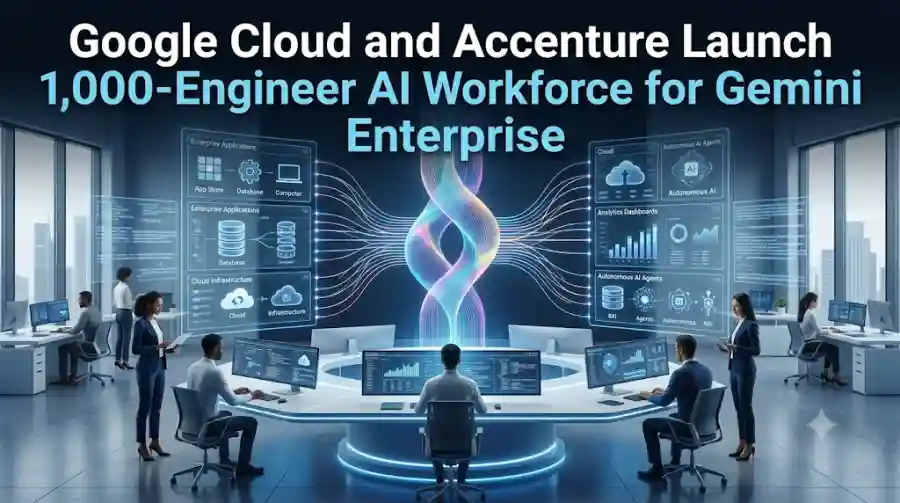
On September 8, 2026, the two companies announced the Accenture Gemini Enterprise Business Group, a new global initiative designed to help organizations scale Google's Gemini Enterprise platform and agentic AI applications.
The centerpiece of the initiative is a planned workforce of 1,000 forward-deployed engineers, or FDEs, who will work closely with enterprise customers on AI implementation.
The move is significant because it shows that the AI industry is increasingly competing not only on models and infrastructure, but also on the ability to actually deploy AI inside businesses.
What Is the Accenture Gemini Enterprise Business Group?
The Accenture Gemini Enterprise Business Group is a new joint initiative between Accenture and Google Cloud.
Its purpose is to help companies move from experimenting with AI to deploying it across real business operations.
The group combines several resources, including:
- Accenture's Gemini Enterprise-certified professionals
- Forward-deployed engineers
- Google Cloud engineering expertise
- Accenture's industry specialists
- AI and data capabilities
- Industry-specific implementation frameworks
Accenture says the initiative will operate across the Gemini Enterprise portfolio and focus on helping organizations create measurable business value from agentic AI and data investments.
This is different from simply selling companies access to an AI platform.
The two companies are also providing people and implementation expertise to help businesses actually build with it.
1,000 Forward-Deployed Engineers Will Work With Enterprises
The most important part of the announcement is the planned 1,000-person forward-deployed engineer workforce.
Forward-deployed engineers are specialists who work closely with customers rather than operating entirely from a company's internal development environment.
The idea is simple.
Instead of giving a business an AI platform and asking its employees to figure everything out themselves, engineers work directly with the organization to identify useful applications, integrate data and redesign workflows.
Accenture says the new group builds on its existing base of nearly 50,000 Google Cloud-skilled professionals.
The company and Google Cloud will expand Gemini Enterprise training and certification as part of the initiative.
This could give enterprises access to a much larger pool of people who understand both the technology and the business processes required to deploy it.
Why Enterprises Need AI Deployment Engineers
AI adoption sounds easy when viewed from the outside.
A company can choose an AI model, connect some data and start testing applications.
Real deployments are much harder.
Large companies often have:
- Legacy software
- Multiple databases
- Complex security policies
- Different departments
- Regulatory requirements
- Existing cloud infrastructure
- Data scattered across systems
- Employees with different technical skills
- Business processes that cannot simply be replaced
An AI agent may be technically capable of performing a task, but that does not mean an organization can safely deploy it.
The AI needs to understand the company's data, permissions, workflows and objectives.
This is one reason Google Cloud and Accenture are putting such a strong focus on implementation.
Four Main Priorities of the New AI Group
Accenture says the Gemini Enterprise Business Group will focus on four major areas.
Increasing Gemini Enterprise Adoption
The first goal is helping more organizations adopt Gemini Enterprise.
The group will use proprietary accelerators and implementation frameworks designed specifically for Gemini Enterprise deployments.
The objective is to reduce the amount of time companies spend moving from an AI experiment to a working production system.
Building Industry-Specific AI Solutions
The second priority is developing repeatable solutions for different industries.
A bank does not have the same AI requirements as a retailer.
A healthcare company has different compliance requirements from a manufacturing business.
Industry-specific solutions can reduce the amount of custom work required for every new deployment.
Instead of starting from zero, companies can potentially use frameworks designed around their particular sector.
Moving From Experiments to Enterprise Deployment
The third focus is addressing the gap between AI experimentation and large-scale transformation.
Many organizations have already tested generative AI.
The problem is turning those experiments into systems that employees actually use.
The new group will establish dedicated capability centers intended to help companies scale AI beyond individual pilot projects.
Increasing Employee Adoption
The fourth priority is helping organizations actually use the AI capabilities they build.
A technically successful AI deployment can still fail if employees do not understand how to use it or do not trust the system.
This makes training, workflow redesign and adoption important parts of enterprise AI.
Gemini Enterprise Is Becoming More Than a Chatbot
Google's strategy around Gemini Enterprise is increasingly focused on agents.
The platform is designed to help organizations build and deploy AI agents that can interact with enterprise information and workflows.
That is an important difference from conventional chatbot deployment.
A chatbot might answer:
"How many customers did we acquire last month?"
An agentic system could potentially retrieve the relevant information, analyze it, prepare a report and perform another authorized action based on the result.
That requires much deeper integration with company systems.
Google Cloud's broader Gemini Enterprise strategy includes agent development, orchestration and governance capabilities designed for this type of environment.
The Accenture partnership gives Google another mechanism for helping businesses implement those capabilities.
YouTube Is Already Using the Technology
The announcement includes an interesting example involving YouTube.
According to Accenture and Google Cloud, YouTube worked with the companies to deploy a Gemini Enterprise agent for periods of increased customer-support demand during NFL Sunday Ticket.
The companies say the deployment increased customer sentiment by 11% while reducing average handle time by 37%.
These figures come from the companies involved, so they should be viewed as reported customer results rather than independently verified benchmarks.
Nevertheless, the example demonstrates the type of enterprise problem Google and Accenture are targeting.
The objective is not simply to create an impressive AI demo.
It is to connect AI with a measurable business outcome.
The Bigger Competition Is Now AI Deployment
The announcement also highlights a major change in the enterprise AI market.
AI companies increasingly understand that model quality alone is not enough.
A business might have access to an extremely capable model but still struggle to deploy it.
This has created a new competitive area around:
- AI consulting
- Agent deployment
- Data integration
- Workflow automation
- AI governance
- Security
- Employee adoption
- Industry-specific applications
Google Cloud and Accenture are positioning their new group directly in this market.
TechCrunch described the initiative as part of a broader race involving forward-deployed engineers, with major AI companies and cloud providers increasingly investing in enterprise implementation.
The implication is important.
The next major AI business opportunity may not simply be selling access to models.
It may be helping organizations redesign their businesses around those models.
Why Forward-Deployed Engineers Matter for Agentic AI
Agentic AI creates a different implementation challenge from traditional software.
A conventional application generally follows predefined rules.
An AI agent can reason, select tools and make decisions based on context.
That creates additional questions.
What Can the Agent Access?
Organizations need to determine which databases, applications and documents an agent can use.
What Can the Agent Change?
Reading information is different from modifying records or triggering business processes.
What Requires Approval?
High-impact actions may need human authorization.
How Is the Agent Monitored?
Companies need visibility into what agents are doing and why.
How Does the Agent Fit Existing Workflows?
Even a powerful AI system has limited value if it creates more work for employees.
Forward-deployed engineers can help organizations address these issues during implementation rather than after a system has already been deployed.
The Initiative Could Make Gemini More Attractive to Businesses
Google faces strong competition in enterprise AI.
Businesses can choose from systems built around OpenAI, Anthropic, Microsoft, Google and other providers.
This means AI platforms need to compete on more than model capabilities.
Implementation support can become a major differentiator.
Accenture already has a large enterprise consulting footprint and extensive experience working with major organizations.
Combining that reach with Google's AI infrastructure gives the Gemini ecosystem another route into large-scale enterprise deployments.
Accenture says the two companies have already worked together through their Generative and Agentic AI Center of Excellence and Gemini Enterprise Acceleration Program.
The new group expands that existing relationship into a larger dedicated business operation.
What This Means for AI Developers
For developers, the announcement is another signal that enterprise AI is moving toward agent-based applications.
The most valuable AI systems may increasingly combine:
- Large language models
- Enterprise databases
- APIs
- Business applications
- Internal knowledge
- Security controls
- Human approvals
- Automated workflows
This is very different from simply adding a chatbot to a website.
Developers building enterprise AI products will increasingly need to understand system integration and agent orchestration alongside prompt engineering and model selection.
TheInfoBytes has already covered this broader transition through tools such as Salesforce Headless 360 and Zoho Catalyst 3.0, which connect AI agents with enterprise applications and development infrastructure.
Salesforce Headless 360 and AI Agents
Zoho Catalyst 3.0 and AI Coding Agents
What This Means for Businesses
For businesses considering AI adoption, the announcement carries an important lesson.
Buying an AI subscription is only the beginning.
Companies need to identify where AI can create measurable value.
That could involve:
- Customer support
- Software development
- Marketing
- Sales
- Finance
- Supply chain
- Research
- Internal knowledge management
- Document processing
- IT operations
The next step is connecting AI to the systems employees already use.
This is where enterprise AI implementation becomes much more complicated than consumer AI.
The Google Cloud and Accenture model is designed around that exact challenge.
Could AI Consulting Become a Major Market?
The rise of agentic AI could create a large new market for AI implementation services.
Companies may eventually need specialized teams to:
- Identify suitable AI workflows.
- Prepare enterprise data.
- Connect AI agents to internal systems.
- Create security and governance policies.
- Test agent behavior.
- Train employees.
- Monitor production systems.
- Measure business results.
This could make AI engineering and AI transformation consulting increasingly important.
The 1,000-engineer target announced by Accenture and Google Cloud is therefore more than a staffing number.
It represents a bet that enterprises will need substantial human expertise to successfully enter the agentic AI era.
How This Connects With the Wider AI Agent Trend
The industry is moving rapidly toward autonomous software.
BharatPe recently launched an agentic AI assistant designed to take action across more than 60 live systems for merchants.
BharatPe Agentic AI for Merchants
Enterprise platforms are following a similar direction.
Salesforce is expanding access to AI agents across business applications.
Zoho is giving coding agents access to application infrastructure.
Operant is developing security controls designed specifically around AI-agent intent.
These developments point toward the same destination:
AI is becoming an operational layer rather than simply a conversational layer.
What Happens Next?
The immediate test for Google Cloud and Accenture will be execution.
Creating a 1,000-person workforce is significant, but the real measure of success will be the business results those teams deliver.
Enterprises will want to know:
- How quickly can an AI agent be deployed?
- How much can it reduce operational costs?
- Can employees actually use it?
- How safely can it operate?
- Can it work with legacy systems?
- Can its decisions be audited?
- Can the investment produce measurable ROI?
If the partnership can consistently answer those questions, it could strengthen Google's position in the enterprise AI market.
Google Cloud and Accenture's new Gemini Enterprise Business Group is an important sign that the AI industry is entering an implementation race.
The companies are creating a planned 1,000-person forward-deployed engineering workforce to help businesses build and scale Gemini Enterprise and agentic AI solutions.
The announcement also shows why enterprise AI is different from consumer AI.
Businesses do not simply need smarter models.
They need AI that can connect to data, understand workflows, operate safely, integrate with existing software and deliver measurable results.
That is where the new Google Cloud and Accenture partnership is positioning itself.
As AI agents become more capable, the companies that can successfully move those agents from demonstrations into everyday business operations could gain a major advantage.
For Google Cloud, this partnership is a way to put more implementation expertise behind Gemini Enterprise.
For Accenture, it expands its position in one of the fastest-growing areas of enterprise technology.
And for businesses, it signals that the next stage of AI adoption will be less about asking “Which AI model should we buy?” and more about asking “How do we redesign our business around AI?”
FAQs
What is the Accenture Gemini Enterprise Business Group?
It is a new global initiative launched by Accenture and Google Cloud to help enterprises deploy and scale Gemini Enterprise and agentic AI solutions.
How many AI engineers will the initiative have?
Accenture and Google Cloud plan to establish a workforce of 1,000 forward-deployed engineers.