Gnani Artha Brings an Indian-Language AI Model and Enterprise Agents to Sovereign AI
The announcement is significant because Gnani Artha is designed around a problem that is becoming increasingly important for organizations in India: how to use advanced AI while keeping sensitive information under their own control.
Instead of requiring companies to send all enterprise data to an external AI service, Gnani says Artha can be deployed within an organization's own infrastructure.
That makes the platform particularly relevant to industries such as banking, insurance, healthcare, telecommunications and government.
What Is Gnani Artha?
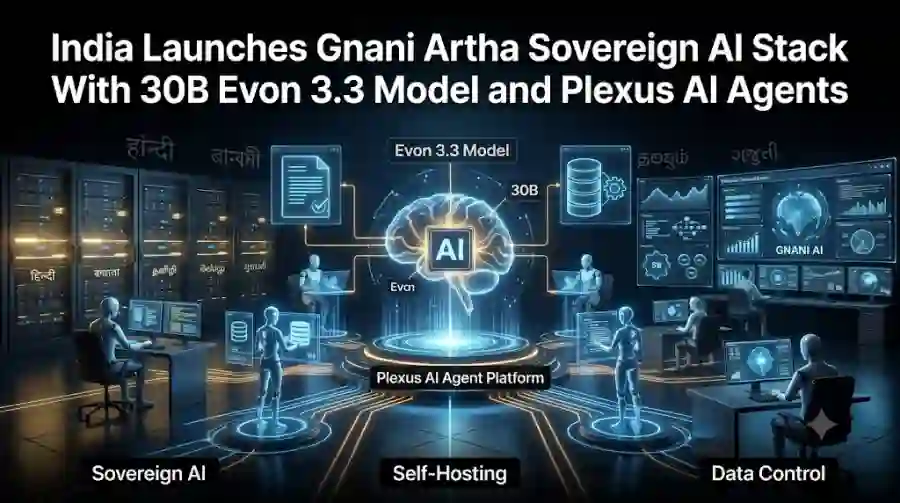
Gnani Artha is a sovereign AI stack developed by GNANI AI.
Rather than being just another chatbot, the platform combines an AI language model with an enterprise agent system.
The two core components are:
- Evon 3.3 — the language and reasoning model
- Plexus — the agentic AI platform
The Indian government describes Evon 3.3 as a large language model and Plexus as a platform that connects AI intelligence with real-world work and institutions.
The combination is designed to move AI from simply answering questions toward performing useful organizational tasks.
That distinction is becoming increasingly important as businesses move from traditional chatbots toward AI agents.
Evon 3.3 Is a 30-Billion-Parameter Model
At the center of Gnani Artha is Evon 3.3, an open-weights model with 30 billion total parameters.
However, it uses a Mixture-of-Experts architecture in which approximately 3.5 billion parameters are active for each token.
This architecture is intended to reduce the amount of computation required compared with activating the entire model for every request.
The model is designed specifically around Indian-language understanding.
According to the model information published by GNANI AI on Hugging Face, Evon 3.3 supports:
- English
- Hindi
- Bengali
- Telugu
- Tamil
- Marathi
- Gujarati
- Kannada
- Malayalam
- Odia
- Punjabi
The model also supports a context length of up to 128K tokens.
This makes the model particularly interesting for applications that need to process long documents or communicate with users in multiple Indian languages.
Evon 3.3 Was Built for Indic Languages
One of the biggest differences between Evon 3.3 and many global AI models is its focus on Indic-language capability.
GNANI AI says the model was trained and optimized specifically for native-script understanding across Indian languages.
The company says its training process included continued pre-training, supervised fine-tuning and reinforcement learning.
The Economic Times reported that GNANI used more than 2 trillion tokens across 11 Indian languages and English during the development process.
This focus matters because Indian-language AI has challenges that are not always visible in English-language benchmarks.
Indian languages can require different tokenization strategies, and inefficient tokenization can increase inference costs.
GNANI says it redesigned the tokenizer for Indic languages to improve efficiency.
The company claims that Evon can use approximately 20% fewer tokens per Indian-language word than GPT-5-family tokenization in its comparison. This is a company claim and should be treated as such rather than as an independently verified industry result.
What Can Evon 3.3 Do?
Evon 3.3 is designed as a general-purpose language and reasoning model rather than a single-purpose chatbot.
The model documentation lists intended applications including:
- Multilingual chat
- AI assistants
- Retrieval-augmented generation
- Long-context applications
- Tool calling
- AI agents
- Code reasoning
- Mathematical reasoning
- Instruction following
The model's Hugging Face release also lists support for OpenAI-compatible message formats and deployment through tools such as Transformers, vLLM and SGLang.
This means developers can potentially use Evon as a foundation for their own applications rather than relying only on a hosted chatbot.
Evon 3.3 Is Available as Open Weights
Another important part of the release is accessibility.
GNANI AI has published Evon 3.3 through Hugging Face.
The current model repository lists the model under an Apache 2.0 license and provides instructions for running it using common machine-learning frameworks.
Developers can access the model repository here:
Gnani Evon v3.3 on Hugging Face
However, access to the model files currently requires users to agree to share contact information with the model publisher on Hugging Face.
That is an important practical detail for developers considering local deployment.
Plexus Turns the Model Into an AI Workforce
Evon 3.3 is only one part of Gnani Artha.
The second component is Plexus, GNANI AI's enterprise agentic platform.
The basic idea is simple:
A language model provides intelligence.
An agent platform connects that intelligence to actions.
GNANI describes Plexus as an enterprise-grade platform for building, orchestrating and deploying autonomous AI agents that can work with organizational systems, documents and workflows.
This gives Gnani Artha a broader purpose than simply offering another open-weight LLM.
The platform is intended to turn model capabilities into actual enterprise workflows.
What Could Plexus Agents Do?
GNANI's Artha platform is designed for organizations that want to create specialized AI agents.
Potential enterprise workflows include:
- Document processing
- Information retrieval
- Database interaction
- Business workflow automation
- Customer support
- Internal knowledge systems
- Data analysis
- Verification workflows
The platform is also designed around governance and auditing.
GNANI says Plexus can connect AI intelligence to real-world institutional workflows while maintaining controlled enterprise deployment.
That makes it closer to an enterprise AI orchestration layer than a standard chatbot.
Why Sovereign AI Matters for India
The term sovereign AI is becoming increasingly important.
Organizations often handle information that cannot easily be transferred to an external AI provider.
This can include:
- Banking records
- Insurance information
- Healthcare data
- Government documents
- Customer information
- Internal corporate documents
- Financial information
Using external AI APIs can create questions around data residency, privacy, security and regulatory compliance.
Gnani Artha is designed to address this by allowing organizations to run AI within their own infrastructure.
GNANI's product information says Artha can be deployed inside an organization's data center or virtual private cloud, with customer data remaining inside the organization's network.
For Indian institutions, this could make sovereign deployment an important alternative to relying entirely on foreign-hosted AI systems.
The Platform Targets Banks, Insurers and Government
Gnani Artha is not primarily being marketed as a consumer chatbot.
Its target customers include organizations that need strong control over sensitive information.
The Economic Times reported that the stack is aimed at Indian companies and public institutions, particularly sectors such as banking, insurance and government where data-location and regulatory requirements can be important.
This is also why the platform emphasizes enterprise deployment rather than only model benchmarks.
For an enterprise customer, questions such as:
Where does my data go?
Can I run the model myself?
Can I control the agents?
Can I audit what the AI does?
can be just as important as:
How intelligent is the model?
Gnani Artha Is Designed for Self-Hosted AI
One of the most interesting aspects of the platform is its deployment strategy.
Instead of requiring organizations to use a fully hosted AI service, Artha is designed for deployment inside private infrastructure.
That can provide greater control over:
- Data
- Model access
- Security
- Network connectivity
- AI workloads
- Enterprise integrations
The official GNANI Artha page says the stack can run inside an organization's own infrastructure or VPC.
For companies with strict data-security requirements, this could be a major advantage.
How Efficient Is Evon 3.3?
The model's 30B parameter count may initially sound large.
But its MoE architecture activates only about 3.5B parameters per token.
This means the model does not need to perform the full 30B-parameter computation for every token.
GNANI says this design helps reduce compute requirements while maintaining strong reasoning and language capabilities.
The model's Hugging Face documentation identifies the architecture as a hybrid Mamba2-Transformer Mixture of Experts model.
That combination is technically interesting because it attempts to balance long-context capability with efficient inference.
What Does Evon 3.3 Score on Indic Benchmarks?
GNANI has published benchmark results comparing Evon 3.3 with other Indic-focused models.
On the company's published MILU results, Evon 3.3 records a macro score of 78.74, compared with 67.15 for Sarvam-30B and 75.71 for Sarvam-105B in the listed comparison.
GNANI says the model leads Sarvam-30B across all 11 languages in its MILU comparison and exceeds Sarvam-105B on 10 of the 11 languages.
These are publisher-reported benchmark results, not independent verification.
As with any model benchmark, developers should test Evon on their own workloads before choosing it for production.
The model's own documentation also warns users to evaluate it for their target languages and domains and not use it for high-stakes decisions without appropriate human oversight.
Why the Open-Weights Approach Matters
Open-weight AI models give organizations more flexibility than closed hosted systems.
Developers can potentially:
- Run models on their own hardware
- Customize deployments
- Build specialized applications
- Integrate models into private systems
- Evaluate model behavior
- Fine-tune models for specific use cases
That flexibility is especially relevant to organizations that cannot send sensitive information to an external AI provider.
Evon 3.3's Apache 2.0 listing makes it particularly interesting to developers exploring self-hosted Indic-language AI.
However, running a 30B model still requires significant computing resources.
The model documentation lists NVIDIA H100, H200 and A100 hardware among supported configurations.
So "open weights" does not mean the model is inexpensive to operate for every individual developer.
How Gnani Artha Fits India's AI Strategy
The launch also fits into India's broader push toward domestic AI capability.
The Vice President's office described Gnani Artha as an example of India's growing ability to build advanced AI technologies rather than simply consume them.
That makes the project relevant beyond GNANI itself.
India has a large multilingual population, major enterprise technology sector and growing demand for AI systems that can work across regional languages.
A model optimized for these requirements could become useful in areas where generic global models are less efficient or less customized.
Is Gnani Artha a ChatGPT Alternative?
It would be misleading to describe Gnani Artha as a direct ChatGPT replacement.
ChatGPT is a consumer-facing AI product with a broad set of features, applications and interfaces.
Gnani Artha is primarily an enterprise sovereign AI stack.
Its focus is on:
- Self-hosted AI
- Indic languages
- Enterprise agents
- Private infrastructure
- Data sovereignty
- Custom workflows
- Open-weight model deployment
Developers should therefore think of Artha more as infrastructure for building AI systems than as another general-purpose chatbot.
Who Should Consider Evon 3.3?
Evon 3.3 could be particularly interesting for:
- Indian-language AI developers
- Enterprise AI teams
- Government technology teams
- RAG developers
- AI-agent developers
- Organizations requiring self-hosted AI
- Researchers studying Indic-language models
- Developers building multilingual applications
It may be less suitable for users who simply want a ready-to-use consumer chatbot.
The model requires technical infrastructure and appropriate deployment knowledge.
What Happens Next for Gnani Artha?
The most important question now is whether developers and enterprises adopt the platform.
The model is already available through Hugging Face, giving researchers and developers a way to inspect and experiment with the open-weight model.
GNANI is also positioning Plexus as the layer that turns the model into enterprise AI agents.
Future development will likely focus on:
- Better agentic capabilities
- Tool calling
- Enterprise integrations
- Indic-language reasoning
- Long-context workflows
- Deployment efficiency
- More AI agents
- Enterprise adoption
The model documentation itself says tool use and agentic capabilities remain an active area of development.
Gnani Artha is an important new addition to India's rapidly developing AI ecosystem.
The stack combines Evon 3.3, a 30-billion-parameter open-weight model focused on English and 10 Indic languages, with Plexus, an enterprise agent platform designed to connect AI intelligence with real-world workflows.
Its strongest differentiator is not simply model size.
It is the combination of:
Indic-language optimization + open weights + self-hosted deployment + enterprise AI agents.
That combination could be valuable for organizations that need advanced AI while maintaining control over their data and infrastructure.
The launch also shows that India's AI competition is expanding beyond consumer chatbots.
The next stage may be about building AI systems that understand local languages, operate inside private infrastructure and actually perform business tasks.
Gnani Artha is attempting to bring all three elements together.
FAQs
What is Gnani Artha?
Gnani Artha is a sovereign AI stack developed by GNANI AI that combines the Evon 3.3 language model with the Plexus agentic AI platform for enterprise and institutional use.
What is Evon 3.3?
Evon 3.3 is a 30-billion-parameter open-weight language model developed by GNANI AI with a focus on English and 10 Indic languages. It uses a hybrid Mamba-Transformer Mixture-of-Experts architecture.