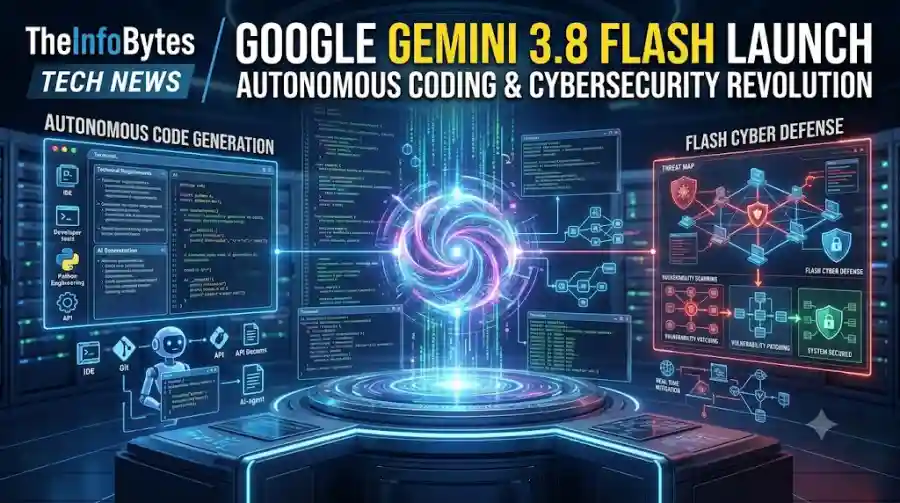
Gemini 3.8 Flash Arrives With Major Coding Upgrades and a New Cybersecurity Model
The new model was announced on September 2, 2026, only about three weeks after Gemini 3.7 Flash. Google says Gemini 3.8 Flash is its most intelligent Flash model yet and is designed to deliver stronger performance without giving up the speed and relatively low cost that make the Flash series attractive to developers.
Google also introduced a second model called Gemini 3.8 Flash Cyber.
While the standard model targets general AI workloads, coding and agentic tasks, Flash Cyber is specifically designed for cybersecurity. Google says it focuses on vulnerability discovery and automated patching and is being provided to trusted defenders through its new Fairwind Program.
The launch is important because Google's strategy is becoming increasingly focused on AI systems that can do more than answer questions.
Gemini 3.8 Flash is designed to reason through longer tasks, use tools repeatedly and work on software projects with less human intervention.
What Is Gemini 3.8 Flash?
Gemini 3.8 Flash is the latest iteration of Google's Flash model family.
The Flash series is designed to provide a balance between intelligence, speed and cost.
Google says the new 3.8 version improves performance across:
- Software engineering
- Autonomous AI agents
- Multi-step reasoning
- Professional workflows
- Enterprise applications
- Specialized knowledge tasks
Google describes it as a “workhorse” model rather than a model designed for only one particular task.
That distinction is important.
A model designed for general-purpose agentic work needs to handle many different tasks during the same workflow.
For example, an AI coding agent may need to understand a request, inspect a project, modify several files, run tests, analyze errors and then make additional changes.
Gemini 3.8 Flash is designed around this type of long-running workflow.
Gemini 3.8 Flash Is Built for AI Agents
One of the biggest improvements is Google's focus on agentic workflows.
Traditional chatbots generally follow a simple pattern:
User asks → AI responds
An AI agent operates differently.
It can:
Understand task → Plan → Use tools → Inspect results → Reason → Continue → Complete task
Gemini 3.8 Flash is designed to work effectively inside this second type of workflow.
Google says the model uses long-running agentic loops that allow it to recursively evaluate and refine its work.
This matters because AI agents increasingly need to operate for longer periods.
A simple question might require one response.
A software-development task could require dozens of decisions.
The model therefore needs to maintain context, evaluate intermediate results and decide what to do next.
Gemini 3.8 Flash is specifically designed for that kind of workload.
Gemini 3.8 Flash Improves AI Coding
Software development is one of the main areas Google is targeting.
Google says Gemini 3.8 Flash delivers substantial improvements over Gemini 3.7 Flash in software engineering.
The company tested the model on DeepSWE v1.1, a benchmark focused on long-horizon software engineering tasks.
According to Google, Gemini 3.8 Flash outperformed most larger frontier models tested on that benchmark while operating at a lower cost.
The significance goes beyond benchmark scores.
Modern AI coding increasingly involves complete development tasks rather than simple autocomplete.
A capable coding agent needs to understand:
- Existing project architecture
- Multiple files
- Dependencies
- Tests
- APIs
- Configuration
- Errors
- Developer instructions
Gemini 3.8 Flash is being positioned for exactly these longer workflows.
Google Shows Gemini 3.8 Flash Building Complete Projects
Google demonstrated several examples of what the model can create.
One example involved building a playable game using a simple prompt through Google Antigravity.
The generated project included puzzles, environmental storytelling and textures created with Nano Banana.
Another demonstration showed Gemini 3.8 Flash creating a functional DOS-style version of Google Maps through a single prompt.
Google says the project included locations, directions and Street View functionality.
A separate demonstration used Gemini 3.8 Flash to create an interactive 3D hardware visualizer using Three.js.
These demonstrations show the direction Google is taking.
The goal is not simply:
“Write this function.”
It is increasingly:
“Build this working experience.”
That is a major shift in AI-assisted software development.
Gemini 3.8 Flash Can Handle Complex Reasoning
Coding is only one part of the release.
Google also reports improvements in specialized reasoning tasks.
The model achieved a 54.9% score on HLE-Verified, according to Google's published evaluation.
Google also tested Gemini 3.8 Flash on professional benchmarks involving finance and legal reasoning.
The company says the model outperformed Gemini 3.7 Flash and other frontier models on benchmarks including Vals Finance Agent V2 and Harvey's Legal Agent Benchmark.
These results are based on Google's own testing, so developers should not treat them as proof that Gemini 3.8 Flash will outperform every competing model in every real-world task.
Actual performance depends heavily on the workload, prompting, tools, context and deployment environment.
Still, the results show where Google believes the model has improved.
Gemini 3.8 Flash Uses More Reasoning When Needed
One of the interesting characteristics of Gemini 3.8 Flash is that it can spend additional computation on difficult tasks.
Google says the model can execute extra reasoning steps and call tools iteratively when dealing with complicated problems.
That means the model may use more tokens on difficult tasks in order to improve its final result.
This creates an important trade-off.
More reasoning can improve quality.
But additional token usage can also increase the total cost of a task.
Google therefore allows developers to select lower effort levels when compute efficiency is more important.
Developers can also continue using Gemini 3.7 Flash for efficiency-first workloads.
Gemini 3.8 Flash Pricing
Pricing is one of the most important parts of the release for developers.
Google is initially pricing Gemini 3.8 Flash at:
$0.75 per 1 million input tokens
and
$3.75 per 1 million output tokens
These are the introductory prices and match the introductory pricing used for Gemini 3.7 Flash.
However, the introductory price is temporary.
Google says that beginning January 1, 2027, pricing will increase to:
$1.50 per 1 million input tokens
and
$7.50 per 1 million output tokens.
That makes the current period particularly interesting for developers evaluating the model.
However, developers should calculate total workload costs rather than looking only at the per-token rate.
If Gemini 3.8 Flash uses more tokens to complete difficult agentic tasks, the actual cost per completed task may be higher than the headline token prices suggest.
Where Can You Use Gemini 3.8 Flash?
Google has made Gemini 3.8 Flash available across several of its AI products and developer platforms.
The model is available to developers through:
- Gemini API
- Google AI Studio
- Google Antigravity
- Android Studio
- Gemini Enterprise
Google also says consumers can access Gemini 3.8 Flash through the Gemini app, AI Mode in Google Search and Gemini in Google Sheets for eligible Google AI Pro and Ultra subscribers.
This gives the model a broad distribution strategy.
It is not limited to developers.
Google is simultaneously putting it into consumer and enterprise products.
Gemini 3.8 Flash Cyber Is Built for Security
Alongside the general-purpose model, Google launched Gemini 3.8 Flash Cyber.
This version is specifically designed for cybersecurity.
Google describes it as its most capable cybersecurity model and says it focuses on:
- Vulnerability discovery
- Vulnerability analysis
- Automated patching
- Defensive security workflows
The model is not being released as a normal public AI chatbot.
Instead, Google is providing access to trusted defenders through its Fairwind Program.
The program includes government authorities, critical infrastructure operators and software maintainers.
That restricted access reflects the dual-use nature of advanced cybersecurity AI.
A model that can discover vulnerabilities can potentially be useful to defenders, but the same capabilities can create risks if freely available for malicious purposes.
Gemini 3.8 Flash Cyber Can Find Vulnerabilities
Google tested Flash Cyber using CyberGym, an industry benchmark focused on vulnerability discovery.
Google says Gemini 3.8 Flash Cyber demonstrated frontier-level performance and exceeded both the previous Gemini 3.5 Flash Cyber model and larger frontier models on the benchmark.
Google also evaluated the model against an internal benchmark covering complex codebases written in 20 programming languages.
The company says Flash Cyber achieved a success rate exceeding 70% in that internal evaluation.
Again, these numbers come from Google's evaluations and should be viewed in that context.
The more interesting point is the direction of the technology.
Google is increasingly training AI models not only to identify vulnerabilities but also to help fix them.
Automated Patching Is a Major Focus
Finding a security vulnerability is only the first step.
Organizations then need to determine:
- What caused it?
- How serious is it?
- Can it be reproduced?
- What code needs to change?
- Will the fix break anything?
- How should the patch be tested?
Gemini 3.8 Flash Cyber is designed to help with this remediation process.
Google says it specifically prioritized vulnerability fixing over offensive capabilities such as exploitation.
That is an important distinction.
The objective is to give defenders tools that can help close security gaps rather than simply demonstrating how systems can be attacked.
Why Gemini 3.8 Flash Matters for Developers
For developers, Gemini 3.8 Flash represents another step toward AI-assisted software engineering becoming more autonomous.
The traditional development model requires humans to manually perform most steps.
AI assistants have already automated pieces of that workflow.
The next stage is AI agents handling larger chunks of the process.
Gemini 3.8 Flash is designed for this transition.
A future development workflow could look like:
Idea → AI planning → Code generation → Testing → Debugging → Refinement → Deployment
The developer remains responsible for the final result, but the amount of manual work could decline.
This could be especially valuable for small teams that cannot afford large engineering departments.
Gemini 3.8 Flash vs Gemini 3.7 Flash
The biggest difference is not simply the version number.
Google says Gemini 3.8 Flash improves performance across long-horizon software engineering, agentic tasks and complex reasoning while maintaining the Flash family's speed and cost positioning.
Gemini 3.7 Flash still remains relevant for users who prioritize efficiency.
Google explicitly says developers can continue using 3.7 Flash when minimizing token overhead is more important than maximizing performance.
That means developers do not necessarily need to move every workload to 3.8 immediately.
A practical approach would be to test both models against actual workloads.
Gemini 3.8 Flash vs Other AI Models
The AI model market is becoming extremely competitive.
Developers now have access to models from Google, OpenAI, Anthropic and a growing number of open-model companies.
Gemini 3.8 Flash is Google's attempt to compete particularly strongly in the middle ground between cost and intelligence.
Google is emphasizing that it can deliver performance approaching larger frontier models while maintaining Flash-level speed and pricing.
Independent reporting has also highlighted the model's strong coding and agentic performance, although the exact ranking depends heavily on the benchmark being used.
For developers, benchmark rankings are less important than testing real projects.
A model that performs well on a benchmark may still behave differently when working with an organization's codebase, APIs or internal tools.
What Gemini 3.8 Flash Means for AI Agents
The larger story behind Gemini 3.8 Flash is the growing importance of AI agents.
Chatbots are becoming interfaces.
Agents are becoming workers.
Instead of simply generating text, modern AI systems can increasingly:
- Browse
- Search
- Write code
- Use APIs
- Run tools
- Inspect files
- Analyze data
- Modify applications
- Complete multi-step tasks
Gemini 3.8 Flash is designed around this direction.
Its ability to reason through longer workflows and repeatedly call tools makes it more suitable for agent-based applications than a model designed primarily for short conversations.
Should You Try Gemini 3.8 Flash?
Developers building AI agents, coding tools, automation systems or enterprise applications should consider testing Gemini 3.8 Flash.
It is especially interesting if your workload involves:
- Long coding tasks
- Multi-step reasoning
- Tool use
- Software engineering
- Professional analysis
- Agentic workflows
- Large development projects
For simpler tasks, Gemini 3.7 Flash may remain sufficient.
The best choice will depend on the balance between quality, speed, token consumption and overall task cost.
Gemini 3.8 Flash is more than another incremental model update.
Google is clearly positioning it around the next stage of AI development: long-running agents that can reason, use tools and complete complex tasks.
Its strongest areas are software engineering, agentic workflows and multi-step reasoning.
The introduction of Gemini 3.8 Flash Cyber also shows how Google is applying the same underlying intelligence to specialized security workloads.
For developers, the most interesting part may be the combination of capability and cost.
The model starts at $0.75 per million input tokens and $3.75 per million output tokens, although those introductory rates are scheduled to increase in January 2027.
For consumers, Gemini 3.8 Flash is being integrated into Google's broader ecosystem, including Gemini, Search and Sheets for eligible subscribers.
For security professionals, Flash Cyber represents a more restricted but potentially powerful tool for vulnerability discovery and remediation.
The bigger trend is clear.
AI models are moving away from simply answering questions and toward completing complex jobs.
Gemini 3.8 Flash is Google's latest attempt to push that transition forward.
FAQs
What is Gemini 3.8 Flash?
Gemini 3.8 Flash is Google's latest Flash-family AI model, designed for software engineering, autonomous agents, multi-step reasoning and enterprise workflows. Google describes it as its most intelligent Flash model yet.
What is Gemini 3.8 Flash Cyber?
Gemini 3.8 Flash Cyber is a specialized cybersecurity version focused on vulnerability discovery and automated patching. Access is currently provided to trusted defenders through Google's Fairwind Program.