Endeavor 1.0 Challenges Closed AI Models With Frontier Reasoning, Coding and Deployment Freedom
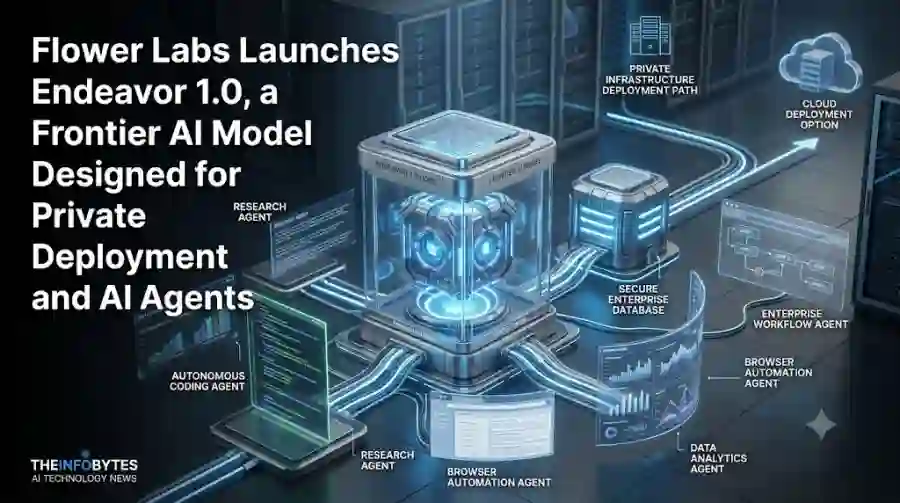
Announced on September 1, 2026, Endeavor 1.0 is described by Flower as a frontier-class generalist designed for reasoning, coding and long-horizon agent work. The company says organizations can use Endeavor through a managed Flower service or deploy it inside infrastructure they control.
That deployment flexibility is the central idea behind the model.
Instead of forcing organizations to choose between a highly capable closed API and a more controllable but potentially less capable model, Flower wants Endeavor to provide frontier-level performance while giving businesses a path toward private deployment.
The company is initially making Endeavor 1.0 available as a preview to selected organizations and partners.
What Is Endeavor 1.0?
Endeavor 1.0 is Flower Labs' latest general-purpose AI model.
Flower describes it as a frontier-class generalist rather than a model designed around one narrow capability.
The model is built to handle:
- Advanced reasoning
- Software development
- Coding tasks
- Complex knowledge work
- Long-horizon agent workflows
- Tool use
- Multi-step tasks
- Enterprise workloads
Flower says Endeavor is designed to serve as a core model for products, agents and complex workflows.
This makes the model particularly interesting for organizations that want to build AI agents around a model rather than simply use AI for basic chat.
Endeavor 1.0 Benchmark Results
Flower has published several early benchmark results for Endeavor 1.0.
The model scored:
- 92.0 on GPQA
- 98.2 on HumanEval
- 99.9 on AIME 2026
- 94.1 on IFEval
Flower says Endeavor records the highest HumanEval score in its launch comparison and matches GPT-5.6 Sol and Claude Fable 5 on AIME 2026.
The published comparison looks like this:
| Benchmark | Endeavor 1.0 | GPT-5.6 Sol | Claude Fable 5 | Kimi K3 | Nemotron 3 Ultra |
|---|---|---|---|---|---|
| GPQA | 92.0 | 94.1 | 92.6 | 93.5 | 86.7 |
| HumanEval | 98.2 | 95.1 | 97.0 | 96.3 | 96.3 |
| IFEval | 94.1 | 95.9 | 91.7 | 92.8 | 91.9 |
| AIME 2026 | 99.9 | 99.9 | 99.9 | 96.7 | 94.2 |
These are company-reported launch results, so they should not be treated as a complete measurement of real-world model quality.
Flower itself notes that a small collection of benchmarks cannot fully describe how useful a model will be in practice.
That is particularly relevant for Endeavor because Flower is positioning it around real enterprise workflows rather than benchmark competition alone.
Endeavor Is Built for Long-Horizon AI Agents
One of the most important parts of Endeavor 1.0 is its focus on long-horizon agent work.
Traditional chatbots generally operate around individual prompts.
An agent may need to perform a sequence of actions.
For example:
- Understand a task
- Create a plan
- Search for information
- Use external tools
- Write code
- Test the code
- Review the result
- Correct mistakes
- Complete the final task
This type of workflow can require an AI system to maintain context and recover from errors over a much longer period.
Flower says Endeavor is designed to plan and carry out multi-step work across the web, files, code and external tools. It can also maintain context, adapt as information changes and recover from intermediate failures.
That makes Endeavor particularly relevant to the growing AI-agent market.
Coding Is Another Major Focus
Endeavor 1.0 is also designed for software development.
Flower says the model can work with unfamiliar repositories, convert specifications into implementations, reproduce problems, review changes, run tests and explain results.
This is important because AI coding is moving beyond autocomplete.
Modern coding agents are increasingly expected to work across entire projects.
A useful coding model needs to understand a codebase, identify the relevant files, make changes and verify whether those changes actually work.
Endeavor is being positioned for this more advanced workflow.
Its 98.2 HumanEval score is also one of the strongest benchmark results published in Flower's launch comparison.
The Biggest Difference Is Deployment Freedom
Benchmark performance is only part of the Endeavor story.
The more unusual feature is deployment flexibility.
Organizations can use Endeavor through Flower's managed service.
Flower handles:
- Deployment
- Scaling
- Model operations
- Infrastructure management
But organizations can also deploy Endeavor inside infrastructure they control.
This can be important for companies handling sensitive information.
Some businesses cannot send every workload to an external AI provider.
They may need greater control over:
- Data
- Infrastructure
- Security
- Compliance
- Model access
- Internal applications
Private deployment gives those organizations another option.
Why Private AI Deployment Matters
The AI industry has traditionally offered two broad choices.
The first is a powerful cloud-based model.
It is easy to access but depends on the provider's infrastructure and policies.
The second is a model that can be deployed independently.
This gives businesses more control but may involve compromises in capability or operational complexity.
Flower is trying to position Endeavor between these two choices.
The company describes the model as providing frontier capability while giving organizations a path toward private deployment.
That could be especially attractive to enterprise customers.
Businesses Can Start With Flower's Managed Service
Organizations do not necessarily have to build their own AI infrastructure immediately.
Flower offers a managed deployment option for Endeavor.
Under this model, Flower handles the operational side while customers interact with the model through a production service.
This can make adoption easier for organizations that want to experiment with Endeavor without immediately taking responsibility for model operations.
It also gives businesses a potential path toward private deployment later.
Private Deployment Can Be Used for Sensitive Workloads
Flower says organizations can deploy Endeavor in their own environment when they need greater control over sensitive workloads and infrastructure.
This creates an interesting hybrid possibility.
A company could use the managed service for general workloads while keeping sensitive applications inside its own infrastructure.
That could make Endeavor relevant to industries where data governance is particularly important.
The model's value therefore extends beyond its raw intelligence.
The ability to control where the model operates could become an important part of its appeal.
Endeavor Is Not Just Another Model Endpoint
Flower is also making a broader argument about how companies should think about AI models.
The company says organizations eventually build much more than prompts around a model.
They may create:
- AI agents
- Evaluation systems
- Data pipelines
- Tool integrations
- Guardrails
- Feedback loops
- Internal applications
- Specialized workflows
Once these systems become important to a business, changing the underlying model can become difficult.
Flower argues that Endeavor gives organizations a way to build those capabilities without permanently tying them to a single closed API.
This is a significant strategic difference.
Flower Wants AI Capability to Become an Organizational Asset
The company's broader vision is that AI should become something organizations can build around and control.
Instead of treating AI intelligence as a rented service, companies could develop their own systems around a model that they can operate through Flower or on their own infrastructure.
That means the real product is not simply:
Endeavor API access
It is:
Endeavor + agents + data + evaluations + workflows + deployment control
This approach could become increasingly important as businesses build more sophisticated AI systems.
Endeavor Comes From Flower's Sovereign AI Work
Endeavor did not appear from nowhere.
Flower previously introduced Lizzy-7B, an open-weight model designed for UK sovereign AI requirements.
Flower's own blog says Endeavor arrives four months after Lizzy and represents the next step from a focused sovereign model toward a broad generalist capable of competing with frontier systems.
That gives Endeavor a broader context.
Flower has been working on decentralized and federated AI technologies for years.
Endeavor extends that philosophy into a much more capable general-purpose model.
How Endeavor Is Built
Flower says Endeavor builds on mature capabilities from the open-weight AI ecosystem.
These include:
- General language understanding
- Broad public knowledge
- Common coding capabilities
The company then adds its own model capabilities and training work.
Flower says this includes continual pre-training, targeted post-training and model integration, along with capabilities developed through its own model program.
The company also says Endeavor incorporates knowledge and reasoning developed through Lizzy.
Flower Uses Real Enterprise Workflows for Evaluation
Another interesting aspect of Endeavor's development is FlowerBench.
Flower describes FlowerBench as a benchmark designed around long-horizon enterprise work.
Instead of relying exclusively on public benchmark questions, FlowerBench uses tasks contributed by organizations that have opted into the Flower Enterprise Evaluation Network.
The tasks can run inside those organizations' environments while the underlying proprietary data remains there.
This allows Flower to study how models perform on real workflows involving tools, domain rules and deliverables.
That is particularly relevant for AI agents.
A model might perform well on a standard benchmark but struggle when it needs to complete a complicated business task involving several systems.
Real-world evaluation can expose those weaknesses.
Endeavor 1.0 vs Closed Frontier Models
Endeavor is entering a market dominated by models from major AI companies.
Flower directly compares Endeavor with models from OpenAI and Anthropic, along with open-weight competitors including Kimi K3 and Nemotron 3 Ultra.
But Endeavor is not necessarily trying to win solely by offering a better benchmark score.
Its strongest differentiator is control.
For organizations, the decision may eventually look like:
Which model is smartest?
but also:
Where can we run it?
Who controls the infrastructure?
Can we keep sensitive workloads private?
Can we build long-term systems around it?
How difficult is it to migrate later?
Endeavor is designed to address those questions.
Who Could Benefit From Endeavor 1.0?
The model is primarily aimed at organizations rather than casual chatbot users.
Potential users include:
Enterprise AI Teams
Businesses building internal AI systems could use Endeavor as a general-purpose foundation.
Software Companies
Developers could build coding agents and AI-powered development tools around the model.
AI Agent Developers
Its long-horizon agent focus makes it relevant to companies creating autonomous workflows.
Privacy-Sensitive Organizations
Companies that need private infrastructure could benefit from deployment control.
Research Organizations
Teams working on advanced AI applications may value the ability to integrate the model into custom systems.
Government and Public-Sector Organizations
Organizations with strict infrastructure and data requirements could potentially benefit from private deployment.
The exact suitability will depend on each organization's infrastructure and access requirements.
Is Endeavor 1.0 Available Now?
Yes, but the launch is initially limited.
Flower says Endeavor 1.0 is being introduced as a preview, with access initially available to selected organizations and partners rather than immediate full self-service access.
Organizations can request access.
Flower plans to broaden availability as compute capacity expands.
This means Endeavor is not currently positioned as a mass-market chatbot competing directly for everyday consumer users.
Its first target is organizations that want frontier AI capability with more deployment control.
Can Developers Access Endeavor Through an API?
Flower says Endeavor can be called from existing applications and agent frameworks through familiar model APIs and response formats.
That makes integration easier for organizations that already have AI applications.
Instead of rebuilding their entire software stack, developers can potentially integrate Endeavor into existing systems.
The model can then serve as the intelligence layer behind:
- AI agents
- Coding applications
- Enterprise assistants
- Research workflows
- Internal business applications
- Automated processes
Is Endeavor Open Source?
Endeavor should not be confused with Flower's Lizzy 7B open-weight model.
Flower presents Endeavor as a frontier model that can be accessed through its managed service or deployed privately with Flower support.
The company emphasizes deployment control rather than describing Endeavor as a conventional fully open-source consumer model.
That distinction is important for users looking for downloadable model weights.
What About Pricing?
Flower's launch announcement does not provide a standard public consumer price for Endeavor 1.0.
The model is currently being introduced through a preview program with access available by request.
Pricing and deployment costs will therefore depend on the eventual availability model and the requirements of individual organizations.
Businesses interested in using Endeavor should request access directly from Flower for current commercial information.
Why Endeavor Matters for the AI Industry
The launch reflects a broader shift in enterprise AI.
Businesses are increasingly asking for more than powerful models.
They want:
- Data control
- Infrastructure control
- Security
- Customization
- Long-term stability
- Agent support
- Integration flexibility
Closed APIs remain attractive because they are easy to use.
But as AI becomes embedded in critical business systems, organizations may want more control over the technology underneath.
Endeavor is designed around that exact tension.
The Rise of Sovereign and Controllable AI
The concept of sovereign AI is becoming more important around the world.
Governments and businesses increasingly want AI infrastructure that can operate under their own policies and within their own environments.
This can be motivated by:
- Data sovereignty
- National security
- Regulatory requirements
- Privacy
- Infrastructure independence
- Vendor risk
Flower's previous Lizzy model was explicitly connected to UK sovereign AI requirements.
Endeavor takes the concept toward a broader frontier model.
What Happens Next?
The biggest question will be whether Endeavor can maintain its reported benchmark performance in real-world deployments.
Benchmark results are encouraging, but enterprise AI is complicated.
Organizations need models to:
- Follow instructions reliably
- Use tools correctly
- Maintain context
- Avoid dangerous mistakes
- Work with internal systems
- Recover from failures
- Meet security requirements
Flower is specifically emphasizing long-horizon work and enterprise evaluation, so real-world adoption will be an important test.
The company says it will initially work closely with early organizations and partners before expanding availability.
Flower Labs' Endeavor 1.0 is one of the more interesting new AI model launches because it is competing on two fronts.
The first is intelligence.
Flower reports strong results across reasoning, coding, instruction following and mathematics, including a 98.2 HumanEval score and 99.9 AIME 2026 score.
The second is control.
Organizations can use Endeavor through Flower's managed service or deploy it inside infrastructure they control.
That combination is designed to appeal to companies building serious AI systems rather than users looking for another consumer chatbot.
Its focus on long-horizon agents and coding also makes it relevant to the next phase of AI development, where models are expected to complete multi-step tasks instead of simply responding to individual prompts.
Endeavor 1.0 is currently launching as a preview for selected organizations, so its wider impact remains to be seen.
But its core proposition is clear:
Frontier AI capability without permanently giving up control over where that AI runs.
If Flower can deliver that promise at scale, Endeavor could become an important alternative for organizations that want advanced AI while reducing dependence on a single closed model provider.
FAQs
What is Endeavor 1.0?
Endeavor 1.0 is a frontier-class general-purpose AI model from Flower Labs designed for reasoning, coding, complex knowledge work and long-horizon AI agents.
What are Endeavor 1.0's benchmark scores?
Flower reports scores of 92.0 on GPQA, 98.2 on HumanEval, 99.9 on AIME 2026 and 94.1 on IFEval.