Estha Brings Offline AI Agents, Document Analysis and Private Automation to Apple Silicon Macs
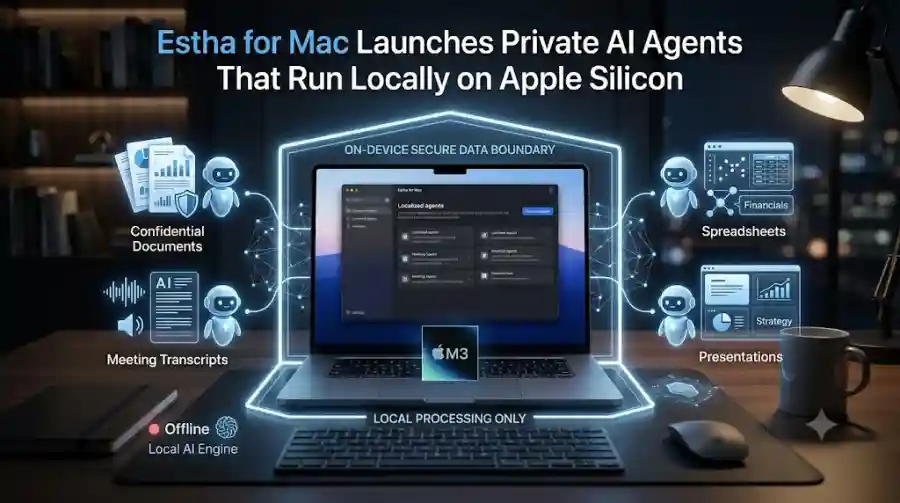
On September 4, 2026, Estha officially launched Estha for Mac, a private AI platform designed for Apple Silicon computers. The platform combines local AI inference, prebuilt AI agents and no-code tools for tasks such as document analysis, meeting notes, data processing and content creation.
The company's main selling point is privacy.
Supported workflows can run directly on the user's Mac after the required models are installed, allowing sensitive documents and business information to remain on the device instead of being sent to a cloud AI provider.
That makes Estha particularly interesting for professionals working with confidential business information.
What Is Estha for Mac?
Estha for Mac is a local AI workspace designed specifically for Apple Silicon Macs.
The platform combines several AI capabilities into one application instead of requiring users to assemble different local AI tools themselves.
According to Estha, users can use the platform for:
- AI chat
- Document analysis
- Meeting notes
- Data analysis
- Presentation creation
- Writing assistance
- Knowledge-base workflows
- Private AI agents
- No-code AI applications
- Internal business automation
The company describes the product as a private AI platform for professionals and organizations that need more control over sensitive information.
AI Runs Locally Instead of Sending Everything to the Cloud
The biggest difference between Estha and mainstream cloud AI tools is where inference happens.
Estha says its Mac platform performs AI inference locally on Apple Silicon hardware.
The company's platform currently supports Macs with M2 or newer Apple Silicon processors and recommends at least 16GB of RAM. It also lists a 32GB-plus configuration for a more capable experience.
Because processing can happen locally, users can work with sensitive information without automatically transferring that information to an external AI service.
This could be particularly useful for:
- Legal professionals
- Financial teams
- Consultants
- Healthcare organizations
- Human resources teams
- Small businesses
- Researchers
- Enterprise employees
For these users, the question is often not whether AI is useful.
The bigger question is whether sensitive information can safely be used with AI.
Estha Supports Offline AI Workflows
Another important feature is offline operation.
Estha says supported local workflows can continue working without an internet connection after the application and required model have been downloaded.
That changes the economics and architecture of AI usage.
A cloud AI application generally depends on an internet connection and sends requests to remote infrastructure.
A local AI application can continue operating on the user's hardware.
This can be useful when working:
- During travel
- In locations with poor connectivity
- With confidential documents
- In restricted environments
- Without recurring cloud inference charges
It also means that an internet outage does not necessarily stop every AI workflow.
Estha Includes Ready-to-Use AI Agents
Estha is not simply a local chatbot.
The company is building a collection of AI agents designed for practical business tasks.
Its platform currently highlights agents and applications for document processing, data analysis, presentations and meetings.
This is important because many users do not want to download a local AI model and then spend hours configuring it.
They want to open an application and complete a task.
Estha's approach is therefore closer to a packaged AI workspace than a developer-focused local LLM environment.
Meeting Notes Can Be Processed Locally
One of the practical use cases is meeting intelligence.
Estha lists meeting notes among its built-in capabilities.
Instead of uploading meeting information to a third-party cloud service, organizations can potentially process supported meeting data locally.
This can be useful for businesses where meeting discussions contain:
- Customer information
- Product plans
- Financial discussions
- Internal strategy
- Legal information
- Employee information
Keeping that data within a controlled environment can simplify privacy considerations.
Document Analysis Is Another Major Use Case
Estha also focuses heavily on document-heavy workflows.
Its platform is designed to help users analyze documents and work with private business information locally.
This is an important market because many professional AI workloads are document-based.
For example, a consultant might need to analyze client documents.
A lawyer might need to review contracts.
An HR team might work with confidential employee documents.
A financial advisor might analyze client information.
In these situations, the ability to process information locally can be more valuable than simply having the most powerful general-purpose model.
Estha Adds No-Code AI Creation
The platform also includes tools for creating private AI applications without traditional programming.
Estha's website describes Quick Bot and Advanced Studio as tools for building private internal AI applications.
This means a business employee could potentially create an internal AI assistant around company knowledge without building an entire software application from scratch.
For example, a company could create a private assistant that helps employees:
- Search internal information
- Answer questions about company procedures
- Analyze documents
- Summarize reports
- Follow internal workflows
- Provide specialized guidance
The company can then control how that AI application is distributed within the organization.
Enterprise Governance Is Built Into the Platform
Estha is also targeting businesses rather than only individual Mac users.
Its enterprise platform includes administrative controls around users, AI bots and permissions.
The company describes three main roles:
Administrator
Administrators can control the platform, manage users and configure access policies.
Creator
Creators can build AI bots, assign isolated knowledge bases and publish approved applications.
User
Users can access approved internal bots while interactions remain within the local environment.
This structure is designed to prevent every employee from independently deploying unrestricted AI systems.
Instead, organizations can create an internal AI environment with defined boundaries.
Estha Uses Qwen3.5 as Its Default Model
Estha's current Mac platform lists Qwen3.5 as its default model, with additional models planned.
The company lists a 262K-token context window and support for 201 languages on its current platform.
The platform uses MLX and Apple's Metal acceleration to optimize local inference for Apple Silicon.
This is significant because Apple's chips have become increasingly capable at running AI models locally.
Rather than depending entirely on expensive cloud GPUs, applications can use the CPU, GPU and unified memory available inside modern Macs.
How Estha Differs From ChatGPT and Claude
Estha is not necessarily trying to replace cloud AI assistants in every situation.
The difference is mainly architectural.
Cloud AI
With services such as ChatGPT or Claude, most advanced model inference takes place on remote servers.
This provides access to extremely powerful models without requiring powerful local hardware.
Local AI
Estha moves supported inference onto the user's Mac.
This provides stronger control over data and reduces dependency on external infrastructure.
The trade-off is that local hardware has limitations.
A Mac cannot necessarily match the computing resources available in a large AI data center.
So Estha's strongest selling point is not simply model intelligence.
It is privacy, control and local execution.
Estha Could Be Useful for Sensitive Business Data
The privacy argument becomes stronger when looking at real business workflows.
A company might already use cloud AI for public marketing copy or general brainstorming.
But the same company may hesitate to upload:
- Customer contracts
- Internal financial reports
- Employee records
- Proprietary research
- Legal documents
- Confidential strategy documents
A local AI platform gives businesses another option.
Instead of asking whether the cloud AI provider can be trusted with every document, companies can keep certain workloads inside their own environment.
Estha itself recommends using local AI for sensitive workflows rather than treating local AI as a replacement for every cloud workload.
Local AI Also Changes AI Costs
Cloud AI services generally charge according to usage or subscription plans.
Local AI has a different cost structure.
Once the necessary hardware and models are available, local inference does not require a separate per-token cloud charge.
Estha specifically promotes its local platform as having no recurring inference charges for supported local workloads.
This could matter for organizations with large amounts of repetitive AI work.
A company processing thousands of documents every month could potentially benefit from moving some workloads locally.
However, the hardware itself still has a cost, and local models may not provide the same capability as the most powerful cloud systems.
Estha for Mac Pricing
Estha launched the Mac platform with an individual price of $99, while enterprise plans start at $4,800 per year, according to the company's launch information. A two-week trial is also promoted for the Mac product.
The enterprise offering adds governance capabilities designed for organizations managing multiple users and AI applications.
This pricing positions Estha differently from free local AI applications.
It is targeting professionals and businesses that value a managed private AI environment rather than simply wanting to experiment with local models.
What Happens When the Internet Is Disconnected?
This is one of the most interesting questions for local AI.
Estha says its supported local workflows can operate offline after the application and model have been installed.
That means users can potentially continue working with local AI even when the Mac cannot access cloud services.
However, not every feature should automatically be assumed to work offline.
Cloud-dependent integrations, online services and features requiring external information can still require connectivity.
The distinction is important when evaluating local AI products.
The Limitations of Local AI
Local AI has clear advantages, but it also has limitations.
Hardware Requirements
Larger models require more memory and computing resources.
Estha currently recommends at least 16GB RAM and supports Apple Silicon hardware beginning with M2.
Model Capability
A local model may not match the reasoning or tool capabilities of the newest frontier cloud models.
Updates
Cloud models can be upgraded centrally.
Local systems need model and software updates to be downloaded and installed.
External Information
Offline AI cannot automatically access every piece of new information on the internet.
These limitations mean local and cloud AI will likely coexist rather than one completely replacing the other.
Why Estha's Launch Matters
The launch arrives as businesses become more aware of AI privacy risks.
Companies increasingly want AI capabilities, but they also want control over sensitive data.
That creates a growing market for private AI.
Estha is betting that some businesses will prefer a hybrid approach:
Cloud AI for general workloads + local AI for sensitive workloads.
That may be more realistic than expecting companies to move every AI task onto local hardware.
The Bigger Shift Toward Private AI
Estha's launch is part of a broader change in the AI industry.
The first wave of generative AI focused heavily on making models more capable.
The next phase is increasingly about where AI operates.
Companies are now asking:
- Where is our data processed?
- Can AI work without the internet?
- Who controls the model?
- Can employees use AI with confidential information?
- Can administrators control AI agents?
- Can AI actions be audited?
- How much does large-scale AI usage cost?
Private and on-device AI platforms are responding to these questions.
Estha for Mac is one example of that movement.
Who Should Consider Estha for Mac?
Estha is particularly interesting for professionals who use Apple Silicon Macs and regularly handle sensitive information.
Potential users include:
Consultants
Analyze client documents without automatically sending them to cloud AI services.
Financial Professionals
Work with sensitive reports and analysis inside a more controlled environment.
Legal Teams
Process confidential documents locally.
HR Teams
Build private AI workflows around recruitment and employee information.
Small Businesses
Create internal AI assistants without maintaining a large AI infrastructure project.
Privacy-Conscious Professionals
Use AI while keeping supported workflows on their own hardware.
Estha for Mac is an interesting addition to the growing private-AI market.
Its biggest advantage is not that it promises to beat every cloud AI model.
Instead, it offers something cloud platforms cannot provide in the same way: local control over AI processing.
The platform combines local inference, AI agents, document processing, meeting tools and no-code AI creation into a single Mac-focused environment.
For professionals handling sensitive information, that combination could be more important than having the absolute most powerful AI model available.
As AI agents become more deeply integrated into business workflows, the ability to control where those agents operate may become just as important as how intelligent they are.
Key Takeaways
- Estha for Mac launched on September 4, 2026.
- It is designed for Apple Silicon Macs.
- Supported AI workflows can run locally and offline after installation.
- Estha targets private and sensitive business workflows.
- The platform includes AI chat, document analysis, meeting notes and data tools.
- Users can build private AI bots without traditional coding.
- Enterprise controls include user management and access policies.
- The platform currently lists Qwen3.5 as its default model.
- Estha supports M2-or-newer Apple Silicon Macs with at least 16GB RAM.
- Launch pricing starts at $99 for individuals and $4,800 per year for enterprise plans.
FAQs
What is Estha for Mac?
Estha for Mac is a private AI platform for Apple Silicon Macs that provides local AI inference, AI agents, document processing, meeting tools and no-code AI creation.
Does Estha for Mac work offline?
Supported local workflows can operate offline after the required software and AI models have been installed.