Empirik Emerges With $21M to Give AI Agents a Real-Time View of Infrastructure Changes
Cloud resources are created. Permissions are modified. Deployments happen more frequently. Kubernetes configurations change. New dependencies appear.
Infrastructure teams are then expected to understand the consequences of those changes before something breaks.
That is the problem a new AI startup called empirik is trying to solve.
The company emerged from stealth on September 1, 2026, announcing more than $21 million in funding from Sequoia, S32, Canapi Ventures and Alumni Ventures.
Empirik describes itself as an autonomous infrastructure engineer designed to understand what infrastructure changes will affect before those changes are executed.
The company is targeting a growing gap between machine-speed software development and traditionally human-driven infrastructure operations.
What Is Empirik AI?
Empirik is an AI-powered infrastructure change intelligence platform.
Its main purpose is not simply to monitor servers after something goes wrong.
Instead, empirik attempts to understand infrastructure changes before they happen.
The platform captures the intent behind a proposed change and maps that change against a live model of an organization's infrastructure.
It then attempts to determine what could be affected.
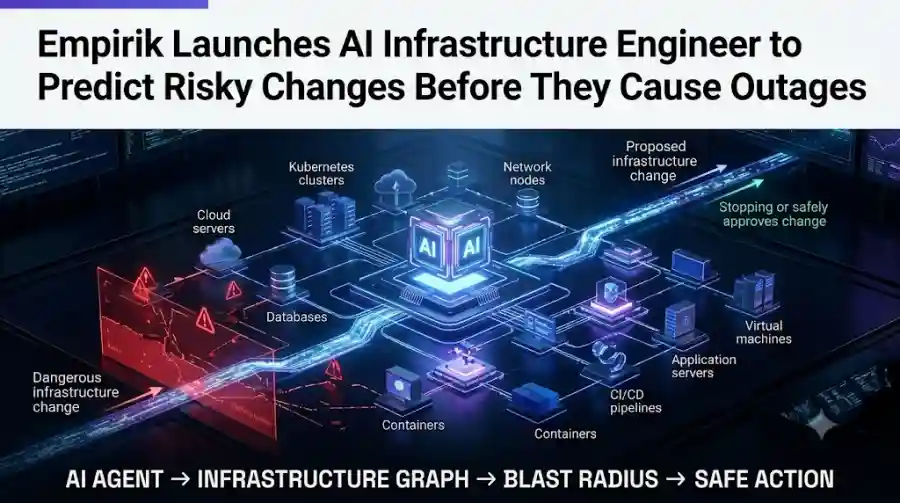
This includes relationships between applications, cloud resources, Kubernetes environments, identity and access controls, networking systems, CI/CD pipelines and other infrastructure components.
Empirik calls this an operational layer for autonomous infrastructure engineering.
The basic concept is:
Understand intent → Map infrastructure → Calculate impact → Decide how to act
That approach could become increasingly important as companies allow AI agents to make more software and infrastructure changes.
Why Infrastructure Is Becoming an AI Problem
AI coding tools have changed the speed of software development.
A developer can now ask an AI coding agent to modify a large codebase, create a feature or prepare a deployment much faster than before.
But writing software is only one part of running a modern application.
The resulting code has to operate somewhere.
That infrastructure may include:
- Cloud servers
- Kubernetes clusters
- Databases
- Networking
- IAM permissions
- Security groups
- SaaS services
- CI/CD pipelines
- Virtual machines
- On-premise systems
- Monitoring systems
A small software change can therefore have consequences far beyond the original repository.
For example, changing a service configuration could affect another application.
A permission update could expose a sensitive resource.
A deployment could create unexpected traffic.
A configuration change could trigger a chain of failures.
Traditional infrastructure tools often discover these problems after they happen.
Empirik is attempting to move that reasoning earlier in the process.
How Empirik Works
Empirik's platform is built around two important pieces of information:
Intent — What a developer or AI agent is trying to change.
Impact — What that change could actually affect.
The platform captures change events from places such as pull requests, tickets, pipelines, console actions and agent calls.
It then maps those changes against a continuously updated representation of the live environment.
Empirik calls this a live application graph.
The graph is intended to represent relationships across infrastructure rather than looking at individual systems separately.
This is important because infrastructure is rarely isolated.
A production application may depend on several cloud services, databases, IAM policies, network rules and external platforms.
Understanding those connections is essential if an AI system is eventually going to make changes autonomously.
What Is the Empirik Infrastructure Graph?
One of Empirik's central ideas is that infrastructure needs a shared machine-readable representation.
Traditional Infrastructure as Code can describe the intended state of infrastructure, but it does not necessarily capture every relationship in a constantly changing production environment.
Cloud infrastructure can drift.
Temporary resources can appear.
Permissions can change.
Kubernetes workloads can be created and removed.
External SaaS dependencies can also become part of an application's operational environment.
Empirik attempts to create a continuously updated graph that connects these systems.
The company says its model includes cloud, on-premise and SaaS environments while treating elements such as IAM policies and routing tables as important infrastructure objects.
The goal is to give an AI agent more reliable context before it takes action.
Empirik Can Calculate Blast Radius
One of the platform's most important concepts is blast radius.
In infrastructure engineering, blast radius refers to the potential scope of impact from a change.
Imagine an engineer wants to modify a production service.
The immediate change might look small.
But that service could connect to databases, APIs, authentication systems and other applications.
A seemingly simple modification could therefore affect several parts of the business.
Empirik attempts to identify those relationships before the change is executed.
Its platform can project proposed changes onto the live environment and return information about affected services, owners, risks and dependencies.
This could allow engineers to identify potentially dangerous changes earlier.
Empirik Is Designed for AI Agents Too
The timing of Empirik's launch is significant because AI agents are increasingly moving from assistants toward autonomous systems.
An AI coding agent can already modify software.
The next step is giving agents permission to deploy, configure and manage infrastructure.
That creates a major safety problem.
An AI agent that can change production infrastructure needs to understand the consequences of its actions.
Otherwise, an apparently reasonable command could produce a serious outage.
Empirik is designed to provide that missing context.
The company says its system can give engineers and AI agents a common ground-truth view of architecture, migrations, incidents, security and provisioning.
This creates a potentially important architecture:
AI Agent → Empirik → Infrastructure Context → Risk Evaluation → Action
Instead of allowing an agent to make a change blindly, the infrastructure layer can evaluate the proposed action first.
From Monitoring Problems to Preventing Them
Traditional observability systems are extremely useful.
They can tell engineers when a system is unhealthy.
But there is a difference between detecting an outage and preventing an outage.
Empirik is focused heavily on the second problem.
Its platform is designed to examine proposed changes before execution.
That could allow organizations to:
- Flag risky changes before deployment
- Identify affected services
- Detect infrastructure drift
- Find hidden dependencies
- Determine ownership
- Review potential blast radius
- Decide whether an AI agent should act autonomously
- Require human approval for higher-risk changes
The company says the same infrastructure model can eventually support validation, execution and verification as enterprises give AI systems more authority.
Why Empirik Emerged Now
The growth of AI coding agents is one of the main reasons this category is becoming more important.
Software teams can now produce changes at a much faster rate.
Infrastructure teams, however, cannot necessarily review those changes at the same speed.
This creates an operational bottleneck.
If developers can generate hundreds of infrastructure-related changes while humans still manually evaluate each one, the organization eventually faces a mismatch.
Empirik's argument is that infrastructure operations need an intelligence layer capable of operating at machine speed as well.
The company's CEO describes the broader opportunity as bringing the same transformation AI agents created for software development into infrastructure engineering.
Empirik's Autonomous Infrastructure Engineer
Empirik does not position itself as another simple monitoring dashboard.
Its larger goal is to become an autonomous infrastructure engineering layer.
The platform can potentially move through several stages.
First, it understands a proposed change.
Next, it evaluates what that change could affect.
Then it can determine whether the change is safe.
For lower-risk actions, organizations could eventually allow greater automation.
For high-risk changes, the system could request human approval.
This creates a model where AI autonomy increases according to risk.
That could be especially useful for large companies operating complex environments where manually reviewing every change is expensive.
Who Is Using Empirik?
Empirik says it is already operating in production environments.
The company has customers ranging from startups to major enterprises.
Its official announcement identifies Guardant Health, a Fortune 50 consumer packaged goods company and a Fortune 500 financial-services company among organizations using the technology.
TechCrunch separately reported that Empirik has customers including S&P Global, Guardant Health and a major consumer packaged goods company.
The company therefore enters the market with more than just a research demonstration.
It says the platform is already being used in real enterprise environments.
Empirik Raises More Than $21 Million
Empirik emerged from stealth with more than $21 million in funding.
The round included Sequoia, S32, Canapi Ventures and Alumni Ventures.
Sequoia had previously incubated the startup before it became an independent company.
TechCrunch reported that Empirik was incubated by Sequoia beginning in 2023 before former Quantum Metric and Salesforce executive Kartik Chandrayana became CEO.
The funding gives the company additional resources to expand its infrastructure intelligence platform as enterprises experiment with autonomous AI operations.
How Empirik Differs From AI Coding Agents
AI coding agents focus mainly on software development.
They understand repositories, files, functions and code.
Empirik focuses on what happens after software changes reach the infrastructure layer.
That distinction is important.
A coding agent might know that a configuration file has changed.
Empirik attempts to understand what that change means for the entire running environment.
In simple terms:
Coding AI understands the software.
Empirik attempts to understand the infrastructure around the software.
The two systems could therefore eventually work together rather than compete directly.
Could Empirik Help Prevent AI-Caused Outages?
Potentially, this is one of its most important use cases.
As AI agents receive more authority, they will inevitably make mistakes.
The question is how organizations control those mistakes.
A traditional application can use strict permissions and predefined workflows.
An autonomous agent is more flexible, but flexibility introduces uncertainty.
An infrastructure intelligence system could become a middle layer between the agent and production systems.
The agent proposes an action.
Empirik analyzes the action.
The organization can then allow, block or review it depending on the expected impact.
This approach could become an important part of enterprise AI safety.
What Are Empirik's Limitations?
Empirik is promising, but it does not eliminate the challenges of autonomous infrastructure.
The first challenge is maintaining an accurate representation of a constantly changing environment.
Modern infrastructure can change thousands of times per day.
A graph that is outdated could produce incorrect conclusions.
Another challenge is complexity.
Large enterprises may have thousands of applications and millions of infrastructure relationships.
Understanding all of those connections requires substantial computing resources and accurate integrations.
There is also the problem of trust.
Organizations will need evidence that an AI-generated risk assessment is reliable before allowing it to automatically approve production changes.
Finally, autonomous execution creates security concerns.
Giving any AI system authority over infrastructure requires carefully designed permissions, audit trails and approval mechanisms.
Empirik therefore does not remove the need for governance.
It attempts to make governance more intelligent.
What Empirik Means for the Future of AI Agents
The AI industry is increasingly moving toward agents that can perform actions rather than simply answer questions.
But useful autonomy requires context.
An AI agent that can write code but does not understand the environment where that code will run has limited operational awareness.
Infrastructure-aware AI could change that.
The emerging architecture could look like:
AI Agent → Understand Task → Understand Infrastructure → Calculate Risk → Execute → Verify
That would move AI agents closer to becoming reliable digital operators rather than simple assistants.
Empirik is entering the AI market with a different focus from the latest wave of chatbots and coding models.
The company is building an autonomous infrastructure engineer designed to understand infrastructure changes before they are executed.
Its platform captures the intent behind changes, maps those changes against a live infrastructure graph and calculates their potential impact.
The goal is to identify risky changes before they become outages.
The idea becomes even more important as AI coding agents accelerate software development and companies begin giving AI systems more authority over production environments.
Empirik's $21 million emergence from stealth also shows that investors see infrastructure intelligence as an increasingly important part of the agentic AI ecosystem.
The technology still faces major challenges around accuracy, trust, security and the complexity of enterprise environments.
But the underlying problem is becoming difficult to ignore.
AI agents are getting faster at changing software.
Infrastructure now needs to become smart enough to understand what those changes will do before they happen.
FAQs
What is Empirik AI?
Empirik is an AI-powered infrastructure engineering platform designed to understand infrastructure changes, calculate their potential impact and help organizations safely automate operational decisions.
What does Empirik do?
Empirik captures the intent behind infrastructure changes and maps them against a live model of an organization's environment. It can identify affected services, dependencies and potential blast radius.