Cursor Projects Turns AI Coding Into Long-Running Software Teams With Thousands of Parallel Agents
The challenge is no longer simply getting one AI agent to write code. It is coordinating many tasks across a large codebase while keeping context, dependencies, testing and long-running work under control.
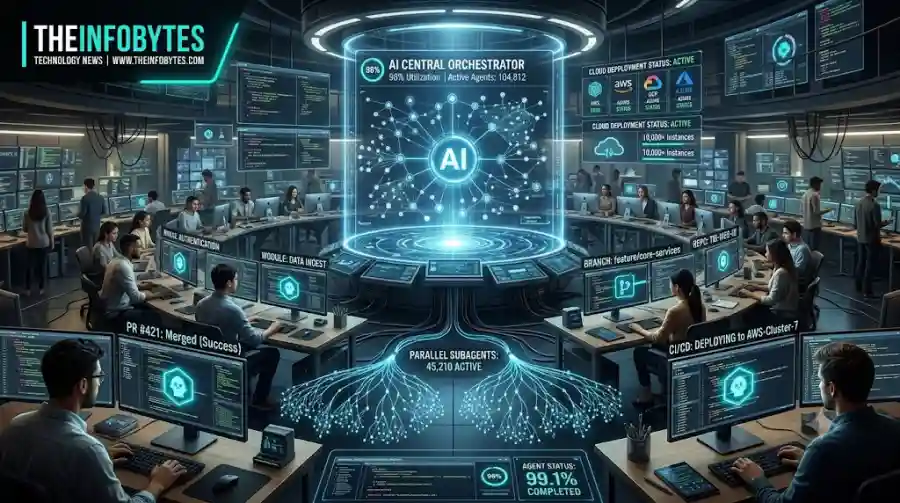
Cursor is now moving directly into that problem with Projects, a new feature designed to coordinate large bodies of software work through a central AI coordinator.
Launched on September 10, 2026, Cursor Projects can maintain context over months, delegate tasks to thousands of subagents and perform recurring work without requiring a developer to continuously prompt it.
This represents a significant shift from the traditional AI coding assistant model.
Instead of asking one agent to complete one task, developers can give a Project a larger objective and let the coordinator determine how the work should be divided.
What Is Cursor Projects?
Cursor Projects is designed for larger software-development workloads such as building a feature, completing a migration or working on an entire application.
The key difference is the level at which developers interact with the system.
Instead of directly managing every individual coding agent, developers communicate with a coordinator agent.
The coordinator does not primarily write the code itself. It plans the work, delegates tasks to other agents, manages those agents and brings the completed work back for review.
That creates a hierarchy:
Developer → Coordinator Agent → Specialized Coding Agents → Completed Work
The developer therefore focuses more on what needs to be accomplished, while the AI handles much of the task distribution.
Cursor says its own teams have already used Projects for work including migrations involving hundreds of pull requests, maintaining consistency across its design system and building Projects itself.
One Coordinator Can Direct Thousands of Agents
The most notable part of Cursor Projects is its ability to delegate work to large numbers of subagents.
A traditional coding assistant generally operates around the current task. Even an advanced agent may be limited by the amount of work it can reasonably handle in one execution.
Projects changes that model.
The coordinator can break a larger objective into smaller tasks and distribute those tasks across agents running in parallel.
For example, a large application migration could potentially be divided into separate jobs for different services, repositories, tests or components.
One agent might inspect the existing implementation.
Another could update a backend service.
Another could migrate database-related code.
Additional agents could update tests, documentation or configuration.
The coordinator remains responsible for organizing those activities.
Cursor says coordinators can create and manage agents on a project's behalf and run as many in parallel as the work requires.
This makes Projects less like an AI autocomplete feature and more like an AI-managed development workforce.
Projects Keep Working When You Close Your Laptop
Another important feature is that Projects operate through cloud infrastructure by default.
A Project runs on its own computer in the cloud, meaning work does not stop simply because the developer closes their laptop.
That matters for long-running software tasks.
Large migrations, testing operations and multi-stage development work can take significantly longer than a normal coding session.
With Projects, the coordinator can continue managing the work while the developer is away.
When something requires access to the developer's local environment, Cursor says the coordinator can launch a local agent to perform the necessary testing or work on the developer's machine.
The result is a hybrid architecture:
- Cloud agents handle scalable parallel work.
- Local agents handle tasks that require the developer's machine.
- The coordinator manages the overall project.
- The developer remains responsible for direction and review.
Shared Context Is a Major Part of the System
One of the biggest problems with multi-agent development is context fragmentation.
If every new agent starts from zero, developers have to repeatedly explain:
- How the codebase works
- Which conventions the team follows
- How tests should be executed
- Which architectural decisions have already been made
- What previous agents discovered
- Which tasks are still incomplete
Cursor Projects attempts to solve this through shared context.
Each Project maintains a collection of files that can synchronize across the cloud and local machines used by its agents.
Agents can add research, artifacts, information about the codebase and instructions about how the team prefers work to be performed.
That context can then become useful to future agents.
For example, if one agent determines the correct procedure for testing a particular service, another agent working on the same Project can reuse that information rather than rediscovering it.
Over time, the Project's context can therefore become a continuously growing knowledge base.
Projects Can Perform Recurring Work
Cursor is also giving Projects a way to respond to events rather than waiting for a developer to manually send another prompt.
Developers can configure a coordinator to:
- Watch a Slack channel
- Run on a schedule
- Follow pull requests
- React to new signals
- Automatically delegate work
Cursor gives a bug-report workflow as one example.
A team could connect a Slack channel containing bug reports and configure the Project to respond whenever new reports arrive. The coordinator can then delegate the appropriate tasks to coding agents.
This moves AI coding closer to continuous software operations.
Instead of:
Prompt → Agent → Code → Stop
the workflow becomes:
Signal → Coordinator → Multiple Agents → Testing → Review → Repeat
That could eventually allow some maintenance and engineering workflows to operate continuously.
Cursor Projects Is Different From a Normal AI Coding Agent
The distinction is important because the market is already crowded with AI coding agents.
Tools such as coding assistants can generate code, debug errors, explain repositories and implement features.
Cursor Projects is targeting a different layer.
The central question is not:
“Can AI write this function?”
It is:
“Can AI coordinate an entire body of engineering work?”
That distinction becomes increasingly important as AI agents become more capable.
A single powerful agent may still struggle with very large projects because one agent has to reason about too many tasks simultaneously.
A coordinator can instead distribute the workload.
This resembles how a software engineering team operates.
A project lead does not personally implement every feature. Instead, they divide the project into workstreams, assign responsibilities, monitor progress and coordinate dependencies.
Cursor is attempting to create an AI version of that organizational structure.
Cursor Reports Higher Productivity With Projects
Cursor says its internal use of Projects has produced notable productivity improvements.
According to the company, new users of Projects merge 30% more pull requests, while users who primarily use Projects merge six times as many.
These are Cursor's own reported figures rather than independent benchmarks, so they should be interpreted as company-reported results rather than universal evidence of productivity gains.
Still, the numbers illustrate what Cursor believes is possible when developers move from managing individual agents to managing larger AI-driven workflows.
The longer-term question will be whether similar gains appear across different organizations, programming languages, repositories and engineering teams.
Projects Builds on Cursor's Cloud Agent Strategy
Cursor Projects does not appear in isolation.
Earlier in September, Cursor introduced support for running cloud agents on machines managed by customers.
That feature allows teams to keep agent execution within their own infrastructure while still using Cursor's agent management system.
Projects builds on this broader direction.
Together, the features point toward an environment where AI agents can operate across cloud infrastructure, customer-controlled machines and local developer systems.
For enterprises, that could become particularly important because software development often involves private repositories, internal services, custom hardware and security restrictions.
What Developers Should Know
Cursor Projects is currently available in beta and is rolling out to users.
The feature can be accessed from Cursor's left-hand navigation.
Developers should think of Projects as a way to manage larger work rather than simply another chat interface for generating code.
It is particularly relevant for tasks such as:
- Large application migrations
- Multi-component feature development
- Repository maintenance
- Repetitive engineering operations
- Codebase-wide consistency work
- Long-running development projects
- Automated response to engineering events
However, more autonomous agents also mean developers need strong review processes.
Delegating thousands of tasks does not eliminate the need for testing, code review, security checks or architectural oversight.
In fact, those safeguards become more important as the number of simultaneously executing agents increases.
Why Cursor Projects Matters for AI Coding
The AI coding market is entering a new phase.
Early tools focused on helping developers write code faster.
The next generation is increasingly focused on allowing AI to manage larger pieces of software development.
Cursor Projects is an important example of that shift.
Its coordinator-agent architecture attempts to separate planning and orchestration from implementation, allowing large numbers of specialized agents to work simultaneously.
The shared context system attempts to solve another major problem: ensuring that agents can learn from work already performed inside the same Project.
And cloud execution allows the system to continue operating even when developers are not actively sitting at their computers.
If this approach works reliably at scale, the definition of an AI coding assistant could change.
Developers may increasingly spend less time telling individual agents exactly what to do and more time defining goals, reviewing results and managing AI-driven engineering systems.
Cursor's Projects launch suggests that the future of AI-assisted programming may not simply involve better coding agents.
It may involve AI-managed teams of coding agents working continuously on entire software projects.
FAQs
What is Cursor Projects?
Cursor Projects is a beta feature that lets developers manage larger bodies of software work through an AI coordinator that delegates tasks to coding agents.
Can Cursor Projects use multiple AI agents at the same time?
Yes. Cursor says the coordinator can create and manage multiple agents and run them in parallel, with Projects designed to delegate work to thousands of subagents.