CrowdStrike SafeMind Uses AI Red-Team and Blue-Team Agents to Find and Stop Cyberattacks
At Fal.Con 2026, CrowdStrike introduced SafeMind, a family of purpose-built cybersecurity models and agentic harnesses designed specifically for defenders. The system was developed by the company's Cyber Superintelligence Lab and is designed to operate natively within the CrowdStrike Falcon platform.
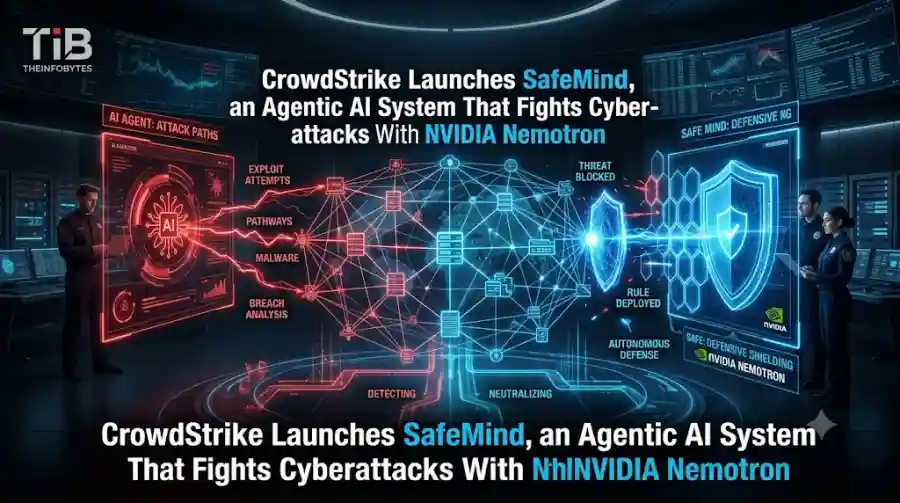
SafeMind is built around a simple idea: instead of waiting for attackers to find a way into a system, AI agents can continuously simulate attacks and have defensive agents work to close those attack paths.
CrowdStrike developed the system with NVIDIA using NVIDIA Nemotron open models.
What Is CrowdStrike SafeMind?
SafeMind is an agentic cybersecurity system designed to bring offensive and defensive AI together.
Rather than functioning like a traditional chatbot or security copilot, SafeMind uses specialized models and agentic harnesses that can perform cybersecurity tasks.
CrowdStrike describes the system as a combination of:
- Offensive AI models
- Defensive AI models
- Agentic harnesses
- CrowdStrike threat intelligence
- Falcon security telemetry
- Digital-twin environments
- Automated detection and remediation workflows
The goal is to create a continuous security loop.
An offensive agent attempts to identify an attack path.
A defensive agent analyzes the attack and works to close it.
The resulting intelligence can then be turned into actionable detections.
NVIDIA says this continuous offensive-defensive process is designed to strengthen security over time.
How SafeMind's Red-Team and Blue-Team AI Works
The most interesting part of SafeMind is its red-team and blue-team architecture.
Red-Team AI Searches for Attack Paths
The offensive side of SafeMind is designed to behave like an attacker.
CrowdStrike's testing environment includes multiple offensive sub-agents that perform different stages of an attack.
According to NVIDIA, the red-agent harness includes:
- Recon
- Assault
- Compromise
These agents operate inside a controlled cyber environment rather than directly attacking a customer's production systems.
Their job is to discover possible attack paths and determine how an attacker could move through an environment.
Blue-Team AI Tries to Stop the Attack
The defensive side then analyzes what the offensive system discovers.
The blue-agent harness monitors activity through Falcon sensors, generates detection candidates and validates those detections.
If the defensive system successfully identifies and blocks the simulated attack, the resulting information can become part of the organization's defensive security workflow.
This creates an automated cycle:
Find attack → Analyze attack → Create defense → Validate defense → Improve security
The process can then repeat.
Why the Red-Team and Blue-Team Approach Matters
Traditional cybersecurity testing often requires security professionals to manually simulate attacks and then determine whether existing defenses work.
That process can be valuable, but it takes time.
AI agents can potentially perform parts of this work continuously.
That changes the security model from occasional testing to ongoing adversarial testing.
Instead of asking:
“Are we secure right now?”
organizations can move toward:
“Can our defenses survive the next attack path the AI discovers?”
This is particularly important as attackers increasingly automate their own operations.
NVIDIA says AI-enabled attacks increased 89% over the previous year, while the fastest observed eCrime breakout time reached 27 seconds, according to CrowdStrike.
SafeMind Uses NVIDIA Nemotron Models
NVIDIA is an important part of the SafeMind architecture.
CrowdStrike built the defensive model using NVIDIA's Nemotron open models and then post-trained them with CrowdStrike's cybersecurity data and experience.
NVIDIA says the system uses Nemotron 3 Ultra to orchestrate the defensive agent harness.
A fine-tuned Nemotron 3 Super model powers the SafeMind rule-generation sub-agent.
This approach allows CrowdStrike to customize the underlying models for cybersecurity instead of relying on a general-purpose AI model that was not specifically designed for security operations.
CrowdStrike Says SafeMind Can Reduce AI Security Costs
CrowdStrike is also highlighting the efficiency of its purpose-built models.
According to NVIDIA, CrowdStrike's internal evaluations found that its Blue Solano defensive model, based on Nemotron 3 Super, delivered higher accuracy than leading frontier models while costing up to 99% less in the company's tests.
That claim should be treated as an internal evaluation rather than an independent industry benchmark.
Still, the underlying strategy is important.
Instead of using the biggest available AI model for every security task, cybersecurity companies can build smaller specialized models that are trained for specific workloads.
For enterprise security, that could make large-scale AI agent deployment more practical.
SafeMind Uses CrowdStrike's Cybersecurity Data
One of CrowdStrike's biggest advantages is its security data.
The company says SafeMind's training data comes from Falcon sensor telemetry and its cybersecurity experience.
CrowdStrike says the defensive models were post-trained using its own threat data rather than sending that training data to an outside provider.
This is important because cybersecurity AI depends heavily on domain-specific information.
A general AI model may understand programming, networking and security concepts.
But a security model trained on large volumes of real-world threat data can potentially learn patterns that are difficult to reproduce using generic training data.
SafeMind Is Tested in a Digital Twin
CrowdStrike and NVIDIA are also testing SafeMind using a high-fidelity cyber-agent environment.
The environment is designed as a digital twin of NVIDIA's accelerated computing infrastructure.
This allows the AI agents to simulate offensive and defensive activity without directly experimenting on a live production network.
The setup gives researchers a controlled environment where they can evaluate:
- Attack discovery
- Defensive detection
- Security rules
- Agent coordination
- Remediation workflows
- Adversarial behavior
The red and blue agents can then repeatedly challenge one another.
That creates an AI-based cybersecurity training environment where each side can improve against the other.
SafeMind Is More Than an AI Security Chatbot
CrowdStrike is making a deliberate distinction between SafeMind and traditional AI copilots.
A normal security copilot might allow an analyst to ask:
“Show me suspicious activity from this endpoint.”
The AI then analyzes available information and provides an answer.
SafeMind is designed to go further.
Its agents can participate in a security workflow that includes discovering attack paths, generating defensive responses and validating those responses.
That makes it closer to an agentic security system than a conventional conversational assistant.
NVIDIA specifically describes SafeMind as a system that combines models and specialized harnesses to turn AI models into cybersecurity agents.
CrowdStrike Is Also Expanding Agentic Security With Falcon IQ
SafeMind was not the only AI announcement from CrowdStrike at Fal.Con 2026.
The company also announced Falcon IQ, an agentic workload automation system designed to automate security assessment, prioritization and remediation workflows.
NVIDIA says Falcon IQ uses more than 50 agents working together as a unified agentic workforce.
That means CrowdStrike is building multiple layers of AI automation.
SafeMind focuses heavily on adversarial cybersecurity intelligence.
Falcon IQ focuses more broadly on automating security workflows.
Together, they show where CrowdStrike wants its platform to go: from security software that detects threats to a security platform where AI agents actively investigate and respond to them.
How SafeMind Could Change Enterprise Cybersecurity
The biggest potential advantage is speed.
Human security teams cannot manually investigate every possible attack path at machine speed.
AI agents can potentially perform large numbers of simulations and investigations simultaneously.
That could help organizations identify weaknesses before attackers do.
For example, an organization could potentially use an AI-driven workflow to:
- Map its environment.
- Simulate possible attack paths.
- Identify defensive gaps.
- Generate detection rules.
- Test those rules.
- Monitor real security telemetry.
- Repeat the process.
The result would be a much more continuous security process.
Human Security Teams Still Matter
Despite the emphasis on autonomous agents, SafeMind does not mean cybersecurity becomes completely human-free.
AI systems can make incorrect assumptions.
A simulated attack path might not be realistic.
A detection rule could generate false positives.
An automated defensive action could also disrupt legitimate business activity.
That makes validation and governance important.
SafeMind's digital-twin testing approach is therefore significant because it provides a controlled environment for evaluating agent behavior before defensive techniques are applied to real systems.
Organizations will still need security engineers to define policies, review important decisions and manage production deployment.
SafeMind and the Growing AI Cybersecurity Market
CrowdStrike is entering a market where AI is becoming a core part of cybersecurity.
Your existing TheInfoBytes coverage already includes several different approaches.
Cloudflare's Vulnerability Discovery and Remediation focuses on discovering vulnerabilities using source code and production context.
Operant AI's Semantic Firewall focuses on preventing dangerous AI-agent actions.
OpenAI's Daybreak initiative focuses on expanding advanced AI capabilities for cyber defenders.
SafeMind takes another approach.
It creates an adversarial AI environment where offensive and defensive agents continuously challenge each other.
These systems are not identical competitors.
They represent different layers of an emerging AI security stack.
The Biggest Challenge Is Trust
The technology is impressive, but the hardest problem may not be technical performance.
It may be trust.
Security teams need to know:
- Why did an AI agent make this decision?
- What evidence did it use?
- Can the result be reproduced?
- Did the simulated attack actually represent a realistic threat?
- Could the defensive rule block legitimate users?
- Who approved the final action?
The more authority AI agents receive, the more important these questions become.
SafeMind's use of specialized harnesses, controlled environments and defensive validation shows that CrowdStrike recognizes this challenge.
What SafeMind Means for AI Agents
SafeMind is another example of how AI agents are moving beyond simple chat interfaces.
The agents are being designed to:
- Observe
- Reason
- Use security tools
- Simulate attacks
- Analyze results
- Generate defensive actions
- Validate those actions
- Repeat the process
That is fundamentally different from using AI only to summarize security alerts.
The emerging model is closer to an AI workforce operating alongside human security teams.
CrowdStrike SafeMind is one of the more interesting AI cybersecurity launches of 2026 because it treats cybersecurity as an ongoing battle between offensive and defensive AI.
The system combines CrowdStrike's security data and Falcon platform with NVIDIA Nemotron models and specialized agentic harnesses.
Its red-team agents attempt to discover attack paths while defensive agents work to detect and close them. The system can then use those findings to strengthen security defenses.
The technology is still developing, and many of CrowdStrike's performance claims come from internal testing rather than independent evaluations.
Even so, the direction is important.
Cyberattacks are becoming increasingly automated.
If attackers can use AI to operate faster, defenders will need AI systems capable of operating at the same speed.
SafeMind represents CrowdStrike's attempt to build that defensive AI layer.
Rather than simply asking AI to explain what happened after an attack, the company wants AI agents to actively search for the next attack path before criminals find it.
That could become a major part of enterprise cybersecurity as agentic AI continues to mature.
FAQs
What is CrowdStrike SafeMind?
CrowdStrike SafeMind is an agentic cybersecurity system that combines offensive and defensive AI models and specialized harnesses to help discover and defend against cyberattack paths.
Who developed SafeMind?
SafeMind was developed by CrowdStrike's Cyber Superintelligence Lab in collaboration with NVIDIA. It uses NVIDIA Nemotron models as part of its defensive AI architecture.