Devin Fusion Uses Frontier AI and Cheaper Sidekick Models Together for More Efficient Coding
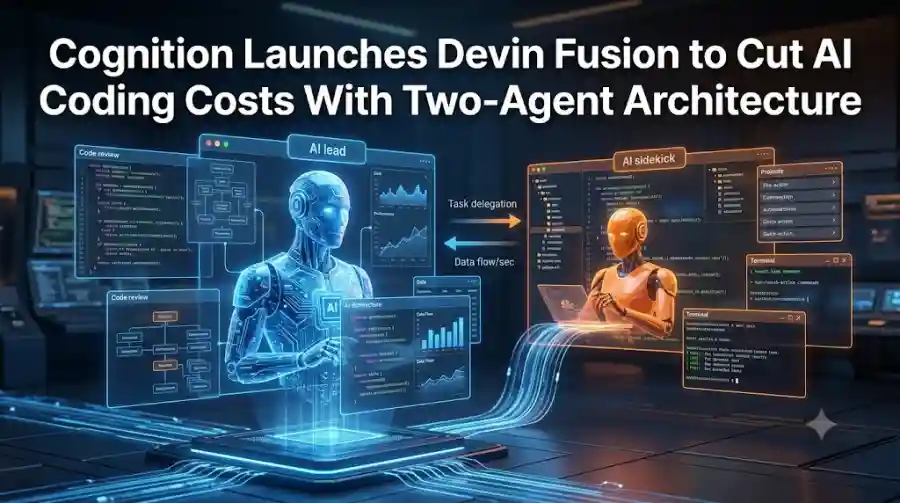
The company has introduced Devin Fusion, a new architecture for its AI software-engineering platform that combines two AI models instead of relying on one model for the entire task.
Cognition says Fusion can deliver frontier-level coding performance while reducing costs by using a powerful model as the lead and a more cost-effective model as the sidekick.
The technology is now available in Devin Desktop and Devin CLI.
What Is Devin Fusion?
Devin Fusion is a multi-model architecture designed for AI-powered software engineering.
Instead of sending every part of a coding task to the same model, Fusion divides responsibilities between two agents.
The first is a frontier model that acts as the lead.
The second is a more cost-effective model that works as the sidekick.
The lead remains responsible for planning, interpreting ambiguous requirements and reviewing the work. The sidekick handles delegated implementation tasks, code exploration, testing and other work that can be separated into well-defined stages.
This creates a different approach to AI model routing.
Rather than deciding at the beginning whether a task is easy or difficult, Fusion keeps the stronger model in control while delegating suitable work to another model.
How the Two-Agent System Works
The basic architecture is relatively straightforward.
A developer starts a task with Devin.
The lead model examines the request and determines what needs to happen.
When part of the work can be delegated, the lead sends the sidekick a focused brief containing the task, constraints and success criteria.
The sidekick then works on its assigned portion.
It can explore the codebase, implement changes, run tests and report the results back to the lead.
The lead then reviews that work and can accept it, request changes or take control itself.
This means the cheaper model does not become the final decision-maker.
The frontier model remains responsible for the overall direction of the session.
Cognition says the two agents maintain their own persistent context and tools rather than continuously passing the entire conversation between models. The agents exchange briefs, results and feedback instead.
That distinction is important because large AI coding sessions can contain enormous amounts of context.
Why Cognition Says Model Routing Is Not Enough
Traditional model routing sounds simple.
Use an expensive model for difficult problems and a cheaper model for easy ones.
The problem is that the difficulty of a software task is often impossible to determine from the initial request.
A developer might write:
Fix this bug.
That could mean changing one line.
It could also mean discovering a deeper architectural problem affecting several parts of a production application.
According to Cognition, the real difficulty becomes clearer only after an agent investigates the codebase.
Switching models after that investigation can also create additional problems, including lost prompt-cache efficiency and duplicated context.
Fusion attempts to avoid that problem.
The frontier lead remains in charge while the sidekick is used for work that can be safely delegated.
Cognition Recommends Fable 5.1 and SWE-2
Cognition recommends pairing Fable 5.1 as the lead with SWE-2 as the sidekick.
This is particularly interesting because SWE-2 was introduced by Cognition only one day before the Fusion announcement.
SWE-2 is Cognition's latest coding model and is designed for agentic software-engineering tasks. The company says it delivers competitive coding performance across different reasoning-effort levels while improving the capability-to-cost balance.
With Fusion, SWE-2 gets a different role.
Instead of being the only model responsible for the entire task, it can serve as the execution-focused sidekick while the stronger lead handles planning and review.
That creates a more specialized division of labor.
Fusion Can Also Work With GPT-6 Astra
Fusion is not limited to one model pairing.
Cognition's published testing also evaluates Fusion using GPT-6 Astra as the lead and SWE-2 as the sidekick.
The company's benchmark table reports lower costs for Fusion across several coding benchmarks while maintaining relatively close performance to using the lead model alone.
For example, Cognition reports:
- DeepSWE 1.1: Astra Fusion reduced reported cost by 40%.
- Terminal-Bench 4: Astra Fusion reduced reported cost by 40%.
- SWE-Atlas QnA: Astra Fusion reduced reported cost by 37%.
- Vals Code Migration: Astra Fusion reduced reported cost by 20%.
- FrontierCode 1.1 Extended: Astra Fusion reduced reported cost by 11%.
These are Cognition's own reported benchmark results, so they should be viewed as vendor-reported measurements rather than universal proof that every coding workload will see the same savings.
The Surprising Idea: A More Expensive Model Can Sometimes Reduce Costs
One of the more interesting conclusions from Cognition's Fusion research is that the cheapest model per token is not necessarily the cheapest model for completing a task.
An inexpensive model might require more turns, more corrections or additional review.
That can increase the total number of tokens consumed.
A stronger model may cost more for each token but finish the task with fewer mistakes and fewer iterations.
Cognition says its experiments found that using a stronger lead model could actually reduce total task costs because the stronger model delegated work more efficiently and created better instructions for the sidekick.
This changes the way AI coding costs should be measured.
Instead of asking:
How much does this model cost per token?
Developers may increasingly need to ask:
How much does it cost to successfully complete the entire task?
Fusion Keeps Frontier Intelligence in Control
A major part of Fusion's design is that the lead agent remains responsible for the session.
The sidekick does not replace the main agent.
Instead, the lead decides what should be delegated, gives the sidekick instructions and reviews the returned work.
That provides an additional layer of control.
If the delegated task turns out to be more complicated than expected, the lead can take control again.
Cognition says this is one of the key differences between Fusion and simple model-routing approaches.
The system does not have to make a perfect prediction about task difficulty before work begins.
The lead can investigate first and delegate after gaining more context.
Why Persistent Context Matters
Long-running AI coding agents can accumulate significant context.
The agent may inspect dozens of files, run commands, analyze errors, read documentation and make several changes before completing a task.
Passing all of that information between models could be expensive and inefficient.
Fusion instead gives each agent its own persistent context.
The lead sends a focused brief to the sidekick rather than transferring the entire session history.
The sidekick then works independently and returns results.
Cognition says this architecture allows both models to benefit from prompt caching while reducing unnecessary context transfer.
Fusion Is Now Available in Devin Desktop and CLI
Cognition has made Fusion available through Devin Desktop and Devin CLI.
The company says developers can select a lead model and a sidekick model when using Fusion.
For its recommended configuration, Cognition suggests Fable 5.1 as the lead and SWE-2 as the sidekick.
This makes Fusion particularly relevant for developers already experimenting with autonomous coding agents.
Rather than adopting a completely separate AI platform, existing Devin users can use the new architecture within the development environment they already use.
What Fusion Means for AI Coding Tools
The launch points to a broader change in how AI coding systems could be designed.
The first generation of coding assistants largely focused on making one model better at writing code.
The next generation is increasingly focused on orchestration.
Instead of asking which single model is best, developers may need to determine which combination of models is best for a particular workflow.
One model could handle architecture.
Another could explore a repository.
A third could run specialized testing.
Another could review security.
This does not necessarily mean every software task needs a large multi-agent system.
In fact, additional agents can introduce coordination costs and complexity.
But Fusion demonstrates one practical approach: keep a high-capability model in charge while using a cheaper model for clearly defined execution work.
Devin Fusion vs Simple AI Model Switching
It is important to distinguish Fusion from simply switching between AI models.
With ordinary model switching, a developer or software system might select a different model depending on the task.
Fusion is more tightly integrated.
The lead and sidekick work together on the same overall objective.
The lead creates the plan.
The sidekick performs delegated work.
The lead reviews the output.
The two agents exchange structured information rather than simply handing the entire conversation from one model to another.
That makes Fusion closer to a collaborative agent architecture than a basic model selector.
What Developers Should Watch
The biggest question for developers is whether the reported savings translate to their own repositories and workloads.
Coding benchmarks provide useful comparisons, but real software projects can behave very differently.
A small web application, a massive enterprise repository and a legacy codebase may require completely different strategies.
Developers should therefore evaluate:
- Total cost per completed task
- Number of required agent turns
- Code quality
- Test success rates
- Review workload
- Debugging time
- Context handling
- Performance on their own repositories
The most important metric is ultimately not the model's headline benchmark score.
It is whether the AI system can complete useful engineering work reliably at a reasonable total cost.
The Bigger Shift Toward Multi-Agent AI
Devin Fusion arrives as the AI industry moves toward increasingly autonomous software agents.
TheInfoBytes has already covered several developments in this area, including AI agents designed for enterprise workflows and coding environments.
Fusion adds another layer to that trend.
The focus is no longer only on making individual models smarter.
It is about designing systems where different models can cooperate according to their strengths.
That could become increasingly important as AI agents take on longer and more complex tasks.
A powerful model may be best at reasoning and planning.
A smaller model may be perfectly capable of implementing a clearly defined change.
Combining them can potentially provide a better balance between intelligence, speed and cost.
Cognition's Devin Fusion is an important development because it tackles one of the less glamorous but increasingly important problems in agentic AI: the cost of completing real work.
Instead of forcing one expensive model to handle every step, Fusion separates planning and execution between a lead model and a cheaper sidekick.
The lead keeps control.
The sidekick handles delegated work.
Both maintain their own context.
And Cognition's published testing suggests that this approach can reduce the cost of complex coding tasks while maintaining competitive performance.
The larger lesson is that the future of AI coding may not belong to a single "best" model.
It may belong to systems that know which model should do which part of the job.
For developers already using Devin, Fusion provides a new way to approach that problem. For the wider AI-tools market, it is another sign that model orchestration is becoming just as important as raw model capability.
FAQs
What is Devin Fusion?
Devin Fusion is Cognition's multi-model architecture for AI software engineering. It pairs a frontier model acting as a lead with a more cost-effective model acting as a sidekick.
How does Devin Fusion reduce AI coding costs?
The lead model handles planning and review while the sidekick performs suitable implementation and exploration tasks. Cognition reports that this can reduce the total cost of completing coding tasks compared with using a frontier model alone.