Coder Agent Relay Brings Cloud AI Coding Agents Into Self-Hosted Enterprise Infrastructure
Announced on September 2, 2026, Coder Agent Relay connects cloud-hosted coding agents with self-hosted Coder workspaces. The first integration is with Cursor Cloud Agents, allowing organizations to keep the Cursor experience while moving the actual tool execution into infrastructure they control.
The company says Agent Relay is currently in private preview with design partners.
This makes the launch different from another AI coding assistant or coding model. Instead, Coder is building an infrastructure layer between AI agents and enterprise environments.
What Is Coder Agent Relay?
Coder Agent Relay is designed to separate where an AI agent thinks from where the agent performs actions.
With a conventional cloud-hosted coding agent, the provider's infrastructure can handle the agent's reasoning, code access and tool execution. That can create problems for organizations that have strict requirements around source code, credentials, internal systems and data residency.
Agent Relay changes the execution side of that architecture.
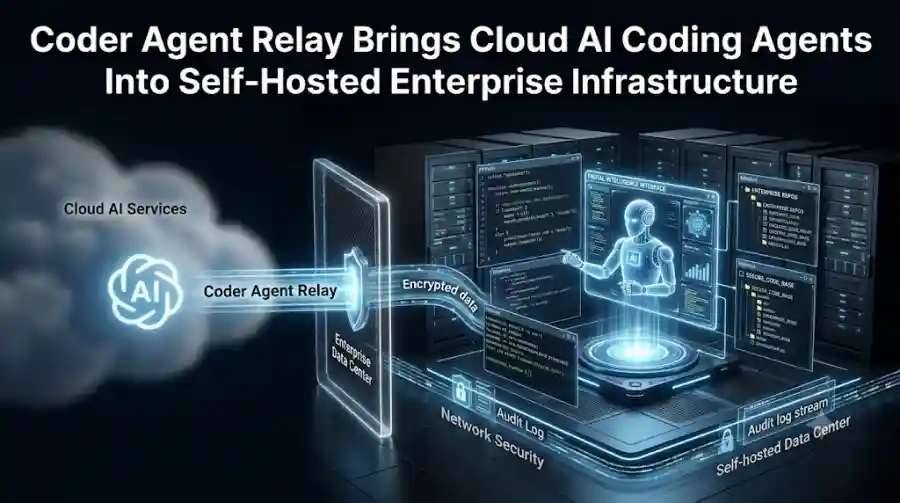
The AI agent can remain cloud-hosted, while its tool calls are executed inside a Coder workspace running on infrastructure controlled by the customer.
In simple terms, the architecture looks like this:
Developer → Cloud AI Agent → Agent Relay → Self-Hosted Workspace → Code and Tools
The important part is that the development environment remains under the organization's control.
Cursor Cloud Agents Is the First Integration
Coder launched Agent Relay with Cursor as its first integration partner.
That means companies using Cursor Cloud Agents can potentially keep the familiar Cursor interface while running the execution environment inside Coder-controlled infrastructure.
Coder's documentation confirms that Agent Relay connects supported cloud-hosted AI agent sessions to self-hosted workspaces. The provider continues to handle orchestration and AI inference, while a worker inside the workspace performs the agent's tool calls.
This distinction is important.
Agent Relay does not turn Cursor into a completely self-hosted AI model.
The reasoning and inference remain with the cloud agent provider. What changes is where the agent interacts with the customer's code, files, commands and other tools.
How Agent Relay Works
The system is built around Coder workspaces.
When a developer starts an agent session, the external agent provider can request an execution resource. Agent Relay can then launch a suitable workspace and connect the provider's agent worker to that environment.
The workspace can use prebuilt configurations to reduce startup time.
Once connected, the agent can perform development operations inside that workspace.
This means organizations can apply their existing infrastructure controls to AI-generated work.
Coder says Agent Relay can work with features such as:
- Role-based access control
- Agent Firewall
- Audit logging
- Network policies
- Self-hosted workspaces
- Customer-controlled infrastructure
- Ephemeral execution environments
These controls are particularly important when AI agents can execute commands instead of simply generating text.
Why Enterprise AI Coding Needs This
For individual developers, sending code to a cloud AI service may be acceptable.
Large organizations have a different set of requirements.
A company may have:
- Private source repositories
- Internal APIs
- Customer information
- Proprietary software
- Cloud credentials
- Strict compliance rules
- Data residency requirements
- Network restrictions
- Audit requirements
Giving an autonomous AI agent access to these systems introduces additional security questions.
An organization needs to know what the agent can access, what it changed, which tools it used and which person requested the operation.
Agent Relay is designed to address these infrastructure-level problems rather than relying entirely on the AI model to behave correctly.
Source Code and Secrets Can Stay Inside the Company's Environment
One of the biggest benefits of the architecture is control over execution.
Coder says workspaces can run on a customer's cloud, VPC or on-premises infrastructure. The company also highlights air-gapped deployment options for environments where external access is highly restricted.
That could be valuable for organizations that cannot allow source code or sensitive credentials to leave their controlled environment.
For example, consider a financial institution using an AI agent to refactor an internal application.
Instead of allowing the agent to execute directly against a vendor-controlled environment, the organization could provide an isolated Coder workspace.
The agent would still be able to perform development tasks, but the execution environment could enforce the company's own network and security policies.
Agent Relay Adds an Important Security Layer
AI agents introduce a different security challenge from traditional software.
A normal application follows predefined instructions.
An AI agent can interpret a task, choose tools and perform a sequence of actions.
That flexibility is useful, but it also creates additional risks.
Prompt injection is one example.
An AI agent could encounter malicious instructions hidden inside a repository, document or webpage. If the agent has broad access to company infrastructure, the consequences could be serious.
Coder's approach is to enforce boundaries at the infrastructure level.
The company's Agent Relay announcement describes sandboxed and ephemeral environments, network controls and policies that can limit what an agent is allowed to reach.
This creates another layer of protection around the AI model.
Every Agent Action Can Be Audited
Governance is another major part of the Agent Relay strategy.
Enterprises need more than a sandbox. They also need an audit trail.
Coder says Agent Relay can associate agent activity with the human who initiated the work.
That means organizations can maintain records around actions such as:
- Files accessed
- Commands executed
- Changes made
- Tool calls
- Blocked operations
- Workspace activity
This can make investigations and compliance reporting easier because organizations have a record of what the agent actually did.
Coder describes this as an important part of making autonomous development suitable for enterprise environments.
Agent Relay Does Not Move AI Inference On-Premises
There is an important limitation that users should understand.
Agent Relay does not mean that the entire AI stack becomes self-hosted.
Coder explains that the external agent provider still handles the reasoning loop and AI inference. The execution of tool calls happens inside the customer's Coder workspace.
That makes Agent Relay different from a completely self-hosted AI coding system.
Organizations that require the model, reasoning process and execution environment to remain under their own infrastructure would need a different architecture.
Coder itself offers Coder Agents for organizations that want a more fully self-hosted approach.
How Agent Relay Differs From Other AI Coding Platforms
The AI coding market is becoming crowded.
Platforms such as Replit are focusing on automatically selecting models and simplifying application development. TheInfoBytes recently covered Replit's Intelligent Model Routing, which automatically chooses models according to task requirements while balancing quality, speed and cost.
Huawei's CodeArts Agent takes another approach by providing enterprise AI coding capabilities around codebase intelligence and development workflows.
Coder is approaching the problem from a different direction.
Its main question is not:
Which AI model should write the code?
Instead, it is asking:
Where should an AI coding agent execute that code, and who controls the environment?
That distinction makes Agent Relay particularly relevant to enterprise AI adoption.
Why This Could Matter for Regulated Industries
Banks, government agencies, defense organizations and healthcare companies often have stricter infrastructure requirements than startups or individual developers.
For these organizations, AI coding agents may already be attractive because they can automate tasks such as:
- Code generation
- Refactoring
- Test creation
- Debugging
- Documentation
- Repository analysis
- Software maintenance
But security teams may reject a tool if they cannot control its execution environment.
Agent Relay attempts to remove that barrier.
Instead of forcing enterprises to choose between modern AI coding tools and strict infrastructure controls, Coder wants to provide both.
Agent Relay Is Still in Private Preview
Despite the potential, Agent Relay is not yet a generally available enterprise product.
Coder currently describes Agent Relay as being in private preview or early access with selected customers and design partners.
That means organizations should not treat it as a finished, universally available deployment option yet.
The current launch is more significant as an architectural direction.
AI coding agents are moving beyond developer experiments, and companies now need infrastructure capable of safely supporting autonomous software development.
What Coder Agent Relay Means for the Future of AI Coding
The next stage of AI coding may not simply be about creating more capable models.
It may be about building better infrastructure around those models.
AI agents need access to files, terminals, repositories, databases, APIs and other tools. Giving them those capabilities creates security and governance challenges that ordinary AI chat interfaces do not face.
Coder Agent Relay addresses one part of this problem by separating the AI agent from the execution environment.
The result is a model where companies can potentially adopt cloud-based AI coding agents while keeping critical development infrastructure under their own control.
That could become increasingly important as autonomous coding moves into heavily regulated industries.
Coder Agent Relay: Key Takeaways
Coder Agent Relay is not another AI coding model. It is an infrastructure layer designed to make cloud AI coding agents more suitable for enterprise environments.
The key points are:
- Cursor Cloud Agents is the first integration.
- Agent reasoning and inference remain cloud-hosted.
- Tool execution can happen inside self-hosted Coder workspaces.
- Enterprises can apply their own security and network controls.
- Workspaces can be isolated and ephemeral.
- Agent actions can be logged and attributed.
- The platform is currently in private preview.
- The approach is particularly relevant to regulated organizations.
If AI agents are going to write and modify production software at scale, controlling where those agents execute may become just as important as choosing the underlying AI model.
FAQs
What is Coder Agent Relay?
Coder Agent Relay is an infrastructure system that connects cloud-hosted AI coding agents with self-hosted Coder workspaces, allowing agent tool execution to occur inside customer-controlled environments.
Which AI coding agent currently works with Agent Relay?
Cursor Cloud Agents is the first supported cloud-hosted agent announced for Coder Agent Relay.