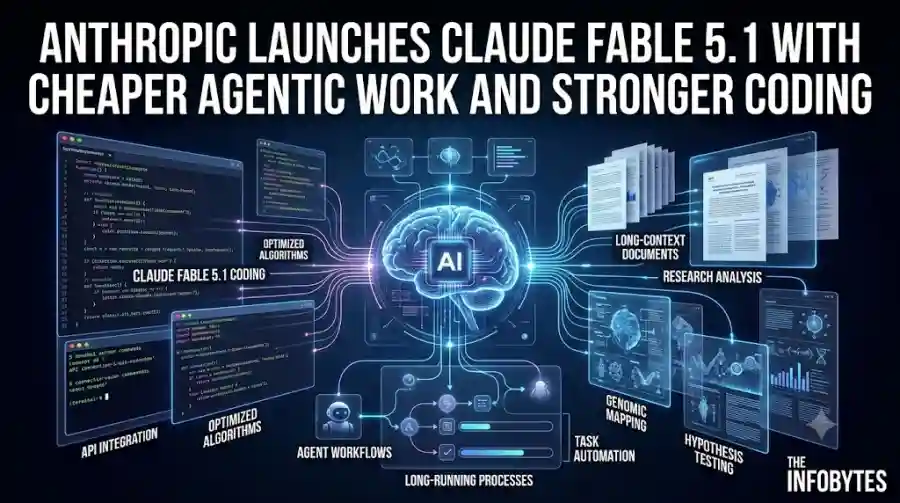
Claude Fable 5.1 Brings Stronger Coding, 1M Context and Up to 45% Lower Agentic Costs
The September 1 launch also introduced Claude Mythos 5.1, a closely related model available through Anthropic's trusted-access programs for specialized cybersecurity and life-sciences work.
Fable 5.1 is now generally available to Claude Pro, Max, Team and Enterprise users, as well as developers through the Claude API and major cloud platforms.
The launch is notable because Anthropic is not only claiming better model performance. It is also targeting one of the biggest problems with advanced AI agents: cost.
Anthropic says Fable 5.1 can reduce the cost of typical workloads by around 25% and highly agentic workloads by up to approximately 45%, largely because cache reads are now much cheaper.
What Is Claude Fable 5.1?
Claude Fable 5.1 is Anthropic's latest model for demanding professional and development workloads.
The company positions it for tasks that can take hours rather than a few seconds.
These include:
- Large software projects
- Code review
- Debugging
- Long-running coding sessions
- Deep research
- Complex document analysis
- Multi-stage knowledge work
- Browser-based tasks
- Autonomous agents
- Technical problem solving
Anthropic describes Fable 5.1 as its most capable generally available model for ambitious coding and knowledge work.
The model is designed to plan a task, use tools, recover when something goes wrong and continue working without requiring constant user supervision.
That makes it more relevant to the growing agentic-AI market than a traditional chatbot model.
Fable 5.1 Keeps a 1 Million Token Context Window
One of the major technical specifications remains the 1 million token context window.
The model can also generate up to 128,000 tokens in a single response.
A large context window matters when AI systems need to work with substantial amounts of information simultaneously.
For developers, this can mean working with larger repositories, documentation and technical specifications.
For researchers and knowledge workers, it can mean analyzing larger collections of documents without repeatedly splitting the work into smaller conversations.
The large context window is particularly useful for agentic workloads because an AI agent may need to retain information across many steps.
Anthropic Makes Fable 5.1 Cheaper for Agentic Work
The biggest practical change may be the pricing structure.
Anthropic lists Fable 5.1 at:
- $10 per million input tokens
- $50 per million output tokens
- $12.50 per million tokens for 5-minute cache writes
- $20 per million tokens for 1-hour cache writes
- $0.25 per million tokens for cache reads
The cache-read price is significantly lower than Fable 5's previous $1 per million token rate.
That matters because agents often reuse the same context repeatedly.
An autonomous coding agent may repeatedly reference the same repository files, instructions, tools and previous work.
Instead of paying the full input price every time, cached information can be reused.
Anthropic says this change reduces typical workload costs by approximately 25% and highly agentic workloads by up to approximately 45%.
Why Lower Agent Costs Matter
AI agents can consume substantially more tokens than ordinary chatbot conversations.
A simple question might require one request and one answer.
An autonomous coding task can involve:
- Understanding the request
- Inspecting the repository
- Reading multiple files
- Creating a plan
- Writing code
- Running tests
- Reading errors
- Changing the implementation
- Running tests again
- Reviewing the final result
Every additional step can increase token consumption.
For businesses running thousands of agent tasks, those costs can quickly become significant.
Lower cache-read pricing therefore has the potential to make long-running agents more practical.
Fable 5.1 Is Built for Long-Running Coding
Anthropic is targeting developers who want AI systems to work on larger projects rather than simply generate isolated snippets.
The company says Fable 5.1 can handle features spanning entire codebases, code review, performance optimization and multi-day autonomous sessions.
The model can also write tests to check its own work.
This is important because autonomous coding is not simply about generating source code.
A useful coding agent needs to verify whether its changes actually work.
The ability to inspect outputs, run tests and iterate can make an AI system more useful for real development workflows.
Fable 5.1 Can Work as an Autonomous Agent
Anthropic has designed Fable 5.1 for tasks that involve multiple applications and tools.
The company says the model can work through backlogs in Cowork, handle requests through Claude Tag beta, operate browsers and run as a managed agent on the Claude Platform.
The intended workflow is closer to delegating a project than asking a chatbot a question.
A user can provide an objective.
The agent can then:
- Plan the work
- Select tools
- Execute actions
- Recover from failures
- Check results
- Continue working
- Report progress
This is one of the clearest signs that AI products are moving from conversational assistance toward autonomous task completion.
Fable 5.1 Improves AI-Assisted Research
Coding is not the only focus.
Anthropic also positions Fable 5.1 as a knowledge-work and research model.
The model can work with documents, diagrams, charts and tables.
Its vision capabilities allow it to interpret visual information embedded in files and PDFs, which can be useful in areas such as finance, legal work, analytics and architecture.
This expands the model beyond conventional text-based research.
A professional could potentially provide a collection of documents containing written information, tables and diagrams and ask the model to analyze them as part of a larger workflow.
Fable 5.1 Can Inspect Its Own Coding Work
Another interesting capability is the use of vision during software development.
Anthropic says Fable 5.1 can use vision to evaluate its coding output against the original design or objective.
This could be useful for frontend development.
Instead of simply producing HTML, CSS or JavaScript and assuming the result is correct, an agent can inspect the rendered output and compare it against the intended design.
That creates a feedback loop:
Build → Inspect → Compare → Fix → Inspect Again
Such loops could become increasingly important as AI coding agents take on larger development tasks.
Claude Mythos 5.1 Targets Specialized Research
Alongside Fable 5.1, Anthropic introduced Claude Mythos 5.1.
Mythos uses the same core specifications as Fable 5.1, including the 1 million token context window, 128K maximum output and $10/$50 per-million-token input/output pricing.
But its availability is different.
Mythos 5.1 is currently offered by invitation through Project Glasswing and trusted-access programs.
Anthropic is targeting specialized use cases involving advanced cybersecurity and life-sciences research.
This restricted approach reflects the potential risks associated with highly capable AI systems in sensitive scientific and cybersecurity environments.
Fable 5.1 Gets More Targeted Safety Controls
Anthropic has also changed its safety approach.
The company says Fable 5.1 includes safeguards designed to reduce misuse risks in areas such as cybersecurity, biology and chemistry.
Some requests involving sensitive areas can be restricted or routed to other Claude models.
At the same time, Anthropic says the new model's cybersecurity safeguards reduce false positives by around 60% for Claude Code users.
This is important for legitimate developers.
An AI coding assistant that incorrectly blocks normal defensive security work can become frustrating.
Anthropic is therefore trying to find a balance between preventing dangerous assistance and allowing legitimate security research and software development.
Fable 5.1 Can Identify Software Vulnerabilities
Anthropic says Fable 5.1 can now be used to identify software vulnerabilities, while safeguards limit assistance that could be used to exploit them.
That creates a distinction between defensive and offensive cybersecurity.
For example, an organization could use an AI system to inspect its software and identify a potential weakness.
But the system is designed to avoid turning that information into instructions for exploiting the vulnerability.
This could make advanced AI more useful for security teams while maintaining stronger restrictions around potentially harmful capabilities.
Fable 5.1 Is Available Across Major Platforms
Developers do not have to use Anthropic's consumer interface to access the new model.
Fable 5.1 is available through:
- Claude
- Anthropic's API
- Amazon Web Services
- Google Cloud
- Microsoft Foundry
Anthropic's official documentation lists the model as generally available.
This makes the launch relevant to both individual professionals and enterprise developers.
Companies can integrate Fable 5.1 into their own applications and agent systems rather than relying entirely on the Claude interface.
How Fable 5.1 Fits Into the AI Coding Market
The AI coding market is becoming increasingly competitive.
TheInfoBytes has already covered platforms such as Replit's Intelligent Model Routing and Huawei CodeArts Agent, which focus on different parts of AI-assisted software development.
Fable 5.1 takes a model-first approach.
Its goal is to provide the underlying intelligence needed for complex coding and agentic workflows.
That means developers can potentially use the model through different environments rather than being locked into one coding platform.
This is particularly relevant as AI development increasingly separates the model, agent framework, IDE and infrastructure layers.
Fable 5.1 vs Traditional Chatbots
Traditional AI chatbots are generally optimized for short interactive conversations.
Fable 5.1 is designed for a different workflow.
Traditional Chatbot
User asks → AI responds → User asks again → AI responds
Fable 5.1 Agentic Workflow
User gives objective → AI plans → AI uses tools → AI executes → AI verifies → AI continues → AI reports results
The second approach requires stronger reasoning, memory, tool use and error recovery.
It also makes cost efficiency much more important.
That explains why Anthropic is emphasizing both capability and lower cache costs with this release.
Who Should Use Claude Fable 5.1?
Software Developers
Developers working on large codebases can use Fable 5.1 for implementation, debugging, testing and code review.
Research Teams
Researchers can use the model for complex document analysis and long-running research workflows.
Enterprise Teams
Businesses can integrate Fable 5.1 into larger knowledge-work and automation systems.
AI Agent Developers
Developers building autonomous agents may benefit from its long context and tool-use capabilities.
Technical Professionals
People working with complex documentation, diagrams, data and multi-stage projects may find the model more useful than a standard chatbot.
What Does Claude Fable 5.1 Mean for AI Agents?
The most important part of this launch may not be the benchmark numbers.
It is the direction of the product.
AI companies are increasingly building models around delegated work.
Instead of asking:
"How can AI answer this question?"
The focus is becoming:
"Can AI take this objective and finish the task?"
Fable 5.1 is clearly designed around that second question.
The model is expected to work for extended periods, use tools, recover from failures and verify results.
That makes it part of the broader shift from AI assistants toward AI workers.
Should You Try Claude Fable 5.1?
For developers and advanced AI users, Fable 5.1 is worth testing if your work involves complex coding, research or long-running agentic tasks.
The lower cache-read cost is particularly interesting for developers running agents repeatedly against large amounts of context.
However, the model is not necessarily the best choice for every task.
Simple questions and lightweight content generation may not justify using a slower, higher-cost frontier model.
The strongest use case is work where better reasoning and extended autonomous execution can save significant human time.
The Bigger Picture
Claude Fable 5.1 shows how competition between AI companies is changing.
Model launches are no longer only about larger benchmark scores.
Developers increasingly care about:
- Cost per completed task
- Context size
- Tool use
- Agent reliability
- Coding performance
- Long-running execution
- Safety controls
- Enterprise availability
- Data privacy
Anthropic's latest release addresses many of these areas simultaneously.
The company is combining a highly capable model with lower cache-read costs, longer workflows, stronger coding capabilities and more targeted safety controls.
If AI agents continue moving toward multi-hour and multi-day autonomous work, those improvements could become more important than raw chatbot performance.
Key Takeaways
Claude Fable 5.1 is Anthropic's latest major model for coding, research and knowledge work.
The most important points are:
- Fable 5.1 is generally available.
- It supports a 1 million token context window.
- Maximum output is 128,000 tokens.
- Base pricing is $10 per million input tokens and $50 per million output tokens.
- Cache reads are priced at $0.25 per million tokens.
- Anthropic estimates up to approximately 45% lower costs for highly agentic workloads.
- The model is designed for long-running coding and research.
- It can use tools and operate as a managed agent.
- Improved safeguards target sensitive cybersecurity, biology and chemistry use cases.
- Mythos 5.1 is restricted to vetted users and specialized programs.
For developers, the most interesting change may be simple: advanced AI agents are becoming cheaper to run for long, repetitive workflows.
That could accelerate the shift from AI that assists developers to AI that independently handles larger portions of software and knowledge work.
FAQs
What is Claude Fable 5.1?
Claude Fable 5.1 is Anthropic's latest generally available frontier model designed for coding, research, knowledge work and long-running agentic tasks.
How much does Claude Fable 5.1 cost?
Anthropic lists pricing at $10 per million input tokens and $50 per million output tokens. Cache reads cost $0.25 per million tokens.