IIT Madras-Backed Bodhan AI Launches Indic-Transcribe for Indian Languages, Accents and Code-Mixed Speech
Bodhan AI and AI4Bharat are trying to address that problem with Indic-Transcribe, a new speech recognition model designed specifically around Indian language use.
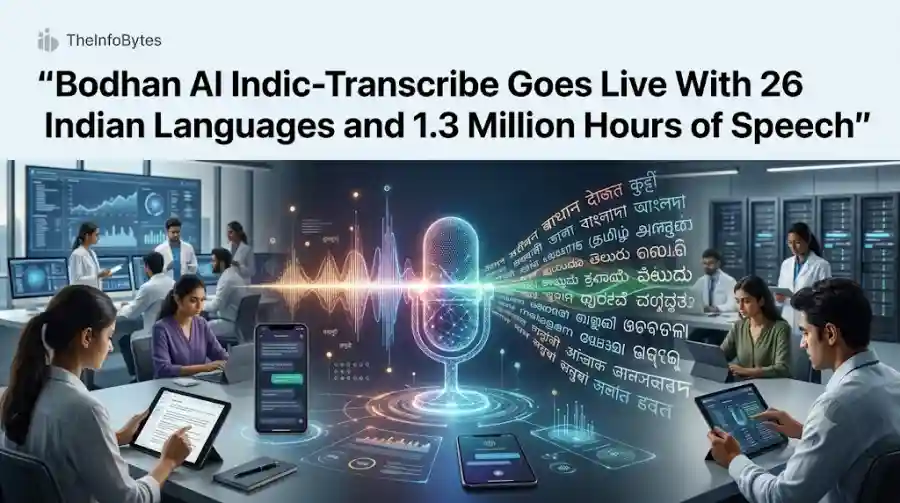
The model is going live on Bodhan AI and Hugging Face on September 5, 2026, following the project's earlier preview announcements. Bodhan AI says Indic-Transcribe supports 26 Indian languages plus English and was trained using approximately 1.3 million hours of speech data.
The model contains approximately 1.2 billion parameters.
Rather than positioning it as another generic transcription model, Bodhan AI is presenting Indic-Transcribe as a foundation for voice applications designed around India's linguistic diversity.
What Is Indic-Transcribe?
Indic-Transcribe is a speech recognition model developed by Bodhan AI in collaboration with AI4Bharat.
Its main purpose is to convert spoken language into text.
But the project is designed around challenges that are common in Indian speech.
These include:
- Multiple Indian languages
- Regional accents
- Code-mixed conversations
- Different scripts
- Children's speech
- Less-represented Indian languages
Bodhan AI describes the model as being built for the way India actually speaks rather than assuming that speakers will use one standardized language or accent.
This distinction could make the model useful for developers building voice-first applications for Indian users.
Indic-Transcribe Supports 26 Indian Languages Plus English
One of the biggest reasons the model is attracting attention is its language coverage.
Bodhan AI says Indic-Transcribe supports 26 Indian languages along with English.
The project is particularly focused on languages and speech patterns that can be difficult for general-purpose speech recognition systems.
This could make the model useful for applications where users naturally switch between languages.
For example, an Indian user might ask a question in Hindi, include an English technical term and then switch back to Hindi.
This type of code-mixed speech is common in everyday conversations.
Indic-Transcribe is specifically designed to handle such situations.
Why Code-Mixed Speech Matters
Code-mixing is one of the biggest challenges for voice AI in multilingual countries.
A person may say:
“Kal meeting hai, please report ready rakhna.”
The sentence combines Hindi and English naturally.
A speech model designed around only one language may struggle with language boundaries, pronunciation or technical words.
Indic-Transcribe is designed with multilingual and code-mixed speech in mind.
That could be valuable for:
- Customer-support systems
- Voice assistants
- Educational applications
- Government services
- Call-center software
- Indian-language content creation
- Accessibility applications
- Voice search
The broader opportunity is to make voice interfaces feel more natural for Indian users.
The Model Was Trained on 1.3 Million Hours of Speech
Training data is a major factor in speech recognition.
Bodhan AI says Indic-Transcribe was trained using approximately 1.3 million hours of speech data.
The model has around 1.2 billion parameters.
The combination is intended to help the model learn different voices, accents, languages and speaking patterns.
Bodhan AI says its training approach is designed to capture the diversity of Indian speech instead of relying primarily on standardized recordings.
This matters because real-world speech can be very different from carefully recorded studio audio.
People speak quickly.
They interrupt themselves.
They use background noise.
They switch languages.
They have regional accents.
A useful speech recognition system needs to handle these conditions rather than only clean audio.
Indic-Transcribe Is Designed for Indian Accents
Accent recognition is another important part of the project.
India has significant regional variation in pronunciation.
Two people speaking the same language can pronounce words differently depending on their region, background and first language.
A model trained on a narrow range of speakers can therefore perform poorly outside those conditions.
Bodhan AI says Indic-Transcribe has been designed to work with diverse Indian accents and speech patterns.
That could make the model more practical for applications targeting users across different parts of the country.
Children's Speech Is Also a Target
Another interesting aspect of the project is its focus on children's speech.
Children can be particularly difficult for automatic speech recognition systems because their voices, pronunciation and speaking patterns differ from adults.
Bodhan AI says Indic-Transcribe has been developed with children's speech in mind.
This is particularly relevant to the project's education focus.
A voice-based AI tutor could potentially allow students to ask questions verbally rather than requiring them to type.
For students who are more comfortable speaking their local language, that could reduce one of the barriers to using AI-powered educational systems.
Indic-Transcribe Fits Into Bodhan AI's Larger Education Strategy
Indic-Transcribe is not an isolated project.
Bodhan AI is an IIT Madras-incubated Centre of Excellence focused on AI for education.
The organization has also been developing a broader multilingual AI infrastructure for India's education ecosystem.
On September 4, Bodhan AI and AI4Bharat announced four foundational AI models covering speech recognition, speech generation, machine translation and optical character recognition. Those models are being positioned as digital public goods for India's multilingual education ecosystem.
Indic-Transcribe adds another important piece to that infrastructure.
The overall concept is straightforward:
Voice → AI understanding → Learning
A student should be able to speak naturally, have the system understand the speech and then receive an AI-powered response.
That workflow becomes much more difficult if the speech recognition layer does not understand the student's language or accent.
How Indic-Transcribe Could Be Used
The model could support several types of applications.
AI Tutors
An education platform could use Indic-Transcribe to allow students to ask questions by voice.
Instead of typing a question in English, a student could speak in a supported Indian language.
The speech could then be converted to text and passed to an AI reasoning system.
The final response could be generated in the student's preferred language.
Voice Search
Search applications could use Indic-Transcribe as a speech recognition layer for Indian-language voice queries.
This could be useful for smartphones, websites and other applications designed around voice interaction.
Customer Support
Companies could use the model to transcribe customer calls.
This could help organizations analyze conversations and create searchable records.
It could also become part of voice-based customer-service agents.
Content Transcription
Creators could use Indic-Transcribe to convert:
- Interviews
- Podcasts
- Lectures
- Videos
- Meetings
- News recordings
into searchable text.
For regional-language creators, better support for local accents and languages could reduce the amount of manual correction required.
Accessibility
Speech recognition can also help users who have difficulty typing.
A multilingual speech-to-text layer can make digital services easier to access for users who prefer speaking in their native language.
Indic-Transcribe Is Different From Google's Gemini 3.5 Transcribe
The InfoBytes has already covered Google Gemini 3.5 Transcribe, which supports more than 85 languages and provides features such as smart transcription, speaker detection and custom vocabulary.
Indic-Transcribe is targeting a different problem.
Gemini 3.5 Transcribe is a broad commercial speech model intended for developers building voice applications across many global languages.
Indic-Transcribe is more specifically focused on Indian speech.
Its emphasis includes:
- Indian languages
- Indian accents
- Code-mixed speech
- Children's voices
- Underrepresented languages
- India's education ecosystem
That specialization is important.
The goal is not necessarily to compete with every general-purpose speech model.
Instead, Bodhan AI is attempting to build a model that performs well in situations specific to India.
Indic-Transcribe and India's Multilingual AI Push
India has become one of the world's most important markets for AI adoption.
But language remains a major challenge.
Many digital services are still optimized around English or a small group of widely supported languages.
India's linguistic diversity creates a different requirement.
AI systems need to understand not only multiple languages but also:
- Regional accents
- Different scripts
- Code mixing
- Local terminology
- Informal speech
- Different speaking speeds
This is why projects such as Indic-Transcribe can be important even when larger global models already support Indian languages.
Specialized models can focus on the data and use cases that general-purpose systems may not prioritize.
Indic-Transcribe Could Help Build Voice-First AI in India
The next generation of AI applications may increasingly use voice as an interface.
Users do not always want to type a long prompt.
Voice can be faster and more natural.
This is particularly relevant on mobile devices.
A user could potentially say:
“Find the information about my electricity bill.”
The speech recognition system converts the request into text.
An AI agent interprets the instruction.
The agent accesses the relevant service.
The user receives a response.
For this workflow to work reliably, the first stage needs to understand what the user said.
Indic-Transcribe could therefore become part of a larger voice-agent ecosystem.
The Model Could Be Useful Beyond Education
Although education is a major focus of Bodhan AI, the technology could have applications beyond classrooms.
Potential use cases include:
Banking
Banks could use Indian-language speech recognition for customer service and voice-based assistance.
Government Services
Government portals could potentially use voice interfaces to make digital services easier to access.
Healthcare
Healthcare applications could use speech recognition to transcribe conversations, although high-stakes deployments would require careful validation and appropriate privacy controls.
Media
Newsrooms, broadcasters and content creators could use the model to transcribe regional-language recordings.
Enterprise
Businesses could use it for multilingual meetings, calls and internal voice applications.
These are potential applications rather than guarantees of current product availability.
Indic-Transcribe Is Being Released as an Open Model
One of the most important aspects for developers is accessibility.
Bodhan AI has announced that Indic-Transcribe is being made available through its platform and Hugging Face.
The project's public materials describe the model as an open AI system intended to become a building block for applications serving Indian users.
That gives researchers and developers an opportunity to experiment with the technology instead of treating it only as a closed API.
Open model availability can also encourage independent evaluation.
Developers can test the model against their own audio and languages before deciding whether it is suitable for production.
Indic-Transcribe Joins a Growing Indian AI Ecosystem
Indic-Transcribe is arriving during a period of rapid growth in Indian AI.
TheInfoBytes recently covered Gnani Artha, another Indian AI initiative focused on sovereign deployment, Indic languages and enterprise AI agents.
The difference is that Gnani Artha focuses heavily on language models and enterprise agents, while Indic-Transcribe focuses on speech recognition.
Together, projects like these show that India's AI ecosystem is expanding beyond general-purpose chatbots.
Developers are increasingly building specialized infrastructure for:
- Indian languages
- Voice AI
- Education
- Enterprise automation
- Sovereign AI
- AI agents
- Document understanding
What Makes Indic-Transcribe Interesting for Developers?
For developers building applications in India, the model offers several potentially useful characteristics.
Broad Indian Language Coverage
Support for 26 Indian languages plus English gives developers a foundation for multilingual applications.
Code-Mixed Speech
The ability to handle conversations where users switch between languages could be valuable in real-world applications.
Accent Diversity
Support for regional accents can improve the usefulness of voice applications across different parts of India.
Children's Speech
This could be especially relevant for education applications.
Open Access
Developers and researchers can experiment with the model and investigate its capabilities.
What Developers Should Test Before Production
Despite the promising specifications, developers should not assume that a model will work equally well for every language or environment.
Real-world testing remains important.
Developers should evaluate:
- Word error rates
- Regional accents
- Background noise
- Code-mixed conversations
- Speaker variation
- Children's speech
- Domain-specific vocabulary
- Audio quality
- Latency
- Infrastructure requirements
A model can perform strongly on published benchmarks and still require additional testing for a specific application.
This is especially important for systems used in education, healthcare, finance or government.
Indic-Transcribe Could Become a Building Block for India's Voice AI Future
The most interesting part of Indic-Transcribe is not simply its 1.2-billion-parameter size.
It is the problem the model is trying to solve.
India does not have one standard way of speaking.
People use different languages, accents, scripts and combinations of languages.
For voice AI to become genuinely useful across the country, speech systems need to reflect that reality.
Indic-Transcribe is designed around exactly that challenge.
With support for 26 Indian languages plus English, approximately 1.3 million hours of training data and a focus on accents, code-mixed speech and children's voices, the model could become a useful foundation for developers building voice-first applications for India.
Its release also arrives at the right time.
AI agents are becoming more capable, while education platforms, businesses and public services are increasingly experimenting with conversational interfaces.
The next major step could be making those systems understand users in the languages and voices they naturally use.
Indic-Transcribe is an important step in that direction.
FAQs
What is Bodhan AI Indic-Transcribe?
Indic-Transcribe is a speech recognition model developed by Bodhan AI and AI4Bharat for Indian-language speech. It converts spoken language into text and is designed for multilingual speech, regional accents and code-mixed conversations.
How many languages does Indic-Transcribe support?
Bodhan AI says Indic-Transcribe supports 26 Indian languages plus English.