Anthropic Brings AI Agents Into Labs and Factories With New Model Hardware Standard
The announcement is important because much of the current AI-agent race has focused on software. Today's agents can write code, browse websites, analyze documents and perform digital workflows. MHS points toward another stage: agents that can coordinate machines in the physical world.
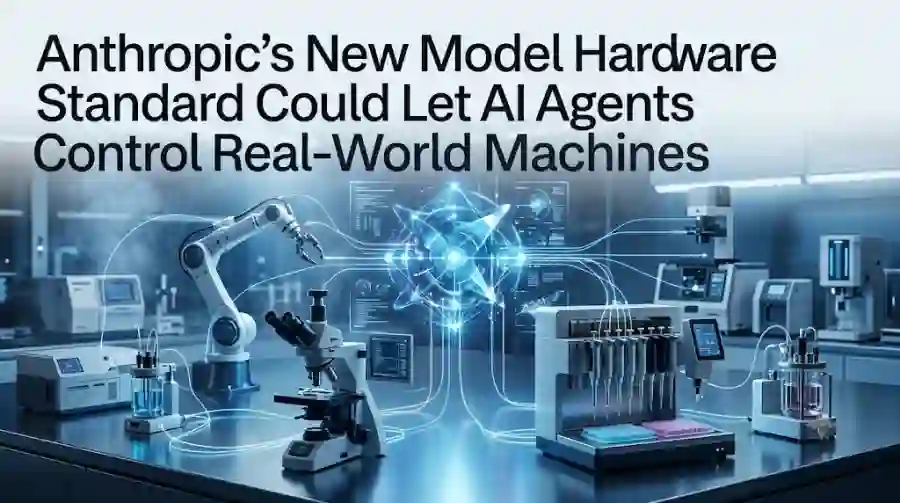
Anthropic says MHS can allow agents to work with equipment such as microscopes, liquid handlers and robotic arms. The company is initially working with scientific research labs and advanced manufacturers while it develops safety evaluations and deployment practices.
What Is Anthropic’s Model Hardware Standard?
The Model Hardware Standard is a common interface designed to help AI agents communicate with programmable physical devices.
The basic problem is straightforward. Laboratories and manufacturing facilities often use equipment from different vendors. Each machine can have its own software, controls and programming interface.
Connecting several machines into one automated workflow can therefore require custom integration work.
Anthropic says this setup process can take weeks or even months in some environments. MHS is designed to reduce that integration burden by providing a standardized way for devices and AI agents to discover each other and communicate.
The system uses standardized commands that Anthropic describes as primitives such as reading information from a device or writing a new setting to it.
For example, an AI agent could potentially read a temperature from one piece of laboratory equipment and then issue a command to another device based on that information.
This is different from simply asking an AI chatbot for instructions.
The agent can become part of the actual workflow.
AI Agents Could Coordinate Multiple Machines
One of the most interesting parts of MHS is its ability to connect multiple devices.
Anthropic says the standard can allow AI agents to operate several laboratory and manufacturing instruments in parallel.
Potential equipment includes:
- Microscopes
- Liquid handlers
- Robotic arms
- Lasers
- Laboratory automation systems
- Other programmable devices
The goal is to allow an AI agent to reason through an experiment, interact with equipment, monitor results and adjust parameters when appropriate.
Anthropic has already described demonstrations involving coordinated laboratory equipment.
In one example, a liquid handler and robotic arm were able to coordinate their actions so that one machine did not begin its next movement until the other had completed its operation. Anthropic says the setup allowed the instruments to work together without collisions during repeated tests.
That kind of coordination could become particularly useful in laboratories where experiments require many repetitive steps.
Why This Matters for AI Agents
The AI industry is increasingly moving from conversational assistants toward systems that can perform tasks.
A normal chatbot might explain how a scientific experiment should be conducted.
An AI agent connected through a hardware interface could potentially help execute parts of that experiment.
That distinction is significant.
Software agents already interact with APIs, websites, databases and computer applications. Physical machines are harder because they have real-world constraints.
A mistake in software may produce an incorrect document.
A mistake involving a robotic arm, chemical system or industrial machine could damage equipment, ruin an experiment or create a safety problem.
That is why Anthropic is treating MHS as a research preview rather than immediately releasing it as a mature, unrestricted system.
MHS Is Not Limited to Claude
Another important detail is that the Model Hardware Standard is designed to be model-agnostic.
Anthropic says MHS can work with different AI models and agent systems rather than being restricted exclusively to Claude. Agents can access the standard through common protocols, including Anthropic's Model Context Protocol.
That could make the project more significant than a normal Claude feature.
If hardware manufacturers, researchers and software developers eventually adopt a common standard, different AI systems could potentially interact with the same equipment.
This resembles the broader purpose behind interoperability standards in computing: reducing the need for every company to build a completely separate connection.
How MHS Could Change Scientific Research
Scientific research is one of the clearest potential applications.
Modern laboratories already use sophisticated automation. Researchers can operate robotic equipment to handle samples, measure results and repeat experiments.
The problem is that integrating all those systems can require significant engineering work.
Anthropic says MHS could allow researchers to interact with specialized laboratory equipment using natural-language interfaces while reducing the need to manually write custom integration code.
This could eventually support longer-running automated experiments.
For example, an AI system could potentially monitor an experiment, identify a change in conditions, adjust a parameter and continue the workflow.
The company says the broader goal is to help build autonomous laboratories where AI handles repetitive mechanical parts of experimental execution while human scientists continue focusing on areas such as experimental design, interpretation and decision-making.
Drug Discovery Could Be a Major Use Case
Drug discovery is another area where the technology could become valuable.
Laboratory research can involve thousands of repetitive operations and large numbers of variables.
Automating those processes could allow researchers to test more possibilities without requiring humans to manually perform every mechanical step.
Anthropic says MHS is being tested in scientific environments that include drug-discovery workflows.
The company also describes the standard as useful for coordinating systems involved in experiments that require multiple instruments to work together.
If these systems become reliable, AI agents could eventually become an orchestration layer between scientific objectives and laboratory equipment.
That does not mean AI scientists are replacing human researchers.
Instead, the more realistic near-term scenario is AI taking over repetitive execution while people remain responsible for deciding what should be tested and how results should be interpreted.
Manufacturing Could Also Benefit
MHS is not limited to laboratories.
Anthropic is also working with advanced manufacturers as part of the research preview.
Factories contain many programmable systems, sensors and robotic machines.
A standardized interface could potentially make it easier for AI agents to coordinate those systems.
Possible applications include:
- Machine monitoring
- Automated quality checks
- Robotic workflows
- Equipment calibration
- Production optimization
- Predictive maintenance
- Multi-machine coordination
The actual applications will depend heavily on safety requirements and the capabilities of the connected machines.
For now, Anthropic is positioning MHS as an early framework rather than a fully autonomous industrial-control platform.
Safety Is a Major Challenge
Connecting AI to physical machines creates a different category of risk.
An AI system that produces a bad answer is one problem.
An AI system that sends the wrong command to a machine is another.
Anthropic acknowledges that AI models still have limitations when reasoning about the physical world. The company specifically notes that human oversight remains important and that some physical failures can be difficult for an AI system to recognize correctly.
This is one reason the company is using the research preview to develop safety evaluations and best practices before making the standard open source.
Anthropic says it plans to strengthen protections for AI systems operating physical equipment and release additional guidance alongside a future open-source version.
MHS Is Still a Research Preview
Users should not confuse the announcement with a finished consumer AI product.
MHS is currently being offered as a research preview to an initial group of scientific research organizations and advanced manufacturers.
Anthropic says it is working with partners across science, robotics, electronics and manufacturing while developing the standard and its safety practices.
The company has also invited interested organizations to join a waitlist for the research preview.
The standard currently requires physical equipment to have a programmable interface. Anthropic says it is working with manufacturers to expand compatibility to more devices.
What Happens Next?
The most important development to watch is whether MHS becomes an industry-wide interoperability layer or remains primarily an Anthropic-led experiment.
Anthropic's earlier Model Context Protocol helped establish a standardized approach for connecting AI models with software tools.
MHS takes a similar idea into the physical world.
If developers adopt it broadly, AI agents could eventually have standardized ways to discover machines, understand their capabilities and perform controlled actions.
That could create an important bridge between AI software and robotics.
However, widespread adoption will depend on safety, reliability, hardware support and whether manufacturers are willing to adopt common interfaces.
The Bigger Picture for AI Agents
The announcement shows how the definition of an AI agent is changing.
The first generation of assistants mainly answered questions.
The next generation began using software tools.
Today's advanced agents can write code, browse the web and complete multi-step digital tasks.
The next major step could be interaction with physical environments.
Anthropic's Model Hardware Standard does not mean fully autonomous robots are arriving immediately. It is an early infrastructure project.
But it addresses a fundamental problem: how AI systems can communicate with machines from different manufacturers without requiring a completely custom integration for every device.
If that problem can be solved safely, AI agents could become useful not only inside computers but also inside laboratories, factories and other physical environments.
For AI developers and businesses, that makes MHS a development worth watching closely.
FAQs
What is Anthropic’s Model Hardware Standard?
Anthropic's Model Hardware Standard, or MHS, is a specification designed to let AI agents safely communicate with and operate programmable physical devices.
Can MHS control laboratory equipment?
Yes. Anthropic says the research preview can connect AI agents with equipment including microscopes, liquid handlers and robotic arms.