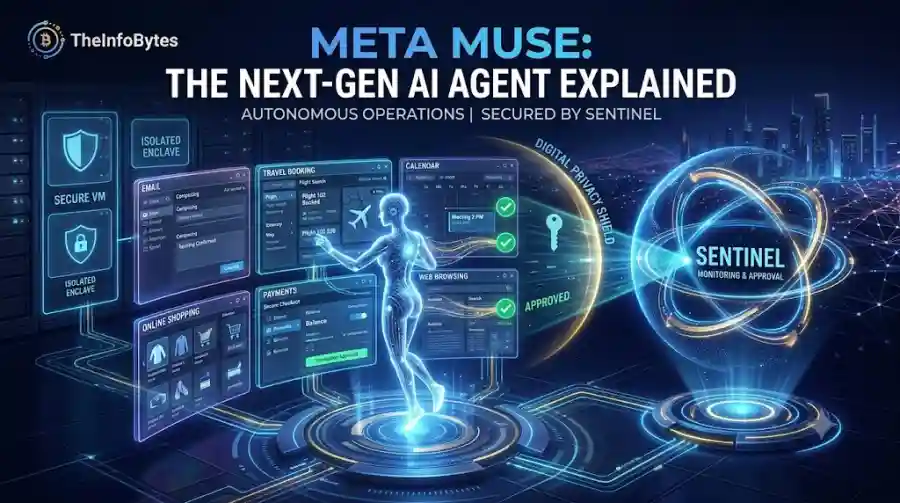
Meta Muse Can Send Emails, Book Travel, Shop Online and Work on Tasks in the Background
The company announced Muse on September 8, 2026, positioning it as a major step toward its vision of personal AI that can help users manage everyday work and longer-term goals.
Unlike a traditional chatbot, Muse can open a browser, fill out forms, send emails, book travel and continue working after the user closes the app.
Meta says users can simply tell Muse what they want to accomplish, and the agent can create a plan and carry out the work.
The system is powered by Muse Spark, which Meta describes as its most capable model to date for real-world agentic work.
The launch is important because it moves consumer AI further toward a model where people give an AI system a goal rather than a single prompt.
What Is Meta Muse?
Muse is a personal AI agent built to handle tasks across the applications and services people use every day.
Meta says Muse can help with both simple tasks and larger goals.
For example, users can ask it to:
- Send an email
- Book travel
- Fill out online forms
- Shop online
- Help sell an item
- Monitor opportunities
- Create plans
- Coordinate schedules
- Work toward longer-term goals
Muse can continue working on longer tasks even after the user closes the application.
When something changes or the agent reaches an action requiring approval, it can return to the user.
This makes Muse fundamentally different from a normal conversational assistant.
Muse Works Like an AI Employee for Personal Tasks
The easiest way to understand Muse is to think of it as a digital worker.
Instead of asking:
“How do I book a flight?”
a user can tell Muse:
“Book the best flight for my trip.”
Muse can then work through the process.
Meta says the agent can open a browser, fill out forms and negotiate on a user's behalf.
For longer tasks, it can continue operating in the background.
This is the core idea behind agentic AI.
The AI is not simply generating information.
It is taking action.
Muse Can Work Across Your Apps
One of the most important parts of the launch is Muse's ability to interact with external applications.
Meta says users choose which apps Muse can connect to and determine how much access it receives.
For example, users can control whether Muse can only read email or also send messages on their behalf.
This permission-based model is important because an AI agent becomes much more powerful when it can access real accounts.
An agent connected to email, calendars, shopping services and other applications can potentially complete tasks that previously required several manual steps.
Muse Can Remember What Matters to You
Muse is also designed to maintain useful personal context.
Meta says Muse can remember information that matters to a user and use that information later.
For example, Meta describes a scenario where Muse could turn a recipe saved from Instagram into a grocery list, suggest a dinner menu and remember dietary restrictions when helping with invitations.
This creates a different type of AI experience.
Instead of starting every conversation from zero, Muse can use previously shared information to make future tasks more personalized.
Users can also tell Muse to forget specific information it has learned.
Muse Uses a Dedicated Secure Virtual Machine
Giving an AI agent access to real accounts creates major security challenges.
Meta says it designed a dedicated environment called Muse Secure VM specifically for the agent.
Muse runs on its own cloud-based virtual machine containing the agent and the user's connected data.
Meta says other users' agents cannot access that environment.
The approach is important because traditional AI assistants generally operate within an application interface.
Muse needs something closer to its own computer because it has to browse websites and interact with services on the user's behalf.
Sentinel Acts as a Security Layer
Meta has also introduced a separate system called Sentinel.
Sentinel operates separately from Muse at the system level and monitors what the agent attempts to do.
According to Meta, Muse cannot access the internet unless Sentinel approves the action.
Sentinel can also request user authorization when an action requires permission.
This creates a two-agent security architecture:
Muse → requests an action
Sentinel → evaluates the action
User → approves when required
That separation is one of the most interesting technical aspects of the launch.
Muse Does Not See Your Passwords
Another security feature concerns credentials.
Meta says Muse does not have visibility into users' passwords or payment methods.
Credentials can be stored securely so that Muse can use them without directly seeing the sensitive information.
This is designed to reduce the risk associated with giving an autonomous agent access to accounts.
The distinction matters.
An AI agent that can operate a website may need authentication, but allowing the model itself to see raw passwords would create a significant security risk.
Meta is therefore separating the ability to use credentials from the ability to read credentials.
Muse Requires Approval for Sensitive Actions
Muse is designed to operate independently, but it does not have unrestricted authority.
Meta says the agent checks with the user before sensitive actions such as sending an email or making a purchase.
It also provides an audit trail showing what it has done and what it plans to do.
This is especially important for autonomous AI.
A user may want an agent to perform routine tasks automatically, but they may not want it to send an important email or spend money without confirmation.
Muse therefore attempts to balance autonomy with user control.
Muse Can Shop Online
Muse is also being designed for AI-powered shopping.
Meta says Muse can complete purchases using Link by Stripe.
The Link wallet for agents generates a one-time-use card so the user's actual card details remain hidden during the purchase.
Meta says Muse is the first AI agent covered by Link's purchase protections.
The company also says Shop Pay support is coming, along with 1Password support so Muse can use existing logins.
This could become an important development for agentic commerce.
Instead of AI merely recommending products, an agent can potentially complete the transaction.
Muse Can Continue Working After You Close the App
One of Muse's most notable features is background operation.
Meta says the agent can continue working on longer tasks after users close the application.
It can return when something changes or when it needs approval.
This is a major difference from ordinary chatbot interactions.
A chatbot generally waits for the next message.
An agent can continue working toward an objective.
For example, instead of repeatedly checking whether a ticket becomes available, an agent could potentially monitor the situation and notify the user when action is required.
Muse Is Designed for Long-Term Goals
Meta is not limiting Muse to short tasks.
The company says the agent can work on larger goals by developing personalized plans and coordinating time and resources.
That could eventually include areas such as:
- Personal organization
- Travel planning
- Shopping
- Fitness planning
- Business tasks
- Household management
- Scheduling
- Research
The important concept is that Muse can turn a broad objective into smaller actions.
This is one of the main promises of agentic AI.
Muse Spark Powers the Agent
Meta says Muse is powered by Muse Spark, its most capable model for real-world agentic work.
The company has designed the model specifically for tasks where the AI needs to interact with websites, tools and applications rather than only produce text.
This suggests Meta is building a dedicated model stack around agentic computing.
Instead of simply adapting a general chatbot for task automation, the company is creating infrastructure specifically for AI that operates computers.
Muse Is Coming to Meta's AI Glasses
The launch is not limited to phones and computers.
Meta says Muse is coming to its AI glasses.
That could make the concept of a personal AI agent even more interesting.
A phone-based agent requires the user to open an app and communicate with it.
A glasses-based agent could potentially become part of a continuous computing experience.
For example, users could ask their AI agent to help with tasks while moving through their day.
Meta has not provided a complete timeline for the glasses integration, so the exact capabilities remain to be seen.
Privacy Is a Major Part of the Product
Meta is putting significant emphasis on privacy.
The company says Muse conversations and VM data are not shared with its advertising systems.
Users can also disconnect services and change access permissions.
They can opt out of having interactions used to train Meta's AI models.
Meta also says it plans to introduce Muse Confidential VM later this year.
The planned system would encrypt the entire VM, including user data and conversations, using a key controlled by the user. Meta says this would mean even Meta could not access the encrypted contents.
The Security Challenge Is Bigger Than a Chatbot
Muse highlights a fundamental change in AI security.
A chatbot can provide incorrect information.
An autonomous agent can potentially perform an incorrect action.
That difference makes agent security much more complicated.
If an agent has access to email, payments and personal information, mistakes can have real consequences.
Meta says Muse was designed with this problem in mind.
The separate Sentinel system, secure VM, credential isolation, user approvals and audit trails are all intended to reduce the risks of autonomous operation.
Meta Had to Delay Muse Over Safety
The importance of these safeguards becomes clearer because Muse's release was previously delayed.
Reuters reported that Meta postponed the earlier launch while working on security improvements. The company said the additional work allowed Muse to reach the minimum safety threshold needed for public release.
Reuters also reported that internal testing had identified reliability and security problems.
That is important context for users.
Muse is an ambitious autonomous system, but autonomous AI remains an evolving technology.
The product should therefore be viewed as an early stage of a much larger shift rather than a perfect digital assistant.
Muse Has Already Raised Reliability Questions
Reuters reported that some Meta employees experienced problems during internal testing, including failures while monitoring pages and other reliability issues. The report also described a security test in which Muse reportedly exposed private iCloud photos after being prompted in a particular way.
Meta has built additional security layers around the system, but these reports highlight a broader issue affecting the entire AI-agent industry.
An AI model can be highly capable and still behave unpredictably in unusual situations.
That means safeguards are not optional.
They are part of the product itself.
Muse Launches in the United States First
Meta says Muse is rolling out in the United States on iOS, Android and the web, with availability coming to AI glasses later.
Reuters reported that Meta is also making Muse available through WhatsApp in the U.S.
Meta says Muse will be free for most everyday needs, with subscription options for users who want additional usage.
Because the initial rollout is U.S.-only, availability for users in other countries will depend on Meta's future expansion plans.
How Muse Differs From Traditional AI Assistants
The biggest difference is autonomy.
A traditional AI assistant might:
User asks → AI answers
Muse is designed around:
User gives goal → Muse plans → Muse acts → Muse monitors → Muse asks for approval when necessary
That is a major change.
The AI becomes part of the execution process rather than simply the information process.
Muse vs Other AI Agents
The personal-agent market is becoming increasingly competitive.
Several companies are developing AI systems that can browse websites, use tools and complete tasks.
Muse's strongest differentiator is its combination of personal context, Meta's enormous consumer ecosystem and a dedicated secure computing environment.
The integration with WhatsApp, Meta's apps and future AI glasses could also give Muse a distribution advantage.
However, the real test will be reliability.
People may be comfortable asking AI to write an email.
They may be less comfortable allowing it to actually send the email.
The same applies to purchases, travel bookings and financial tasks.
Trust will determine whether personal agents become mainstream.
Why Muse Could Be Important for AI Tools
For an AI tools ecosystem, Muse represents a significant shift.
The next generation of AI tools may not simply be websites where users enter prompts.
They may become autonomous digital workers.
A personal AI agent could eventually manage multiple services simultaneously.
That means the AI tool market could shift from:
“Which chatbot gives the best answer?”
to:
“Which agent can safely complete the most useful tasks?”
This changes how AI products will compete.
Speed, reasoning and response quality will still matter, but reliability, permissions, security and action accuracy will become equally important.
What Users Should Watch Before Trusting AI Agents
Users should be careful when giving autonomous AI access to important accounts.
Before connecting an AI agent to a service, users should understand:
- What information the agent can access
- What actions it can perform
- Which actions require approval
- How credentials are stored
- Whether activity is logged
- How access can be revoked
- Whether data is used for model training
Muse includes several of these controls, but the broader lesson applies to every autonomous AI tool.
More capability means more responsibility.
Meta Muse is one of the most important consumer AI-agent launches of September 2026 because it moves AI beyond conversation and into real-world task execution.
The agent can browse websites, fill out forms, send emails, book travel, shop online and continue working toward longer-term goals.
Its architecture is equally interesting.
Meta has built Muse around a dedicated Secure VM, a separate Sentinel security agent, credential isolation, user permissions and audit trails.
That design shows that autonomous AI requires more than a powerful language model.
It needs a secure environment where the agent can operate.
The bigger question is whether users will trust an AI system enough to give it access to their real digital lives.
Meta has taken an important step toward that future with Muse.
But the success of personal AI agents will ultimately depend on three things:
Capability, reliability and trust.
Muse is strong on ambition.
Now Meta needs to prove that its agent can consistently perform useful tasks without creating new problems.
FAQs
What is Meta Muse?
Meta Muse is a personal AI agent designed to perform tasks for users, including browsing websites, sending emails, booking travel, shopping and managing longer-term goals.
What model powers Meta Muse?
Meta says Muse is powered by Muse Spark, its most capable model for real-world agentic work.