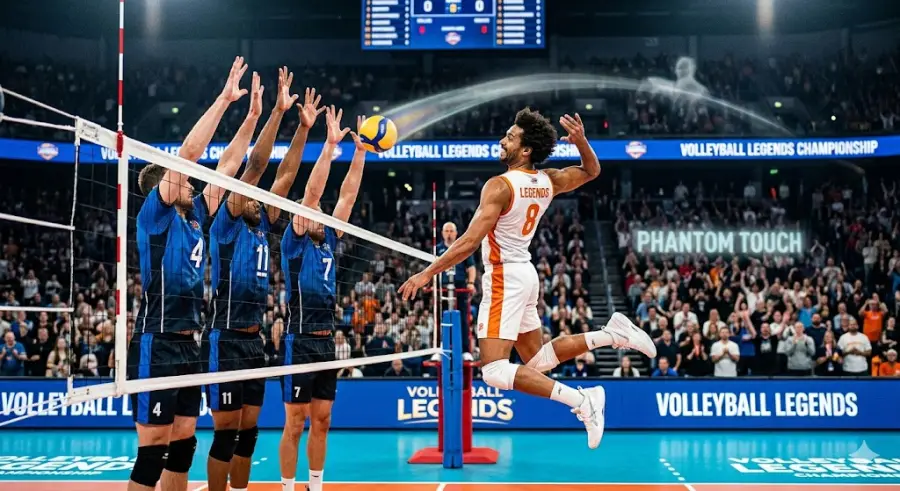
Mastering Deception How Smart Play Beats Raw Power in Volleyball
In the fast, intense world of professional volleyball, one moment can completely change the energy of a match. Few things feel as powerful as a perfectly timed block—when defenders rise together and send the ball crashing straight back. For most attackers, that wall of hands is something to fear. It limits their options, forces mistakes, and can quickly break confidence.
But then there are the legends—the players who didn’t just deal with the block, they redefined it.
For them, the block wasn’t a wall at all. It was something they could bend, trick, and even use to their advantage. This is where the idea of the “Phantom Touch” comes in—a style built not on raw power, but on smart decisions, timing, and deception. While others tried to smash through defenders, these players made it look like the block wasn’t even there.
Let’s break down how they did it.
Understanding the Blocker’s Mind
Before you can outplay a blocker, you have to understand how they think.
Blockers are trained to read the attacker’s body. They watch the approach, the shoulders, and even the eyes. When they see a hitter charging in with speed and force, they react instantly—jumping high, pushing their hands over the net, and trying to close every possible angle.
This reaction is powerful, but it also has a weakness: it’s predictable.
Legendary players like Karch Kiraly and Logan Tom understood this perfectly. They knew that once a blocker commits, they can’t change direction mid-air. That single moment of commitment is all it takes to turn the tables.
Instead of seeing a barrier, these players saw an opportunity.
1. Using the Block Against Itself
One of the smartest techniques in volleyball is something called “wiping the hands.” At first glance, it might look like a mistake—the ball hits the blocker and flies out of bounds. But in reality, it’s completely intentional.
The idea is simple but brilliant: instead of aiming for the court, the hitter targets the outer edge of the blocker’s hands. Just a slight brush—often on the fingers—is enough to change the ball’s direction. The result? The ball lands out of bounds, and the point goes to the attacker.
What makes this move so effective is how subtle it is. The blocker might barely feel the contact, yet the play is already over.
This was a signature move of players like Giba. Even when defenders positioned themselves perfectly, he could still score by turning their own hands into a tool. It wasn’t about overpowering the defense—it was about outsmarting it.
2. The Power of the Last-Second Change
Most players decide where they’re going to hit before they even leave the ground. But elite players take a different approach—they wait.
This technique is all about making the decision at the very last moment, right at the peak of the jump. By doing this, the hitter forces the blockers to commit first.
A great example is Earvin N'Gapeth. He often approaches as if he’s going to hit cross-court, pulling the blockers in that direction. Then, in a split second, he changes the angle with a quick wrist snap and sends the ball down the line instead.
From the blockers’ perspective, it’s almost impossible to react. Everything about the movement looks the same until it’s too late. By the time they realize what’s happening, the ball is already past them.
It’s not just skill—it’s timing, awareness, and confidence.
3. Slowing the Game Down
Volleyball is often associated with power—hard spikes, fast rallies, and explosive movements. But sometimes, the smartest play is the softest one.
This is where off-speed shots come into play.
Instead of hitting with full force, players gently guide the ball over or around the block. It could be a roll shot that loops just over the fingertips or a soft push into an empty area of the court.
Players like Lang Ping and Sergey Tetyukhin mastered this style. When defenders expected a powerful spike, they delivered something completely different—a slow, controlled shot that dropped exactly where no one was standing.
The reason this works is simple: blockers can’t adjust while they’re in the air. Once they jump, they’re committed. A soft shot takes advantage of that limitation, landing in spaces they simply can’t reach in time.
It’s a perfect example of how patience can beat power.
4. Finding the Smallest Openings
Even the best block isn’t perfect. When multiple players jump together, there’s almost always a small gap between them. This gap—often called the seam—is tiny, but it’s there.
Most players don’t even notice it.
But elite hitters do.
They have the awareness and precision to aim for that narrow space and send the ball straight through it. It’s not easy—it requires incredible control and vision—but when done right, it completely bypasses the block.
Players like Saied Marouf were known for this kind of awareness. They could read the defense in real time and spot openings that others missed.
To them, the block wasn’t solid—it was full of possibilities.
A Different Way to Play the Game
The idea of the “Phantom Touch” isn’t just about technique. It’s a mindset.
It’s about understanding that you don’t always need to be the strongest or the fastest player on the court. Sometimes, being smarter makes all the difference.
These legendary players proved that volleyball is as much about thinking as it is about physical ability. They didn’t just react to the game—they controlled it. They made defenders second-guess themselves, hesitate, and eventually lose confidence.
And that’s what truly made them so difficult to stop.
If there’s one lesson to take from all of this, it’s that volleyball isn’t just about hitting the ball as hard as possible. It’s about reading the situation, making smart choices, and staying one step ahead of your opponent.
The next time you watch a match, don’t just focus on the big spikes or dramatic blocks. Pay attention to the subtle moments—the slight touch off the hands, the unexpected soft shot, or the perfectly placed hit through a tiny gap.
That’s where the real magic happens.
Because in the end, the best players aren’t the ones who fight the block—they’re the ones who make it disappear.