Counter-Strike 2’s Biggest Update Yet Reshapes Weekly Drops, Trade-Ups, Map Gameplay, and Case Opening Economics
Whether you're grinding Premier, building your inventory, chasing rare skins, or simply trying to understand where Counter-Strike 2 is headed next, here's everything you need to know about Valve's latest blockbuster update.
Highlights
Key Takeaways From the Update
- New gameplay adjustments improve ladder accuracy behavior and movement consistency.
- Multiple visual bugs and spectator issues have been fixed.
- Souvenir items can now be used in Trade-Up Contracts.
- Mirage and Dust II received important map fixes.
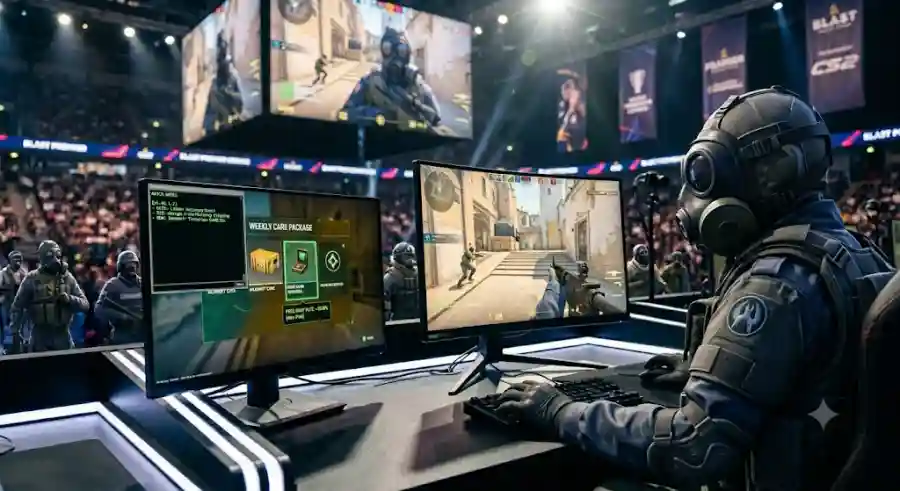
- Weekly Care Package rewards have been significantly reworked.
- Legacy collections have been removed from free drop rotation.
- New Harlequin and Achroma collections enter the reward pool.
- Dead Hand Terminal and Genesis Terminal now dominate weekly drops.
- Official weapon case opening odds remain publicly available.
- Terminal mechanics introduce a more transparent reward system.
Complete CS2 Patch Notes Breakdown
Valve's latest update focuses on three major goals: improving gameplay consistency, reducing frustrating visual issues, and optimizing the competitive experience for Premier matchmaking players.
Many of these adjustments target long-standing complaints from the community, particularly those involving movement exploits, clipping problems, and visual inconsistencies.
Gameplay and Quality-of-Life Improvements
Ladder Accuracy Gets a Major Adjustment
One of the more technical additions in this patch is a new server command:
weapon_accuracy_stack_boost_limit
The command is set to a default value of 2 and introduces dynamic ladder inaccuracy for players attempting aggressive run-and-gun tactics while being boosted by multiple teammates.
This specifically targets situations where players created unusual vertical stacks to gain sightlines that were never intended by normal gameplay design. Those infamous triple-stack pixel peeks that occasionally appeared in competitive matches should now be significantly less effective.
For players who value fair engagements and predictable gunplay, this is a welcome improvement.
Smoother Ground and Ledge Movement
Movement enthusiasts will likely appreciate another subtle but important change.
Valve adjusted ground collision behavior in locations where players could stand on extremely thin, awkward, or glitch-prone ledges. Window frames, rooftop trims, and other narrow surfaces should now feel much smoother when traversing.
While this may seem minor on paper, these types of improvements can have a noticeable impact during intense rounds where precise movement often determines survival.
Silencer Visual Bug Finally Fixed
A long-standing visual inconsistency involving dropped weapons has finally been resolved.
Previously, weapons equipped with detachable silencers could sometimes display incorrect visual states after being dropped. In certain situations, players would see a silencer attached when it was actually removed, or vice versa.
The update now ensures dropped weapons accurately reflect their real silencer status at all times.
Better Flashbang Experience for Spectators
Tournament organizers, content creators, and broadcast teams also received a useful improvement.
Remote spectators can now utilize the command:
r_spectator_flashbang_opacity
This allows custom adjustment of flashbang intensity while observing matches.
Valve also fixed an issue where flashbang effects could interfere with HUD visibility. Flash effects now correctly render beneath interface elements, ensuring statistics and tournament overlays remain visible throughout broadcasts.
Economy Update: Souvenir Trade-Ups Arrive
One of the most impactful economy changes in this patch involves Trade-Up Contracts.
Souvenir Items Can Now Be Included
For years, Souvenir skins occupied a unique position in Counter-Strike's economy because of their event-related stickers and collectible status.
Now, Valve allows players to include Souvenir-quality items alongside standard skins in Trade-Up Contracts.
However, there is an important condition.
When a Souvenir item is used:
- All Souvenir attributes are permanently removed.
- Event stickers and gold tournament markings disappear.
- The resulting item becomes a normal-quality skin.
- The output skin will be one rarity tier higher.
This change opens up entirely new trade-up strategies while also creating fresh discussions among investors regarding the long-term value of lower-tier Souvenir items.
Mirage, Dust II, and General Map Fixes
Map stability and visual consistency remain major priorities for Valve, and several well-known issues have now been addressed.
Mirage Improvements
Mirage received multiple fixes aimed at visual clarity and grenade consistency.
B-Site Railings Visual Fix
A shader issue involving Ambient Occlusion and alpha testing previously caused strange visual artifacts around the B-site railings.
Players occasionally encountered dark, blocky silhouettes that could impact visibility and create confusion during engagements.
The issue has now been resolved.
A-Site Scaffolding Grenade Adjustments
Valve also simplified grenade clipping around A-site scaffolding.
Before the update, certain smoke grenades could bounce unpredictably and travel into unintended locations. The revised collision behavior should create more reliable utility usage.
Dust II Pixel Gap Removed
Dust II players will be particularly pleased with one fix.
Valve patched a notorious pixel gap located near the door outside Long.
The exploit allowed Counter-Terrorists to gather information on incoming attackers with virtually no risk. Competitive players frequently criticized the angle because it provided free intelligence without meaningful counterplay.
That gap is now gone.
General Clipping Improvements
Across multiple maps, Valve addressed geometry issues that could cause the bomb to become permanently inaccessible.
Previously, under specific circumstances, a dropped C4 could become trapped inside map geometry after a player died.
These problematic locations have now been cleaned up, reducing the chances of rounds being affected by unreachable objectives.
Understanding the 2026 Weekly Care Package System
The modern Counter-Strike reward system is very different from the classic CS:GO era.
Gone are the days when random drops simply appeared after matches. In 2026, free inventory growth revolves entirely around the Weekly Care Package system.
How Weekly Rewards Work
To receive a Weekly Care Package:
- You must own Prime Status.
- Earn 5,000 XP.
- Level up your Profile Rank.
- Receive four randomized reward options.
- Select exactly two rewards.
This system gives players more control than previous drop models while still maintaining randomness.
New Collections Replace Legacy Drops
Valve recently made a significant change to the collection pool.
Several older collections have been removed from free reward rotation, including:
- Safehouse Collection
- Dust 2 Collection
- 2018 Nuke Collection
- 2018 Inferno Collection
Taking their place are two brand-new collections:
Harlequin Collection
One of the most anticipated additions to the modern drop ecosystem, the Harlequin Collection immediately attracted attention due to its fresh visual style and market potential.
Achroma Collection
The Achroma Collection joins Harlequin as a major newcomer and is already generating interest among traders and collectors looking for future investment opportunities.
2026 Weekly Container Drop Rates Explained
Community researchers have spent months gathering Care Package data to determine how frequently various containers appear.
The estimated allocation rates currently look like this:
| Drop Item | Category | Estimated Chance |
|---|---|---|
| Sealed Dead Hand Terminal | Active Drop Pool | ~39.6% |
| Sealed Genesis Terminal | Active Drop Pool | ~16.3% |
| Kilowatt Case | Active Weapon Case | ~14.8% |
| Revolution Case | Active Weapon Case | ~14.8% |
| Dreams & Nightmares Case | Active Weapon Case | ~13.3% |
| Rare Pool Cases (Bravo, Hydra, etc.) | Legacy Rare Pool | ~1.0% |
Why Rare Pool Cases Are So Valuable
The rare pool represents only about 1% of container drops.
When one appears, it should almost always be selected immediately.
Legacy cases such as Bravo or Hydra frequently command prices exceeding $50 on the Steam Community Market, making them among the most valuable free rewards available in the game.
For most players, receiving one is equivalent to hitting a small jackpot.
The Mathematics Behind CS2 Weapon Case Openings
Many players choose to sell their weekly cases. Others decide to test their luck by purchasing a key.
If you choose the second route, understanding the odds is essential.
Due to gaming transparency regulations in several regions, Valve publicly discloses the probability structure behind case openings.
Official CS2 Case Rarity Odds
Here are the official rarity probabilities for standard Counter-Strike 2 weapon cases:
Mil-Spec (Blue)
79.92%
Approximately four out of every five openings.
Restricted (Purple)
15.98%
Roughly one in six openings.
Classified (Pink)
3.20%
About one in 31 cases.
Covert (Red)
0.64%
Approximately one in 156 openings.
Exceedingly Rare Special Item (Gold)
0.26%
Around one in every 385 openings.
These gold-tier rewards include highly desirable knives and gloves that often drive the excitement surrounding case openings.
The StatTrak™ Multiplier
The rarity system doesn't stop there.
Every item that drops has an additional 10% chance of being a StatTrak™ version.
That means players pursuing a StatTrak™ knife or StatTrak™ gloves face dramatically longer odds.
Actual Odds of a StatTrak™ Gold Item
- Gold Item Chance: 0.26%
- StatTrak™ Chance: 10%
Combined probability:
0.026%
That works out to approximately:
1 in 3,850 cases
This staggering number highlights why StatTrak™ knives remain some of the most coveted and expensive items in the Counter-Strike economy.
The Reality of Return on Investment
Case openings often create viral moments on social media, but the financial reality is far less glamorous.
Because nearly 80% of all openings result in Mil-Spec blue items, most weapon cases carry negative expected value over the long run.
Industry analysis and community tracking consistently suggest players lose between 30% and 50% of their money on average across large opening samples.
Why the Kilowatt Case Stands Out
Among active cases, the Kilowatt Case continues to attract attention.
Several factors contribute to its popularity:
- Features the iconic Kukri Knife.
- Includes the first-ever Zeus skin, Olympus.
- Maintains stronger mid-tier skin values than many competing cases.
- Offers comparatively steadier return potential.
While no case guarantees profit, Kilowatt remains one of the most watched cases in the current CS2 market.
What Are Dead Hand and Genesis Terminals?
The most controversial and fascinating addition to Counter-Strike 2's reward ecosystem is undoubtedly the Terminal system.
Introduced as part of Valve's evolving approach to digital item distribution, Terminals represent a significant shift away from traditional blind-box mechanics.
How the Terminal System Works
The process is surprisingly simple.
Step 1
Receive a Terminal through your Weekly Care Package.
Step 2
Inspect the Terminal in your inventory.
Step 3
The game immediately reveals the exact skin contained inside.
Step 4
Decide whether you want to spend the required credits or currency to unlock that specific item.
Unlike traditional cases, there is no mystery regarding the reward before payment.
Why Valve Introduced Terminals
Many analysts view Terminals as Valve's response to increasing global scrutiny surrounding loot boxes and gambling-like mechanics.
Traditional weapon cases rely heavily on uncertainty and anticipation.
Terminals eliminate that uncertainty.
Players know exactly what they are getting before spending money.
This transparency reduces the slot-machine-style psychological element that has fueled debates around loot boxes for years.
Industry Impact and Future Predictions
The arrival of Terminals could have consequences far beyond a single update.
Market watchers, traders, and longtime investors are already speculating about Valve's long-term plans.
Some believe traditional weapon cases may eventually become less important—or even disappear entirely—if transparent systems continue gaining regulatory and consumer support.
If that happens, existing active weapon cases could become increasingly desirable collector items over time.
While Valve has not confirmed any such plans, the conversation has become one of the hottest topics within the Counter-Strike community.
How to Maximize Your Weekly Drops
Players looking to take full advantage of the new system should adjust their weekly routine.
Earn XP Early
Avoid waiting until the final hours before reset.
Focus on High-XP Modes
Deathmatch and Premier remain excellent options for quickly earning the required 5,000 XP.
Prioritize Valuable Rewards
Whenever available, choose:
- Dead Hand Terminal
- Genesis Terminal
- Active weapon cases
- Rare legacy cases
Avoid selecting low-value rewards when stronger options are available.
Check Item Values Carefully
Before trading or selling any reward, inspect:
- Market price
- Float value
- Demand trends
- Collection popularity
A quick price check can make a significant difference.
Why This Update Matters
Valve's latest Counter-Strike 2 update isn't just another patch filled with bug fixes.
It represents a broader evolution of the game's competitive, economic, and reward systems.
From movement improvements and map corrections to transparent reward mechanics and revamped drop pools, the update touches nearly every aspect of the player experience.
The introduction of Terminals signals a potentially major shift in how digital items are distributed, while new Trade-Up possibilities create fresh opportunities for collectors and traders.
At the same time, players now have better insight into exactly how weekly rewards and weapon case odds function.