A Complete to Blockly Games, Its 8 Coding Levels, Pros, Cons and Learning Value
Created by Google as a free, open-source educational project, Blockly Games introduces programming through visual puzzles instead of immediately asking learners to write traditional text-based code. Users connect colorful blocks together, almost like digital LEGO bricks, and use those blocks to solve challenges.
What Is Blockly Games?
Blockly Games is a collection of web-based educational puzzles designed to teach fundamental computer science concepts.
The platform is built around the Blockly library, Google's visual programming editor. Instead of manually typing commands, learners assemble interlocking blocks that represent programming instructions.
Behind the scenes, those blocks can be translated into actual JavaScript code.
That detail is one of Blockly Games' strongest educational features. A beginner can start by thinking visually about commands and logic, then gradually see how those same instructions appear in a real programming language.
The platform does not require users to create an account or install complicated software. It works directly through a modern web browser and follows a self-paced structure.
There is also no expectation that Blockly Games will transform a complete beginner into a full-stack developer.
Its real purpose is computational thinking.
That means learning how to break problems into logical steps, recognize patterns, use conditions, repeat instructions, work with functions, and develop algorithms. These ideas form the foundation of programming regardless of whether someone eventually chooses Python, JavaScript, Java, or another language.
Blockly Games' Eight Progressive Levels
One of the most useful aspects of the platform is its progression.
Blockly Games contains eight distinct games, with each one introducing different programming or computational concepts. The challenges become more complicated as learners move through the platform.
| Game Title | Primary Concept Taught | Difficulty Level |
|---|---|---|
| Puzzle | Attributes, Key-Value Relationships | Beginner |
| Maze | Loops, Conditional Statements (if/else) | Beginner-Intermediate |
| Bird | Deep Conditionals, Complex Logic Operators | Intermediate |
| Turtle | Loops, Nested Loops, Mathematical Drawing | Intermediate |
| Movie | Mathematical Formulas, Time-based Animation | Intermediate-Advanced |
| Music | Functions, Composition, Parameters | Advanced |
| Pond Tutor | Text-based Syntax, Programmatic Control | Advanced |
| Pond | Open-ended Algorithmic Strategy | Expert |
This progression is important because the learner is not asked to understand every programming concept at once. Each stage adds another layer.
Let's look at what each game actually teaches.
1. Puzzle: The Gentle Starting Point
The Puzzle game acts as the introduction to Blockly Games.
Rather than throwing users into complicated algorithms, it starts with simple matching activities. Players match animals to their pictures, count their legs, and organize information about their traits using visual blocks.
At this stage, there is not much conventional programming involved.
That is intentional.
The goal is to help users understand how Blockly's interface works. Learners become comfortable selecting blocks, connecting them, and thinking about relationships between pieces of information.
For a complete beginner, that low-pressure introduction can make the rest of the platform feel much more approachable.
2. Maze: Where Programming Logic Really Begins
Maze is where Blockly Games starts to feel like a genuine programming lesson.
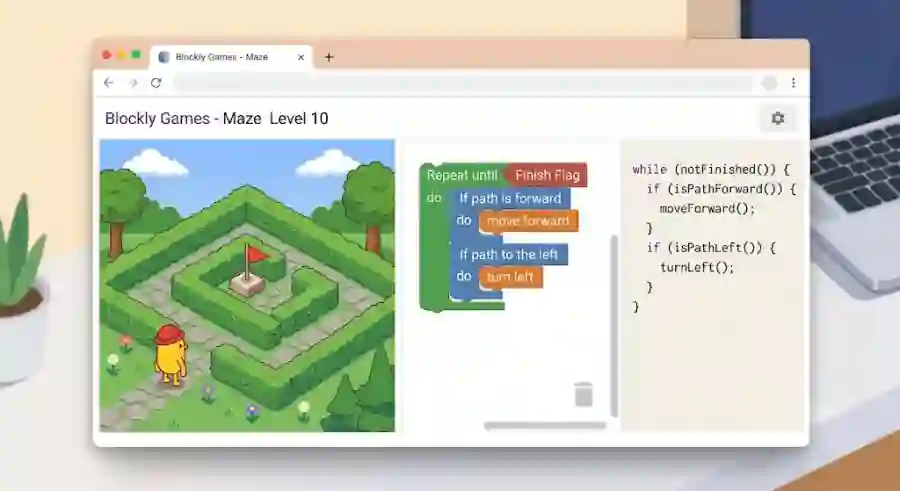
Players guide a character through a maze using commands such as move forward and turn left.
The early levels focus on sequencing. In other words, learners need to figure out which instructions should happen first, second, third, and so on.
As the challenges become harder, simple sequences are no longer enough.
Players begin working with while loops and if-else conditions.
A typical logical instruction might be:
"If there is a path to the left, turn left; otherwise, move forward."
The learner must think about what the character sees, what condition is true, and which instruction should execute as a result.
Some puzzles also impose limited block budgets. This adds another layer of challenge because players are encouraged to find efficient solutions rather than simply throwing more commands at the problem.
For beginners, Maze is arguably one of the most valuable parts of Blockly Games because it demonstrates why programming is fundamentally about logical decision-making.
3. Bird: More Complex Conditional Logic
The Bird game moves deeper into control flow.
Here, players control a bird's flight angle while trying to collect worms and return to its nest.
The challenge is no longer simply about moving from one location to another. Players must consider coordinates, conditions, and changing circumstances simultaneously.
For example, the bird may need to change its trajectory depending on whether it is carrying a worm or whether its position has moved beyond a particular X or Y coordinate.
This introduces learners to more complicated logical relationships.
Instead of thinking only about "do this, then that," they start asking questions such as:
- What is the bird's current position?
- Is a particular condition true?
- Should the bird change direction?
- What should happen if the condition is false?
- How can multiple conditions work together?
That makes Bird an important bridge between basic programming exercises and more sophisticated control-flow thinking.
4. Turtle: Programming Through Drawing
If you have ever encountered Logo or Turtle graphics in school, the Turtle game will probably look familiar.
The player controls an avatar using pen commands to create drawings.
At first, the concept seems simple. But the real challenge comes from creating increasingly complex geometric designs efficiently.
Instead of manually telling the Turtle how to draw every individual line, players use loops and nested loops to produce repeated structures.
This can lead to shapes such as stars, spirals, and other intricate patterns.
Turtle demonstrates one of programming's most useful ideas: repetition does not need to mean repeating the same instructions manually.
A short loop can replace dozens or even hundreds of individual commands.
For learners, that is a powerful visual demonstration of why loops matter.
5. Movie: Bringing Mathematics and Animation Together
The Movie game takes Blockly Games into a more dynamic direction.
Here, players work with mathematical formulas, variables, and time-based animation.
By connecting shapes to a time variable called frame, learners can create simple animations.
Examples include a swimmer moving across a pool or a basketball bouncing through a scene.
This stage is particularly interesting because it connects several subjects at once.
Programming logic combines with:
- Geometry
- Basic algebra
- Mathematical formulas
- Variables
- Computer graphics
- Animation
Instead of learning these concepts in isolation, players see how mathematics can control what happens on a screen.
Movie therefore creates a natural transition from simple coding puzzles toward the type of computational thinking used in graphics and interactive applications.
6. Music: Learning the Power of Functions
The Music game introduces another major programming concept: functions.
Players use blocks to compose songs using elements such as pitch, duration, and notes.
The important lesson is not simply making music.
It is learning how to reuse instructions.
Imagine creating a sequence of blocks for a chorus and then needing that same sequence several times. Rebuilding the blocks every time would be inefficient.
Instead, learners can package the instructions into a reusable custom function.
This teaches a concept that appears throughout real-world software development: write a useful piece of logic once, then call it whenever you need it.
Music also introduces composition and parameters, giving learners exposure to increasingly advanced ways of organizing instructions.
7. Pond Tutor: Moving Toward Real Code
The Pond Tutor game represents a major transition.
Instead of relying entirely on visual programming blocks, players control a cannon-firing duck that battles other AI-controlled ducks.
More importantly, users can switch between the block-based interface and native JavaScript syntax.
This is where Blockly Games starts addressing one of its most interesting educational goals: helping learners move from visual programming toward text-based programming.
The learner has already spent time working with loops, conditions, variables, functions, and logical decisions.
Now those concepts begin appearing in the form of actual programming syntax.
That transition can be much less intimidating because the underlying logic is already familiar.
8. Pond: Open-Ended Algorithmic Strategy
The final game, Pond, takes the idea even further.
By this point, players are writing raw code to program ducks and develop strategies against competing scripts.
The challenges involve concepts such as:
- Target-seeking algorithms
- Radar sweeps
- Counter-attacks
- Programmatic control
- Open-ended strategy
Unlike earlier puzzles that often have a clearly defined path toward a solution, Pond provides a more open-ended environment.
That makes it the most advanced part of Blockly Games.
It also demonstrates an important difference between following instructions and actually designing an algorithm.
Key Benefits of Blockly Games
Blockly Games has several strengths that make it useful for beginners and educators.
No Frustrating Syntax Errors
One of the biggest problems for new programmers is syntax.
A missing bracket, incorrectly typed command, or misplaced character can prevent an entire program from working.
Blockly removes that problem from the early learning process.
Because users connect predefined visual blocks, they can focus on logic instead of spelling and punctuation.
That makes the experience particularly useful for learners who are still developing confidence.
Immediate Visual Feedback
Blockly Games provides immediate feedback.
When a learner creates a solution, they can see what their instructions actually do.
This makes abstract ideas such as loops and conditional statements much easier to understand.
Instead of simply reading that a loop repeats an instruction, the player can watch the character perform the repeated action.
That connection between instruction and visible result can make concepts easier to remember.
JavaScript Is Visible Underneath
Another major advantage is the platform's connection to JavaScript.
After completing levels, users can see the actual JavaScript code generated from their blocks.
This creates a useful bridge between visual programming and text-based programming.
A learner might first understand an instruction as a block. Later, they see how that same idea appears as JavaScript.
That transition can make the move into a traditional code editor feel more familiar.
Completely Free and Lightweight
Blockly Games is also attractive because of its accessibility.
There are:
- No hidden paywalls
- No account registration requirements
- No complicated installation process
- No heavy software package required
The platform runs directly in a modern web browser.
For parents, students, and teachers, that low barrier to entry matters.
The Limitations You Should Know
Blockly Games is useful, but it is not perfect.
The Overall Experience Can Be Short
Experienced problem-solvers or older students may complete the entire platform within only a few hours.
That makes Blockly Games a strong introduction, but not necessarily a long-term programming curriculum.
Once the learner understands the core mechanics, there may not be enough depth to keep an advanced student challenged for weeks or months.
Limited Guidance When You Get Stuck
Another weakness appears in the more difficult levels.
If a learner becomes stuck on a late-stage Maze or Bird challenge, the platform provides limited guidance explaining why the logic failed.
That can be frustrating for someone learning independently.
A teacher, parent, mentor, or another learning resource may therefore be useful when a student reaches a difficult concept.
Blockly Is Not a Complete Programming Language
Perhaps the most important limitation is that visual blocks cannot replace actual programming experience.
Blockly can teach logical thinking, loops, conditions, functions, and algorithms.
But eventually, learners need to experience the realities of text-based programming.
That includes:
- Writing actual syntax
- Debugging errors
- Organizing files
- Structuring projects
- Reading documentation
- Working with larger codebases
- Building software from scratch
Blockly Games should therefore be viewed as a foundation, not a complete programming education.
Who Should Use Blockly Games?
Total Beginners
Blockly Games is particularly suitable for people with little or no programming experience.
The platform is described as suitable for young learners around age 8 and older, while its simple visual interface can also help adults who feel intimidated by traditional programming.
The absence of syntax errors removes one of the biggest early barriers.
Teachers and Educators
Teachers can use Blockly Games as a warm-up activity or supplementary module in a computer science curriculum.
It can introduce programming concepts before students move on to tools and languages such as Scratch, Python, or web development.
Because the platform is free and browser-based, it can also be relatively easy to incorporate into classroom activities.
Self-Learners Who Are Nervous About Coding
For someone who looks at a Python or JavaScript editor and immediately feels overwhelmed, Blockly Games offers a softer starting point.
Spending an afternoon working through its puzzles can help build confidence around concepts such as conditions, loops, functions, and algorithms.
Once those ideas become familiar, moving into text-based coding may feel less like learning an entirely foreign system.
Blockly Games vs. Traditional Coding Lessons
The biggest difference between Blockly Games and traditional beginner coding lessons is the point at which syntax enters the picture.
A conventional programming course may begin by teaching variables, punctuation, functions, and basic commands through typed code.
Blockly Games reverses that process.
It begins with logic and problem-solving, then gradually introduces the idea that those visual instructions can become real JavaScript.
That approach can be especially effective for learners who struggle with the technical appearance of code.
However, the two approaches ultimately work best together.
Blockly can establish the mental model. A language such as Python or JavaScript can then provide the practical environment in which the learner applies that knowledge to larger projects.
Industry and Educational Impact
The broader value of tools like Blockly Games comes from their focus on computational thinking.
Modern programming is not simply about memorizing commands.
Developers need to break large problems into smaller pieces, identify patterns, make decisions based on conditions, repeat processes efficiently, and create reusable logic.
Those skills appear throughout software development.
Blockly Games makes those ideas visible in a way that beginners can interact with immediately.
Its game-based structure also reflects a broader trend in technology education: making difficult technical concepts more accessible through interactive learning rather than relying entirely on lectures and textbooks.
That does not mean games can replace serious study.
Instead, they can provide a low-pressure entry point that helps learners discover whether they enjoy solving programming problems before committing to a more demanding course.
Why Blockly Games Still Matters
Blockly Games is not trying to compete with professional development environments.
That is exactly why it works.
Its greatest strength is simplicity.
A learner can open a browser, choose a game, start connecting blocks, and immediately begin solving problems. There are no installation headaches and no account requirements standing between curiosity and experimentation.
The platform also understands something important about learning to code: the hardest part for many beginners is not understanding what a loop does. It is getting past the fear of making a mistake.
By removing syntax errors from the earliest stages, Blockly Games gives learners room to make logical mistakes instead.
Those mistakes are much more useful.
They encourage users to ask why an algorithm failed, change the instructions, test the result, and try again.
That cycle is at the heart of programming.