How Jujutsu Shenanigans Outperformed The Strongest Battlegrounds and Other Roblox Anime Games With Fun-First Gameplay
So what exactly allowed Jujutsu Shenanigans to outperform many of its serious competitors? The answer lies in several carefully designed systems that work together to create one of Roblox's most enjoyable anime battleground games.
Highlights
- Simple combat system with surprisingly deep mechanics
- Fully destructible environments that transform every battle
- Vertical movement and dynamic parkour gameplay
- Fun-first philosophy instead of hyper-competitive gameplay
- Anime-accurate Domain Expansion experiences
- Distinct character playstyles that encourage strategic variety
- Frequent balance updates and community-driven improvements
- Accessible for beginners while remaining rewarding for experienced players
Simple Combat That Offers Remarkable Mechanical Depth
One of the biggest mistakes many anime battle arena games make is confusing complexity with depth.
Developers often believe that adding dozens of keyboard shortcuts, complicated parry mechanics, strict perfect-dodge timing, and unforgiving combo systems automatically creates a better competitive experience. In reality, these mechanics often intimidate newcomers before they even have the chance to enjoy the game.
For casual players, stepping into these highly technical games can feel overwhelming. Experienced players who have already memorized lengthy 40-hit true combos frequently dominate newcomers, turning matches into one-sided encounters where learning becomes frustrating rather than enjoyable.
Jujutsu Shenanigans takes a refreshingly different approach.
Instead of overloading players with unnecessary mechanics, the developers built the combat system around a few easy-to-understand fundamentals.
At its core, every player has access to:
- Basic M1 attacks
- A block mechanic
- A dash for mobility
That's it.
There are no excessively complicated parry systems forcing frame-perfect reactions. Likewise, players don't have to master frustrating perfect-dodge mechanics before they can compete.
This simplicity dramatically lowers the barrier to entry.
New players can jump into a match using either a keyboard or controller and immediately understand how combat works. They aren't forced to spend hours studying guides before enjoying their first fight.
However, simplicity doesn't mean shallow gameplay.
The brilliance lies in how these core mechanics interact with each character's abilities.
Experienced players learn how to extend combos using well-timed M1 attacks, exploit dash positioning to move behind an opponent's guard, and combine character-specific abilities into creative offensive sequences.
Because the foundation is so accessible, the skill ceiling naturally develops through timing, positioning, and game knowledge rather than through memorizing dozens of complicated inputs.
This creates a rare balance that many competitive games struggle to achieve.
Beginners feel capable from day one.
Veterans continue discovering advanced techniques, experimenting with new combo routes, and refining strategies for hundreds of hours.
That balance between accessibility and mastery has become one of the game's greatest strengths.
Fully Destructible Environments Transform Every Battle
Visual presentation plays a huge role in anime-inspired games, especially those based on a series like Jujutsu Kaisen, where characters possess overwhelming destructive power.
Many battle arena games unfortunately fall short in this area.
Players launch devastating attacks that should level entire city blocks, only to watch opponents bounce harmlessly against completely indestructible walls. The battlefield rarely changes, making even powerful abilities feel strangely disconnected from the anime they're meant to recreate.
Jujutsu Shenanigans completely changes that experience by introducing fully destructible environments alongside an impressive movement system.
Rather than acting as static decorations, buildings become active parts of every battle.
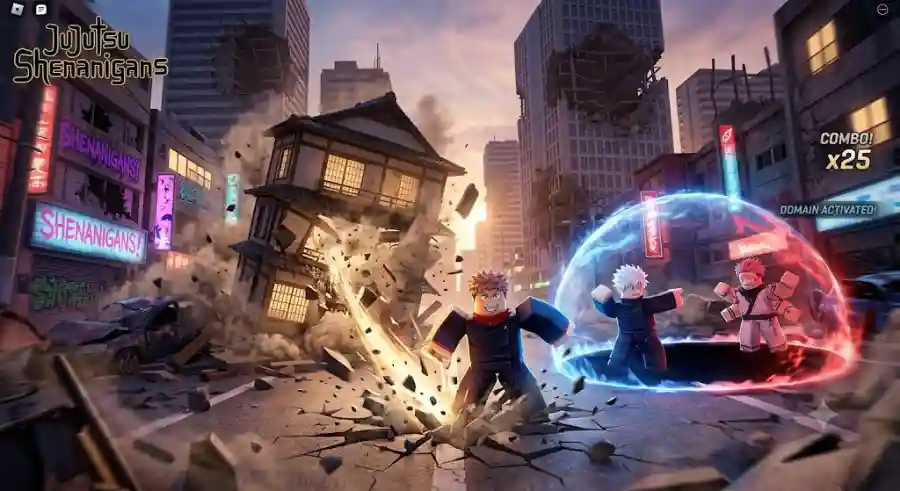
When powerful characters like Gojo unleash devastating techniques or Sukuna slices through an area using Cleave, surrounding structures don't simply display visual damage.
They crumble.
Walls collapse.
Buildings shatter into debris.
Entire sections of the battlefield are transformed in real time.
This creates a much stronger sense of scale and authenticity, making players feel like they're participating in genuine anime battles instead of fighting inside a rigid arena.
The destruction isn't simply cosmetic either.
It directly influences gameplay by constantly changing available cover, movement routes, and combat opportunities throughout each match.
Vertical Gameplay Adds Another Strategic Layer
The map itself becomes an important part of combat.
Instead of remaining on flat streets for the entire match, players can:
- Wall-run across buildings
- Vault over obstacles
- Leap between rooftops
- Chase enemies across multiple elevations
This vertical movement system significantly expands tactical possibilities.
Players aren't simply tracking cooldowns anymore.
They're also considering positioning, escape routes, environmental advantages, and elevation differences.
A fight can begin at street level before quickly moving onto rooftops, through collapsing buildings, and back down into newly created open spaces.
Every encounter feels more dynamic because the environment continuously evolves alongside the players.
Throwing an opponent through an entire building isn't merely satisfying from a visual perspective.
It actually reshapes the battlefield itself, creating an unpredictable sandbox experience that static battleground games simply cannot replicate.
A Game That Embraces Its Own Name: Shenanigans Over Sweat
Modern competitive multiplayer games often fall into the same trap.
Winning becomes everything.
Communities gradually become more serious, more toxic, and increasingly focused on optimization until casual players begin feeling unwelcome.
Many battleground games evolve into environments where experienced players actively seek to dominate newcomers, creating a culture built around showing superiority rather than sharing enjoyable experiences.
Jujutsu Shenanigans intentionally avoids that direction.
Its developers clearly understood that the game's identity wasn't meant to revolve solely around competitive rankings or flawless execution.
Instead, they embraced exactly what the title promises—shenanigans.
Rather than discouraging playful interactions, the game actively encourages them.
Comedy, meme culture, unpredictable moments, and humorous player interactions have become core elements of the overall experience instead of distractions from it.
This philosophy creates a dramatically different atmosphere compared to many competing battleground titles.
| Feature | Traditional Battleground Games | Jujutsu Shenanigans |
|---|---|---|
| Overall Atmosphere | Serious, intense, highly competitive | Chaotic, humorous, welcoming |
| Emotes | Mostly used to taunt defeated players | Built around memes and lighthearted interactions |
| Community Feel | Often dominated by experienced "sweat" players | High-energy community where fun frequently takes priority |
The difference becomes obvious after only a few matches.
Players regularly encounter hilarious situations that couldn't be scripted.
A Hakari player may be sprinting across the map after activating Jackpot, while a gigantic Mahoraga wreaks havoc nearby and multiple Domain Expansions overlap across the battlefield.
Even when players lose a duel, frustration often gives way to laughter because the events leading to defeat are simply entertaining to watch.
Instead of feeling punished for every mistake, players remain engaged because the game consistently produces memorable moments that are worth sharing with friends or posting across social media.
That sense of controlled chaos has become one of the defining reasons behind the game's remarkable popularity.
(Continued in Part 2...)