Grow a Garden Elemental Bee Best Incubator Setup, Egg Types, and Hatching
This complete Grow a Garden Hive Egg Guide breaks down everything players need to know, including egg tiers, incubator construction, environmental manipulation, resonance management, common mistakes, and the exact steps required to hatch a successful Elemental Bee.
If you want your hive to evolve beyond a standard colony, this is where the real journey begins.
Main Highlights
What You’ll Learn in This Guide
- How the Hive Egg system works in Grow a Garden
- Differences between Dormant Flora, Radiant Core, and Prismatic Hive Eggs
- How to build the Elemental Incubator Module
- The best setup for Fire, Ice, Earth, and Air elemental paths
- How to manage Temperature, Moisture, and ResonanceCommon mistakes that ruin elemental hatches
- The final hatching ritual explained
- Best ways to use Elemental Bees after unlocking them
What Is a Garden Hive Egg?
Before players can unlock an Elemental Bee, they first need to understand how Hive Eggs function.
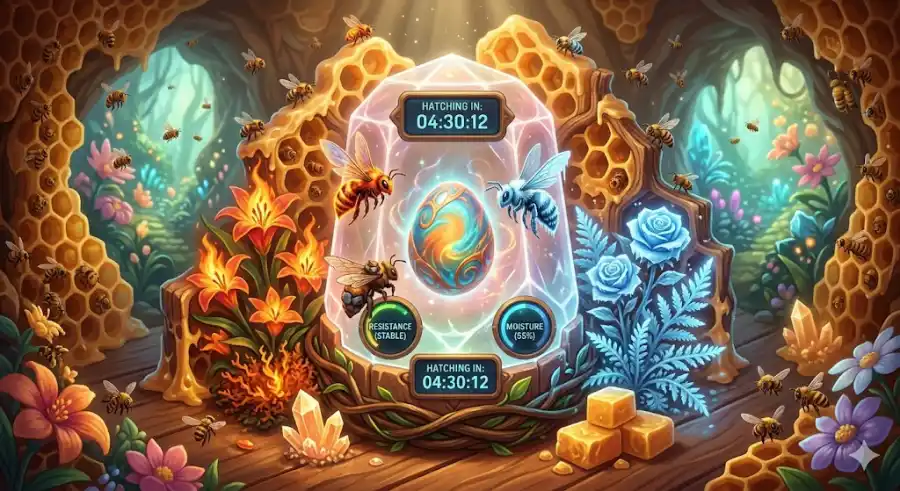
Unlike standard larvae or basic worker spawns, Garden Hive Eggs are considered rare biological-energy containers within the game’s ecosystem. They stand out immediately because of their shifting colors, glowing shell effects, and faint humming audio cue that activates when players approach them.
These eggs are usually earned through:
- Rare drops
- High-tier rewards
- Advanced colony progression
- Special update events
- Endgame hive activities
Not every egg guarantees an elemental outcome. In fact, most failed attempts happen because players misunderstand the egg rarity system.
Currently, there are three confirmed egg tiers capable of producing Elemental Bees.
The Three Known Hive Egg Types
Dormant Flora Eggs
Dormant Flora Eggs are the most common elemental-capable eggs in the game. They appear frequently enough that newer players often assume they are easy wins.
That assumption usually backfires.
These eggs require extensive stabilization and proper environmental conditions. If players incubate them carelessly, the egg often defaults into producing a normal Queen Bee or Drone instead of an elemental variant.
Why Dormant Flora Eggs Are Risky
- Low baseline elemental success rate
- Highly dependent on environmental setup
- Sensitive to temperature imbalance
- Easily downgraded during failed incubation
Experienced players often save these eggs until their hive infrastructure is properly upgraded.
Radiant Core Eggs
Radiant Core Eggs are considered the sweet spot for most mid-to-high-level players.
These uncommon eggs carry a built-in 25% baseline chance of hatching into an Elemental Bee even before modifiers are applied.
That alone makes them significantly more reliable than Dormant Flora Eggs.
Benefits of Radiant Core Eggs
- Better elemental odds
- More stable incubation
- Easier resonance management
- Higher chance of premium stats
Players aiming to consistently farm Elemental Bees often prioritize these eggs over all others due to their balance between rarity and success rate.
Prismatic Hive Eggs
Prismatic Hive Eggs sit at the top of the rarity ladder.
These rare eggs are the ultimate target for dedicated hive builders because they are guaranteed to hatch into a random high-tier Elemental Bee — assuming players incubate them correctly.
That final requirement is extremely important.
Even a Prismatic Egg can fail if the incubator environment collapses during the process.
Why Players Chase Prismatic Eggs
- Guaranteed elemental hatch
- High-tier elemental variants
- Increased shiny/stat potential
- Valuable late-game companion
For competitive colony optimization, Prismatic Eggs are considered game-changing assets.
Pro Tip Before You Start Incubation
One of the biggest mistakes new players make is incubating a Dormant Flora Egg immediately after obtaining it.
That impatience usually wastes the egg.
Without proper hive modifications and environmental tuning, lower-tier eggs frequently hatch into standard bees. Smart players wait until their incubator setup is fully optimized before beginning the process.
Patience matters more than speed in the Garden Hive system.
Step 1: Preparing Your Incubation Zone
A standard brood chamber cannot safely contain elemental energy.
To hatch an Elemental Bee successfully, players must unlock and build the specialized Elemental Incubator Module.
This structure acts as a controlled chamber designed specifically for unstable elemental eggs.
Required Resources for the Elemental Incubator
Players need the following materials before construction begins:
- 50x Refined Beeswax
- 20x Crystallized Nectar
- 5x Elemental Shards
The Elemental Shards should ideally match the desired elemental outcome if players are targeting a specific bee type.
For example:
- Fire builds should use Fire-aligned shards
- Ice builds should use Frost shards
- Earth builds benefit from Terra shards
- Air builds respond best to Wind shards
Best Incubator Placement Strategy
Placement matters more than many players realize.
The incubator should always sit on a central hive tile rather than isolated corners or outer chambers.
Why Central Placement Works Best
Central positioning allows surrounding worker cells to provide passive thermal regulation. That background heat stabilization helps maintain consistent incubation temperatures during the process.
Poor placement can lead to:
- Temperature spikes
- Moisture instability
- Longer incubation periods
- Reduced hatch quality
Advanced players often redesign entire hive layouts around optimal incubator positioning.
Step 2: Choosing Your Elemental Path
One of the smartest mechanics in Grow a Garden is that players can influence which Elemental Bee emerges from the egg.
The environment surrounding the incubator acts like an elemental catalyst.
By placing specific flora and environmental objects nearby, players essentially “seed” the incubator with elemental energy.
This determines the likely elemental outcome.
Fire Path: Pyre Bee
Required Environment
- Magma Lilies
- Ember Moss
Primary Bonus
The Pyre Bee increases honey production speed by 15%.
Pyre Bees are extremely popular among productivity-focused players because they dramatically accelerate hive output. Large honey farms benefit enormously from stacking fire-aligned bonuses.
Best Use Cases
- Resource farming
- Fast honey production
- High-output colonies
Ice Path: Frostwing Bee
Required Environment
- Winter Roses
- Frost-ferns
Primary Bonus
Frostwing Bees slow flower decay within their local radius.
These bees are incredibly useful for maintaining rare flower zones and preserving high-value plants longer than usual.
Best Use Cases
- Long-term flower preservation
- Rare crop management
- Sustainable nectar farming
Earth Path: Terra Bee
Required Environment
- Ironwood Saplings
- Stone-crop
Primary Bonus
Terra Bees double hive structure durability.
Defensive hive builders love Earth variants because they dramatically strengthen colony infrastructure during attacks or environmental stress events.
Best Use Cases
- Defensive colonies
- Long-session gameplay
- Structural optimization
Air Path: Zephyr Bee
Required Environment
- Open-air incubator placement
- Orchid Vines nearby
Primary Bonus
Zephyr Bees improve foraging speed and flight distance.
These bees are excellent for exploration-heavy players who rely on wide-area resource collection.
Best Use Cases
- Long-distance gathering
- Exploration-focused gameplay
- Efficient resource scouting
What Happens If You Leave the Incubator Neutral?
Neutral incubation creates unpredictable outcomes.
- Prismatic Hive Eggs choose a random element
- Lower-tier eggs usually default into ordinary honeybees
That randomness can be exciting, but players targeting a specific build should avoid neutral setups entirely.
Step 3: Managing the Incubation Process
Once the egg enters the incubator, the countdown officially begins.
The standard incubation duration is:
- 24 hours in real time
- 4 hours with premium pollen accelerators
This is where many hatches fail.
Players must actively maintain three critical systems throughout incubation:
- Temperature
- Moisture
- Resonance
Ignoring even one can ruin the hatch.
Temperature Stabilization Explained
Elemental eggs are extremely sensitive to climate conditions.
Fire and Earth Variants
Require higher temperatures.
Ice and Air Variants
Require cooler environments.
If the incubator becomes unstable:
- Excessive heat can crack the egg
- Low temperatures can freeze the timer entirely
Temperature control becomes increasingly important during the final incubation phase.
Moisture Control and Reservoir Management
Moisture levels directly affect shell flexibility.
Players must keep Dewdrops or Distilled Water stocked in the incubator reservoir at all times.
Critical Warning
If moisture falls below 40%:
- The shell hardens
- Natural hatching becomes difficult
- Manual intervention becomes necessary
Manual cracking costs stamina, making it an expensive mistake for unprepared players.
Understanding Resonance
Resonance is arguably the most misunderstood mechanic in the entire Garden Hive update.
This gauge represents the magical stability of the egg.
As worker bees move around the hive, resonance gradually decreases due to environmental interference.
To stabilize resonance, players should assign:
- Bard Bees
- Scholar Drones
These support units “sing” to the egg, keeping magical energy balanced during incubation.
Why High Resonance Matters
Maintaining strong resonance increases the odds of:
- Shiny variants
- Better overall stats
- Rare hatch traits
- Improved elemental stability
Veteran players often consider resonance optimization more important than temperature management during high-tier Prismatic incubations.
Step 4: The Final Hatching Ritual
When the countdown reaches zero, the real excitement begins.
The egg starts cracking while emitting a bright elemental glow that reflects the bee type inside.
This stage is interactive.
Players should never leave the game during the final hatching sequence because the process requires direct player input.
How the Hatching Ritual Works
Interact With the Incubator
As soon as the prompt appears, players must click or tap the incubator immediately.
Missing the timing can interrupt the hatch.
Siphon Energy Into the Egg
Players then channel either:
- Player energy
- Standard Honey resources
This final burst helps the bee break free from the shell.
Name Your Elemental Bee
Once hatched, players can officially name their companion.
This is more important than it sounds because changing names later requires a rare Name Tag item.
Many players save premium names for high-stat or shiny variants.
Common Mistakes That Destroy Elemental Hatches
Even experienced colony managers lose valuable eggs.
Here are the most common reasons hatches fail.
Mixing Opposing Elements
Never place:
- Magma Lilies near Winter Roses
- Fire and Ice catalysts together
Conflicting elemental energy destabilizes the incubator and usually produces either:
- Failed hatches
- Basic worker bees
- Reduced-quality outcomes
Ignoring Hive Attacks
Wasps and predators become especially dangerous during late-stage incubation.
If the hive enters combat:
- Egg stress spikes dramatically
- Resonance drops quickly
- Hatch success rates decrease
Always station Guard Bees near the incubator before the final hours begin.
Running Out of Nectar
The incubator continuously consumes nectar to maintain internal energy systems.
If hive storage reaches zero:
- The incubator powers down
- Incubation halts
- The egg may fail permanently
Resource management becomes critical during long incubations.
Enjoying Your New Elemental Bee
Successfully hatching an Elemental Bee changes how your colony operates.
These rare companions are best used strategically rather than casually assigned to random tasks.
Smart Deployment Ideas
- Assign Fire Bees to production hubs
- Place Frostwing Bees near rare flowers
- Use Terra Bees to defend core structures
- Send Zephyr Bees on long-range gathering routes
As colonies expand, players can eventually experiment with breeding systems involving multiple Elemental Bees.
That opens the door to possible hybrid variants — a feature many players are already calling one of the most exciting long-term mechanics in Grow a Garden.
Why the Elemental Bee System Matters
The Garden Hive update represents a major evolution for Grow a Garden.
Before this feature, hive management mainly focused on efficiency and scaling. Elemental Bees introduce:
- Deeper strategy
- Environmental planning
- Long-term colony specialization
- Advanced resource balancing
The system rewards patience, preparation, and experimentation rather than pure grinding.
That shift adds meaningful depth to gameplay and keeps veteran players engaged far beyond the early game loop.
The Elemental Bee system is easily one of the most ambitious and rewarding mechanics added to Grow a Garden so far.