Theme Park Tycoon 2 vs Modern Roblox Tycoons Does the Legendary Coaster Builder Still Rule the Genre?
For many players, that sound instantly brings back memories of Theme Park Tycoon 2 (TPT2), one of the most iconic and influential management games ever created on Roblox.
Highlights
- Created by veteran Roblox developer Den_S and launched in 2012
- Has accumulated well over 1.5 billion visits
- Inspired by classic simulation franchises such as RollerCoaster Tycoon and Planet Coaster
- Offers unmatched creative freedom compared to most Roblox tycoon games
- Features advanced coaster construction and park customization tools
- Continues receiving support and updates from its developer
- Faces criticism for limited economic depth and aging guest AI systems
- Remains one of Roblox's most replayable and creative management experiences
The Secret Formula Behind Theme Park Tycoon 2’s Success
A Love Letter to Theme Park Simulation Classics
At its core, Theme Park Tycoon 2 is a celebration of classic PC management games.
Players familiar with legendary franchises like RollerCoaster Tycoon and Planet Coaster immediately recognize the inspiration. Instead of guiding players through scripted objectives, the game places them on a large, empty plot of land and hands them a modest budget.
From that point forward, success depends entirely on the player's creativity and planning.
The experience begins with a simple challenge: transform a patch of empty grass into a thriving amusement empire.
The progression system follows a straightforward but highly addictive loop:
The Core Gameplay Cycle
Build a ride → Attract guests → Earn money → Maintain the park → Expand with bigger attractions
This formula sounds simple on paper, yet it remains incredibly engaging even after hundreds of hours.
Every new attraction increases guest traffic. More visitors generate more income. More income allows players to build larger and more impressive creations. The cycle continually rewards experimentation and long-term planning.
Why TPT2 Feels Different From Traditional Roblox Tycoons
One of the biggest reasons Theme Park Tycoon 2 has endured for so long is that it avoids the common pitfalls of many Roblox tycoon experiences.
Traditional Roblox tycoons often rely on a repetitive formula:
- Step on a button
- Unlock a wall
- Step on another button
- Unlock a machine
- Repeat until complete
While that approach can be entertaining for a short period, it rarely provides lasting engagement.
Theme Park Tycoon 2 takes a completely different approach.
Rather than automating creativity, the game puts control directly into the player's hands.
Players manually:
- Design coaster layouts
- Build pathways
- Place scenery
- Position decorations
- Adjust ride angles
- Create guest flow systems
- Manage park aesthetics
Every decision has a visible impact on the final result.
This emphasis on player agency is one of the biggest reasons TPT2 continues attracting both new players and longtime fans.
Freedom vs Finance: A Sandbox Disguised as a Tycoon
The Fascinating Management Paradox
When evaluating Theme Park Tycoon 2 strictly as a management simulator, an interesting contradiction emerges.
On one hand, it absolutely belongs in the management genre. Players oversee finances, guest satisfaction, ride placement, staffing decisions, and park expansion.
On the other hand, the economic systems themselves are relatively straightforward.
Most financial success comes down to a few simple principles:
- Set reasonable prices
- Keep the park clean
- Offer enough food and drink options
- Build attractive rides
- Maintain guest happiness
Once a successful coaster begins generating revenue, financial struggles become significantly less threatening.
Compared to more business-focused management games, the economic challenge can feel somewhat limited.
However, that is also where Theme Park Tycoon 2's greatest strength emerges.
Creativity Is the Real Endgame
Many Roblox management games focus on maximizing profit.
Theme Park Tycoon 2 focuses on maximizing imagination.
The game gradually evolves from a business simulator into a powerful creative sandbox where players become architects, engineers, and designers.
Instead of obsessing over spreadsheets and profit margins, many experienced players spend dozens of hours perfecting a single coaster, building detailed environments, or recreating famous real-world theme parks.
This creative focus gives TPT2 a unique identity that few competitors have managed to replicate.
The Customization Revolution That Changed Everything
From Casual Tycoon to Advanced Building Platform
One of the biggest reasons Theme Park Tycoon 2 has remained relevant is the steady stream of improvements introduced by Den_S over the years.
What started as a relatively straightforward tycoon eventually transformed into one of Roblox's most advanced construction systems.
Several major building features dramatically expanded player creativity, including:
Advanced Placement Tools
Advanced placement tools gave players significantly greater control over how objects could be positioned throughout their parks.
Disable-Collision Building
The introduction of collision-free building unlocked entirely new design possibilities.
Builders could now create structures that previously would have been impossible using standard placement limitations.
Micro-Adjustment Systems
Precision adjustment tools allowed players to fine-tune virtually every element of their creations.
These additions pushed Theme Park Tycoon 2 far beyond the boundaries of a typical Roblox tycoon game.
What Players Are Building Today
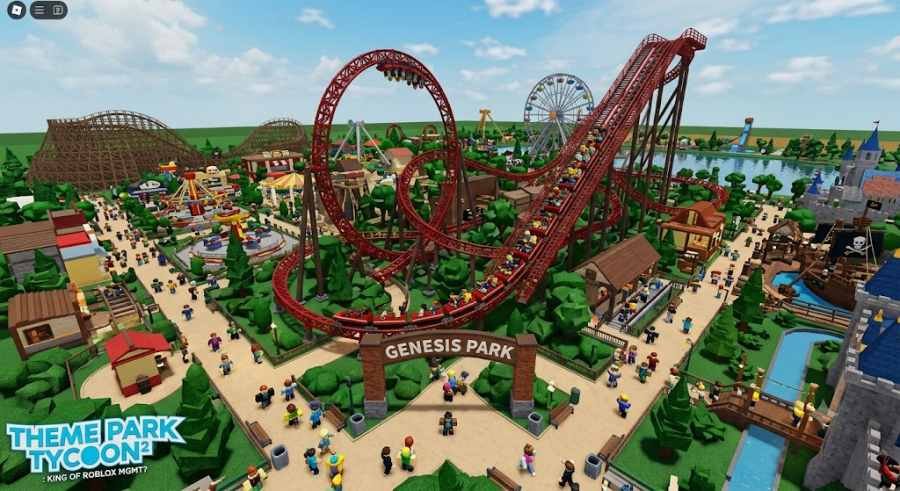
Modern Theme Park Tycoon 2 parks look dramatically different from the simple attractions that populated servers years ago.
Visit highly rated community parks today and you'll discover creations that showcase incredible attention to detail.
Some of the most impressive examples include:
Hyper-Realistic Custom Coasters
Players routinely construct smooth steel roller coasters featuring realistic layouts, advanced banking angles, and professional-level track designs.
Massive Themed Environments
Entire worlds are built within individual parks, including:
- Medieval kingdoms
- Futuristic space stations
- Tropical jungles
- Fantasy cities
- Historical landmarks
Complex Custom Architecture
Builders use primitive shapes and advanced placement techniques to create structures that barely resemble traditional Roblox blocks.
The result is a game that quietly hides professional-grade design tools behind an accessible and family-friendly interface.
Theme Park Tycoon 2 vs Modern Roblox Management Games
The Roblox tycoon genre has evolved considerably over the years.
Today's top experiences generally fall into two categories:
Active Management Games
These prioritize business strategy, optimization, staffing, and economic decision-making.
Creative Sandbox Games
These prioritize freedom, design, and player expression.
Theme Park Tycoon 2 occupies a unique position between both categories.
| Game | Management Depth | Creative Freedom | Best For |
|---|---|---|---|
| Theme Park Tycoon 2 | Moderate | Unmatched | Creative builders and coaster enthusiasts |
| Retail Tycoon 2 | High | Moderate | Strategy-focused business managers |
| Restaurant Tycoon 2 | High | High | Players who enjoy structured progression |
| Miner's Haven | Moderate (Puzzle-Based) | Low | Optimization and idle-game fans |
Retail Tycoon 2 vs Theme Park Tycoon 2
When it comes to pure business management, Retail Tycoon 2 presents serious competition.
The game places a heavy emphasis on:
- Supply chain management
- Inventory control
- Shelf stocking
- Demand-based pricing
- Employee management
- Store optimization
Players must continuously make strategic decisions that directly affect profitability.
Retail Tycoon 2 often feels closer to running an actual business.
Theme Park Tycoon 2, by comparison, places far less pressure on the player financially.
Once a few successful attractions are operating, bankruptcy becomes relatively uncommon.
For players seeking intense economic management, Retail Tycoon 2 arguably offers a deeper experience.
Restaurant Tycoon 2 vs Theme Park Tycoon 2
Restaurant Tycoon 2 occupies an interesting middle ground.
It combines:
- Active cooking mechanics
- Meaningful progression systems
- Restaurant customization
- Staff management
- Customer satisfaction systems
The game delivers a satisfying balance between creativity and structured gameplay.
However, even with its polished systems and regular improvements, Restaurant Tycoon 2 cannot replicate the sheer scale that Theme Park Tycoon 2 offers.
There is something uniquely satisfying about riding a roller coaster you personally designed.
Experiencing your own creation from a first-person perspective alongside friends creates memorable moments that restaurant simulators simply cannot reproduce.
Where the Tracks Start to Get Bumpy
No classic game is perfect, and Theme Park Tycoon 2 is no exception.
While the experience remains impressive, several limitations reveal its age.
The Guest AI Problem
Perhaps the most frequently discussed issue within the community is the game's guest artificial intelligence.
For years, players have requested smarter visitor behavior.
Unfortunately, park guests still behave in fairly simplistic ways.
Common issues include:
- Guests becoming stuck on poorly designed pathways
- Pathfinding struggles in larger parks
- Limited behavioral variety
- Basic reactions and decision-making systems
Compared to modern simulation games, the AI often feels outdated.
The Guest Cap Limitation
Performance optimization is another challenge.
To ensure mobile devices and lower-end hardware can run the game smoothly, Theme Park Tycoon 2 typically enforces a guest limit of approximately 180 visitors per park.
From a technical standpoint, this decision makes sense.
However, it introduces an immersion problem.
Players who spend hundreds of hours building enormous theme parks sometimes discover that their sprawling attractions feel surprisingly empty.
Watching a gigantic, highly detailed roller coaster launch with only two passengers seated in the front row can diminish the feeling of realism.
A Surprisingly Steep Learning Curve
Although beginners can quickly place pre-built attractions and enjoy the game, mastering advanced construction is another story entirely.
Building smooth custom roller coasters requires:
- Understanding coaster pacing
- Managing track banking
- Controlling ride intensity
- Designing realistic layouts
- Balancing excitement ratings
Many players eventually encounter the dreaded message:
"Intensity rating too high."
Learning how to avoid that penalty often requires significant practice and experimentation.
For newcomers, the transition from casual builder to expert designer can take considerable time.
Industry Impact: Why Theme Park Tycoon 2 Matters
Theme Park Tycoon 2's influence extends far beyond its own player base.
The game helped demonstrate that Roblox could support deep, long-form management experiences rather than simple click-based progression systems.
Its success inspired countless developers to pursue:
- Advanced building mechanics
- User-generated creativity
- Sandbox-focused gameplay
- Long-term progression systems
- Community-driven content
Many modern Roblox simulation games owe part of their design philosophy to the groundwork established by Theme Park Tycoon 2.
In many ways, it helped define what a high-quality Roblox tycoon experience could become.
Why Theme Park Tycoon 2 Still Matters in 2026
Even after more than a decade, very few Roblox games offer the same combination of accessibility and depth.
A six-year-old player can log in and build a simple water slide within minutes.
Meanwhile, a college student can spend fifty hours recreating an entire Disney-inspired resort with astonishing detail.
Few games successfully serve such a wide audience.
The combination of:
- Creative freedom
- Long-term replayability
- Community blueprint sharing
- Consistent developer support
- Deep building mechanics
continues to keep Theme Park Tycoon 2 relevant in an increasingly competitive Roblox ecosystem.