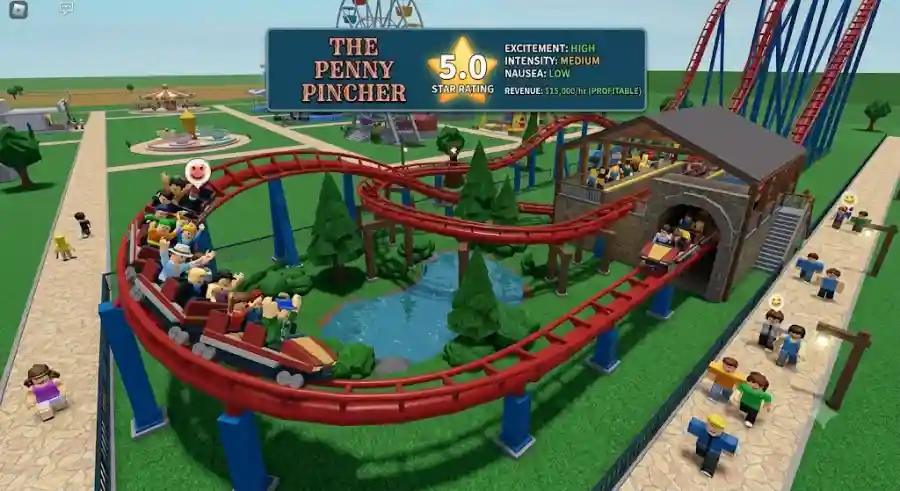
How to Create a Profitable 5-Star Coaster in Theme Park Tycoon 2 Using Smart Design, Budget Planning and Advanced Ride Mechanics
One of the biggest misconceptions in Theme Park Tycoon 2 is that bigger automatically means better. In reality, the highest-rated coasters are rarely the most expensive. The secret lies in understanding how the game's ride physics, guest preferences, coaster statistics, and financial systems work together.
Highlights
Key Principles for a 5-Star Coaster
- Maintain a cash reserve before construction begins.
- Choose coaster types that offer strong value for money.
- Focus on excitement rather than extreme intensity.
- Use airtime hills and near-miss elements effectively.
- Bank turns properly to reduce nausea.
- Run multiple trains using block brakes.
- Enhance ratings with inexpensive scenery.
- Test and fine-tune every section before opening.
These principles form the foundation of nearly every highly rated coaster in Theme Park Tycoon 2.
Start With the Budget in Mind
Avoid the Classic "No Money" Trap
One of the most common mistakes made by new and intermediate players is spending every available dollar on track pieces.
The excitement of building a massive coaster often leads players to ignore essential park expenses. By the time construction finishes, there is no money left for queue paths, decorations, landscaping, maintenance, or operational improvements.
The result is a beautiful coaster sitting inside an unfinished area of the park.
Create a Financial Safety Net
Before placing your first track piece, establish a comfortable financial buffer.
A good rule is to avoid starting any major coaster project unless you have at least:
$20,000 to $30,000 in available cash
This reserve provides flexibility during construction and prevents your park from becoming financially unstable.
Unexpected adjustments happen frequently. You may need to rebuild sections, add scenery, extend queues, or purchase additional trains. Having spare cash ensures these improvements remain possible.
Use the Cash Cow Strategy
When funds become tight, focus on generating passive income before expanding.
Certain flat rides consistently produce reliable revenue and can help finance larger projects.
Popular money-making attractions include:
- Teacups
- Ferris Wheel
- Other guest-friendly flat rides
Place these rides near the park entrance where guest traffic is highest.
While your coaster is under construction, these attractions continue generating income. This strategy creates a steady financial stream that supports ongoing development without forcing you to pause construction.
Choosing the Right Coaster Type
Not Every Coaster Offers the Same Value
A common mistake among ambitious builders is selecting the most expensive coaster available without considering return on investment.
Different coaster types excel at different stages of park development.
Coaster Comparison Guide
| Coaster Type | Cost | Best Stage | Advantages |
|---|---|---|---|
| Junior / Family Coaster | Low | Early Game | Affordable, guest-friendly, low risk |
| Steel Roller Coaster | Medium | Mid Game | Flexible, customizable, excellent ratings potential |
| Hypercoaster | High | Late Game | Massive stat potential but requires significant investment |
Why Steel Coasters Are Often the Best Choice
For players seeking maximum value, Steel Coasters remain one of the strongest options in Theme Park Tycoon 2.
They offer:
- Excellent customization options
- Reliable speed management
- Affordable construction costs
- Consistently high guest appeal
- Easier paths toward 4-star and 5-star ratings
Wooden Coasters also provide impressive value, especially for players working with tighter budgets.
The combination of affordability and performance makes Steel and Wooden Coasters some of the smartest investments available.
Understanding the Holy Trinity of Coaster Stats
How Ride Ratings Actually Work
Every coaster in Theme Park Tycoon 2 revolves around three critical statistics:
Excitement
Measures how enjoyable and thrilling guests find the ride.
Intensity
Measures the physical forces experienced during the ride.
Nausea
Measures how likely guests are to feel sick afterward.
The ultimate goal is simple:
Maximize Excitement while keeping Intensity and Nausea within a comfortable Medium-to-High range.
Once Intensity reaches Extreme or Ultra Extreme levels, guests become reluctant to ride.
Even an expensive coaster becomes unprofitable if guests refuse to board it.
How to Increase Excitement Without Spending a Fortune
Airtime Is King
Experienced coaster builders consistently prioritize airtime.
Airtime occurs when riders briefly experience a sensation of weightlessness while traveling over hills at speed.
Guests absolutely love this effect.
Build Camelback Hills
After major drops, add a series of smaller hills commonly called camelbacks.
These hills:
- Increase excitement ratings
- Improve ride pacing
- Cost very little to build
- Deliver strong guest satisfaction
Airtime elements often provide more value than expensive inversions.
Use Near-Miss Elements
One of the smartest ways to boost excitement is through visual illusions.
Players often call these "head-chopper" effects.
Build track sections:
- Close to the ground
- Through tunnels
- Near support structures
- Around existing coaster elements
Although riders remain perfectly safe, the visual impression creates a sense of danger that increases excitement ratings.
The best part is that these improvements cost almost nothing.
Increase Ride Interactivity
Guests enjoy attractions that feel connected to the rest of the park.
Consider routing your coaster:
- Above guest pathways
- Near flat rides
- Around buildings
- Through busy sections of the park
This creates a more immersive environment and contributes positively to overall ride appeal.
Mastering Coaster Layout Mechanics
Smoothness Is Everything
Many failed coasters share the same problem.
Poor pacing.
A coaster moving too quickly through a tight corner produces excessive G-forces. A coaster moving too slowly over hills risks stalling.
Creating a smooth flow between elements is one of the most important skills in Theme Park Tycoon 2.
Designing the Perfect Lift Hill
Bigger Isn't Always Better
Many players assume a giant lift hill automatically leads to a better coaster.
In practice, excessively tall lift hills often create problems.
A very high first drop:
- Costs significantly more money
- Produces excessive speed
- Requires additional brake sections
- Can increase intensity dramatically
Instead, build your lift hill only high enough to allow the train to complete the full circuit comfortably.
Efficient design almost always beats excessive height.
Bank Every Fast Turn
The Most Important Rule in Coaster Design
If your coaster exceeds approximately:
30 mph (48 km/h)
during a turn, banking becomes essential.
Unbanked corners generate severe lateral G-forces that dramatically increase both nausea and intensity.
This is one of the fastest ways to ruin an otherwise excellent coaster.
Proper Banking Technique
Always utilize the advanced editor when creating turns.
For most situations:
- Use 30° banking for moderate speeds
- Use up to 60° banking for faster sections
Correct banking allows the train to lean naturally into the turn.
Correct Banking
Train smoothly follows the curve while maintaining excitement.
Incorrect Banking
Train slams sideways into the turn, producing excessive nausea and discomfort.
A properly banked coaster feels faster, smoother, and significantly more enjoyable.
Inversions: Less Is Often More
Quality Over Quantity
Loops, corkscrews, barrel rolls, and other inversion elements can dramatically improve a coaster when used correctly.
However, many players make the mistake of adding too many.
A coaster overloaded with inversions often suffers from:
- Excessive intensity
- High nausea
- Poor ride balance
The most effective budget coasters usually feature:
1 to 3 carefully placed inversions
This approach keeps the ride exciting without overwhelming guests.
Watch Your Entry Speed
Timing matters.
Entering an inversion too fast can create extreme G-forces.
Entering too slowly can cause the train to stall.
The ideal inversion occurs when the train maintains moderate speed and flows naturally into the next section of track.
Increase Profitability With Block Brakes
Why Throughput Matters
Building a great coaster is only half the challenge.
The ride must also make money.
One of the biggest profit killers in Theme Park Tycoon 2 is operating only a single train.
A coaster can have fantastic ratings and still earn money slowly if guest throughput remains low.
Extend the Station
Longer stations create opportunities for larger trains and additional cars.
This increases the number of guests processed per dispatch.
More riders per cycle translates directly into higher profits.
Use Block Brakes
Block brakes are among the most powerful tools available to advanced coaster builders.
They divide the track into separate operating sections.
This allows multiple trains to run safely on the same coaster simultaneously.
Benefits of Block Brakes
- Higher capacity
- Increased efficiency
- Faster guest turnover
- Improved revenue generation
Two trains operating at once can effectively double income potential compared to a single-train setup.
Optimize Dispatch Timing
Fine-tuning dispatch settings can make a surprisingly large difference.
Configure your coaster so that:
- One train leaves
- The next train enters the station immediately
Reducing downtime increases operational efficiency and improves guest satisfaction.
Cheap Scenery Hacks for Better Ratings
Scenery Matters More Than Most Players Realize
Many players focus exclusively on track design and completely overlook the environment surrounding the coaster.
This is a costly mistake.
A coaster placed on an empty field of grass will almost always perform worse than a similar coaster integrated into a themed environment.
Fortunately, creating impressive scenery doesn't require millions of dollars.
The Nature Blueprint
One of the cheapest and most effective landscaping techniques involves using:
- Trees
- Bushes
- Rocks
Place these items beneath and around the track.
The cost remains low while environmental ratings receive a significant boost.
This strategy delivers one of the best value-to-cost improvements in the game.
Build Tunnels
Tunnels provide both visual appeal and excitement bonuses.
Using the terrain editor:
- Dig into the ground.
- Route the coaster through the opening.
- Cover the section to create a tunnel.
Guests love sudden transitions from open air into darkness.
The excitement increase often justifies the minimal construction cost.
Add Water Features
Water is another highly effective scenery element.
Even a small pond can enhance the visual appeal of your coaster.
Consider placing water beneath:
- Low turns
- Airtime hills
- Fast drops
These additions create attractive photo-worthy moments while improving overall presentation.
Testing and Fine-Tuning Before Opening
Never Skip Testing
Opening a coaster without testing is one of the fastest ways to damage your park's reputation and profitability.
Before welcoming guests, switch the ride into Test Mode and monitor performance carefully.
The live data panel provides valuable information that can reveal hidden problems.
Identify Red Zones
Pay close attention to intensity graphs.
If a specific section shows bright red spikes:
- Widen the turn
- Increase banking
- Rebuild problematic track segments
Small adjustments often produce major improvements.
Use Trim Brakes Strategically
Sometimes a coaster becomes too fast near the end of the ride.
Instead of rebuilding large sections, install trim brakes before the final brake run.
Trim brakes:
- Reduce speed gradually
- Lower nausea levels
- Improve ride comfort
- Preserve existing layout designs
This simple solution can save thousands of dollars in reconstruction costs.
Industry Impact: Why Advanced Coaster Design Matters in Theme Park Tycoon 2
As Roblox tycoon and simulation games continue growing in popularity, Theme Park Tycoon 2 remains one of the platform's most respected park-building experiences.
The game's coaster system stands out because it rewards thoughtful engineering rather than mindless spending.
Players who understand pacing, G-forces, throughput, and guest behavior consistently outperform those who simply build larger attractions.
This design philosophy mirrors real-world theme park management, where successful rides must balance thrill, comfort, capacity, and profitability.
That depth is one of the reasons Theme Park Tycoon 2 continues attracting dedicated builders years after release.
Why This Guide Matters
Creating a five-star roller coaster is not about spending the most money.
It is about understanding the systems operating beneath the surface.
Players who master:
- Airtime design
- Proper banking
- Throughput optimization
- Scenery integration
- Financial management
can consistently build attractions that earn strong ratings and generate impressive profits.
These skills become even more valuable as parks expand and construction budgets grow.