Devolver Digital’s First-Person Double-Deckbuilder Brings Card Combat and Fungal Monsters to Steam
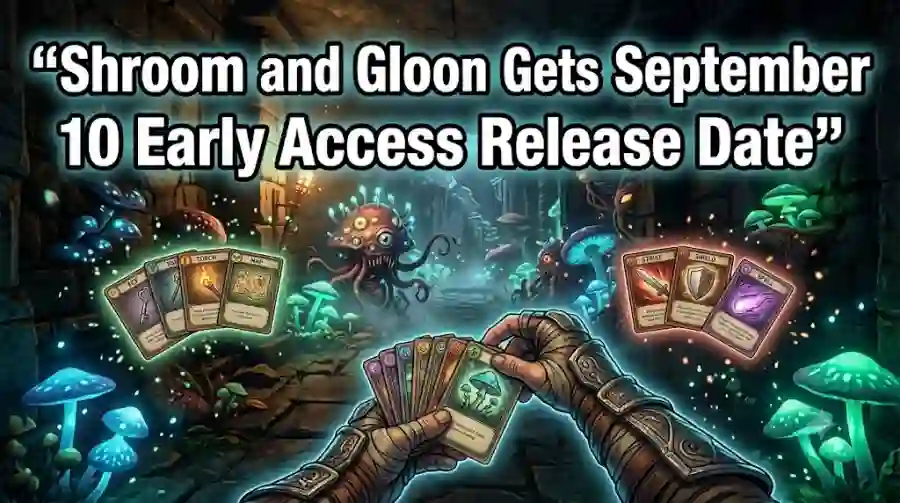
Instead of exploring realistic medieval environments or futuristic laboratories, players enter hand-drawn underground worlds filled with strange fungal creatures.
The objective is not simply to defeat everything in sight.
Players need to build their decks, manage resources, explore dangerous locations and create powerful combinations before the mysterious Gloom overwhelms them.
With its September release now confirmed, Shroom and Gloom is moving from an interesting indie curiosity into one of the more distinctive PC games to watch next month.
Shroom and Gloom Has a Very Different Deckbuilding Formula
The biggest idea behind Shroom and Gloom is its two-deck system.
Most deckbuilding games focus heavily on one collection of cards.
Shroom and Gloom instead separates exploration and combat into different decks.
That means the cards used to navigate the dungeon are not necessarily the same cards used during battles.
Exploration itself becomes part of the strategic game.
Players can encounter obstacles and situations that require specific responses.
A locked door, for example, may require a particular card or another solution.
Other environmental interactions can force players to decide whether they want to spend a valuable resource now or continue exploring while taking a greater risk.
That makes the journey through the dungeon almost as strategically important as the fights.
Hundreds of Cards Create Huge Build Possibilities
The developers describe Shroom and Gloom as featuring hundreds of cards spread across its different systems.
For a roguelike, that creates an important source of replayability.
Players can experiment with different combinations during each run instead of following exactly the same progression.
A card that looks weak in one build might become extremely powerful when combined with another ability.
That encourages experimentation.
It also means players will have to learn which cards complement each other rather than simply collecting the strongest individual options.
The best strategy may not always involve the most powerful card.
Sometimes the strongest build is the one where several seemingly ordinary cards interact perfectly.
First-Person Exploration Makes It Stand Out
The game is not presented from the traditional top-down perspective associated with many roguelike deckbuilders.
Shroom and Gloom uses a first-person viewpoint.
Players move through hand-drawn underground environments while making decisions about where to go and how to interact with the world.
This changes the feeling of exploration.
Instead of viewing the dungeon like a board, players experience it more directly.
The developers have also reworked the exploration system during development.
Recent updates introduced mechanics involving torches, creatures and environmental interactions, allowing players to investigate areas and discover new ways to improve their decks.
That makes exploration more than a transition between battles.
It becomes a core gameplay system.
The Gloom Is Always Waiting
The title's "Gloom" is not simply there for atmosphere.
It represents a threat that can punish players who remain in the dungeon for too long.
The developers' exploration system includes a risk associated with resting and taking too much time.
Players need to make decisions about when to recover and when to keep moving forward.
That creates an interesting tension.
Normally, recovering health or resources is a safe decision in a game.
In Shroom and Gloom, recovery can come with a cost.
Players therefore have to consider whether their current situation is dangerous enough to justify resting or whether they should continue with the resources they already have.
This gives exploration a sense of urgency.
The Dungeon Is Filled With Fungal Enemies
The game's enemies fit its strange visual identity.
Instead of conventional fantasy monsters, players encounter grotesque fungal creatures.
The developers describe the game as a journey through hand-drawn dungeons filled with fungal foes and opportunities to create increasingly powerful combinations.
That visual direction gives Shroom and Gloom a distinctive personality.
The hand-drawn presentation also helps separate it from the increasingly common wave of realistic-looking indie roguelikes.
The world looks deliberately handmade.
That works particularly well with the game's card-based mechanics.
The entire experience feels like a strange illustrated adventure brought to life.
Combat Is About Building Synergies
The combat system revolves around creating combinations between cards.
Rather than relying on a conventional equipment system, players construct their strategy through the cards they collect.
A strong run can therefore develop around a particular theme.
One player might focus on direct damage.
Another might prioritize defensive effects.
Someone else could attempt to create a combination that generates resources and then converts those resources into increasingly powerful attacks.
The developers are clearly leaning into the idea of synergy rather than simply increasing numbers.
That is important for long-term replayability.
If the most effective strategy were always obvious, the game would become repetitive quickly.
Instead, Shroom and Gloom encourages players to discover interactions for themselves.
Every Run Can Develop Differently
The roguelike structure means that players should not expect every attempt to follow the same path.
Cards, encounters and exploration decisions can change the direction of a run.
That creates the familiar risk-reward loop associated with the genre.
Players make progress.
They become stronger.
They encounter more dangerous enemies.
Then a bad decision can potentially end the run.
Starting again is not simply repeating the same content.
It provides another opportunity to experiment with a different combination.
This structure is one of the main reasons roguelikes have remained so popular.
Shroom and Gloom takes that formula and combines it with a first-person exploration layer.
The Demo Is Already Available
Players do not necessarily need to wait until September to find out whether the concept works for them.
A playable demo is already available through Steam.
That is particularly useful for an unusual game like Shroom and Gloom.
Descriptions can explain the two-deck concept, but actually playing the game gives players a much better idea of how the systems interact.
The demo has also received major updates during development.
Team Lazerbeam previously introduced an exploration overhaul that added new mechanics and expanded how players interact with dungeon environments.
That means the demo provides a useful preview of the direction the developers are taking before Early Access begins.
Why Early Access Makes Sense
Shroom and Gloom is exactly the type of game that can benefit from Early Access.
Its systems are highly interconnected.
The developers need to balance cards.
They need to tune enemy difficulty.
They need to make sure exploration remains interesting.
They also need to ensure that the two-deck system does not create situations where one strategy dominates everything else.
Player feedback can help identify those problems.
Team Lazerbeam has already involved its community during development, and the Early Access launch will provide a much larger opportunity to see how players actually approach the game's systems.
Devolver Digital Is Publishing the Game
Shroom and Gloom is being developed by Team Lazerbeam and published by Devolver Digital.
That partnership is worth noting because Devolver has developed a reputation for publishing distinctive independent games.
The publisher's portfolio includes titles that are willing to experiment with unusual concepts and visual styles.
Shroom and Gloom fits that identity particularly well.
It is not trying to compete with a major AAA RPG.
Instead, it is targeting players who want something unusual and mechanically focused.
The Game Is Coming Exclusively to PC at First
The currently confirmed platform for the Early Access release is PC through Steam.
The Steam listing identifies the game as a single-player title.
There is currently no confirmed console Early Access release.
That makes September 10 an important date primarily for PC players.
Console versions could potentially be considered later, but they should not be treated as confirmed unless the developers make an official announcement.
What Players Should Expect From Early Access
Players entering Early Access should expect the game to continue evolving.
The developers have already changed major systems during development, including exploration.
That process is likely to continue.
Cards may be balanced.
Enemy difficulty may change.
New mechanics may be added.
Existing systems may be redesigned.
That is normal for Early Access and is particularly relevant for a game whose identity depends heavily on interconnected mechanics.
Players should therefore approach the September release as the beginning of another stage of development rather than the final version.
Why Shroom and Gloom Could Find an Audience
The roguelike and deckbuilding markets are crowded.
That makes it difficult for another card-based game to stand out.
Shroom and Gloom has several features that could help.
The first-person perspective gives it a different feel.
The two-deck system gives it a distinct mechanical identity.
The hand-drawn presentation makes it visually recognizable.
And the fungal setting provides plenty of room for strange enemies and creative card effects.
Those elements give the game a clear identity before players even enter their first dungeon.
The real test will be whether those ideas remain interesting after dozens of runs.
September Could Be a Strong Month for the Game
The September 10 launch puts Shroom and Gloom into an increasingly busy gaming period.
Several major games are scheduled for September, meaning competition for player attention will be high.
But that can also benefit smaller games.
Players looking for something outside the biggest releases may be more willing to try a distinctive indie title.
The relatively low barrier of entry created by the existing demo could also help.
Players can test the game before committing to Early Access.
If the demo continues generating interest, the September launch could provide Team Lazerbeam with a strong starting community.
What We Know So Far
Here are the confirmed details:
- Game: Shroom and Gloom
- Developer: Team Lazerbeam
- Publisher: Devolver Digital
- Genre: First-person roguelike double-deckbuilder
- Platform: PC via Steam
- Early Access: September 10, 2026
- Mode: Single-player
- Core system: Two separate decks for exploration and combat
- Content: Hundreds of cards
- Setting: Hand-drawn underground dungeons
- Enemies: Grotesque fungal creatures
- Demo: Available now
- Full Early Access release: September 10, 2026
Conclusion
Shroom and Gloom is preparing to move into Steam Early Access on September 10, 2026, giving PC players the opportunity to experience one of the more unusual roguelike deckbuilders arriving this year.
Its biggest selling point is not simply that it combines cards and dungeon crawling.
It is the way those systems are separated.
Players have an exploration deck and a combat deck, forcing them to think about both movement through the dungeon and the battles waiting inside it.
The first-person presentation gives the experience another layer of identity, while the hand-drawn environments and fungal enemies make it visually different from many competing roguelikes.
The presence of a mysterious Gloom also adds pressure to exploration, preventing players from treating recovery and resource management as completely safe decisions.
Most importantly, players can already try the demo before Early Access.
That gives Team Lazerbeam an opportunity to build a community before the September launch while allowing players to decide whether its unusual mechanics are worth following.
The game will still have plenty to prove.
A clever concept is not enough to sustain a roguelike for dozens or hundreds of hours.
The cards need to remain interesting, combinations need to feel rewarding and the exploration system needs to avoid becoming repetitive.
But the foundation is certainly different.
For players looking for something outside the usual AAA releases, Shroom and Gloom could be one of September's more interesting indie experiments.
Frequently Asked Questions
When does Shroom and Gloom enter Early Access?
Shroom and Gloom launches into Steam Early Access on September 10, 2026.
What is Shroom and Gloom?
It is a first-person roguelike double-deckbuilder where players explore hand-drawn dungeons and fight fungal enemies using cards.