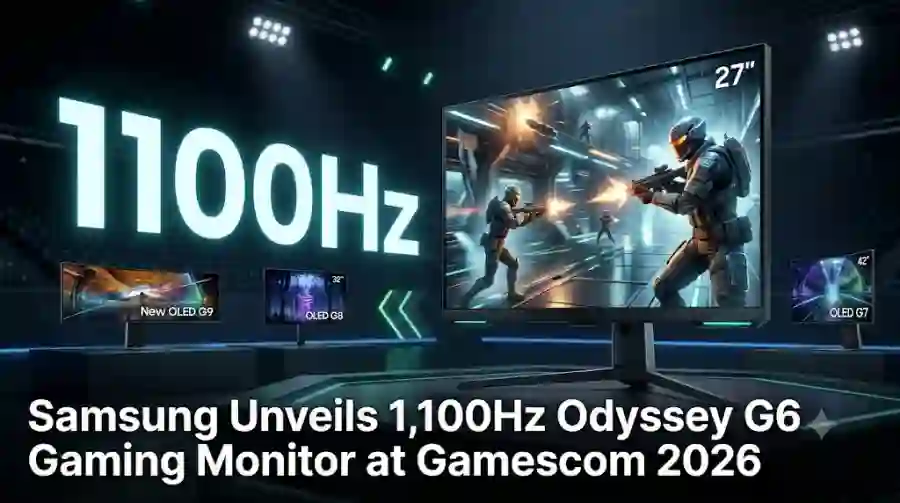
Samsung Pushes Gaming Monitors Into a New Era With 1,100Hz G6 and a New Generation of High-Speed OLED Displays
However, there is an important detail behind the headline specification. The G6 reaches its maximum 1,100Hz mode at HD resolution, while its native QHD resolution supports up to 600Hz. Samsung is positioning the monitor primarily toward competitive FPS players who value extremely fast motion above maximum resolution.
The G6 is not the only interesting display in the new lineup. Samsung has also introduced three OLED monitors that focus on large screens, high resolution, HDR and flexible refresh-rate modes.
Together, the four displays show where Samsung believes high-end gaming monitors are heading.
Samsung Odyssey G6 Reaches 1,100Hz
The biggest announcement is the Odyssey G6 G60H.
The 27-inch Fast IPS monitor has a native resolution of 2560 × 1440 and supports up to 600Hz at QHD. In its high-speed mode, the display can reach 1,100Hz at HD resolution. Samsung also lists a 1ms response time.
The monitor is designed primarily for competitive players.
Games such as competitive shooters can benefit from high refresh rates because a higher refresh rate allows the display to update the image more frequently.
But 1,100Hz is an extreme figure.
At that speed, the monitor is refreshing the image roughly 1,100 times every second. That makes the maximum refresh mode relevant mainly to players who prioritize motion clarity and extremely high frame rates.
For most players, the more practical mode may be the 600Hz QHD setting.
That provides significantly higher resolution while still offering an exceptionally high refresh rate.
Why 1,100Hz Does Not Automatically Mean Better Gaming
The headline number is impressive, but refresh rate is only one part of gaming performance.
To actually benefit from a 1,100Hz display, a gaming system needs to generate an extremely high number of frames per second.
If a game is running at 200 FPS, a 1,100Hz monitor cannot magically create 1,100 unique frames from the game engine.
The benefit therefore depends heavily on the game, graphics settings, hardware and player's competitive needs.
This is why Samsung's dual-mode approach makes sense.
Players can use QHD at up to 600Hz when they want a balance between resolution and speed.
They can then switch to the lower-resolution mode when maximum refresh rate is the priority.
Samsung says the G6 will be available globally during the second half of 2026, although pricing and exact market availability have not yet been announced.
The 49-Inch Odyssey OLED G9
Samsung's new Odyssey OLED G9 takes a completely different approach.
Instead of targeting esports players who want the fastest possible refresh rate, the G9 focuses on immersion and an enormous ultrawide screen.
The new model features a 49-inch DQHD display with a 5120 × 1440 resolution and a 360Hz refresh rate. It can also use a dual-mode configuration to reach 720Hz at a lower resolution.
Samsung is using a fifth-generation QD-OLED panel with its Penta Tandem technology.
The company says the panel design improves longevity, while its RGB stripe layout is intended to reduce text-fringing issues associated with some OLED displays.
Samsung also lists peak brightness of up to 1,300 nits for the new G9.
That combination makes the monitor much more than an esports display.
It is designed for players who want a huge field of view for racing games, flight simulators, RPGs and other immersive experiences.
The 32-Inch Odyssey OLED G8 Brings Triple-Mode Gaming
The new 32-inch Odyssey OLED G8 G80SJ sits between extreme competitive performance and cinematic gaming.
It features a 4K QD-OLED panel with a 360Hz refresh rate.
The interesting feature is its triple-mode functionality.
Samsung says the monitor can operate at:
- 4K at 360Hz
- QHD at 520Hz
- Full HD at 680Hz
That gives players multiple ways to prioritize image quality or speed depending on the game.
For a single monitor, that is an unusually flexible configuration.
A player could use 4K 360Hz for visually demanding single-player games and switch to a lower resolution with a higher refresh rate for competitive shooters.
This approach could become increasingly common as gaming monitors attempt to serve multiple types of players rather than forcing consumers to choose between image quality and speed.
Samsung Also Introduces a 42-Inch Curved OLED G7
The fourth display is the 42-inch Odyssey OLED G7 G75SJ.
Samsung describes it as the world's first 42-inch 16:9 curved OLED gaming monitor.
It combines a 4K resolution with a 165Hz refresh rate and a 1000R curvature. The monitor is also designed with Glare Free technology to reduce reflections from external light sources.
The G7 is therefore aimed at a different audience from the 1,100Hz G6.
Instead of focusing almost entirely on competitive speed, it is designed to provide a larger and more immersive gaming experience.
Its 42-inch size could also make it attractive to players who want something closer to a television-sized gaming display while still using a desktop monitor format.
Samsung Is Expanding HDR10+ Gaming
Samsung's Gamescom announcement is not only about monitor hardware.
The company is also expanding its HDR10+ GAMING partnership with Activision Blizzard.
Samsung says the technology will be expanded across more than 20 titles, including Call of Duty: Modern Warfare 4.
HDR10+ GAMING is intended to provide more dynamic HDR information during gameplay.
For compatible games and displays, that can help adjust brightness and contrast based on the content being displayed.
The partnership is another sign that Samsung is trying to build a broader gaming-display ecosystem rather than simply selling monitors with higher refresh rates.
What the New Lineup Says About Gaming Monitor Trends
Samsung's new Odyssey range highlights several trends happening in gaming displays.
First, refresh rates continue to climb.
The G6 reaching 1,100Hz shows how aggressively monitor manufacturers are targeting competitive gaming.
Second, flexible modes are becoming increasingly important.
The G6, G8 and G9 all demonstrate different approaches to changing resolution and refresh rate depending on what the player needs.
Third, OLED technology is becoming more prominent at high-end gaming sizes.
Samsung's new G7, G8 and G9 all use OLED-based technology, while the G6 uses Fast IPS to prioritize extreme refresh rates.
This suggests that the premium monitor market is increasingly dividing into specialized categories.
Competitive players may prioritize refresh rate.
Enthusiasts may prioritize OLED image quality.
Immersion-focused players may choose ultrawide screens.
And hybrid users may prefer displays that can switch between multiple modes.
Release Dates and Pricing
Samsung has not yet announced final pricing for the new Odyssey lineup.
The company also says availability will vary by market.
The Odyssey G6 is scheduled to become available globally in the second half of 2026.
The other displays are part of Samsung's 2027 Odyssey lineup, with availability and launch timing expected to vary by market.
That means gamers should not assume that all four models will arrive at the same time or at the same price.
Samsung is expected to reveal more information closer to launch.
Who Should Care About the 1,100Hz G6?
For ordinary gamers, 1,100Hz may sound more important than it actually is.
Most players will probably gain more from a combination of high resolution, good image quality, HDR and a high-but-practical refresh rate.
The G6 is much more interesting for competitive players who already have hardware capable of pushing extremely high frame rates.
Fast-paced esports games are the clearest use case.
The 600Hz QHD mode may ultimately be the more useful feature for many competitive players because it maintains considerably more detail while still offering an extremely fast refresh rate.
The 1,100Hz mode is better understood as a demonstration of how far gaming display technology can be pushed.
Confirmed Information
Samsung has officially confirmed:
- The 2027 Odyssey lineup includes four new gaming monitors.
- The Odyssey G6 G60H is a 27-inch Fast IPS display.
- The G6 supports up to 1,100Hz in HD mode.
- The G6 supports up to 600Hz at QHD.
- The G6 has a 1ms response time.
- The G6 is scheduled for global availability in the second half of 2026.
- The Odyssey OLED G9 is a 49-inch DQHD display.
- The G9 supports 360Hz and a 720Hz dual mode.
- The Odyssey OLED G8 is a 32-inch 4K OLED monitor.
- The G8 supports 360Hz at 4K, 520Hz at QHD and 680Hz at Full HD.
- The Odyssey OLED G7 is a 42-inch curved 4K OLED monitor.
- Samsung plans to expand HDR10+ GAMING support across more than 20 titles.
Rumors / Speculation
Samsung has not yet announced final pricing for the new monitors.
Exact launch dates and availability for individual markets remain unknown.
Claims about how much these monitors will cost or exactly how well games will perform at 1,100Hz should therefore be treated as speculation until Samsung provides official figures or independent testing becomes available.
Why This Matters for PC Gaming
Gaming monitors have reached a point where raw specifications are becoming increasingly extreme.
A few years ago, 144Hz was considered a high-refresh gaming target.
Today, 240Hz and 360Hz monitors are widely available in the enthusiast market, while displays above 500Hz are increasingly common for competitive gaming.
Samsung's move to 1,100Hz represents another step in that progression.
But the more interesting development may actually be the company's multi-mode approach.
Instead of forcing players to choose one fixed configuration, Samsung is giving users different combinations of resolution and refresh rate.
That could become more useful as gaming PCs become powerful enough to take advantage of these displays.
Conclusion
Samsung has used Gamescom 2026 to push the gaming-monitor market into another high-speed era.
The new Odyssey G6 stands out with its 1,100Hz maximum refresh rate, while its 600Hz QHD mode provides a more practical option for competitive gamers. At the same time, the OLED G9, G8 and G7 demonstrate Samsung's focus on large displays, high resolutions and flexible refresh-rate modes.
The 1,100Hz figure will attract most of the headlines, but the broader lineup may be more important.
Samsung is effectively targeting several different groups at once: esports players, OLED enthusiasts, ultrawide fans and gamers who want one display capable of adapting to different types of games.
Pricing and exact availability remain unknown, so the real value of the new Odyssey family cannot be judged yet.
Still, the announcement makes one thing clear: gaming monitors are no longer competing only on resolution.
Refresh rate, panel technology, screen size and flexible display modes are becoming equally important parts of the next generation of gaming hardware.
Frequently Asked Questions
What is the Samsung Odyssey G6 1,100Hz monitor?
It is a 27-inch Fast IPS gaming monitor designed for competitive gaming, capable of reaching 1,100Hz in HD mode and 600Hz at native QHD resolution.
Does the Odyssey G6 run at 1,100Hz in 1440p?
No. Samsung specifies up to 1,100Hz in HD and up to 600Hz at QHD.