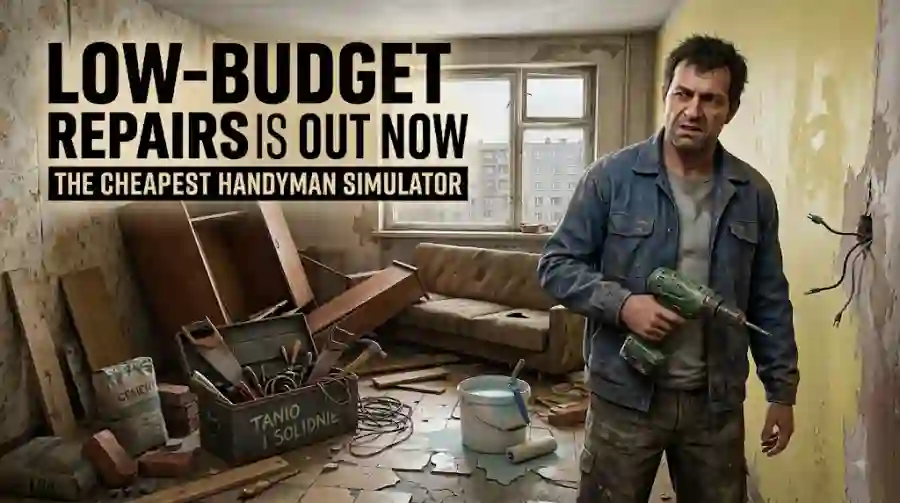
The Quirky Renovation Simulator Lets Players Make Money by Doing the Cheapest and Messiest Repair Jobs Possible
The unusual renovation simulator officially launches today, August 13, 2026, on PC via Steam. Developed by Gray2RGB and published by Simplicity Games and PlayWay, the game puts players in the role of a handyman running a small repair business in a 1990s Polish apartment block.
The unusual part is that you're not necessarily rewarded for doing perfect work.
Your real objective is much simpler:
Spend as little as possible while getting paid as much as possible.
And that means cutting corners whenever you can.
Low-Budget Repairs Release Date
Low-Budget Repairs releases on August 13, 2026.
The game launches on PC through Steam.
The official Steam community page lists the release time as 5 PM CEST on August 13, while the Steam store confirms the same launch date.
There is currently no confirmed PlayStation, Xbox or Nintendo Switch 2 version listed on the official Steam page.
What Is Low-Budget Repairs?
Low-Budget Repairs is a first-person renovation and business simulation game.
You play a handyman operating a small repair business in a Polish apartment block during the 1990s.
Your customers want their homes repaired.
But you have another priority:
Make money.
The game encourages players to save money wherever possible, even if that means using cheap materials, questionable techniques or tools that barely work.
The Steam description openly presents shortcuts as part of the gameplay.
The Goal Isn't Perfect Work
Traditional renovation games often reward players for completing beautiful rooms.
Low-Budget Repairs takes the opposite approach.
If you can finish the job quickly and cheaply, you can increase your profit.
That means players may deliberately choose:
- Cheap tools
- Cheap materials
- Faster methods
- Imperfect repairs
- Questionable shortcuts
The important question isn't always:
"Did I do a good job?"
It can be:
"Did the customer notice?"
Dilute the Paint to Save Money
One of the game's funniest mechanics involves paint.
If paint costs too much, you can simply dilute it with water.
The result may not look perfect, but if the customer accepts the job, you've saved money.
It's a perfect example of the game's central philosophy.
Cut costs wherever possible.
Crooked Tiles Can Still Make You Money
The same idea applies to tiling.
You don't necessarily have to spend time making every tile perfectly level.
If the final result is a little uneven, you can simply consider it part of the design.
The game's humor comes from turning bad workmanship into a legitimate gameplay strategy.
Cheapest Tools Are Often the Best Choice
The hardware store becomes an important part of your business.
Instead of automatically buying the best equipment, players need to consider the cost.
A cheap tool might break quickly, but if it costs significantly less than a professional tool, it could still be worth purchasing.
This creates a simple business decision:
Spend more now for better equipment or save money and risk problems later?
Low-Budget Repairs Is Set in 1990s Poland
The game's setting is another major part of its identity.
Players work inside 1990s Polish apartment blocks, complete with period furniture, interiors and the atmosphere of a post-communist neighborhood.
The setting helps separate Low-Budget Repairs from other renovation simulators.
Instead of modern luxury apartments, players are dealing with older homes and increasingly strange repair jobs.
You Can Renovate Different Parts of a Home
The game includes a wide range of repair and renovation activities.
Players can work on things such as:
- Painting
- Plastering
- Tiling
- Electrical work
- Wood paneling
- Furniture assembly
- Windows
- Doors
- Cleaning
- General repairs
The developers have also confirmed additional unusual activities and side jobs.
Some Jobs Are Completely Unexpected
Low-Budget Repairs isn't limited to normal apartment renovations.
The developers have teased unusual jobs including:
- Cleaning a brothel
- Putting out a fire
- Dealing with pigs
- Other strange side activities
These unexpected jobs help prevent the game from becoming a repetitive renovation simulator.
Build Your Own Repair Business
The game isn't only about completing individual jobs.
Players are also building a small business.
The money earned from jobs can help you take on larger opportunities and improve the way you operate.
That introduces a light business-management element alongside the renovation mechanics.
Every decision can affect your profits.
Low-Budget Repairs Has a Free Demo
Players don't need to purchase the full game blindly.
A free demo is already available on Steam.
The demo launched on July 24 and has already attracted a large audience.
According to the developers, more than 260,000 people had played the demo before launch.
That is an impressive number for an indie simulation game.
More Than 1.17 Million Steam Wishlists
Low-Budget Repairs has also generated significant interest before launch.
The developers announced that the game had reached 1.17 million Steam wishlists shortly before release.
Earlier reporting put the number at around 1.14 million, meaning the game continued gaining wishlists rapidly during the final days before launch.
That makes Low-Budget Repairs one of the more unusual indie games to watch on Steam today.
Launch Discounts Were Unlocked
The developers also tied wishlist milestones to launch discounts.
After reaching 1.17 million wishlists, the game unlocked a 15% launch discount.
The developers were aiming for 1.2 million wishlists to unlock a larger 25% discount milestone.
This created another reason for the community to keep adding the game to their wishlists before launch.
Why Is Low-Budget Repairs So Popular?
The concept is easy to understand.
You are a handyman.
You have jobs.
You need money.
But instead of making everything perfect, you're encouraged to find clever ways to reduce costs.
That creates a gameplay loop that is both practical and comedic.
The game's 1990s setting also gives it a distinctive visual identity.
Low-Budget Repairs Gameplay Loop
The basic gameplay loop looks like this:
Accept a job → Buy materials → Enter the property → Complete repairs → Cut costs → Get paid → Grow your business
But things can go wrong.
Cheap tools can cause problems.
Bad decisions can create additional work.
Customers may notice mistakes.
And some jobs can turn into complete disasters.
That unpredictability is part of the game's appeal.
Can You Fail a Repair Job?
The game is designed around making decisions that can lead to either profit or trouble.
Players aren't simply completing a checklist.
They need to balance:
- Time
- Materials
- Tool costs
- Repair quality
- Customer expectations
- Profit
Doing everything cheaply isn't automatically the best strategy.
You still need to get the job completed.
Is Low-Budget Repairs Multiplayer?
No.
Low-Budget Repairs is designed as a single-player simulation experience.
The focus is on building your repair business and completing jobs rather than playing cooperatively.
What Platforms Is Low-Budget Repairs On?
At launch, Low-Budget Repairs is available on:
PC via Steam.
There is currently no confirmed console release listed on the game's official Steam page.
Low-Budget Repairs vs House Flipper
The easiest comparison is probably House Flipper, but Low-Budget Repairs has a very different philosophy.
House Flipper focuses heavily on cleaning, renovating and improving properties.
Low-Budget Repairs is more interested in the chaos surrounding cheap repair work.
Instead of asking:
"How beautiful can I make this apartment?"
Low-Budget Repairs asks:
"How cheaply can I finish this job without getting caught?"
That difference gives it a much more comedic identity.
The Game's Biggest Strength Is Its Humor
The concept could easily have become another ordinary simulator.
Instead, the developers built the game around intentionally questionable decisions.
Diluting paint.
Using cheap tools.
Ignoring imperfections.
Finding ridiculous ways to move furniture.
These mechanics turn ordinary renovation tasks into comedy.
What Makes the 1990s Setting Interesting?
The 1990s Polish setting isn't simply a visual theme.
It helps establish the game's atmosphere.
The apartment blocks, furniture, tools and neighborhood provide a specific period feel that makes the world different from modern renovation simulators.
The environment also creates opportunities for unusual jobs and characters.
Who Should Play Low-Budget Repairs?
The game should appeal to players who enjoy:
- Simulation games
- Renovation games
- Business simulators
- Comedy games
- Indie games
- First-person simulators
- Job simulators
- Relaxing games
- Management games
It may not be ideal for players looking for:
- Competitive multiplayer
- Action combat
- RPG progression
- Open-world exploration
- High-speed gameplay
Low-Budget Repairs launches today, August 13, 2026, on PC through Steam.
What makes the game interesting is its simple but unusual idea.
You're a handyman, but perfection isn't necessarily the goal.
You want to finish jobs, reduce expenses and make as much money as possible.
That can mean diluting paint, buying cheap tools, laying imperfect tiles or finding ridiculous solutions to everyday problems.
The game's popularity before launch is also worth watching. More than 260,000 people have already played the demo, while Steam wishlists have passed 1.17 million.
For TheInfoBytes, this is a strong fresh topic because it targets the simulation, indie gaming, Steam and funny-games audiences without repeating the Roblox, codes, dinosaur horror or Soulslike topics we've recently published.
Frequently Asked Questions
When does Low-Budget Repairs release?
Low-Budget Repairs releases on August 13, 2026, with the Steam community announcement listing a 5 PM CEST launch time.
What platform is Low-Budget Repairs available on?
The game launches on PC via Steam.
Is Low-Budget Repairs free?
The full game is a paid release, but a free demo is available on Steam.