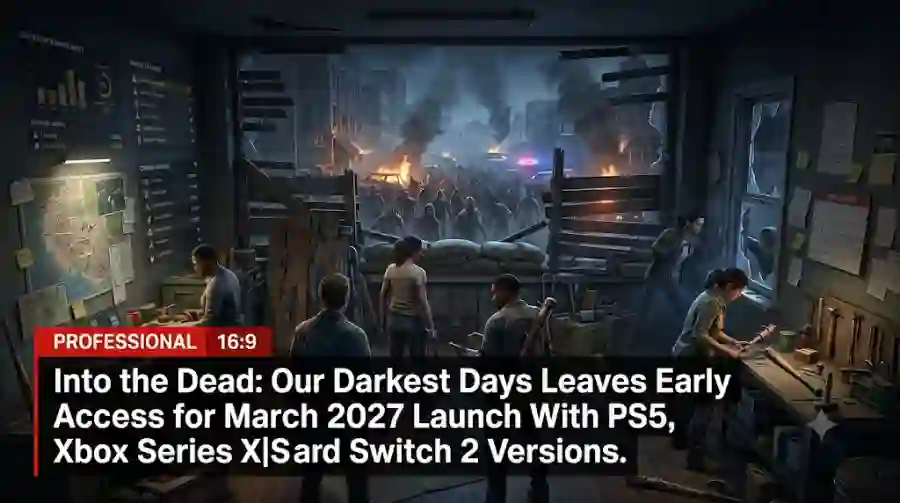
Into the Dead Our Darkest Days Is Expanding Beyond PC With a Full 1.0 Release and New Console Versions
But what exactly makes Into the Dead: Our Darkest Days different from other zombie games?
It is not simply another shooter where players run through cities eliminating endless waves of zombies.
Instead, it combines survival horror, resource management, shelter management, exploration and difficult human decisions.
And that combination could make the 1.0 release one of the more interesting zombie-game launches to watch in 2027.
What Is Into the Dead: Our Darkest Days?
Into the Dead: Our Darkest Days is a side-scrolling shelter survival game set during a zombie apocalypse.
The story takes place in Texas in 1980, where the fictional city of Walton City is suddenly overwhelmed by a devastating zombie outbreak.
The player controls a group of ordinary survivors trying to escape the city.
They are not superheroes.
They are not heavily trained soldiers.
They are normal people who have been forced into an impossible situation.
That is a major part of the game's identity.
Instead of making the player feel powerful, the game constantly emphasizes vulnerability.
Survival depends on planning, resource management, exploration and making difficult decisions.
The official Steam description explains that players must guide survivors from refuge to refuge while scavenging, crafting and fighting to stay alive.
March 2027 Is the Big 1.0 Release
The most important announcement is the full release window.
PikPok has confirmed that Into the Dead: Our Darkest Days will leave Early Access and enter its 1.0 release in March 2027.
A specific day in March has not been announced yet.
That means players should currently treat March 2027 as the confirmed launch month rather than expecting a particular date.
The additional time should give PikPok an opportunity to finish the remaining work planned for the Early Access period.
That is important because the developer has specifically said that the game is not finished yet.
PikPok plans to continue updating the Early Access version before the 1.0 release.
For players who prefer waiting for a more complete experience, the March launch could therefore be the best entry point.
Console Versions Are Finally Confirmed
One of the biggest parts of today's announcement is the expansion to consoles.
Into the Dead: Our Darkest Days is coming to:
- PlayStation 5
- Xbox Series X|S
- Nintendo Switch 2
- PC
- GeForce NOW
On PC, the game will be available through Steam and Epic Games Store.
This is a significant expansion from the game's current Early Access availability.
The original PC release allowed PikPok to work closely with players during development.
The eventual console release will introduce the game to a much larger audience.
That could be especially useful for a game that relies heavily on strategic decision-making rather than traditional PC-focused controls.
Steam Deck Support Is Also Staying
PikPok has also confirmed that the game will remain Steam Deck Verified.
This gives PC players another way to experience the game.
The side-scrolling structure and management-focused gameplay could potentially work particularly well on handheld hardware.
Instead of requiring a large screen and keyboard setup, players can manage their survivors and explore Walton City from a portable device.
For players who enjoy indie survival games on handhelds, this is an important detail.
Thirteen Major Updates Have Already Arrived
One of the strongest arguments for Into the Dead: Our Darkest Days is how much the game has changed during Early Access.
According to PikPok, the team has delivered 13 major content updates since the game's Early Access launch.
Those updates have introduced a wide range of additions.
They include:
- New zombie types
- New starting characters
- New recruitable survivors
- New Escape Plans
- New gameplay systems
- Combat improvements
- New survivor missions
- Relationship systems
- New weapons
- New districts
- Difficulty settings
- Content controls
- Save slots
- Additional improvements and bug fixes
This is important because Early Access games can sometimes remain largely unchanged for long periods.
That does not appear to be the approach PikPok has taken here.
The studio has used player feedback to continue developing the game's systems and content.
The Game Is About More Than Killing Zombies
The biggest difference between Into the Dead: Our Darkest Days and a traditional zombie shooter is the focus on survival.
You are not simply clearing a building.
You are trying to keep a group of people alive.
That creates a different type of tension.
A survivor can become hungry.
Another can become exhausted.
Someone else may be injured.
Another character could suffer psychological trauma.
The official game description specifically mentions needs such as Hunger, Exhaustion and Despair, along with injuries and traumas such as broken ribs and nightmares.
That makes every decision potentially important.
A character who is physically strong may still become a liability if they are exhausted.
A valuable survivor may become injured during a dangerous scavenging run.
And sometimes players may have to decide whether the risk of obtaining supplies is worth potentially losing someone.
Shelter Management Is a Major Gameplay System
The survivors need somewhere to live.
That is where shelters become important.
Players can establish and upgrade shelters to protect their group from the zombie threat.
But these locations are not permanent safe zones.
The game's official description warns that no barrier can keep the undead away forever.
Every night can become a new threat.
Players need to prepare.
They need resources.
They need enough supplies.
They need survivors capable of defending the shelter.
And they need an escape plan.
This creates an interesting gameplay loop.
During the day, players can explore and gather resources.
At night, they need to survive the consequences of their decisions.
Moving From Refuge to Refuge
The goal is not to build one perfect shelter and remain there forever.
Players need to keep moving.
The zombie hordes continue closing in, meaning survivors must travel from one refuge to another while searching for a way out of Walton City.
This creates constant pressure.
A shelter may be safe today but dangerous tomorrow.
A location may contain valuable supplies but become surrounded by zombies.
A new refuge may offer better protection but require a dangerous journey to reach.
The player therefore has to think ahead.
Scavenging Can Become Dangerous
Resources are essential.
Food, weapons, crafting materials and medical supplies can make the difference between survival and disaster.
But getting those resources requires exploration.
Players must send survivors into dangerous areas of Walton City.
The game uses stealth as an important survival tool.
The official description explains that players can choose whether to avoid encounters or engage in combat with zombies and human threats.
That choice is critical.
Fighting may solve an immediate problem.
But it can also consume ammunition, damage a survivor or attract additional enemies.
Sometimes the smartest option is simply to stay hidden.
Human Enemies Matter Too
The apocalypse does not only create dangerous zombies.
Other survivors can also become threats.
When resources are limited, people may become desperate.
That means players can encounter human enemies while searching for supplies.
The game allows players to decide whether to fight, avoid danger or attempt to interact with other people.
This makes the world more complicated than a simple humans-versus-zombies scenario.
The player is constantly dealing with competing priorities.
Do you risk helping another survivor?
Do you take their supplies?
Do you leave them behind?
Do you recruit them?
These decisions can shape the group's future.
Recruitment Adds Another Layer
Players can recruit other survivors into their group.
That might sound like an obvious advantage.
But every additional person creates another responsibility.
More survivors require more food.
They may need medical attention.
They may have different personalities.
They may have different strengths and weaknesses.
A large group is not automatically better than a small one.
The player needs to manage the people they have and decide who is worth bringing into the group.
That creates a strategy layer that is missing from many conventional zombie games.
Crafting Helps Survivors Stay Alive
Crafting is another central mechanic.
Players can create tools, weapons and shelter upgrades using resources found during exploration.
This means scavenging is directly connected to progression.
Finding a useful resource is not simply about collecting a number.
It could determine whether the group can craft something necessary for survival.
That creates a satisfying gameplay loop:
Explore → Scavenge → Craft → Improve → Survive → Move Forward.
But because resources are limited, players cannot necessarily craft everything.
Prioritization becomes essential.
The Game Forces Difficult Decisions
One of the most interesting aspects of Into the Dead: Our Darkest Days is its emphasis on human choices.
The official game description says players will face decisions involving who will live, who will die and who will be left behind.
That immediately gives the game more emotional weight.
In a traditional zombie shooter, losing a character often means little beyond restarting a checkpoint.
Here, a survivor can become part of the player's larger group.
They can have relationships.
They can become injured.
They can develop psychological problems.
They can contribute important skills.
Losing them can therefore affect the entire group.
Walton City Is More Than a Background
The game takes place in a fictional Texas city called Walton City.
Before the outbreak, it was a large coastal metropolis dealing with a heatwave and economic crisis.
Then the zombie outbreak changes everything.
The city becomes a dangerous environment filled with abandoned buildings, resources, survivors and undead threats.
Its side-scrolling structure allows PikPok to focus heavily on atmosphere.
Instead of building an enormous open world simply for scale, the game can concentrate on individual locations and situations.
That may make the city feel more deliberate.
Every building can potentially contain something useful.
But it can also contain something dangerous.
Every Playthrough Can Be Different
Replayability is another important part of the design.
The official Steam page describes a varying world intended to make each playthrough a new experience.
That means players cannot necessarily memorize one perfect route and follow it every time.
Different situations can force different decisions.
Survivors may change.
Resources may vary.
Threats may appear in different circumstances.
This makes the game more suitable for repeated play.
It also fits the survival genre.
A good survival game should make players adapt rather than simply follow a fixed script.
Early Access Feedback Has Shaped the Game
PikPok has emphasized the importance of community feedback throughout development.
The developer says it has used player feedback to fix bugs, improve systems and expand the game's content.
That approach is one of the main reasons Early Access exists.
Instead of developing the complete game behind closed doors, the studio can observe how real players interact with its systems.
Players can discover problems the developers did not anticipate.
They can also identify systems that are particularly enjoyable.
That feedback can then influence future updates.
For Into the Dead: Our Darkest Days, the 13 major updates suggest that this process has already had a substantial impact.
What Is Still Coming Before 1.0?
The March 2027 launch does not mean development stops immediately.
PikPok has specifically said there is still more work planned for Early Access before the 1.0 release.
The developer says updates will continue until the team completes its roadmap.
That means PC players still have a reason to keep following the game before March.
There may be additional systems, balancing changes, content and polish before the final version arrives.
The studio has also confirmed that achievements will be included.
PC Players Already Have Strong Feedback
The existing PC community has responded positively to the game.
Steam currently shows the title with a Very Positive overall English review rating, with more than 3,000 English reviews and a 92% positive rating at the time of checking. Recent reviews are also marked Very Positive.
That does not guarantee that the final 1.0 version will be perfect.
But it is a useful sign.
Players who have spent substantial time with the Early Access version appear to be responding well to the game's survival systems.
That could help the game attract attention when the console versions arrive.
Why the Console Launch Could Change Everything
The PC Early Access community is only one part of the potential audience.
The March 2027 console release could dramatically increase the game's visibility.
PlayStation 5 and Xbox Series X|S have large audiences interested in survival games.
The Nintendo Switch 2 version could also introduce the title to players who prefer portable or Nintendo-focused experiences.
That combination gives PikPok several opportunities to grow the game's audience.
The key challenge will be making sure the console versions deliver the same quality as the PC release.
Why Switch 2 Could Be Particularly Interesting
The Switch 2 version deserves special attention.
The game's side-scrolling structure, management systems and relatively focused environments could potentially make it a natural fit for a handheld platform.
Players could manage their survivors in short sessions or spend longer periods exploring Walton City.
The portable format may also suit the game's slower, strategic rhythm.
Unlike a competitive shooter, Into the Dead: Our Darkest Days does not depend on ultra-fast multiplayer reactions.
That makes it a potentially comfortable handheld experience.
What Makes This Zombie Game Different?
The zombie genre has been crowded for years.
There are first-person shooters.
Open-world survival games.
Co-op zombie games.
Story-driven horror games.
But Into the Dead: Our Darkest Days takes a different approach.
Its core identity combines:
- Zombie survival
- Shelter management
- Resource gathering
- Crafting
- Survivor management
- Stealth
- Tactical decisions
- Psychological survival
- Difficult moral choices
That combination is what makes the project interesting.
The zombies are important, but they are not the only threat.
Sometimes the biggest problem may be hunger.
Sometimes it may be exhaustion.
Sometimes it may be another survivor.
And sometimes the hardest decision may be deciding who cannot be saved.
Is Into the Dead: Our Darkest Days a Shooter?
Not in the traditional sense.
Combat exists, but the game is fundamentally a survival-management experience.
Players can fight zombies and human threats, but ammunition and equipment are limited.
Stealth is often important.
The game encourages players to consider whether fighting is actually worth the risk.
That makes combat a tool rather than the entire gameplay loop.
Should You Play the Early Access Version?
For PC players, the answer depends on what they want.
If you enjoy Early Access and want to help shape a game before its final release, the current version already contains substantial content.
Steam lists multiple characters, threats, weapons, locations and crafting options in the current build.
But if you prefer a finished experience, waiting for the March 2027 1.0 launch may make more sense.
The developer has confirmed that more updates are still coming.
So the final version should represent a more complete form of the game's intended experience.
The March 2027 Launch Could Be a Major Opportunity
The biggest opportunity for Into the Dead: Our Darkest Days is its ability to reach players who have never touched the Early Access version.
When the game launches on consoles, many players will be experiencing it for the first time.
That gives PikPok a chance to present the polished version of the game to a much larger audience.
If the final release performs well, the game could become a notable entry in the zombie survival genre.
Its existing PC community provides a foundation.
The console versions can then expand that community.
What Players Should Watch Before Launch
There are several things worth watching between now and March.
First, PikPok still has Early Access updates planned.
Second, the final console versions need to maintain performance and stability.
Third, the developer needs to continue balancing survivor management and resource systems.
Fourth, the 1.0 version needs to provide a satisfying conclusion to the game's progression loop.
And finally, the studio needs to make sure that the game feels complete rather than simply being an Early Access build with a new version number.
The good news is that PikPok has several months to address those concerns.
Into the Dead: Our Darkest Days is officially moving toward its biggest milestone yet.
PikPok has confirmed that the game will leave Early Access and enter its full 1.0 release in March 2027, while also expanding to PlayStation 5, Xbox Series X|S and Nintendo Switch 2. PC players will continue to have access through Steam and Epic Games Store, with GeForce NOW support also planned.
The announcement is especially interesting because the game has already spent more than a year in Early Access.
During that time, PikPok has delivered 13 major updates, adding new zombie types, survivors, weapons, districts, missions, systems and other improvements.
That means the March 2027 release is not simply the arrival of an unfinished concept.
It is the culmination of a long development and feedback process.
The game itself offers something different from conventional zombie shooters.
Players are not simply expected to eliminate every undead enemy they encounter.
They need to manage survivors, maintain shelters, find resources, craft equipment, explore dangerous areas and make difficult decisions.
Hunger, exhaustion, despair, injuries and psychological trauma can all affect the group.
Sometimes stealth will be smarter than combat.
Sometimes another survivor may be more dangerous than a zombie.
And sometimes there will be no perfect choice.
That is what gives Into the Dead: Our Darkest Days its identity.
The upcoming console launch could also dramatically increase its audience.
PS5, Xbox Series X|S and Switch 2 players will finally be able to experience the game without needing to join the PC Early Access community.
For now, the most important date is March 2027.
The exact day has not been announced yet.
But the road to 1.0 has officially begun.
And with more Early Access updates still planned, there is plenty of time for PikPok to turn Into the Dead: Our Darkest Days into one of the more memorable zombie survival games of 2027.
Frequently Asked Questions
When does Into the Dead: Our Darkest Days leave Early Access?
The game will leave Early Access and launch as version 1.0 in March 2027. PikPok has not yet announced the exact day.
What platforms will Into the Dead: Our Darkest Days support?
The 1.0 release will be available on PC, PlayStation 5, Xbox Series X|S and Nintendo Switch 2. It will also support GeForce NOW