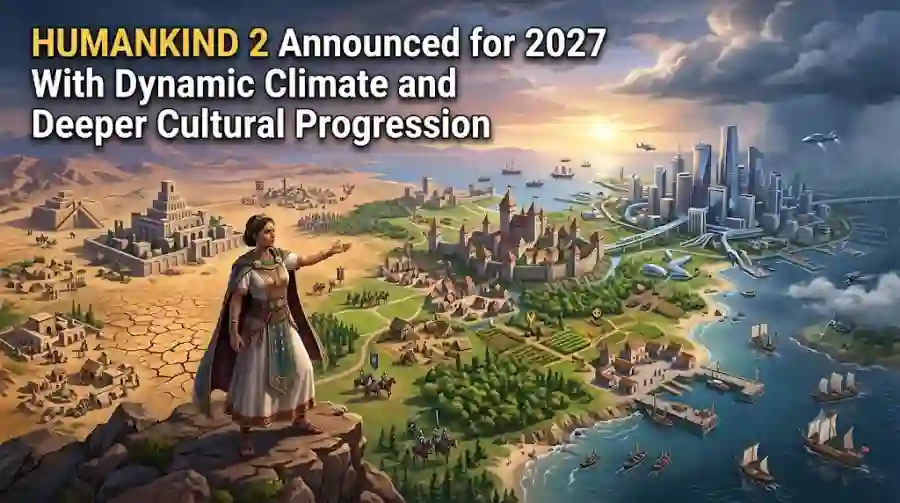
Amplitude Studios Rebuilds Its Historical 4X Strategy Formula With Changing Biomes, Expanded Cultures and More Meaningful Civilization Choices
Rather than simply adding more historical content to the original formula, Amplitude says the sequel introduces new progression systems, a deeper cultural system, improved visuals, a modernized user interface and broader gameplay improvements based on player feedback and the studio's experience developing the first game.
One of the biggest changes is the role of nature.
In HUMANKIND 2, climate changes can reshape the strategic map over the course of a campaign. Players will have to adapt their cities, economies and expansion plans as environments and biomes change.
That could make long-term planning more important than ever.
HUMANKIND 2 Takes the Series Into a New Era
The basic goal remains familiar.
Players will build a civilization and guide it from its earliest settlements toward the Modern Age.
Along the way, they will establish cities, develop technology, form alliances, conduct diplomacy, manage resources and command armies.
But Amplitude is placing greater emphasis on how individual decisions connect across the entire history of a civilization.
The official Steam description says choices made earlier can influence later developments, including the climate and culture of the player's civilization.
This is an important direction for a 4X strategy game.
Instead of treating each era as a collection of disconnected bonuses, HUMANKIND 2 appears designed around continuity.
Your civilization should feel like it has developed from the decisions you made generations earlier.
Cultural Progression Becomes More Detailed
Culture is one of the biggest systems receiving an overhaul.
In the original HUMANKIND, players could change cultures as they moved through different eras.
HUMANKIND 2 is taking that concept further.
Each era gives players an opportunity to adopt a culture that adds new identity and unlocks exclusive customs through cultural progression trees.
The goal is to make cultural development feel like an evolving process rather than a simple selection of bonuses.
Different cultural influences can combine over time, allowing players to create civilizations with their own unique identities.
This also means that two civilizations starting from similar positions could potentially develop into very different societies by the end of a campaign.
Players can follow historical paths or deliberately move away from them.
That freedom is central to the game's concept.
A Civilization Can Develop Its Own Identity
Amplitude wants HUMANKIND 2 to give players more control over the story of their civilization.
Instead of simply recreating history, players can create alternate versions of it.
A civilization can inherit ideas from earlier cultures while adding new influences as it advances through the eras.
This creates a sense of continuity.
A player's modern civilization should not feel completely disconnected from the settlement they started with hundreds or thousands of years earlier.
The developers are also introducing new historical cultures, including the Saqqaq, Etruscans and Scythians, among others.
That gives the sequel a broader historical foundation while also providing additional possibilities for unusual civilization combinations.
Climate Change Becomes a Strategic System
Perhaps the most interesting new mechanic is the changing climate.
HUMANKIND 2 features a world where climate changes can transform the strategic map as civilizations progress through history.
That means nature is not simply visual decoration.
Changing conditions can affect biomes, resources, cities and economic planning.
A region that is highly valuable early in a campaign may become less useful later.
Likewise, environmental changes could force players to reconsider where they build cities or how they organize their economies.
This introduces a new layer of long-term strategy.
A successful civilization will not only need to respond to rival empires.
It will also need to respond to the planet itself.
Cities and Economies Must Adapt
Climate changes can create problems for players who build their civilization without considering the long-term consequences.
HUMANKIND 2 encourages players to adapt cities and economies to shifting environments.
Resources can become more difficult to access, while changing biomes can alter the value of different parts of the map.
This could make strategic planning much less predictable.
In a traditional 4X campaign, players often identify valuable locations early and build their long-term plans around them.
If environmental conditions can change significantly over time, those plans may need to evolve.
That creates a more dynamic strategic environment.
Diplomacy and Warfare Still Matter
HUMANKIND 2 is not abandoning the traditional foundations of the 4X genre.
Players can still forge alliances, develop technologies, command armies and interact with neighboring civilizations.
Diplomacy remains an important part of civilization management.
Players will have to decide when cooperation is useful and when competition becomes unavoidable.
Military power is also still part of the experience.
The combination of diplomacy, technology, economics and warfare means players will need to manage several different systems simultaneously.
That is essential for maintaining the series' identity as a historical 4X strategy game.
The Sequel Is Being Built Around Player Feedback
Amplitude says many of HUMANKIND 2's improvements are guided by extensive player feedback and the studio's experience working on the original game.
That is significant because the first HUMANKIND continued receiving updates and additional content after launch.
The developers have therefore had several years to observe how players interact with its systems.
They have also been able to identify areas where the original design could be improved.
The sequel gives Amplitude an opportunity to make larger structural changes rather than attempting to solve every issue through updates to the first game.
Visuals and the User Interface Are Getting an Upgrade
HUMANKIND 2 will also feature enhanced visuals and a modernized user interface.
For a strategy game, interface design is particularly important.
Players may spend dozens of hours managing cities, technologies, diplomacy, armies and resources.
If important information is difficult to understand, the complexity can become frustrating.
A cleaner interface should make it easier to understand the state of an empire and make informed decisions.
The visual improvements should also help distinguish different cultures and environments as civilizations progress through history.
Single-Player and Multiplayer Are Planned
The Steam listing currently identifies both single-player and multiplayer features for HUMANKIND 2.
That means the sequel is being designed for both solo campaigns and games involving other players.
Multiplayer can significantly increase the longevity of a 4X strategy game because human opponents can behave in less predictable ways than computer-controlled civilizations.
Diplomatic relationships can become more complicated, military strategies can change quickly and alliances can collapse unexpectedly.
The exact multiplayer structure and player-count details have not yet been fully announced.
Those details will likely become clearer as Amplitude reveals more information.
HUMANKIND 2 Is Coming to PC in 2027
Amplitude Studios has confirmed a 2027 release window.
The Steam listing currently identifies Windows PC as the platform and allows players to wishlist the game.
There is no specific launch date yet.
The game is still in development, so players should not assume that a particular month or quarter has been confirmed.
Amplitude is expected to reveal more information during the coming months.
Additional gameplay footage should provide a better look at the new systems, civilizations and interface.
Confirmed Information
The following details have been officially announced:
- HUMANKIND 2 is being developed by Amplitude Studios.
- It is a historical turn-based 4X strategy game.
- The planned release window is 2027.
- PC is confirmed through Steam.
- Single-player and multiplayer are supported.
- The sequel introduces new progression systems.
- Cultural progression has been expanded.
- New historical cultures include the Saqqaq, Etruscans and Scythians.
- Climate changes can reshape the strategic map.
- Biomes and resources can change over time.
- Enhanced visuals and a modernized UI are planned.
- Gameplay improvements are based partly on player feedback and studio experience.
Rumors and Speculation
A specific release date has not been announced.
The exact number of playable cultures, multiplayer player count and complete endgame structure are also unknown.
There is currently no confirmed information about a console version.
Any claims suggesting specific launch dates, monetization details or unrevealed features should therefore be treated as speculation until Amplitude officially confirms them.
Why HUMANKIND 2 Could Be Important for Strategy Fans
The historical 4X genre is highly competitive.
Players have access to long-running franchises with extremely deep systems, so a sequel needs more than improved graphics to stand out.
HUMANKIND 2's approach to culture and climate could provide that difference.
The cultural system is designed around creating civilizations that evolve in distinctive ways.
Meanwhile, the climate system can force players to rethink strategies over the course of a campaign.
Those two systems work together particularly well.
Culture affects how a civilization develops, while environmental changes affect the conditions under which that civilization survives.
That could make each campaign feel more dynamic.
The Biggest Question Is Balance
The ambition of the new systems also creates a challenge.
Changing climates, deeper cultural progression and additional historical choices could make HUMANKIND 2 considerably more complex.
That is potentially good news for experienced strategy players.
However, the game will also need to make those systems understandable.
If environmental changes are too disruptive, players could feel that careful planning is being punished.
If they are too predictable, the system may become little more than another modifier.
The success of HUMANKIND 2 will therefore depend heavily on how these mechanics interact.
What Players Should Watch Next
The next major information should focus on actual gameplay.
Players will want to see how cultures evolve during a complete campaign and how quickly environmental changes affect the map.
Multiplayer details will also be important.
The first announcement establishes the broad direction, but there is still much to learn about diplomacy, warfare, city development and technology.
Amplitude has already indicated that more information will arrive in the coming weeks.
That means HUMANKIND 2 is likely to remain a significant strategy-game story throughout the rest of 2026.
Conclusion
HUMANKIND 2 is shaping up to be a substantial second attempt at Amplitude Studios' historical 4X formula.
The sequel keeps the foundation of civilization building, diplomacy, warfare and technological development while adding deeper cultural progression, a modernized interface and a dynamic climate system.
The ability for environmental changes to reshape the strategic map could become one of its defining features.
Combined with evolving cultural identities, the system could make long campaigns feel more connected and less predictable.
HUMANKIND 2 is currently scheduled for 2027 on PC, with both single-player and multiplayer support listed.
There is no exact release date yet, but the Gamescom reveal has given strategy fans their first official look at the sequel.
If Amplitude can successfully balance its expanded systems while keeping the game accessible, HUMANKIND 2 could become a much stronger and more ambitious evolution of the original formula.
Frequently Asked Questions
What is HUMANKIND 2?
HUMANKIND 2 is a historical turn-based 4X strategy sequel from Amplitude Studios.
When will HUMANKIND 2 release?
The game is planned for release in 2027. An exact date has not been announced.
What platforms will HUMANKIND 2 support?
PC is confirmed through Steam. No console version has been officially confirmed so far.