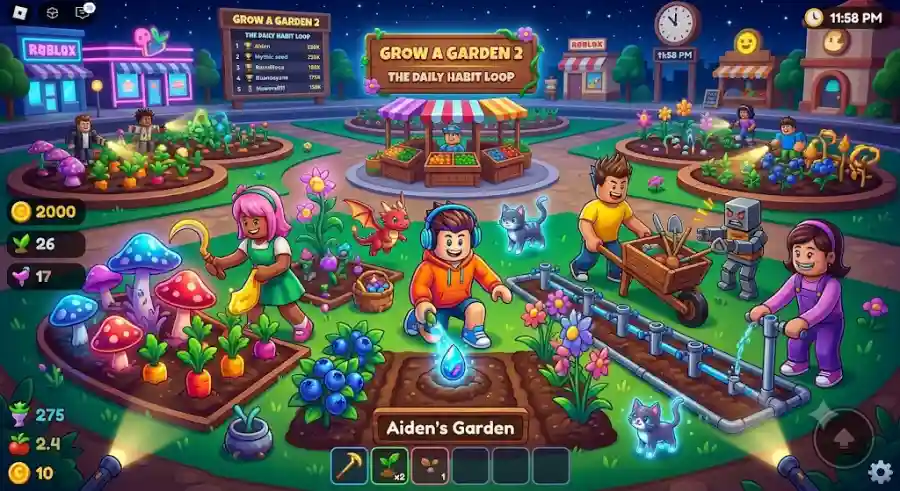
The Psychology Behind Grow a Garden’s Record-Breaking Success and Why Millions of Roblox Players Keep Coming Back Every Day
This is a deep exploration of how Grow a Garden mastered the daily-habit loop, why millions of players became hooked on its gameplay cycle, and what game developers can learn from one of Roblox’s most impressive retention success stories.
Highlights
- Grow a Garden became one of Roblox’s most successful games despite its simple farming premise.
- The game uses proven behavioral psychology principles to encourage daily engagement.
- Idle growth mechanics create powerful anticipation while players are offline.
- Farming systems remain easy to learn but gain strategic complexity over time.
- Variable rewards and rare mutations keep every harvest exciting.
- Grow a Garden 2 introduced social mechanics and risk-based gameplay to further improve retention.
- The franchise demonstrates how strong game design can outperform larger-budget competitors.
Understanding the Psychology Behind the Habit Loop
To fully appreciate why Grow a Garden is so effective, it helps to understand one of the most influential concepts in behavioral psychology: the habit loop.
Popularized by Charles Duhigg in his bestselling book The Power of Habit, the habit loop explains how repeated behaviors become automatic routines.
The model consists of three essential stages:
The Cue
A trigger that signals the brain to begin a specific behavior.
The Routine
The action or activity a person performs in response to that trigger.
The Reward
A positive outcome that reinforces the behavior and encourages repetition.
When these three elements work together consistently, behaviors become habits.
Many successful mobile games, social media platforms, and digital products rely on this framework. However, Grow a Garden integrated it so naturally into its gameplay that many players participate in the loop without consciously realizing it.
The game transforms simple virtual farming into a continuous cycle of anticipation, action, and reward, creating an experience that feels satisfying every time players log in.
The First Step: Creating the Perfect Cue
Passive Growth and the Power of Offline Anticipation
One of Grow a Garden’s smartest design decisions revolves around what happens when players are not actively playing.
Traditional games often pause progression when users log out. Once a player leaves, advancement stops until they return.
Grow a Garden takes the opposite approach.
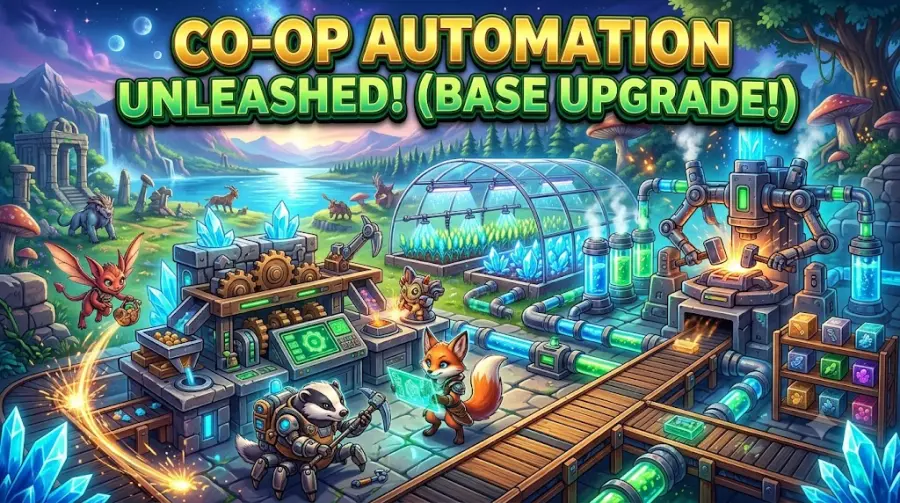
Its idle farming mechanics allow crops to continue growing even while players are offline. Whether a player goes to school, heads to work, eats dinner, or goes to sleep, their virtual farm remains active.
This seemingly simple feature creates an incredibly powerful psychological trigger.
Instead of thinking:
"Maybe I'll play Grow a Garden later."
Players begin thinking:
"My crops should be ready by now."
Or:
"Those Dragon's Breath seeds must be fully grown already."
This subtle shift is extremely important.
The anticipation becomes automatic. Logging off no longer feels like stepping away from progress. Instead, time away becomes productive time.
Every hour spent offline increases curiosity about what awaits on the farm.
As a result, Grow a Garden creates a natural reason for players to return without relying heavily on aggressive notifications or forced engagement tactics.
Why Offline Progression Is So Effective
Modern gamers have limited time.
School, work, family responsibilities, and other hobbies compete for attention every day. Games that demand constant activity often struggle to fit into busy schedules.
Grow a Garden cleverly turns this challenge into an advantage.
Players feel rewarded even when they are not actively playing. Progress continues in the background, creating a sense of investment that grows throughout the day.
This approach has been successful in many idle games, but Grow a Garden adapted the concept exceptionally well for Roblox's younger and highly active audience.
Every period away from the game becomes part of the gameplay experience itself.
That anticipation acts as the first stage of the habit loop—the cue that encourages players to return.
The Routine: Keeping Gameplay Simple but Meaningful
Why Simplicity Matters
Many games lose players because they overwhelm newcomers with complicated systems.
Grow a Garden takes the opposite route.
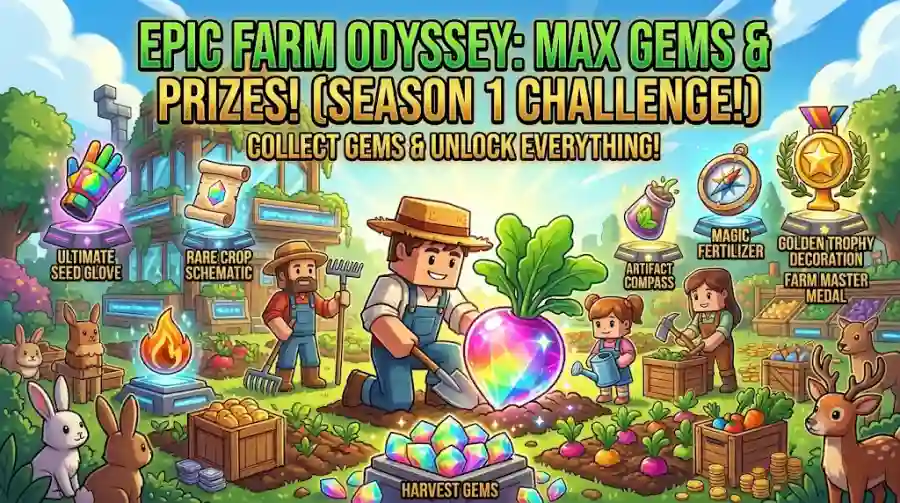
The initial gameplay routine is remarkably straightforward:
- Equip a seed.
- Click a dirt plot.
- Plant the seed.
- Wait for growth.
- Harvest crops.
- Earn Sheckles, the game's currency.
Anyone can understand the core loop within minutes.
This accessibility removes barriers and allows players to experience rewards quickly.
However, simplicity alone is not enough to maintain long-term interest.
If gameplay never evolves, boredom eventually takes over.
Grow a Garden avoids this problem through a design principle often seen in successful long-term games: gradual complexity.
From Casual Farming to Strategic Optimization
As players spend more time in the game, the farming process becomes increasingly sophisticated.
What starts as planting crops in neat rows eventually develops into a deeper strategic experience involving:
Automated Sprinkler Systems
Players begin arranging equipment for maximum efficiency, optimizing crop growth and production rates.
Pet Management
Special pets provide valuable stat boosts and gameplay advantages.
Choosing the right pets and utilizing them effectively becomes an important part of progression.
Farm Layout Planning
Available space becomes a resource that must be managed carefully.
Players experiment with layouts, placement strategies, and production chains to maximize profits.
Efficiency Optimization
The focus gradually shifts from basic farming to creating highly productive agricultural systems.
This progression keeps the routine fresh.
Players continue performing familiar actions while constantly discovering new layers of strategy and optimization.
The result is a routine that remains approachable for beginners while providing meaningful depth for dedicated players.
The Reward System That Keeps Players Hooked
The Science of Variable Rewards
The reward phase is arguably the most important part of any habit loop.
Research in behavioral psychology consistently shows that unpredictable rewards are often more engaging than guaranteed outcomes.
When rewards become completely predictable, excitement fades.
Humans naturally respond more strongly to uncertainty.
This principle explains why lottery tickets, collectible card packs, and many successful video games generate such strong engagement.
Grow a Garden applies this concept masterfully.
The Seed Shop and Stock Market Rush
One of the game's most effective systems involves seed availability.
The in-game seed shop refreshes every five minutes.
That means players never know exactly what inventory will appear next.
Rare seeds can suddenly become available and disappear just as quickly.
Missing a refresh could mean losing an opportunity to acquire:
- Mythic seeds
- Divine seeds
- Other highly valuable farming resources
This creates a constant sense of urgency.
Players develop routines around checking stock rotations because the possibility of discovering something rare remains ever-present.
The excitement comes from uncertainty.
Every refresh feels like a new opportunity.
Mutation Mechanics and Rarity Chasing
The reward loop becomes even stronger through crop mutations.
Harvesting is not simply about collecting standard rewards.
Each harvest carries the possibility of producing special variants that dramatically increase value.
Players may discover crops with rare mutations such as:
- Bloodlit
- Gold
- Rainbow
These enhanced versions can multiply crop worth exponentially.
This system transforms harvesting from a routine task into a thrilling moment of possibility.
Every collection action becomes a miniature gamble.
Will this crop be ordinary?
Or will it become the jackpot harvest that changes everything?
Because players never know what they will receive, anticipation remains high regardless of how many times they repeat the activity.
The unpredictability fuels long-term engagement and creates countless memorable moments.
Grow a Garden 2 and the Evolution of Player Retention
Moving Beyond Solo Farming
The original Grow a Garden excelled at creating a personal habit loop.
Players focused primarily on their own farms and individual progression.
While effective, the experience remained largely peaceful and self-contained.
Grow a Garden 2 expanded this formula dramatically.
The sequel introduced systems designed to increase interaction between players and create entirely new emotional motivations.
A Redesigned Social Hub
One of the biggest changes came through the map structure.
Instead of isolated farming spaces, player plots now surround a central marketplace within a circular hub design.
This layout naturally increases visibility and interaction.
Players constantly encounter other farmers, observe their progress, compare achievements, and engage with the broader community.
These social elements add another layer of investment beyond personal progression.
Success becomes something players can display and share.
The Nighttime Theft Mechanic
Perhaps the most significant addition in Grow a Garden 2 is the nighttime stealing system.
Unlike the original game, players can now sneak onto other farms and steal crops under specific conditions.
This single mechanic fundamentally changes the emotional experience.
Previously, players logged in because they hoped to gain rewards.
Now they also log in because they fear potential losses.
This introduces one of the strongest concepts in behavioral psychology:
Loss Aversion
Research consistently shows that people are often more motivated to avoid losing something than they are to gain something of equal value.
Grow a Garden 2 leverages this principle brilliantly.
Players no longer return solely because crops have grown.
They return because valuable resources might be at risk.
The emotional stakes become significantly higher.
Defensive Farming and High-Stakes Gameplay
The introduction of theft mechanics transformed farming into a more strategic and competitive experience.
Players now invest in defensive tools and protective measures to safeguard their resources.
One notable example is the Wheelbarrow, a premium gear item valued at 500,000 Sheckles.
Items like these add meaningful decision-making and risk management to the gameplay loop.
The result is a fascinating evolution.
What was once a relaxing idle farming simulator has become a living ecosystem filled with:
- Resource protection
- Strategic planning
- Social competition
- Cooperative interactions
- Coordinated raids and midnight heists
This additional layer of engagement makes the habit loop even stronger than before.
Industry Impact: Why Developers Are Paying Attention
The success of Grow a Garden carries important lessons for the broader gaming industry.
For years, many developers believed that bigger budgets, larger teams, and increasingly realistic visuals were the keys to long-term success.
Grow a Garden challenged that assumption.
Its rise demonstrates that understanding player psychology can be just as important—if not more important—than technical complexity.
The game proves that:
- Strong retention beats short-term hype.
- Meaningful progression encourages loyalty.
- Anticipation is a powerful engagement tool.
- Social systems amplify emotional investment.
- Unpredictable rewards keep experiences exciting.
These principles apply not only to Roblox but also to mobile gaming, live-service titles, online communities, and digital products across the industry.
Why Grow a Garden Matters
Grow a Garden represents more than a successful Roblox game.
It highlights a broader shift in modern game design.
Today's most successful experiences often focus less on creating one-time moments of excitement and more on building sustainable daily routines.
The game demonstrates how carefully designed systems can transform simple mechanics into deeply engaging experiences.
By combining offline progression, accessible gameplay, strategic depth, variable rewards, and social interaction, Grow a Garden created a retention model that many developers are now studying closely.
Its success serves as a reminder that innovation does not always require complexity.
Sometimes the most effective ideas are also the simplest.