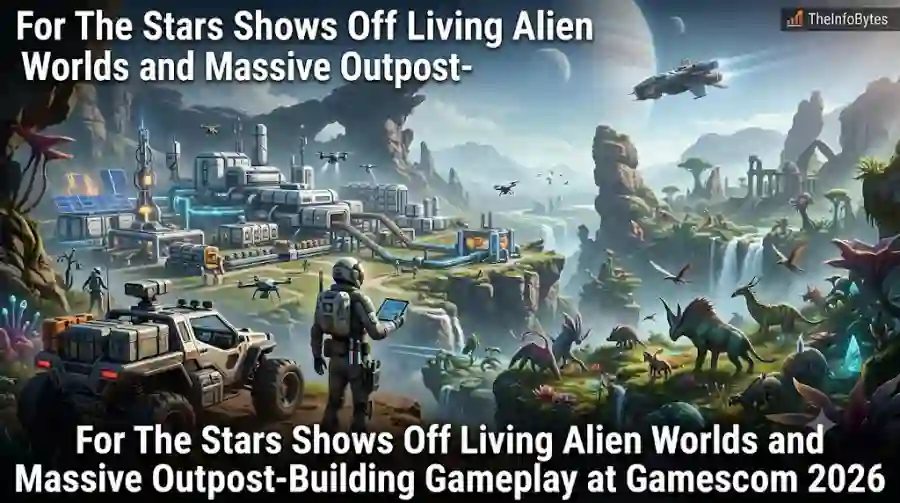
For The Stars Wants Players to Build Colonies Across a Persistent Alien Universe Where Every Ecosystem Can Change
Unlike traditional survival games that keep players tied to one map, For The Stars is designed around traveling from planet to planet.
Each world can contain different creatures, resources, climates and ecosystems.
Players will have to understand those environments before they can safely establish themselves.
The game is currently listed as coming soon, with no specific release date announced.
That makes the new gameplay footage particularly important because it provides one of the clearest looks yet at the systems Snail Games is building.
For The Stars Is More Than a Traditional Survival Game
At first glance, For The Stars looks like another open-world survival game.
There are resources to collect.
There are dangerous creatures.
Players need shelter and equipment.
Bases must be constructed.
But the game's scale is much larger.
Instead of building one permanent base and spending hundreds of hours inside the same environment, players can travel between different planets.
The goal is to establish outposts throughout the universe.
Those outposts can then become part of a larger network supporting exploration and research.
That creates a progression system where players are not simply making one survival camp better.
They are gradually expanding their presence across space.
Every Planet Has Its Own Ecosystem
One of the most interesting ideas shown in the new gameplay is the importance of planetary ecosystems.
For The Stars is designed around worlds with their own creatures, resources and environmental conditions.
A lush planet may provide completely different opportunities from a barren rocky world.
Some planets may have dangerous weather.
Others may contain hostile creatures.
Some could provide rare materials needed for advanced technology.
This means players cannot approach every planet in exactly the same way.
Equipment that works well on one world may not be ideal on another.
The vehicles players bring can also become important when traveling through dangerous environments.
The developer has described the planets as having distinct ecosystems rather than simply being different visual backgrounds.
The Ecosystems Can Actually React to Players
This is where For The Stars becomes more ambitious.
The game's ecosystems are designed to behave as interconnected systems.
That means removing one species can potentially affect other parts of the environment.
For example, destroying a nest of alien insects could create a chain reaction involving nearby plants and animals.
This gives players another reason to think carefully about how they interact with the environment.
In many survival games, players simply kill whatever creature is blocking access to a resource.
For The Stars wants those decisions to have wider consequences.
A species may be dangerous, but it may also have an important role within the local ecosystem.
Removing it could solve an immediate problem while creating another one later.
That could make exploration much more interesting.
Outposts Are the Heart of Progression
Building an outpost is not simply about placing a few walls and a storage box.
Players can construct larger facilities including:
- Laboratories
- Factories
- Living quarters
- Resource infrastructure
- Production facilities
- Research facilities
These structures allow players to transform a dangerous alien location into a functioning settlement.
The more advanced the technology becomes, the more capable those settlements can become.
This creates a clear progression path.
First, players survive.
Then they establish an outpost.
After that, they improve production.
Eventually, they can develop advanced technologies that allow them to travel farther into the universe.
Factories Will Automate Resource Production
Resource gathering is one of the major survival systems in For The Stars.
But players will not necessarily need to manually collect everything forever.
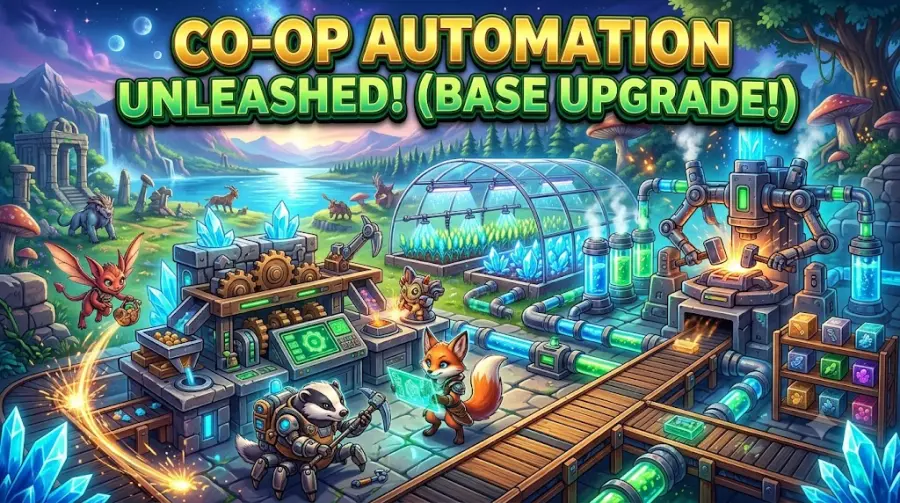
The game's development materials have shown automated industrial systems involving pipes, ducts, conveyor belts and drones.
These systems can transport different materials from extraction points toward storage and production areas.
That suggests the game can gradually transition from basic survival into industrial-scale colonization.
Early gameplay could involve manually gathering materials.
Later, players can build infrastructure that handles much of the work.
This creates an appealing sense of technological progression.
You begin as an explorer.
Eventually, you become the administrator of an alien industrial network.
Research Is Connected to Exploration
Research is another major part of the game's progression.
Players can study alien artifacts, natural phenomena and the environments they discover.
Those discoveries can unlock new technologies.
The research system is therefore directly connected to exploration.
Traveling to another planet is not only about finding resources.
Players may also discover information that allows them to develop better tools and equipment.
That gives exploration a stronger purpose.
A new planet could contain something that changes what the player can build back at an existing colony.
The game can therefore create a loop between exploration and technological development.
Alien Ruins Could Hide the Universe's Secrets
Not everything players discover will be a natural resource.
For The Stars also features the remains of alien civilizations.
Players can explore ancient ruins and search for hidden discoveries.
These locations could provide clues about the history of the universe.
They can also provide valuable technology or materials.
This creates another reason to explore beyond the immediate area around a colony.
The universe is not supposed to feel empty.
There should be evidence that other civilizations existed before the player arrived.
That mystery could become an important part of the game's narrative.
Your Spacecraft Can Be Customized
Players will also have their own spacecraft.
The ship can be customized according to the player's preferred style.
A player focused on exploration can build around that purpose.
Another player may prioritize resource transportation.
Someone else may prepare their ship for combat.
This is important because the spacecraft becomes the bridge between planets.
It is effectively the player's mobile headquarters.
The better the ship becomes, the farther players can potentially travel.
That creates another progression system alongside character equipment and planetary outposts.
Combat Is Part of the Exploration
For The Stars is not purely a peaceful space-colonization game.
The universe contains hostile alien creatures and other dangers.
Players can use futuristic weapons and special abilities to defend themselves.
Combat equipment can also be customized.
The game is therefore combining survival mechanics with third-person action.
Players may need to fight their way through dangerous areas to reach valuable resources.
They may also encounter other players in contested regions.
This adds another layer of risk to exploration.
A valuable planet could also be a dangerous one.
Multiplayer Could Change the Scale of the Game
For The Stars is being developed around a persistent multiplayer universe.
Players can explore with friends, build together and share discoveries.
They can also form alliances with other players.
This makes the game's outpost system potentially much larger than what one player could build alone.
A group could divide responsibilities.
One player could focus on exploration.
Another could manage resource production.
Someone else could concentrate on research and technology.
The result could be a functioning player-created colony.
The game also allows players to enter contested areas where they can compete against other players for control.
That gives the peaceful exploration side a potential competitive counterpart.
PvE and PvP Exist in the Same Universe
The multiplayer design is particularly interesting because For The Stars is not limited to one type of online experience.
Players can cooperate against environmental threats.
They can build colonies together.
They can share resources.
They can explore unknown planets as a team.
But contested areas can introduce player-versus-player conflict.
This gives players different ways to interact with the same universe.
Someone who prefers cooperative exploration does not necessarily need to spend all their time fighting other players.
Those who want competition can seek out contested regions.
That flexibility could help the game appeal to different types of survival players.
The Game Wants Exploration to Feel Dangerous
One common problem with large open-world survival games is that once players become powerful enough, exploration loses much of its tension.
For The Stars is attempting to keep danger relevant through environmental differences.
A new planet can introduce unfamiliar weather.
New creatures can create new combat problems.
Different resources can require different equipment.
And players may need specific technologies to survive particular environments.
This means reaching a new planet should not automatically mean the player is prepared for it.
The unknown remains dangerous.
That is exactly what a space exploration survival game needs.
Resource Decisions Could Become Important
Players will also need to make choices before leaving their colonies.
Which vehicles should they bring?
How much cargo space is required?
Which equipment is necessary for the planet?
How much material should be transported back?
Those decisions can create risk.
Taking too little equipment could make a mission dangerous.
Taking too much could reduce the amount of valuable resources players can carry.
That gives resource transportation a strategic element.
Exploration becomes a planning exercise rather than simply walking toward the next objective.
Building a Civilization Across Multiple Worlds
The biggest ambition of For The Stars is its scale.
Players are not simply surviving.
They are establishing a civilization across multiple planets.
Each new outpost can become another part of the player's network.
One planet could specialize in research.
Another could focus on resource production.
A third could become a military or PvP base.
A fourth could serve as a transportation hub.
That creates a much broader strategic layer.
Instead of asking, “How do I survive here?”
Players eventually start asking:
“How do I build an interplanetary civilization?”
That is the question that could separate For The Stars from more traditional survival games.
Technology Will Drive Expansion
Advanced technology is expected to play a major role in expansion.
Players begin with relatively advanced equipment, but continued research allows them to improve their capabilities.
Better technologies can improve:
- Resource extraction
- Outpost production
- Research
- Exploration
- Equipment
- Spacecraft
- Automation
- Survival
This creates a technology tree that is closely connected to everything else.
Research is not just an optional side activity.
It can determine how efficiently players can expand.
The Game Is Still in Development
Despite the new Gamescom gameplay, For The Stars is not ready for release yet.
Steam currently lists the game as Coming soon, without a confirmed launch date.
That means some of the systems shown in trailers can still change.
The developers have already been releasing developer diaries and gameplay footage throughout 2026.
The latest Gamescom footage represents another development milestone rather than a launch announcement.
Players should therefore avoid assuming that a specific release month is imminent.
PC Is the Confirmed Steam Platform
For The Stars has an active Steam page and is currently listed as an upcoming title.
The Steam listing describes the project as a massively multiplayer game with sandbox, survival, strategy, exploration and shooter elements.
The developer's own materials also emphasize its persistent multiplayer universe.
The final platform strategy should become clearer as development progresses.
For now, PC through Steam is the clearest officially supported platform information.
Why the New Gameplay Matters
The latest Gamescom footage is important because it demonstrates that For The Stars is becoming more than a concept.
The developers have now shown several interconnected systems:
- Planetary exploration
- Alien ecosystems
- Resource gathering
- Outpost construction
- Research
- Automated production
- Spacecraft customization
- Combat
- Multiplayer exploration
- Cooperative construction
- Contested regions
That is an unusually broad feature set.
The challenge will be connecting all of those systems without making the game feel like a collection of unrelated mechanics.
If the systems reinforce one another, the result could be an extremely deep sandbox.
The Biggest Question Is Scale
The game's biggest strength could also become its biggest challenge.
A persistent universe containing multiple planets sounds impressive.
But size alone does not guarantee meaningful gameplay.
Each planet needs to offer something worth discovering.
Each ecosystem needs to feel different.
Outposts need to serve a real purpose.
Research needs to provide meaningful upgrades.
And multiplayer needs to give players reasons to cooperate or compete.
If Snail Games can achieve that balance, For The Stars could become a serious contender in the increasingly crowded survival genre.
How It Compares With Other Space Survival Games
For The Stars enters a market that already contains several major space exploration and survival experiences.
However, its combination of systems gives it a different direction.
It is not focused solely on exploration.
It is not purely a base builder.
It is not simply an MMO.
And it is not only a survival shooter.
Instead, it attempts to combine all of these ideas.
The emphasis on interconnected ecosystems and multi-planet civilization building is particularly ambitious.
That could become the game's biggest selling point if the systems work as intended.
What Players Should Watch Next
The next important announcements will likely involve testing, system requirements, multiplayer details and the eventual release window.
The developer also needs to demonstrate how large-scale multiplayer works once many players occupy the same persistent universe.
Performance will be another major consideration.
A game featuring detailed planets, dynamic ecosystems, large outposts and multiplayer systems could place significant demands on hardware.
The final optimization level will therefore matter.
Confirmed Information
The currently confirmed information includes:
- For The Stars is developed and published by Snail Games USA.
- New gameplay footage was shown at Gamescom 2026.
- The game is an open-universe space survival experience.
- Players take the role of explorers and scientists.
- Multiple alien planets can be explored.
- Worlds have different ecosystems.
- Alien creatures and resources vary between planets.
- Players can establish and expand outposts.
- Laboratories, factories and living quarters can be constructed.
- Research can unlock technologies.
- Alien ruins can be explored.
- Resources can be used for advanced equipment.
- Spacecraft can be customized.
- Combat includes futuristic weapons and alien abilities.
- Cooperative multiplayer exploration is supported.
- Players can form alliances.
- Contested areas can feature PvP.
- The game is currently listed as coming soon on Steam.
- No specific release date has been announced.
What Is Still Unconfirmed
The exact launch date remains unknown.
The final release schedule has not been announced.
The precise scale of the persistent multiplayer universe at launch is also not yet clear.
Players should therefore treat the current gameplay footage as a demonstration of the game's development direction rather than a complete representation of the final product.
Conclusion
For The Stars is becoming one of the more ambitious space survival projects to watch.
The new Gamescom 2026 gameplay footage shows a game built around far more than collecting resources and constructing a basic shelter.
Players will travel between planets, study alien ecosystems, discover ancient civilizations, establish outposts, build factories, research technologies and customize spacecraft.
The ecosystem system could become the game's most interesting feature.
Destroying one species can potentially affect the surrounding environment, meaning players may need to understand a planet before exploiting it.
Meanwhile, persistent multiplayer gives the universe another layer.
Players can cooperate to build colonies and explore new worlds, while contested regions can create competition for control.
The biggest question is whether Snail Games can successfully connect all these systems.
For The Stars is clearly ambitious.
It wants to be a survival game, a space exploration game, a colony builder, a research sandbox, a multiplayer experience and a combat game at the same time.
If those pieces work together, the result could be something much larger than another survival title.
For now, however, the game remains coming soon, with no confirmed release date.
The next step is seeing whether the impressive systems shown at Gamescom can become a genuinely cohesive playable universe.