Fire Emblem Fortune’s Weave Developers Explain the Cut From Eight Heroes to Four and the Game’s Unusual Save System
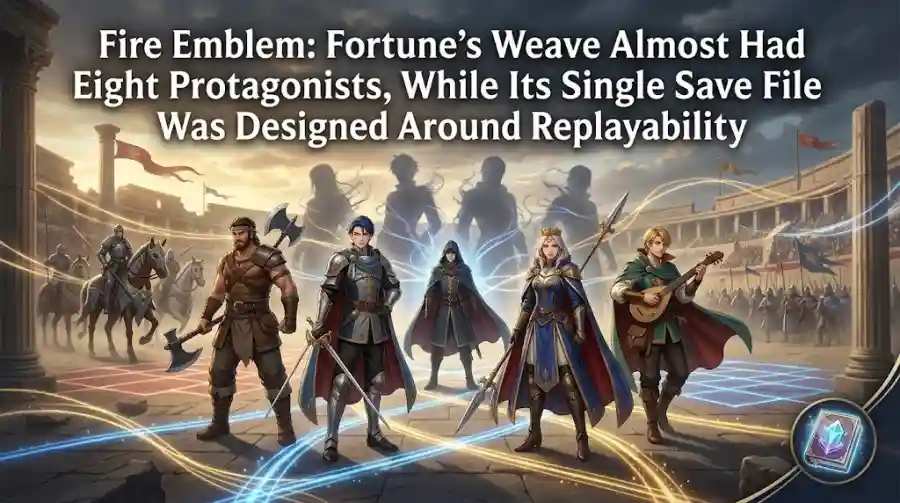
Director Toshiyuki Kusakihara explained that the team initially wanted to expand the multi-perspective structure of Fire Emblem: Three Houses, which used three major perspectives. The original Fortune’s Weave plan would have increased that number to eight. The developers eventually decided that eight perspectives created too much information for players to track, leading them to focus the game around four main protagonists instead.
That was not the only major design change.
The protagonist Eshmel, who plays a critical role in connecting the four stories, did not exist until roughly halfway through development. The team added Eshmel after realizing that the separate story paths did not naturally converge into one unified narrative.
The result is a Fire Emblem structure that is very different from Three Houses while still borrowing some of its most successful ideas.
Why the Team Originally Planned Eight Heroes
The developers wanted Fortune’s Weave to build on the multi-perspective storytelling that made Three Houses distinctive.
In Three Houses, players experience the conflict through one of three major powers.
For Fortune’s Weave, Kusakihara initially proposed something much larger: eight separate protagonists, each offering their own perspective on the story.
Nintendo's developers later explained that the idea sounded exciting on paper, but eight perspectives created a problem.
There was simply too much for players to keep track of.
Producer Genki Yokota said the team worried that the number of protagonists would make the game feel complicated.
As a result, the developers reduced the central cast to four protagonists.
Those four are:
- Cai
- Dietrich
- Theodora
- Leda
Each comes from a different background and approaches the story from a different perspective.
The reduction was not about removing the multi-perspective concept.
Instead, it was about making that concept easier to understand while preserving the variety the developers wanted.
The Four Protagonists Tell Different Stories
The final game places its four protagonists in the continent of Dagda, a region connected to the world of Fire Emblem: Three Houses but set in a different time and place.
The first half of the game revolves around the Heroic Games in the Dagdan Empire's capital, Dagsion.
Cai comes from the peaceful village of Ribeira and becomes involved in the Heroic Games while trying to uncover the mystery surrounding his birth.
Dietrich is a swordsman from Fódlan who arrives in Dagda after surviving a shipwreck.
Theodora is the young queen of Saramis, entering the Heroic Games with a goal connected to the long-term hopes of her people.
Leda is a bard driven by revenge after her homeland and family were destroyed.
Their motivations are deliberately different.
That allows the same world events to be experienced from dramatically different perspectives.
But unlike Three Houses, these stories are ultimately designed to come together rather than remain permanently divided.
Why Eshmel Was Added Halfway Through Development
One of the strangest development stories from the interview involves Eshmel.
The game did not originally have this character.
The initial concept was simple: players would choose one of the four protagonists and continue following that character's story.
The problem appeared once the developers reached the point where the four narratives needed to converge.
Kusakihara explained that the separate perspectives did not feel as though they were naturally becoming one story.
The team needed another character who could look at the entire situation from a broader perspective.
That is where Eshmel came in.
The character was added while development was already well underway.
In the final structure, the player initially controls Eshmel, who arrives in a world affected by the rule of the underworld.
Eshmel then travels back into the past, meets the four protagonists and helps bring their stories together before the final battle.
The addition therefore changed more than the cast.
It changed the overall structure of the story.
Time Travel Became Part of the Gameplay Structure
Once Eshmel was added, the idea of returning to the past became central to the game's design.
Instead of simply watching four separate stories move toward the future, players can revisit earlier experiences and build upon what they have learned.
That created a connection between story and mechanics.
The game is now built around the idea that previous experiences are not wasted.
Players can return to earlier points, retry chapters and continue developing their characters.
Nintendo's developers said this concept eventually became one of the core ideas behind Fortune’s Weave: different experiences are gathered and later woven into one outcome.
That philosophy explains one of the game's most unusual decisions.
Fire Emblem: Fortune’s Weave Has One Main Save File
Most modern RPGs give players several save slots.
Fortune’s Weave takes a different approach.
The developers deliberately built the game around a single save file.
That decision is directly connected to the structure of its four story paths and replay systems.
Because player progress from multiple protagonists is designed to merge into one overall experience, the developers felt separate saves would make the system harder to understand and manage.
Nakanishi explained that separate save files would create system-related complications because the game needs to keep track of how much progress a player has made across each protagonist's route.
Instead, the developers chose to keep those paths inside the same overall progression.
It is not simply a restriction.
It is part of how the game is designed to work.
Chapter Checkpoints Make the Single Save System More Flexible
The developers also realized that some players would still want the freedom to revisit earlier content.
To address that, the game preserves save data from the beginning of chapters for each main protagonist.
Players can then return to those points.
That means the single-save system does not prevent players from replaying important sections.
They can revisit chapters, review maps, rewatch specific scenes and retry battles.
This effectively replaces traditional multiple-save management with a series of built-in recovery and replay points.
The idea is especially important because the game is intended to be replayed.
There Are No Permanently Missable Elements
The developers also wanted players to worry less about making the wrong choice.
In earlier Fire Emblem games, players can sometimes become accustomed to resetting after something goes badly.
Fortune’s Weave takes a different approach.
Nintendo says the game is designed so that players do not have to worry about permanently missing important elements through their choices.
Instead of constantly resetting, players can keep moving forward and return to earlier content later if necessary.
This is another reason the single-save system makes sense.
The game expects players to experiment.
A decision does not necessarily have to be treated as something that must be perfectly optimized immediately.
Every Protagonist Has a Different Gameplay Identity
Reducing the cast from eight to four also allowed the developers to give each path a much stronger gameplay identity.
During development, the team initially allowed all protagonists to access many of the same exploration and character-development systems.
That created another problem.
Players could start a different path but end up performing essentially the same activities.
The team then redesigned the routes so each protagonist would have mechanics connected to their personality and story.
That is one of the biggest differences between the four campaigns.
Cai Focuses on Animals and Farming
Cai can catch animals, ride them and build relationships with them by caring for them.
He can also work on farms and create fields in certain areas of the map.
Players can trade the resources produced through that system.
This makes Cai's route more connected to animals, agriculture and village life.
Dietrich Develops Combat Arts
Dietrich is more directly focused on combat.
He can earn Combat Arts by defeating enemies and then strengthen those abilities further.
His progression therefore pushes players toward a more battle-oriented experience.
Theodora Commands Battalions
Theodora has a different role.
She can recruit soldiers from settlements and deploy them as battalions.
That makes her route more connected to organized military forces and large-scale combat.
Leda Uses Performance and Exploration
Leda travels to towns and performs in taverns.
Her performances can earn rewards and provide information about secret locations.
Her path is therefore connected to exploration, information gathering and social interaction rather than simply direct combat.
You Can Switch Between the Four Stories
Players do not have to finish one protagonist's route before touching another.
Nintendo says players can move between the four paths during the game.
For example, a player can begin with Cai, encounter another protagonist and then decide they want to learn more about that character.
They can switch over and continue that story.
There is also no officially required order.
The developers deliberately designed the experience so players do not have to worry about making an irreversible choice about which route to follow first.
As players unlock locations on one path, some of those locations can become available from the beginning of another path later in the game.
That creates a more interconnected campaign than the house-selection structure used in Three Houses.
Replayability Actually Makes Characters Stronger
The replay system goes beyond simply allowing players to see scenes they missed.
Character data can also be merged across playthroughs.
Suppose a player develops a protagonist toward magic in one playthrough and toward melee combat in another.
The game is designed to combine those developments later rather than simply replacing one version with the other.
The same principle applies to recruited allies.
A character who is recruited on two different paths and developed differently can have those versions combined later.
This means replaying the game can actually contribute to a stronger final roster.
It is one of the clearest examples of how the developers built progression around the idea of accumulated experiences.
Every Character's Growth Rate Is Visible
Another unusual addition is the decision to make character growth rates visible.
The developers say this is the first time the series has exposed this information directly in this way.
Growth rates help players understand which stats are more likely to increase as a character levels up.
For example, players can make more informed decisions about whether a character should be developed around Strength, Speed or other attributes.
However, the system does not simply tell players exactly how a character should be built.
The developers still encourage experimentation.
A character who does not appear to fit a particular class could surprise players after being deliberately trained in that direction.
New Classes Are Designed Around Dagda
Because Fortune’s Weave takes place in a new region, Intelligent Systems also used the setting to introduce new classes.
The interview names several examples.
One is the ornius rider, a cavalry unit mounted on an ostrich-like creature.
The game also features an ancient chariot-based class and an elephant rider.
These classes are intended to make Dagda feel different from Fódlan.
The result is a world where the faction identities are reflected not just through story and clothing, but through actual gameplay roles.
Blaze Arts Add Risk to Combat
Combat itself also has a new layer.
Certain characters can use powerful techniques called Blaze Arts.
These abilities come with risks but can be extremely powerful when used correctly.
The exact effect depends on the character.
Some Blaze Arts can damage large areas.
Others provide beneficial effects to nearby allies.
Enemies can also use similarly powerful abilities, meaning players cannot simply rush into every battle without considering positioning and timing.
That fits the broader Fire Emblem philosophy of rewarding tactical decision-making.
Fortune’s Weave Even Has a Firearm-Like Weapon
Another surprising reveal from the developer interview is the presence of a firearm-like weapon.
The developers confirm that at least one character uses a weapon resembling a firearm.
They intentionally describe the weapon as unusual for the series and suggest that the story eventually explains why such a weapon exists in the world.
That is another example of how Dagda is being used to push the series beyond some of its traditional fantasy assumptions.
The setting is designed to feel connected to Fire Emblem's established world while still introducing new ideas.
Dagda Is Deliberately Different From Fódlan
Nintendo says the new game is connected to the world of Three Houses, but it is not being treated as a direct sequel.
Dagda lies south of Fódlan, but the region has a very different atmosphere.
Where Fódlan was designed around stricter institutions and doctrines, Dagda is intended to feel more energetic and open.
The developers drew inspiration from the ancient Mediterranean for Dagda's architecture and visual direction.
The region includes different climates and environments, including dangerous oceans, deserts affected by sandstorms and vibrant rainforests.
That environmental diversity also influences the clothing, cultures and classes of its inhabitants.
The Music Is Designed to Sound Different Too
The change from Fódlan to Dagda also extends to the game's soundtrack.
The developers wanted the music to evoke the dry air, blue sea, fire and emotional intensity they associated with the region.
They were particularly interested in flamenco-inspired sounds, supported by strong percussion and hand claps.
Flamenco guitarists were involved in recording some of the game's music.
There is even a musical theme for each main protagonist, with those themes eventually woven together when the characters meet.
That mirrors the game's narrative structure.
The individual characters begin with separate identities, but their stories eventually combine.
The soundtrack follows the same idea.
Family Is One of the Story's Central Themes
The four protagonists do not simply represent four different classes or fighting styles.
Their stories are also connected by a broader theme of family.
Cai's story focuses on growth and family.
Dietrich explores relationships through the idea of a surrogate family.
Theodora's story connects the responsibilities of ruling a kingdom with the responsibilities associated with family.
Leda's story begins with revenge after her home and family are taken from her.
The developers say the game is interested in people who live according to different perspectives rather than separating every character neatly into heroes and villains.
That is another major departure from a simple good-versus-evil structure.
The Four Paths Are Designed to Become One Experience
This is ultimately the central idea behind Fortune’s Weave.
The developers did not want four isolated campaigns.
They wanted multiple experiences to build toward a common outcome.
Players can explore independently, recruit different characters, experiment with different builds and revisit earlier sections.
Those actions are then combined later.
Characters meet.
Progress merges.
Storylines converge.
Even the soundtrack brings its themes together.
The game's unusual one-save structure is therefore not an isolated technical decision.
It is the mechanical expression of its main narrative idea.
Release Date and Platform
Fire Emblem: Fortune’s Weave launches on September 17, 2026.
Nintendo has confirmed it as a Nintendo Switch 2 exclusive.
The game combines turn-based tactical combat with RPG character development, free exploration sections and four interconnected protagonist paths.
The developers have also emphasized that players can experience it as a standalone story even without having played Fire Emblem: Three Houses.
That makes the game both a continuation of ideas from Three Houses and a new starting point for players unfamiliar with that earlier title.
What Players Should Expect at Launch
Players should expect a Fire Emblem campaign that gives them considerably more freedom over how they progress.
There is no single required protagonist route.
Players can switch between the four stories.
Exploration is more open.
Each protagonist has unique gameplay systems.
Classes can be customized.
Growth rates are visible.
Characters can be developed repeatedly.
And progress made across different routes is designed to merge later.
At the same time, the game retains the core tactical RPG foundation that defines Fire Emblem.
Grid-based battles remain central.
Character choices still influence development.
Recruitment remains important.
And the large cast of allies is still one of the game's biggest features.
Why the Eight-Protagonist Revelation Matters
The story about the original eight protagonists is more than an interesting development anecdote.
It explains why the final version of Fortune’s Weave is structured the way it is.
The developers wanted the game to contain more perspectives than Three Houses, but eventually decided that too many perspectives made the experience harder to follow.
The four-protagonist structure became the compromise.
Then Eshmel was added to solve the problem of bringing those four stories back together.
The result is a campaign where players have multiple perspectives without being overwhelmed by eight separate protagonists.
That design decision also influenced the save system, progression structure and replay mechanics.
Fire Emblem: Fortune’s Weave is shaping up to be one of the more structurally ambitious entries in the series.
Nintendo's new developer interviews reveal that the project originally considered eight protagonists before reducing the main cast to four because the larger structure risked becoming too complicated for players to track.
Eshmel was then added halfway through development to solve another structural problem: making four separate narratives converge naturally into one final story.
That same philosophy appears throughout the gameplay.
The game uses a single main save file, preserves chapter checkpoints, allows players to switch between four routes, merges character progression across replayed paths and removes the pressure of permanently missing important content.
The differences between the protagonist routes are also substantial.
Cai works with animals and farming.
Dietrich focuses on combat arts.
Theodora recruits battalions.
Leda gathers information through performances and exploration.
Players can then combine the experiences from those routes as the story progresses.
With visible growth rates, new Dagdan classes, powerful Blaze Arts, a firearm-like weapon and a setting deliberately separated from Fódlan, Fortune’s Weave is clearly trying to expand the Fire Emblem formula while maintaining its tactical RPG foundation.
The game launches exclusively on Nintendo Switch 2 on September 17, 2026.
For players interested in how modern Fire Emblem systems are evolving, the most important detail may not be the eight-to-four protagonist change itself.
It is the philosophy behind it.
Almost every major system in Fortune’s Weave has been built around the same idea: different experiences should eventually become one.
FAQs
Was Fire Emblem: Fortune’s Weave originally going to have eight protagonists?
Yes. Nintendo's developers said the original concept called for eight protagonists, but the team reduced that number to four because eight perspectives risked becoming too complicated to follow.
How many main protagonists are in Fortune’s Weave?
The final game has four central protagonists: Cai, Dietrich, Theodora and Leda. Eshmel also plays a major role as the character who connects their stories.