Dust till Dawn Turns a Peaceful Japanese Cleaning Job Into a Psychological Horror Experience
The game combines the relaxing rhythm of a cleaning simulator with unsettling imagery, psychological horror and the atmosphere of Japanese horror manga.
And there is another reason horror fans may be paying attention: the game's soundtrack features music from Akira Yamaoka, the composer widely associated with the Silent Hill series.
Dust till Dawn Release Date
Dust till Dawn is currently scheduled to launch in:
2027
No exact release date has been announced yet.
The game is currently being developed and published by Mac n Cheese Games and is confirmed for PC through Steam. Steam already has a dedicated product page and a playtest sign-up option.
Players should therefore treat 2027 as a release window rather than a confirmed day or month.
The developers have not announced console versions at this stage.
A Cleaning Simulator With a Dark Secret
The central idea behind Dust till Dawn is intentionally ordinary.
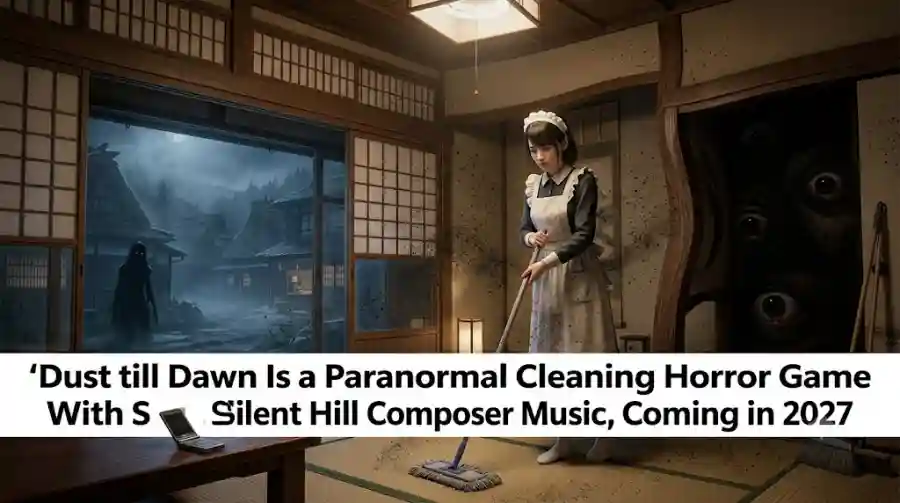
You are the newest maid working in a rural Japanese village.
Your job is to answer requests from local residents, clean different locations and gradually restore them.
You can:
- Dust surfaces
- Mop floors
- Use a squeegee
- Restore rooms
- Buy improved tools
- Unlock new locations
Steam describes the experience as a retro-paranormal cleaning simulator in which players restore a quiet rural village.
The relaxing routine is designed to create a strong contrast with what happens later.
The cleaner the village becomes, the more players are encouraged to look closely at it.
The Dust Keeps Coming Back
The mystery at the center of the game is surprisingly simple.
The village keeps getting covered in a strange dust.
Players clean it.
The dust returns.
That repetition eventually becomes the reason to investigate.
Rather than treating cleaning as the final objective, Dust till Dawn turns the work itself into an investigative tool.
While restoring rooms, players can examine objects and discover clues that may help explain the strange phenomenon.
That changes the player's relationship with the environment.
A messy room is no longer simply a job.
Every object could potentially tell part of the story.
Looking Through Other People's Belongings
The game encourages players to inspect the spaces they are cleaning.
Steam specifically notes that players can look through other people's belongings to search for clues explaining why the dust continues to return.
That creates a natural investigation mechanic.
The player is already entering homes and community locations because of cleaning requests.
The game then gives them another reason to explore those environments.
A photograph, piece of furniture, personal object or unusual detail could provide information that is not immediately obvious.
This means observation becomes just as important as speed.
The Village Changes After Dark
The biggest shift happens when the sun goes down.
The game is designed around a contrast between daytime work and nighttime discovery.
During the day, players can concentrate on cleaning and restoration.
After dark, the same locations can become much more unsettling.
The developer's presentation and early footage show the village becoming increasingly surreal, with unsettling imagery and strange visual distortions appearing around otherwise ordinary environments.
That makes the phrase “don't stay too late” on the Steam page more important than it initially sounds.
Cleaning Is Not Always Safe
Dust till Dawn does not present cleaning as a completely peaceful activity.
The game's horror comes from the gradual realization that something supernatural is happening around the player.
Mac n Cheese Games describes the project as a retro-paranormal powerwash simulator, but the Steam description also categorizes it with psychological horror, atmosphere and story-rich gameplay.
That combination gives the game two different rhythms.
One is calm.
The other is increasingly disturbing.
The tension comes from the transition between them.
The Horror Is Inspired by Japanese Visual Styles
The game's setting is a fictional rural Japanese village.
The developers describe its atmosphere as mixing cozy cleaning activities with the surreal unease associated with Japanese horror manga.
PC Gamer's first look specifically points to twisting geometry, creepy eyes and early-1990s-style horror imagery in the reveal trailer.
That visual direction gives Dust till Dawn a very different identity from conventional Western haunted-house games.
The environment can begin as familiar and comfortable before slowly becoming distorted.
That contrast is essential to the game's presentation.
Akira Yamaoka Is Handling the Music
One of the most notable names attached to the project is Akira Yamaoka.
Yamaoka is known internationally for his work on the Silent Hill series, and he is contributing music to Dust till Dawn.
This is particularly relevant because sound is an important part of psychological horror.
A cleaning simulator naturally creates repetitive sounds: sweeping, wiping, washing and moving around quiet rooms.
Adding a horror-oriented soundtrack creates a strong contrast.
The peaceful rhythm of the job can gradually become unsettling without requiring constant jump scares.
The Game Uses First-Person Exploration
Steam currently lists Dust till Dawn as a 3D first-person game.
That perspective makes the game's environmental investigation more personal.
Players are not watching a character clean.
They are performing the work themselves.
A hallway that appears normal can suddenly feel threatening when viewed from the character's own perspective.
The first-person camera can also make the game's environmental details more important.
A small object sitting on a table may become part of the mystery simply because the player can move close to it and inspect the area.
Better Tools Unlock More Locations
Cleaning is also connected to progression.
Steam says players can use their earnings to purchase new tools, which then unlock additional rooms and locations such as the local school and market.
That gives the cleaning work an actual progression system.
Players are not completing tasks simply to earn points.
They are gradually gaining access to more of the village.
The progression also increases the size of the mystery.
More locations mean more people, more belongings and more opportunities to uncover clues.
The School and Market Expand the Investigation
The mention of new locations such as the school and market is particularly interesting because they can reveal different sides of the village.
A private house contains one person's belongings.
A school can contain objects associated with an entire community.
A market can show how local residents interact.
As players unlock these areas, the game can gradually construct a broader picture of what happened in the village.
The cleaning progression therefore becomes tied directly to the mystery.
The Game Is Designed as a Single-Player Experience
Dust till Dawn is currently listed as a single-player game.
There is no confirmed multiplayer or co-op mode.
That makes sense for its narrative structure.
The game depends heavily on atmosphere, investigation and the feeling that the player is alone inside unfamiliar homes after dark.
A multiplayer mode could fundamentally change that tension.
For now, Mac n Cheese Games is keeping the experience focused on one player.
Playtest Access Is Already Available
Although Dust till Dawn will not release until 2027, Steam already offers a playtest registration option.
This is important because the project is still relatively early in development.
The current Steam page does not provide a finished release date, detailed PC requirements or a final price.
The existence of a playtest suggests the developers are preparing to gather direct feedback before the final release.
That also means some gameplay systems may change as development progresses.
PC Is the Only Confirmed Platform
At the moment, PC is the only confirmed platform.
Steam is the primary storefront, with the game listed as a 2027 release.
The developers have not announced PlayStation, Xbox or Nintendo Switch versions.
That keeps the project firmly in the PC indie-game space for now.
Players should therefore avoid treating possible console versions as confirmed until Mac n Cheese Games announces them.
Dust till Dawn Does Not Have a Final PC Specification Yet
The Steam page currently lists the system requirements as TBC for both minimum and recommended configurations.
That is expected for a game still in development.
There is currently no confirmed minimum CPU, GPU, RAM or storage requirement.
Those details should become clearer closer to the playtest and eventual release.
For now, players should rely on Steam's official listing rather than third-party hardware requirement estimates.
What the Daily Gameplay Loop Looks Like
The current information suggests a simple but increasingly tense cycle.
Daytime
Players receive cleaning requests around the village.
They enter a location.
They clean and restore the space.
They earn money.
They investigate unusual objects and details.
Progression
Players use their earnings to purchase better equipment.
New tools allow access to additional rooms and locations.
This expands the playable area.
Nighttime
Players can remain in the village after dark.
This is where the paranormal side of the experience becomes more prominent.
The longer the player investigates, the more they can discover about the mystery behind the dust.
That structure gives the game a clear rhythm without turning it into a conventional combat-focused horror experience.
There Is No Traditional Combat Focus
Everything currently shown points toward Dust till Dawn being an exploration and psychological-horror game rather than a combat-heavy survival horror title.
The Steam listing does not present firearms, weapons or traditional combat systems as core features.
Instead, the gameplay revolves around cleaning, exploration, environmental clues and surviving the psychological tension of the village.
That makes the game closer to an atmospheric investigation experience than a conventional action-horror release.
Why the Cleaning Mechanic Works for Horror
The cleaning concept creates an unusual advantage.
Cleaning requires players to pay attention.
They have to look at surfaces.
They have to inspect rooms.
They have to move furniture and objects.
They have to notice when something does not look right.
Those same behaviors are perfect for environmental horror.
A developer can place an abnormal object in a room and rely on the player to notice it.
The more carefully players clean, the more opportunities they have to see that something is wrong.
The game therefore turns an ordinary task into a method of discovering horror.
The Calm-to-Horror Contrast Is the Main Hook
Many horror games begin with an obvious warning.
Dust till Dawn starts somewhere much quieter.
You are working.
You are cleaning.
The village seems peaceful.
You are earning money and unlocking better equipment.
Then the environment begins changing.
That gradual transition can create a different kind of tension from games that immediately throw players into danger.
The player may initially believe they are playing a relaxing cleaning simulator.
The game slowly teaches them to question that assumption.
The 2027 Release Should Give the Developers Time to Expand the Mystery
Because the game is not scheduled until 2027, the studio still has time to develop the larger mystery and expand the village.
The current Steam page already identifies additional locations beyond the starting spaces, and Mac n Cheese Games has opened a playtest pathway for community feedback.
That suggests the final version may evolve significantly before launch.
For now, the most important confirmed elements are the setting, cleaning mechanics, paranormal mystery, first-person perspective and horror-focused presentation.
What Players Should Expect
Players should not expect Dust till Dawn to behave like a standard power-washing simulator.
The cleaning mechanics provide the foundation, but the larger experience is built around investigation.
You are cleaning because it gives you access to the village.
You are inspecting rooms because the objects inside contain clues.
You are staying after dark because the mystery becomes more visible.
And you are returning to new locations because the story gradually expands.
That makes the cleaning itself part of the narrative rather than a separate mini-game.
Dust till Dawn Release Details
| Detail | Confirmed Information |
|---|---|
| Game | Dust till Dawn |
| Developer | Mac n Cheese Games |
| Publisher | Mac n Cheese Games |
| Genre | Adventure, Simulation, Indie, Casual |
| Horror Style | Paranormal / Psychological Horror |
| Release | 2027 |
| Exact Date | Not announced |
| Platform | PC via Steam |
| Multiplayer | Single-player |
| Playtest | Available to request |
| Perspective | First-person |
| Voice / Audio | English and Japanese audio listed |
| Other Listed Language | Traditional Chinese |
| Composer | Akira Yamaoka |
The platform, genre, playtest and release window come from the current Steam listing, while Yamaoka's involvement was reported following the September 20 reveal.
Dust till Dawn is one of the more unusual horror games revealed during the September 2026 PC Gaming Show Tokyo Direct.
Its central idea is simple enough to explain in one sentence: clean a quiet Japanese village while trying to discover why the dust keeps coming back.
But that simple setup hides a much stranger experience.
Players can sweep, mop and squeegee their way through houses and community locations, use their earnings to buy improved tools and unlock places such as the school and market.
At the same time, the game's paranormal mystery gradually becomes more important.
The player can search through residents' belongings for clues, investigate unusual details and remain in the village after dark when the atmosphere changes dramatically.
The first-person perspective makes those discoveries more direct, while the game's stylized Japanese-horror presentation adds another layer of unease.
Then there is Akira Yamaoka, whose involvement gives the project an obvious connection to one of gaming's most recognizable horror soundtracks.
There is still a lot that has not been announced.
The game has no exact release date beyond 2027.
Its PC requirements remain TBC.
Pricing has not been confirmed.
Console versions have not been announced.
The full scope of its supernatural systems is also still unknown.
That makes the current release information more of a first look than a complete feature breakdown.
Still, Dust till Dawn already has one thing that many new horror games struggle to establish: a clear identity.
It takes one of the most peaceful game genres and places it inside an increasingly disturbing Japanese paranormal mystery.
The result is a game that can look comforting in one screenshot and deeply unsettling in the next.
With a Steam playtest already being prepared, more details should emerge as development continues toward the 2027 release.
FAQs
What is Dust till Dawn?
Dust till Dawn is a paranormal cleaning and psychological-horror game set in a fictional rural Japanese village where mysterious dust keeps returning.
When does Dust till Dawn release?
The game is currently planned for 2027, but Mac n Cheese Games has not announced an exact release date.